
On this page
Start here
Quick answer
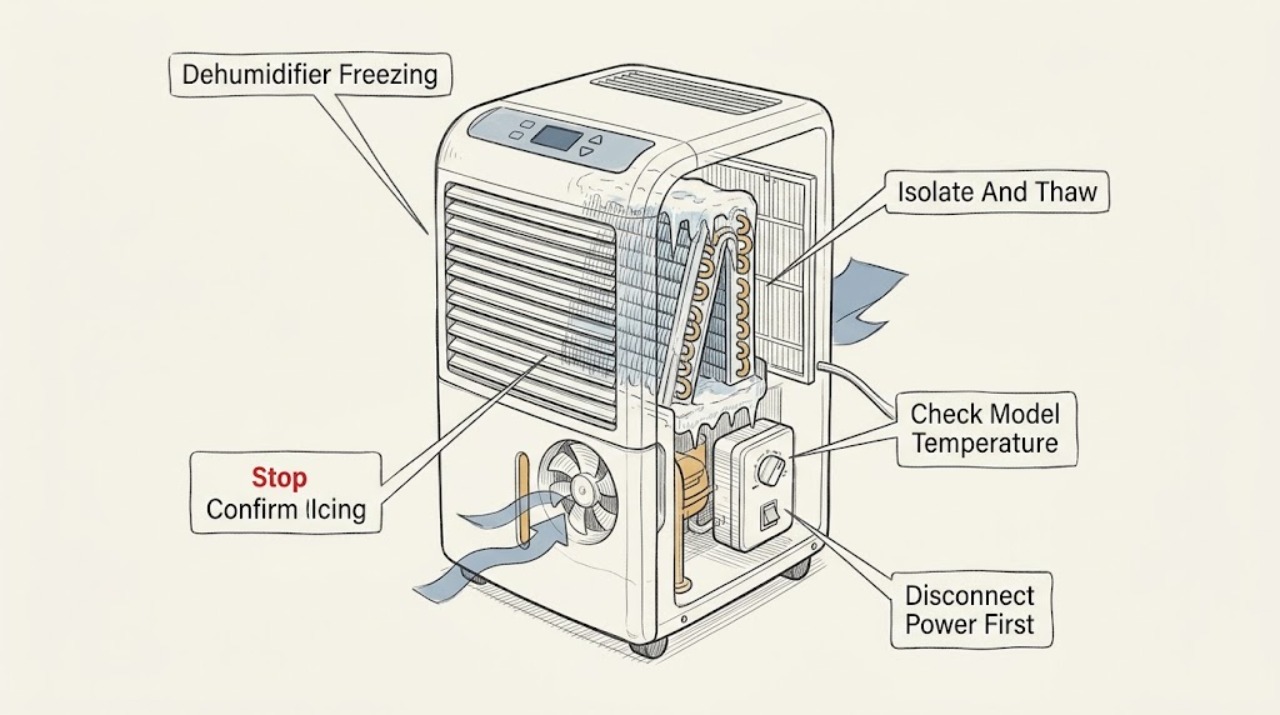
Turn the Hisense dehumidifier off, unplug it, and let coil ice melt naturally before inspecting it. Do not chip ice, use a heat gun, or open the cabinet. First record the complete model, room temperature, whether the ice is on the coil, and whether the fan continues while the compressor stops. Hisense's opened DH5023KP guide says its de-icing function can turn the compressor off while the fan runs, then restart the compressor after the correct operating temperature returns; it also says that model freezes water inside the product at 38°F (3.2°C) or below. The same guide says a dirty or obstructed filter can reduce dehumidifying performance and directs the user to keep louvers clear. Clean the model-permitted air filter only after power is isolated and it is fully dry before reinstalling. If the coil refreezes quickly in an acceptable environment, the fan does not move air, ice remains after a complete thaw, or the unit shows a fault, leak, smoke, odor, or damaged cord, stop using it and arrange qualified service. A dehumidifier's warm exhaust is not by itself a refrigeration failure, and this problem should not be treated as a request to make the unit cool a room.
Before you begin
Safety first
- The user may turn off and unplug the unit, let ice thaw naturally, identify the model, measure the room condition, clean and dry a model-permitted filter, and check visible clearance, bucket seating, and hose routing. Qualified service must handle the fan, controls, sensors, wiring, coil, refrigerant, sealed system, hidden water paths, and live tests.
Work through in order
Diagnostic checks
Use only checks that match the exact appliance or system and its official guide.
-
Check 1
Turn the dehumidifier off and record what is actually freezing: visible frost or ice on the coil behind the filter, ice elsewhere in the cabinet, or only cold air or water in the bucket. Record the complete model, room temperature, operating mode, and whether the fan or compressor was running before shutdown.
Expected result: Ice is visibly attached to the coil, the whole cabinet is cold without visible coil ice, the bucket or drain is frozen, or there is no ice and only warm exhaust or low water collection.
Next step: Follow the coil-icing path only when ice is confirmed. For an unidentified location, a leak, or no actual ice, use the model manual or a different symptom diagnosis.
Stop if: Do not remove panels, probe the coil, scrape ice, or continue operation if there is smoke, burning odor, damaged wiring, standing water, or a damaged cord or plug.
Why this matters
Why: The freezing intent requires coil or internal water-path ice. Warm exhaust is normal for a dehumidifier, and low water collection can have other causes. Ice outside the accessible coil or a leak is not a reason to keep running the unit.
-
Check 2
Switch the unit off, unplug it from the grounded outlet, wait for the fan to stop, and let the ice melt naturally. Protect the floor from meltwater and do not operate the unit while the coil is blocked.
Expected result: The ice melts and the accessible area becomes dry, meltwater reaches the base or electrical area, or the ice does not clear after a complete, undisturbed thaw.
Next step: Proceed only when the unit is dry and fully thawed. For water near electrical parts or ice that remains after thawing, keep it unplugged and arrange qualified service.
Stop if: Do not use a knife, scraper, hair dryer, heat gun, hot water, or any tool to accelerate thawing, and do not tip the unit to drain hidden water.
Why this matters
Why: Thawing restores the air path for a safe visual check. Water near the base or persistent ice can create damage or indicate a condition that cannot be corrected by a routine filter cleaning.
-
Check 3
With the unit unplugged and thawed, compare the room temperature and placement with the exact model's location and operating requirements. As a documented DH5023KP example, Hisense specifies 38°F to 90°F and says water freezes inside that product at 38°F or below; do not transfer that threshold to another model without its manual.
Expected result: The room is below the model's minimum, within the documented range, subject to drafts or an unheated space, or the model's temperature range cannot be verified.
Next step: Move operation to an environment allowed by the exact manual only if the unit can be moved safely and is fully thawed. If the limit is unknown, obtain the model guide before restarting.
Stop if: Do not operate below the model's stated minimum, in standing water, outdoors, or in a space where the unit cannot have the required clearance.
Why this matters
Why: A low ambient temperature can be the expected cause of coil icing, and the DH5023KP de-icer is designed to respond to low temperature. An in-range room with rapid refreezing makes airflow or an internal fault more relevant.
-
Check 4
After the coil is completely thawed and power is isolated, remove and inspect the accessible air filter according to the exact manual. Vacuum or wash it only as that manual permits, let it dry fully, reinstall it correctly, and clear dust or objects from the air inlet and outlet without inserting anything into the grille.
Expected result: The filter is visibly clogged or wet, the louvers are blocked, the filter is clean and dry, or the filter cannot be removed without opening the cabinet.
Next step: Correct only the accessible filter or clearance issue, then wait until the unit is dry and reassemble it exactly. If access requires panels or the problem persists, stop and arrange service.
Stop if: Do not run without the filter, reinstall a wet filter, spray water into the cabinet, or insert fingers or tools into the air inlet or outlet.
Why this matters
Why: Hisense manuals link a dirty or obstructed filter and blocked louvers to reduced airflow and performance; restricted airflow can make icing more likely. A clean accessible filter does not rule out a fan or coil fault.
-
Check 5
Only after the unit is fully thawed, dry, correctly assembled, and in the exact model's allowed environment, observe one normal restart from a safe position. Note whether the fan runs, whether the compressor stops and later resumes as the manual describes, and whether ice begins returning rapidly.
Expected result: The fan runs and the compressor cycles back after the documented de-icing response, the fan does not run, the compressor never resumes, or the coil becomes heavily iced again soon after restart.
Next step: Allow the documented de-icing response to complete once. If the fan, compressor, control, or coil behavior remains abnormal, switch off, unplug, and arrange qualified diagnosis.
Stop if: Do not repeat restart cycles to force a thaw, bypass a temperature or bucket control, or run with the cover removed.
Why this matters
Why: A documented fan-on/compressor-off interval can be normal automatic de-icing. No airflow, no return to dehumidification, or rapid refreezing in an allowed environment points beyond a simple low-temperature condition.
-
Check 6
With power isolated and the unit thawed, check that the bucket is empty, aligned, and seated, and inspect only a visible gravity or pump drain hose for a kink or blockage if the freezing symptom is accompanied by standing water. Do not treat a pump hose as a coil repair.
Expected result: The bucket is full or misaligned, a visible hose is kinked or blocked, the drain path is clear, or ice or water is hidden inside the base.
Next step: Correct only a visible bucket seating or hose-routing issue permitted by the model manual. For hidden ice, a wet base, a pump fault, or recurring freezing, leave the unit off and arrange service.
Stop if: Do not remove a base, reach into the pump, disconnect hidden tubing, or operate a leaking unit near electrical parts.
Why this matters
Why: Hisense says the Empty Bucket condition stops the fan and compressor, and pump models require a correctly connected, unbent hose. These checks explain a stopped unit or water issue but do not explain rapid coil refreezing by themselves.
-
Check 7
Stop owner diagnosis when rapid refreezing continues after a full thaw, correct ambient conditions, clear airflow, and a model-permitted filter check, or when the fan, compressor, sensor, control, refrigerant circuit, or internal wiring would need inspection.
Expected result: The frost does not return after the environmental and filter correction, or it returns quickly with weak or absent airflow, abnormal sound, a fault, leak, odor, smoke, heat, or no water collection.
Next step: Keep the dehumidifier unplugged and arrange qualified Hisense appliance or HVAC service. Provide the exact model, room temperature, time to refreeze, fan/compressor behavior, filter condition, and any display or odor without recreating the fault.
Stop if: Do not open the cabinet, handle refrigerant, puncture the coil, bypass a sensor, or perform live electrical testing.
Why this matters
Why: Persistent icing can involve an internal fan or control, a temperature-sensing or de-icing problem, coil condition, or a sealed refrigeration fault. The external appearance cannot safely distinguish these causes.
Use your observations
Decision map
Find the observation that best matches what you see, then follow the next safe action.
-
PATH 01Safety boundary
What you see
Ice appears in a cold space, the exact model permits low-temperature operation, and the compressor stops while the fan continues or later resumes as the manual describes.
Do this next
Let the documented de-icing response finish, keep airflow clear, and operate only within the exact model's temperature range. If heavy ice or rapid refreezing continues, use the service branch.
Why this path and its safety boundary
Why it matters: Low ambient temperature and the model's automatic de-icing response are more likely than a sealed-system failure. Some freezing can be normal under low-temperature operation on the cited Hisense model family.
Safety stop: Do not scrape the coil or override the de-icer.
-
PATH 02Safety boundary
What you see
The coil thaws, the air filter is dirty or wet, or the intake and outlet are obstructed, and the room is otherwise within the model's allowed range.
Do this next
With power isolated, clean and fully dry the filter as the exact manual permits, restore clearance, and observe one restart. Escalate if the coil refreezes quickly despite clear airflow.
Why this path and its safety boundary
Why it matters: Restricted airflow is more likely to be contributing to icing and poor moisture removal than a temperature setting alone.
Safety stop: Do not operate without a dry filter or insert objects into the grille.
-
PATH 03Safety boundary
What you see
The coil freezes, but the fan does not run during operation or the documented de-icing interval, or airflow remains absent after the filter and louvers are clear.
Do this next
Turn the unit off, unplug it, and arrange qualified service. Do not access the fan or test it with panels removed.
Why this path and its safety boundary
Why it matters: A fan motor, control, sensor, or internal airflow fault is more likely; a blocked filter alone no longer explains the symptom.
Safety stop: No live testing, grille disassembly, or attempts to force the fan.
-
PATH 04Safety boundary
What you see
The exact model is operating within its allowed temperature range, the filter and clearances are correct, but a heavy ice blanket returns quickly after a complete thaw.
Do this next
Keep the dehumidifier off and arrange qualified appliance or HVAC service. Give the technician the time to refreeze and the fan/compressor observations.
Why this path and its safety boundary
Why it matters: An internal de-icing control, sensor, airflow, coil, or sealed refrigeration condition is more likely than normal low-temperature frost.
Safety stop: Do not add refrigerant, open the sealed system, bypass controls, or keep running until the coil is blocked.
-
PATH 05Safety boundary
What you see
Meltwater reaches the base or outlet, the unit is in standing water, the cord or plug is damaged, or there is smoke, burning odor, abnormal heat, or a strange noise.
Do this next
From a dry, safe position disconnect power, do not step into standing water, and arrange qualified appliance or electrical service. Do not move or restart the unit to reproduce the fault.
Why this path and its safety boundary
Why it matters: This is an immediate electrical, fire, or water-damage stop condition, not a routine defrost or filter check.
Safety stop: Never operate a damaged, partially disassembled, wet, or leaking dehumidifier.
Helpful context
Understand the symptom
What freezing means here
This page is for frost or ice on the dehumidifier's internal coil, or icing that appears while the unit runs in a cold room. It is not a guide to refrigerator cooling, air-conditioner cooling, or a normal warm-air complaint. A small amount of frost can be part of a model's automatic de-icing response, but a solid ice blanket, repeated rapid refreezing, or loss of airflow needs a different decision. Use the complete model number before applying a temperature limit or control interpretation.
The fan and compressor tell different stories
During automatic de-icing, the compressor may stop while the fan continues to move air. The DH5023KP guide says the compressor can cycle back on after the de-icer senses the correct operating temperature. That is different from a fan that never moves air, ice that blocks the coil after a full thaw, or a unit that repeatedly freezes in a room within its model's allowed range. Those patterns can require internal airflow, control, or sealed-system diagnosis.
Thaw before checking airflow
Ice hides the coil and restricts airflow, so do not judge the filter or fan while the coil is frozen. Switch off and unplug the unit, wait for the fan to stop, place towels or a shallow container where meltwater can be contained, and let the ice thaw without force. Hisense warns against operating a damaged or partially disassembled unit and against inserting objects into the air inlet or outlet.
Safety boundary
Stop conditions
- Switch off and unplug before removing the filter, bucket, or any accessible part; wait for the fan to stop and contain meltwater safely.
- Do not scrape or chip ice, use a heat gun or hot water, tip the unit, insert tools into the grille, or run it with the coil blocked.
- Use the complete model manual for the operating-temperature range, filter procedure, bucket controls, and de-icing behavior. The DH5023KP 38°F threshold is model-specific.
- Stop immediately for standing water, water near electrical parts, smoke, burning odor, strange noise, abnormal heat, or cord or plug damage. Do not open the cabinet, handle refrigerant, bypass a sensor, or perform live tests.
Only after diagnosis
Potential parts
- air filter
Consider this category only when the exact model's filter is damaged, missing, or cannot be cleaned, and airflow or icing improves after a correct filter check.
Confirm the complete model and use the manufacturer's fit information. A filter replacement does not establish or repair an internal de-icing or refrigeration fault. - fan motor or airflow assembly
Consider this category only after a full thaw, clear dry filter, and unobstructed louvers still leave no airflow or cause rapid refreezing, and qualified service identifies the fan path.
Fan assemblies and electrical connections vary by model. Do not open the grille or test the motor live; verify model fit through qualified service. - temperature sensor or de-icing control
Consider this category only when an in-range unit rapidly refreezes after airflow checks and qualified diagnosis points to sensing or de-icing control.
The exact sensor, control logic, and connectors are model-specific. Do not bypass a sensor or substitute a part based only on the appearance of ice. - sealed refrigeration-system component
Consider this category only when qualified service finds a persistent in-range icing condition after airflow and de-icing checks have been completed.
Refrigerant and sealed-system work is professional-only. Do not puncture the coil, add refrigerant, or open the cabinet to attempt a repair.
When checks do not resolve it
Need a professional?
Arrange qualified Hisense appliance or HVAC service when the coil rapidly refreezes after a complete thaw, correct model-approved room temperature, clear airflow, and a dry filter check; when the fan does not run or the compressor does not return as documented; when ice or water is hidden inside the base; or when a sensor, control, fan, coil, wiring, or sealed refrigeration component requires access. Stop immediately for smoke, burning odor, abnormal heat, standing water, water near electrical parts, or a damaged cord or plug and use qualified electrical help for a supply hazard.
Safety scope: The user may turn off and unplug the unit, let ice thaw naturally, identify the model, measure the room condition, clean and dry a model-permitted filter, and check visible clearance, bucket seating, and hose routing. Qualified service must handle the fan, controls, sensors, wiring, coil, refrigerant, sealed system, hidden water paths, and live tests.
Common questions
FAQ
Why is my Hisense dehumidifier freezing up?
Start with a complete thaw, then check the exact model's allowed room temperature, a clean dry filter, and unobstructed intake and outlet. The cited DH5023KP guide says low temperatures can trigger de-icing and that water freezes inside that model at 38°F or below. If heavy ice returns quickly in an allowed environment, arrange qualified service rather than adding refrigerant or opening the cabinet.
Is some frost normal on a Hisense dehumidifier?
It can be during low-temperature operation on models with automatic de-icing. The DH5023KP guide says the de-icer can shut off the compressor while the fan runs and restart the compressor after the correct operating temperature returns. A solid ice blanket, absent airflow, or rapid refreezing after a full thaw is not a reason to keep running and needs diagnosis.
What temperature is too cold for a Hisense dehumidifier?
Use the exact model's guide. For the DH5023KP, Hisense specifies operation from 38°F to 90°F and says water freezes inside the product at 38°F (3.2°C) or below. Another Hisense model may have different limits, so do not apply that number without matching the model.
Can a dirty filter make a Hisense dehumidifier freeze?
Restricted airflow from a dirty filter or blocked louver can contribute to poor dehumidifying performance and can make icing more likely. Turn the unit off and unplug it, clean the filter only as the model guide permits, let it dry completely, and restore clearance. If the coil refreezes with clear airflow, use qualified service.
Can I scrape the ice off the Hisense dehumidifier coil?
No. Turn the unit off, unplug it, protect the floor from meltwater, and let the ice thaw naturally. Scraping or puncturing the coil can cause further damage, and opening the cabinet or handling the refrigeration circuit is professional work. Arrange service if the ice remains or quickly returns after a complete thaw.
Read the exact guide
Official sources
- DH100KP1WG DH10019TP1WG User ManualHisense USA · Specific Hisense DH100KP1WG/DH10019TP1WG guide with model variation notes; use as supporting evidence for filter and safety boundaries, not a universal Hisense control or parts guide.
- DH5023KP 50-Pint Dehumidifier Use & Care GuideHisense USA · Specific Hisense DH5023KP 50-pint model guide; use its 38°F threshold and de-icing details only as model-specific evidence and a clearly labeled example.
- Hisense Energy Star 50 Pint 3-Speed DehumidifierHisense USA · Official product page for Hisense DH5023KP; confirms the appliance identity and its advertised 38°F low-temperature operation but does not replace the full user manual.
Community feedback
Share a repair observation
Share a plain-text repair observation. Accepted observations are published automatically; this page may take a moment to update.