
On this page
Start here
Quick answer
Ice on a dehumidifier usually means the coil is colder than the room conditions allow, especially in a cold room or with restricted airflow. Turn the unit off and let the ice melt naturally; do not chip at the coil. Check the room temperature, filter, and clear airflow, then use the exact model manual because Wood’s says low-temperature performance depends on the dehumidifier technology and its MRD22 manual warns that ice can build below +5°C.
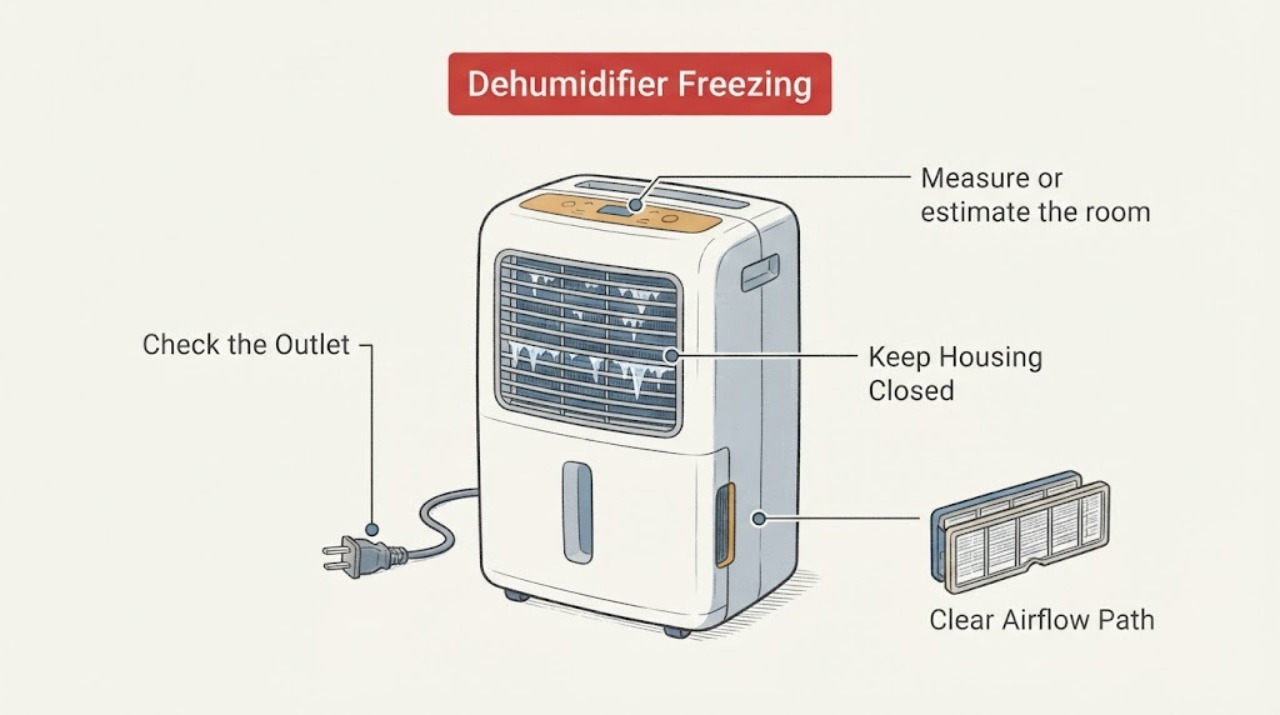
Work through in order
Diagnostic checks
Use only checks that match the exact appliance or system and its official guide.
-
Check 1
Turn the dehumidifier off and unplug it from a dry outlet; let all visible ice melt before restarting or cleaning.
Expected result: Ice is thick, the fan is blocked, water is pooling, or the unit is near wet electrics.
Next step: Keep it off until dry and safe; arrange service if water reached electrics or the fan cannot turn freely.
Stop if: Do not chip ice, pour hot water into the housing, or reach through the fan.
Why this matters
Why: Frozen coils can block airflow and melt water can create a separate electrical or overflow hazard.
-
Check 2
Measure or estimate the room conditions and note whether the unit is in a cold garage, basement, or other space; compare them with the exact manual’s operating range.
Expected result: The room is very cold, near the model’s lower limit, or the model is a condensation type being used in a cold space.
Next step: Move the unit only if safe and permitted by its manual, or choose the correct low-temperature technology; do not force continuous operation below the rating.
Stop if: Stop if the condition becomes unsafe or requires opening the appliance.
Why this matters
Why: Wood’s explains that low-temperature suitability differs by technology, and the MRD22 manual links ice buildup with temperatures below +5°C.
-
Check 3
After the unit is dry and disconnected, clean the user-accessible air filter and ensure the intake and outlet are clear; refit the filter before any test.
Expected result: The filter is clogged, airflow improves after cleaning, or the filter and airflow are already clear.
Next step: Run one supervised cycle within the manual’s conditions. If ice returns, stop and arrange service.
Stop if: Stop if the condition becomes unsafe or requires opening the appliance.
Why this matters
Why: Restricted airflow can keep the evaporator cold enough to freeze; if clear airflow does not change recurrence, the cause may be sensor, fan, refrigerant, or defrost control related.
-
Check 4
On one supervised run, record whether the fan runs, water collects, and ice returns quickly or only after long operation.
Expected result: Ice returns rapidly despite suitable temperature and clear airflow, or the fan does not run.
Next step: Keep the unit off and provide the model, room conditions, filter state, and timing to qualified service.
Stop if: Stop if the condition becomes unsafe or requires opening the appliance.
Why this matters
Why: Rapid recurrence or absent airflow is evidence of a persistent appliance fault rather than normal cold-room behavior.
Use your observations
Decision map
Find the observation that best matches what you see, then follow the next safe action.
-
PATH 01Next step
What you see
Ice forms only in a room below the model’s stated cold limit
Do this next
Let the unit defrost and follow the manual’s temperature/use guidance; do not force the unit to run.
Why this path and its safety boundary
Why it matters: Cold operating conditions are the leading explanation, and a different low-temperature technology may be needed.
-
PATH 02Next step
What you see
Ice returns with clear airflow in a suitable room
Do this next
Stop using it and arrange qualified service.
Why this path and its safety boundary
Why it matters: A defrost, fan, sensor, or sealed-system fault becomes more likely than a dirty filter.
-
PATH 03Next step
What you see
Ice melts but water reaches the electrical base
Do this next
Unplug only from a dry safe position, keep clear, and arrange qualified help.
Why this path and its safety boundary
Why it matters: The thaw event has created an immediate water/electrical hazard.
Helpful context
Understand the symptom
Cold conditions versus a persistent fault
A single frost event in a cold space can be a temperature/application issue. Ice that returns in a suitable room with clear airflow changes the diagnosis toward defrost, fan, sensor, or sealed-system service.
When checks do not resolve it
Need a professional?
Call qualified dehumidifier service when ice returns quickly after a complete defrost and clear airflow, the fan will not run, water reached electrics, or internal refrigeration access would be required.
Common questions
FAQ
Can I scrape the ice off the dehumidifier coil?
No. Let it melt with the unit off and unplugged; scraping can damage the coil and create a leak.
Why does room temperature matter?
Wood’s says dehumidifier technology and operating range determine suitability in cold spaces; the MRD22 manual links ice buildup with very cold conditions.
Read the exact guide
Official sources
- Dehumidifiers for cold rooms, garages and storage roomsWood’s · Wood’s dehumidifiers for cold spaces
- Users manualWood’s · Wood’s MRD22 dehumidifier frost and low-temperature operation
Community feedback
Share a repair observation
Share a plain-text repair observation. Accepted observations are published automatically; this page may take a moment to update.