
On this page
Start here
Quick answer
A GE dehumidifier can show a light coating of frost when first turned on, but GE says it should normally disappear within about 30–60 minutes. Persistent or recurring ice usually starts with operating conditions and airflow: room temperatures below 41°F can freeze the evaporator coil, some models have a documented low-temperature mode, a dirty filter can restrict airflow, and blocked grilles or too little clearance can worsen the condition. Check the exact model manual, keep at least 18 inches of air space around the unit, and clean the model-specific filter with the appliance off and unplugged; GE's filter instructions require complete drying before replacement. If ice is present, stop the dehumidifying cycle and let the coil thaw at room temperature—do not chip it or apply direct heat. On models with automatic defrost, GE says the compressor may stop while the fan runs until frost disappears, then the compressor restarts. If the fan never stops as intended, ice does not clear, freezing returns after suitable temperature and clean airflow, the unit leaks or trips a breaker, or internal access would be needed, arrange qualified dehumidifier service. Do not open the cabinet, bypass frost controls, live-test wiring, touch the compressor or fan, or handle refrigerant.
Before you begin
Safety first
- The user may identify the model, measure room conditions, clear accessible grilles, clean and dry the correct filter, empty the bucket, and allow ice to thaw with power disconnected. Cabinet removal, fan or compressor access, electrical testing, frost-control replacement, wiring work, and refrigerant or sealed-system work belong to qualified service.
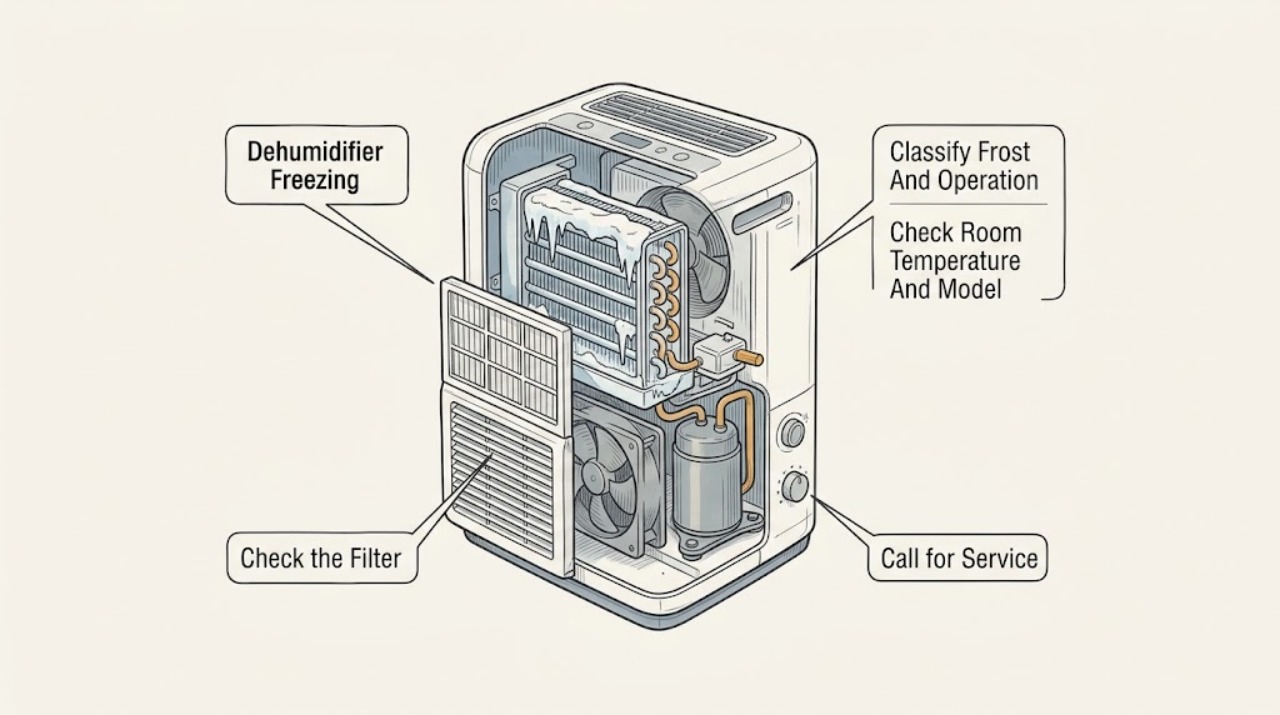
Work through in order
Diagnostic checks
Use only checks that match the exact appliance or system and its official guide.
-
Check 1
From a safe position, classify the condition as a light startup frost, a coil partly or fully blocked with ice, water or ice entering the bucket, or a fan running while the compressor is paused. Record the exact GE model, room temperature, humidity impression, filter status, and whether water collection stopped.
Expected result: Frost clears within 30–60 minutes, frost remains, the fan runs continuously, the compressor restarts after thaw, or the same ice returns.
Next step: Continue with the temperature and airflow checks before judging internal refrigeration components. Stop for smoke, odor, sparking, hot or damaged power parts, water near electrical areas, or repeated breaker operation.
Stop if: Do not open the cabinet, touch the coil or fan, or run a service mode to reproduce freezing.
Why this matters
Why: Short startup frost or an automatic-defrost pause may match GE's documented behavior. Persistent or recurring ice, no recovery after thaw, and a fan that runs continuously outside defrost need a different branch.
-
Check 2
Measure or reasonably verify the room temperature and compare it with the exact owner's manual. GE says temperatures below 41°F can freeze coils, while some models provide low-temperature operation; also verify that the unit is not being used in an unusually dry space where little water is expected.
Expected result: The room is below 41°F, the manual documents low-temperature operation, the room is warm enough for the model, or humidity is too low to produce much water.
Next step: Move the unit only if safe and permitted by the manual, or use the documented low-temperature setting. Do not override model limits; if freezing persists in suitable conditions, continue with filter and grille checks.
Stop if: Do not place the appliance near a heat source, alter a sensor, or open the cabinet to change temperature control.
Why this matters
Why: Cold-room operation is a likely contributor to freezing unless the exact model is designed for it. Low humidity can explain low water collection without proving an ice fault. Suitable conditions make airflow and internal diagnosis more important.
-
Check 3
Turn the dehumidifier off and unplug it before maintenance. Follow the model manual to remove and inspect the filter, clean it with the documented method, let it dry completely, reinstall it, and clear accessible inlet and outlet grilles. Leave at least 18 inches of air space around the unit where the model permits.
Expected result: The filter is clogged, damp, damaged, missing, or clean; grilles were blocked or clear; airflow improves or remains weak after the dry filter is restored.
Next step: Operate only with the correct dry filter installed and monitor one normal cycle. If airflow remains weak or ice returns, stop and arrange service rather than reaching into the blower or coil.
Stop if: Do not run without a filter, reinstall a damp filter, force the grille, or use a filter not specified for the model.
Why this matters
Why: A clogged or incorrectly installed filter and restricted clearance reduce airflow across the cold coil and can contribute to freezing. Persistent weak airflow after a correct filter and clear grilles makes a fan, coil, or internal control problem more likely.
-
Check 4
If ice is present, turn the appliance off, unplug it, and let room-temperature air melt the ice completely. Empty the bucket or protect the floor from meltwater, and do not chip, scrape, flame-heat, or force the ice away.
Expected result: The coil clears and airflow or water collection returns, ice does not clear, or the same ice returns after the room temperature, filter, and airflow are corrected.
Next step: Reinstall the clean dry filter and use model-documented settings after thawing. If frost returns or the fan/compressor pattern is abnormal, arrange qualified service.
Stop if: Do not use sharp tools, open flame, a heat gun, boiling water, or cabinet removal to speed defrosting.
Why this matters
Why: Recovery after a complete thaw supports a temporary frost or airflow condition. Failure to thaw or recurring ice under suitable conditions suggests an airflow, defrost-control, fan, sensor, or refrigeration problem.
-
Check 5
After complete thawing, observe from outside whether the fan continues while the compressor is temporarily off and whether the compressor restarts when frost disappears. Do not touch or electrically test either component; compare the timing only with the model's normal or automatic-defrost description.
Expected result: The fan runs during a finite defrost period and the compressor restarts, the fan continues indefinitely, the compressor never resumes, or the coil refreezes quickly.
Next step: Arrange service for indefinite fan operation, no compressor recovery, or repeat freezing after airflow and temperature checks. Do not infer a failed compressor or sensor from this observation alone.
Stop if: Do not bypass frost controls, open panels, touch moving parts, or perform live electrical tests.
Why this matters
Why: A finite fan-only period can be automatic defrost. GE says a fan that does not shut off as intended is not normal; no compressor restart or rapid refreezing under suitable conditions needs internal diagnosis.
-
Check 6
If the coil repeatedly freezes after a complete thaw, suitable room temperature, clean dry filter, adequate clearance, and clear grilles, document the model, frost location, time to refreeze, fan and compressor behavior, water collection, and any leak, noise, odor, or breaker symptom.
Expected result: Freezing persists under suitable conditions, water leaks after thaw, the unit trips protection, the fan or compressor behaves abnormally, or no safe external cause remains.
Next step: Keep the appliance out of service for any electrical or water hazard and arrange qualified GE or local dehumidifier service. Provide the exact model and the complete observation history.
Stop if: Do not open the cabinet, replace internal parts, bypass a control, live-test, or handle refrigerant.
Why this matters
Why: Remaining possibilities include a fan or blower, frost sensor or control, thermostat, compressor, wiring, or sealed refrigeration fault. The symptom cannot safely select one replacement component.
Use your observations
Decision map
Find the observation that best matches what you see, then follow the next safe action.
-
PATH 01Safety boundary
What you see
Only a light frost appears at startup, disappears within roughly 30–60 minutes, and the dehumidifier then collects water normally without a safety symptom.
Do this next
Monitor under suitable room temperature and clear airflow. Arrange service if frost remains, returns repeatedly, or water collection and fan/compressor behavior change.
Why this path and its safety boundary
Why it matters: GE describes this as possible normal startup frost rather than a confirmed failure.
Safety stop: Do not scrape a light frost or open the cabinet.
-
PATH 02Safety boundary
What you see
The room is below 41°F or the model's manual sets a different low-temperature limit, and the coil freezes while airflow is otherwise clear.
Do this next
Use the model's documented temperature range or move the appliance only when safe and permitted. Allow the coil to thaw at room temperature and retest only within the model's limits.
Why this path and its safety boundary
Why it matters: Cold-room operation is more likely to be causing the coil frost; some GE models have low-temperature operation, but it is not universal.
Safety stop: Do not override the model limit, add heat directly to the appliance, or alter a sensor.
-
PATH 03Safety boundary
What you see
The filter is clogged, damp, damaged, missing, or the inlet/outlet grilles have restricted clearance, and airflow is weak before or during icing.
Do this next
Unplug the unit, clean and fully dry the correct filter, restore it, clear accessible grilles, and provide the documented clearance. Service is needed if airflow stays weak or ice returns.
Why this path and its safety boundary
Why it matters: Restricted airflow is more likely to be contributing to the freeze than a confirmed sealed-system failure.
Safety stop: Do not run without a filter, reinstall it damp, reach into a fan, or force grilles.
-
PATH 04Safety boundary
What you see
Frost causes the compressor to pause while the fan runs for a finite period, the coil clears, and the compressor restarts afterward.
Do this next
Monitor only if the cycle completes and freezing does not recur under suitable conditions. Service is needed for indefinite fan operation, no compressor restart, or rapid refreezing.
Why this path and its safety boundary
Why it matters: This pattern matches GE's description of automatic defrost on some models.
Safety stop: Do not bypass the frost control or test internal wiring.
-
PATH 05Safety boundary
What you see
The coil remains or repeatedly becomes fully iced after suitable room temperature, complete thaw, clean dry filter, adequate clearance, and clear grilles.
Do this next
Stop repeated thaw cycles and arrange qualified dehumidifier service with the model and timing history. Stop immediately for smoke, burning odor, sparking, hot or damaged power parts, water near electrical areas, or repeated breaker operation.
Why this path and its safety boundary
Why it matters: An internal fan, frost control, sensor, thermostat, compressor, wiring, or sealed-system fault is more likely; the ice pattern does not identify one part.
Safety stop: Do not open the cabinet, live-test, replace internal parts, or handle refrigerant.
Helpful context
Understand the symptom
First decide whether the frost is temporary
A light frost immediately after startup can be normal on a GE dehumidifier and should normally disappear within 30–60 minutes. Record whether the entire coil is blocked with ice, whether the fan is moving air, whether the compressor is running or paused, whether water collection stopped, and whether the issue returns after thawing. Frost that remains or repeatedly returns is a fault pattern to investigate, not something to scrape away.
Check room temperature and model limits
GE says dehumidifiers ordinarily do not operate satisfactorily below 41°F because the evaporator coil may freeze, although some models provide low-temperature operation. Check the room temperature and the exact manual before changing controls. A very dry room can also produce little water without a fault. Do not use a generic temperature assumption to override a model's stated operating range.
Restore the airflow path
Keep doors and windows closed in the area being dehumidified and allow at least 18 inches of air space around the appliance. Check accessible inlet and outlet grilles for curtains, furniture, dust, or other blockage. A clogged filter restricts the air crossing the cold coil and can contribute to frost. Follow the exact manual for filter location; GE's instructions require the filter to be cleaned, fully dry, and installed before operation.
Defrost without damaging the coil
If ice covers the coil, turn the dehumidifier off and unplug it before maintenance, then let room-temperature air melt the ice. Empty or protect the bucket from meltwater and do not chip, scrape, use an open flame, or direct a heat gun at the coil or plastic housing. Once completely thawed, reinstall a clean dry filter and use only model-documented settings. Repeated thawing is not a repair when the same ice returns.
Understand automatic defrost behavior
On models with automatic defrost, GE says frost can switch the compressor off while the fan continues running until the frost disappears; the compressor then restarts. Slightly cool exhaust during this period can be part of defrost. If the fan continues indefinitely, the compressor never resumes after a complete thaw, or the coil freezes again under suitable conditions, the model needs service diagnosis.
Keep electrical and sealed-system work professional
A frozen coil does not identify whether the cause is airflow, a frost sensor or control, fan, compressor, thermostat, or refrigerant circuit. Stop using the appliance for smoke, burning odor, sparking, a hot or damaged cord, water near electrical parts, or repeated breaker operation. Do not open the cabinet, bypass a frost control, live-test wiring, touch moving parts, or add or release refrigerant. Provide service with the model, room temperature, filter condition, frost timing, fan/compressor behavior, and whether thawing restored operation.
Only after diagnosis
Potential parts
- model-specific dehumidifier air filter
Consider this category only when the exact model's filter is damaged, missing, or cannot be restored to clean condition after documented cleaning.
GE filter location and fit vary by model; verify the complete model and use only the specified filter. - dehumidifier fan or blower assembly
Consider this category only when qualified diagnosis confirms inadequate airflow or a fan fault after a correct dry filter, clear grilles, and complete defrost.
Fan designs and access vary by model; do not select a fan from freezing symptoms alone. - frost sensor or defrost control
Consider this category only when service confirms an automatic-defrost or frost-sensing fault after room temperature and airflow causes are ruled out.
Controls are model-specific and internal; verify the full model and diagnosis before selecting a component. - compressor or sealed-system component
Consider this category only after qualified diagnosis of recurring freezing under suitable temperature, clean airflow, and completed defrost.
Compressor and refrigerant-circuit work is professional service; the frost pattern does not establish the failed component or fit.
When checks do not resolve it
Need a professional?
Arrange qualified GE or local dehumidifier service when freezing persists after the exact model's temperature limit, complete thaw, clean dry filter, adequate clearance, and clear grilles; when the fan runs indefinitely, the compressor does not restart after defrost, ice returns rapidly, or internal access would be required. Stop using the unit immediately for smoke, burning odor, sparking, a hot or damaged cord, water near electrical parts, or repeated breaker operation. Do not open the cabinet, bypass controls, live-test wiring, or handle refrigerant.
Safety scope: The user may identify the model, measure room conditions, clear accessible grilles, clean and dry the correct filter, empty the bucket, and allow ice to thaw with power disconnected. Cabinet removal, fan or compressor access, electrical testing, frost-control replacement, wiring work, and refrigerant or sealed-system work belong to qualified service.
Common questions
FAQ
Why is my GE dehumidifier freezing up?
Check room temperature, filter condition, grille clearance, and airflow first. GE says temperatures below 41°F can freeze the coil, while a clogged filter or restricted air circulation can worsen performance. Some models have low-temperature operation, so use the exact manual; recurring ice after a complete thaw and clean airflow needs service.
Is a little frost on a GE dehumidifier coil normal?
GE says a light coating of frost when the dehumidifier is first turned on can be normal and should disappear within about 30–60 minutes. Frost that remains, blocks the coil, returns rapidly, or is paired with poor water collection needs further checks and possibly service.
Why is the fan running while the GE dehumidifier is not collecting water?
On models with automatic defrost, GE says frost can turn the compressor off while the fan runs until the coil clears, after which the compressor restarts. If the fan never stops as intended, the compressor does not recover, or the coil refreezes, arrange service.
How do I safely defrost a GE dehumidifier?
Turn it off and unplug it, then allow room-temperature air to melt the ice. Do not chip or scrape the coil, use direct flame or concentrated heat, or open the cabinet. After thawing, install the clean dry model-specific filter and check the room temperature and airflow before retesting.
When should a GE dehumidifier with ice get professional service?
Arrange service when ice returns after a complete thaw, suitable room temperature, clean dry filter, clear grilles, and adequate clearance; when the fan runs indefinitely; when the compressor does not restart; or when electrical, water, smoke, odor, or breaker symptoms appear. Internal frost controls, fans, compressors, wiring, and refrigerant circuits are not user repairs.
Read the exact guide
Official sources
- Dehumidifier - Ideal Operating ConditionsGE Appliances · GE dehumidifiers; low-temperature capability and limits vary by model
- Dehumidifier - Air FilterGE Appliances · GE dehumidifiers; filter location and reminder behavior vary by model
- Dehumidifier - Compressor Not OperatingGE Appliances · GE dehumidifier models equipped with automatic defrost control
- User Manual & Care for AHG30LHGE Appliances · GE AHG30LH dehumidifier; used to establish GE model support, not as a universal control or temperature instruction
- Dehumidifier - Fan Stays On, Will Not Shut OffGE Appliances · GE dehumidifiers; fan timing and controls vary by model
- Dehumidifier - CleaningGE Appliances · GE dehumidifiers; cleaning access varies by model
- Dehumidifier - Cleaning and MaintenanceGE Appliances · GE dehumidifiers; older and newer filter procedures differ by model
Community feedback
Share a repair observation
Share a plain-text repair observation. Accepted observations are published automatically; this page may take a moment to update.