
On this page
Start here
Quick answer
If a Frigidaire dehumidifier has frost or ice on its coil, turn it off and let the coil thaw naturally before inspecting it. Light frost can occur because the evaporator operates close to freezing, but Frigidaire lists low ambient temperature, restricted airflow, a dirty filter, and a continuous-mode/setpoint issue as checks; its frost guidance lists 41°F as the low limit. Keep clearance around the unit and front grille, clean the owner-removable filter according to the model's Use and Care guide, and verify the room is not below the model's operating range. If heavy ice returns after thawing and airflow is clear, or an error code appears, do not scrape the coil or open the sealed system: Frigidaire maps sensor codes AS/ES/F1/F2/L1/F5, sealed-system codes EC/F0, compressor-overload codes H3/E5, and control codes E4/C5 to further assistance or service.
Before you begin
Safety first
- This article covers identifying coil frost, allowing a natural thaw, checking room conditions, restoring visible airflow, cleaning and drying the owner-removable filter, and reading the model's display. Coil covers, fans, sensors, controls, compressors, sealed refrigeration circuits, refrigerant, and live electrical testing require qualified service.
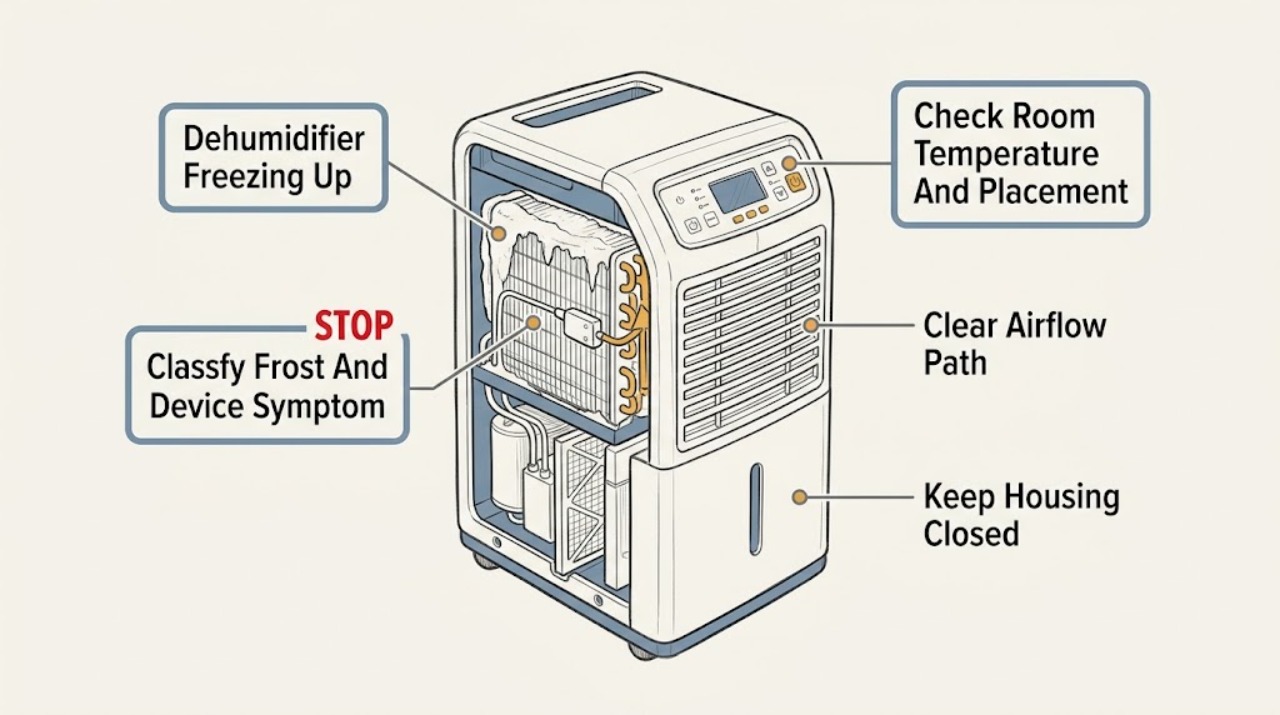
Work through in order
Diagnostic checks
Use only checks that match the exact appliance or system and its official guide.
-
Check 1
Stop the dehumidifier and identify the actual symptom from the outside: light frost on part of the visible coil, heavy ice covering much of the coil, ice that has already melted into the base, or a blank/unresponsive display with no confirmed coil frost. Record whether the fan had been moving air and whether the room felt cold.
Expected result: Only light, localized frost is present; the coil is heavily iced; frost repeatedly returns; or the display/control is the only thing that appears frozen.
Next step: If heavy ice is present, leave the unit off and let it thaw naturally before cleaning or checking the filter. If there is no physical frost, use the exact model's no-power or control guidance instead of this page.
Stop if: Do not chip, pry, or scrape ice from the coil, and do not remove the cabinet or coil cover.
Why this matters
Why: Light frost can occur because the evaporator operates close to freezing. Heavy or recurring ice needs the room-temperature, airflow, filter, and mode checks below. A blank or unresponsive display is not evidence of a frozen coil and belongs to a power/control diagnosis.
-
Check 2
With the unit switched off, measure or otherwise verify the room temperature near the dehumidifier and check that it is within the exact model's stated operating range. Compare the result with Frigidaire's frost guidance, which lists 41°F as the low limit, and confirm the unit is not in an unusually cold garage, basement, or exterior-facing draft.
Expected result: The room is at or below the model's low operating limit; it is near Frigidaire's 41°F low limit; or it is comfortably warmer and the unit still forms heavy ice.
Next step: Move the unit only if it can be done safely and the model permits it, then allow the coil to thaw fully before reassessing. If the room is suitable but ice returns, continue to the airflow and error-code checks and plan service.
Stop if: Do not operate the appliance in a location outside the model's approved temperature range or place it where meltwater can reach an outlet or other electrical equipment.
Why this matters
Why: Low ambient temperature makes normal evaporator frost more likely and can prevent a stable thaw cycle. A warm enough room with recurring heavy ice makes airflow restriction, a sensor/control issue, or an imbalanced sealed system more likely; it does not identify which internal part failed.
-
Check 3
After the coil has thawed and the unit is unplugged, inspect the front grille and the clearance around the cabinet. Remove nearby objects that block the inlet or outlet. Remove and clean only the filter the exact Use and Care guide identifies as owner-removable, then let it dry fully before reinstalling it.
Expected result: The grille was blocked, cabinet clearance was poor, the filter was visibly dirty, the filter is damaged/missing, or the airflow path is clear and the filter is clean.
Next step: Restore the specified filter and clearances, then allow one normal operating period to see whether frost returns. If the filter is damaged, use the exact model information for replacement; if ice returns with clear airflow, stop troubleshooting internally and arrange service.
Stop if: Do not run without the specified filter, reach into the coil or fan, wash the cabinet, or reconnect power while the filter or interior is wet.
Why this matters
Why: Frigidaire links restricted airflow and dirty filters with frost buildup and separately warns that blocked front-grille airflow can prevent proper operation. A clear path and clean filter remove common external causes but cannot rule out an internal fan, sensor, control, or sealed-system problem.
-
Check 4
Read the displayed humidity setpoint and operating mode from the exact model's controls. If the display shows CO/Continuous, follow Frigidaire's frost guidance and change it to the model's normal humidity range after the coil has thawed. Record any error code before resetting or changing settings.
Expected result: CO is active; a normal RH setpoint is active; the control cannot be read; or a code such as AS, ES, F1, F2, L1, F5, EC, F0, H3, E5, E4, or C5 is displayed.
Next step: Use the exact model guide for any allowed setting change and record the code. If a listed code returns, the display is abnormal, or frost persists in a suitable room with clear airflow, leave the unit off and contact Frigidaire or qualified service.
Stop if: Do not bypass a code, enter hidden diagnostic mode, repeatedly reset overload protection, or open the control compartment.
Why this matters
Why: Frigidaire says CO is intended for high humidity for short durations and specifically directs a different range when heavy frost is present. The listed codes point to sensor, sealed-system, compressor-overload, or electronic-control service categories rather than a user-adjustable frost setting.
-
Check 5
After a complete natural thaw, a dry correctly installed filter, clear grilles, and a suitable room temperature, observe the fan, compressor behavior, and coil from the normal exterior access only. Note whether the unit dehumidifies normally, stops and restarts with the humidity setpoint, or begins icing again quickly.
Expected result: The unit operates without renewed frost; light frost appears and clears; heavy frost returns; the fan is weak or absent; or the unit trips power, smells hot/burnt, leaks onto electrics, or displays a code.
Next step: Stop after one controlled observation. Arrange service for recurring heavy ice or any internal symptom, and provide the model, room temperature, filter condition, mode, code, and frost location.
Stop if: Do not continue running with a solid ice block, defeat thermal protection, perform live electrical tests, or attempt sealed-system work.
Why this matters
Why: No renewed ice supports an environmental, airflow, filter, or mode cause. Light frost that clears can be normal. Rapid recurring heavy ice, weak airflow, a fault code, or a hazard makes an internal fan, sensor/control, compressor-overload, or sealed-system issue more likely.
Use your observations
Decision map
Find the observation that best matches what you see, then follow the next safe action.
-
PATH 01Safety boundary
What you see
Only light frost is visible, the room is near or below the model's low operating limit, and the fan and airflow are otherwise normal.
Do this next
Stop the unit and let any frost clear naturally, improve the room conditions if the model permits, and maintain the specified clearance and clean filter. Seek service if frost becomes heavy or returns in a suitable room.
Why this path and its safety boundary
Why it matters: Normal evaporator operation combined with low ambient temperature is more likely than a failed refrigeration component.
Safety stop: Do not force defrost with a heat gun, flame, or sharp object.
-
PATH 02Safety boundary
What you see
Heavy frost is present and the front grille, cabinet clearance, or filter is visibly restricted, dirty, or incorrectly installed.
Do this next
Unplug the thawed unit, clear objects, clean and dry the specified filter, reinstall it, and reassess once. If heavy frost returns with a clear airflow path, arrange service.
Why this path and its safety boundary
Why it matters: Restricted airflow is more likely and can keep ice from melting; a dirty filter is a supported external cause to correct before suspecting internal parts.
Safety stop: Do not operate without the filter or reach past the grille to clean the coil or fan.
-
PATH 03Safety boundary
What you see
Heavy ice is present and the display shows CO/Continuous or an unusually aggressive humidity setting, with no clear room-temperature or airflow explanation.
Do this next
Let the coil thaw, then use the exact model guide to choose a normal RH range and avoid continuous operation unless the room condition calls for it. Escalate if ice returns.
Why this path and its safety boundary
Why it matters: A mode/setpoint mismatch is plausible. Frigidaire says CO is intended for high humidity for short durations and specifically directs changing from CO when heavy frost is visible.
Safety stop: Do not rely on mode changes to conceal recurring ice or keep running a solidly iced coil.
-
PATH 04Safety boundary
What you see
The room is suitable, the filter and grille are clear, the coil has thawed, and heavy frost returns quickly or the fan/airflow is abnormal.
Do this next
Leave the unit off and arrange qualified Frigidaire/dehumidifier service. Provide the exact model, operating temperature, frost location, mode, filter status, and whether the fan ran.
Why this path and its safety boundary
Why it matters: An internal airflow, coil-sensor, electronic-control, compressor-protection, or sealed-system fault is more likely. The frost pattern alone cannot identify a replaceable part.
Safety stop: Do not remove the coil cover, bypass the sensor, measure live wiring, or add refrigerant.
-
PATH 05Safety boundary
What you see
A listed sensor, sealed-system, compressor-overload, or electronic-control code appears, or the dehumidifier trips power, emits a burning odor, or allows water near electrical parts.
Do this next
Turn the unit off and disconnect it from a safe, dry location if possible. Do not restart repeatedly; contact Frigidaire or qualified service with the code and model information.
Why this path and its safety boundary
Why it matters: This is a service and safety branch, not a routine defrost adjustment. Frigidaire assigns the listed codes to internal fault categories and directs owners to further assistance.
Safety stop: Do not operate after smoke, sparking, damaged cord, burning odor, or water entering the electrical area, and do not open the cabinet.
Helpful context
Understand the symptom
Freezing means coil frost, not a frozen display
For this problem, look for white frost or a sheet of ice on the evaporator coil behind the grille. A dehumidifier that has a blank display, will not start, or has a control that does not respond is a different no-power or control symptom. Do not diagnose a coil by opening the refrigeration cabinet. With the unit off, distinguish light frost that clears during the unit's normal protection cycle from heavy ice that covers the coil and restricts air.
Why room conditions and airflow matter
A dehumidifier removes moisture by moving room air across an evaporator that runs near freezing. Frigidaire says low ambient temperature can promote frost and that restricted airflow can keep heavy ice from melting. A blocked front grille, a dirty filter, or too little clearance can therefore imitate a refrigeration fault. The exact low-temperature behavior and controls vary by model, so use the model-specific Use and Care guide for the operating range and filter procedure.
Persistent ice is a service boundary
After a natural thaw, a clean filter, clear grille, and suitable room temperature should be enough to test the ordinary causes. If heavy frost returns, an error code points to a sensor, compressor protection, electronic control, or sealed system, or the coil cannot be inspected without removing covers, stop there. Do not scrape the coil, use a flame or hair dryer, bypass a sensor, or add refrigerant; those actions can damage the unit or expose you to electrical and refrigeration hazards.
Only after diagnosis
Potential parts
- dehumidifier air filter
Consider this only if the exact model's filter is damaged, missing, or cannot be restored by the documented cleaning procedure after an airflow-related frost diagnosis.
Filter shape, dimensions, and installation vary by Frigidaire model; match the complete model number. - coil temperature or humidity sensor
Consider this only after service diagnosis links recurring frost or a sensor code to the sensor circuit once room temperature, filter, grille, and mode have been checked.
Sensor assemblies and connectors are model-specific and are not identified by frost alone. - evaporator fan or electronic control
Consider this only if a qualified technician confirms abnormal airflow or an electronic-control fault after the coil has thawed and external airflow is restored.
Internal electrical parts require exact-model confirmation and safe service access. - sealed-system or compressor service
Consider this only when service diagnosis identifies a persistent refrigeration imbalance, sealed-system code, or compressor-overload condition after environmental and airflow causes are excluded.
Sealed-system and refrigerant work is not a DIY part swap; model, refrigerant, and qualified service diagnosis are required.
When checks do not resolve it
Need a professional?
Safety scope: This article covers identifying coil frost, allowing a natural thaw, checking room conditions, restoring visible airflow, cleaning and drying the owner-removable filter, and reading the model's display. Coil covers, fans, sensors, controls, compressors, sealed refrigeration circuits, refrigerant, and live electrical testing require qualified service.
Common questions
FAQ
Why does my Frigidaire dehumidifier freeze up?
First check room temperature, airflow, and the filter. Frigidaire says the evaporator operates near freezing, low ambient temperatures can promote frost, and 41°F is the listed low limit. Restricted airflow, a dirty filter, and heavy ice can also contribute; persistent ice after a natural thaw needs service.
Can I run a Frigidaire dehumidifier while the coil is covered in ice?
No. Turn it off and let the coil thaw naturally before checking the visible grille and filter. Do not scrape the coil or use a flame or hair dryer. If heavy frost returns after the room and airflow checks, arrange service.
Does Continuous or CO mode cause a Frigidaire dehumidifier to freeze?
Frigidaire specifically says to change from CO to a different range when heavy frost or ice is visible, and describes CO as intended for high-humidity conditions for short durations. Use the exact model guide for the normal RH setting after the coil has thawed; do not use mode changes to hide recurring ice.
What Frigidaire dehumidifier error codes are related to freezing?
Frigidaire's error-code guide assigns AS, ES, F1, F2, L1, and F5 to temperature or humidity sensor failures; EC and F0 to sealed-system failure; H3 and E5 to compressor overload protection; and E4 and C5 to electronic-control failure. Record the code and contact service rather than bypassing it.
Is a Frigidaire dehumidifier with no display also 'freezing'?
Not necessarily. This page concerns physical frost or ice on the coil. A blank or unresponsive display without coil frost is a separate power or control symptom; use the exact model's no-power guidance and do not infer a refrigeration fault.
Read the exact guide
Official sources
- Dehumidifier - Not Collecting WaterFrigidaire · Frigidaire support article marked as applying to dehumidifiers; use the exact model manual for control layout and operating limits.
- Dehumidifier - Frost BuildupFrigidaire · Frigidaire support article marked as applying to dehumidifiers; exact operating behavior and controls remain model-specific.
- Dehumidifier - Fan turning on and off periodicallyFrigidaire · Frigidaire support article marked as applying to dehumidifiers; exact timing and controls can vary by model.
- Dehumidifiers Error Code GuideFrigidaire · Frigidaire support article marked as applying to dehumidifiers; not every code appears on every model.
Community feedback
Share a repair observation
Share a plain-text repair observation. Accepted observations are published automatically; this page may take a moment to update.