
On this page
Start here
Quick answer
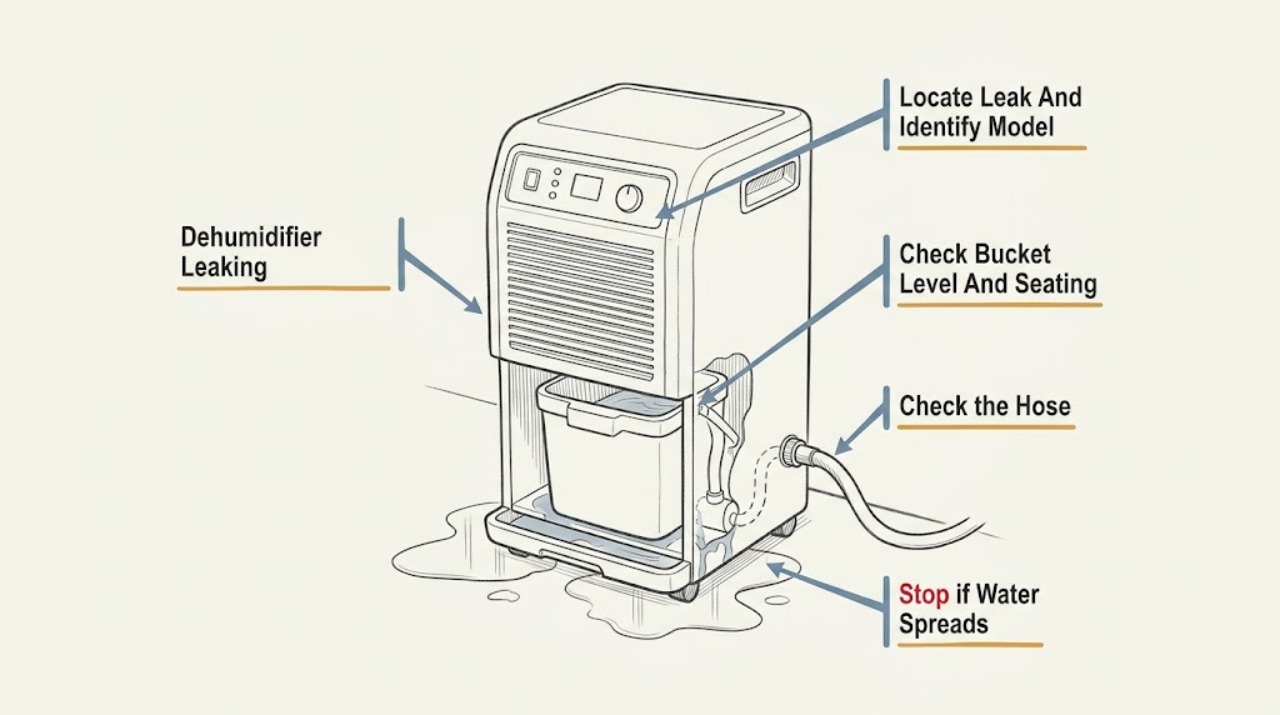
First dry the floor, switch the Frigidaire dehumidifier off, and identify where water starts: around the bucket, at a continuous-drain hose, or from the base/cabinet. A tilted or damaged bucket can leak, so the unit should sit on a flat, level floor and the bucket should be checked for cracks and correct seating. On models using continuous gravity drainage, the hose must follow the exact model arrangement; Frigidaire's drain guidance says it should be below the connection, lie flat and as straight as possible, and not be kinked or blocked. A PU code on pump models means failure to pump out the bucket and calls for checking the pump hose connection, blockage/kinks/freezing, and bucket pickup only as the owner procedure allows. Water from the base can be caused by heavy frost or ice melting over the catch tray, but recurring base leaks, hidden internal leakage, electrical contact, or any need to open the cabinet requires qualified service.
Before you begin
Safety first
- The user may isolate power safely, empty and reseat an accessible bucket, inspect visible hose routing and connector condition, follow the exact owner pump or drain procedure, and clean only as the manual permits. Pump/cabinet access, electrical tests, safety bypasses, internal drains, refrigeration, and repairs are for qualified professionals.
Work through in order
Diagnostic checks
Use only checks that match the exact appliance or system and its official guide.
-
Check 1
Turn the dehumidifier off and unplug it from a dry position. Wipe the floor and observe without removing covers where water first reappears: around the bucket, at the continuous-drain connector or hose, from the pump outlet, or from underneath the base. Record the full model and whether the display shows Full Bucket, PU, or another model-specific indication.
Expected result: Water begins around the bucket, at a hose/connector, from a pump outlet, or from the base; the bucket is full or not seated; a PU code is shown; or the source remains hidden.
Next step: Follow the bucket branch for bucket-area water, the continuous-hose branch for gravity drainage, the PU branch for a pump model, and the base-leak branch for water underneath. If the source cannot be seen safely, keep the unit off and arrange service.
Stop if: Do not energize the unit while water is near the plug or controls, tilt a water-filled unit unpredictably, or open the cabinet to find the leak.
Why this matters
Why: The first wet location separates bucket fit and level from gravity/pump drainage and from frost or internal base leakage. A code is model-specific evidence, not permission to access the pump or cabinet.
-
Check 2
For water around the bucket, confirm the dehumidifier is on a flat, level floor. With power disconnected, remove and empty the bucket using the exact owner instructions, inspect the bucket and its accessible seal for cracks or damage, and reinstall it fully and squarely. Do not force a bucket or dismantle its float or sensor.
Expected result: The bucket is tilted, cracked, damaged, overfilled, not fully seated, or appears sound and correctly installed but water returns.
Next step: Level the placement and replace a visibly damaged bucket only with the exact model-approved part. After drying the area, perform one supervised normal run; if water returns, stop and arrange service.
Stop if: Do not tape a cracked bucket, bypass the full-bucket float, run with the bucket removed, or reconnect power while the floor, plug, or controls are wet.
Why this matters
Why: Frigidaire identifies a damaged or tilted bucket as a leak source and says the unit should be level. A sound, correctly seated bucket with recurring water points toward the tray, float/sensor, drain path, or an internal leak.
-
Check 3
For a model configured for continuous gravity drainage, inspect only the visible connector, washer, hose, end point, and floor path while the unit is off. Confirm the exact model's drain cap/connector arrangement, that the hose is below the connection, lies flat and as straight as possible, is not kinked or frozen, and has no visible leak or obstruction. Do not disconnect a water-filled hose or substitute an unapproved narrow hose.
Expected result: The connector washer is missing/cracked, the hose is above the connection, kinked, blocked, frozen, detached, leaking, or the visible path is clear but water backs up or exits the cabinet.
Next step: Correct only the visible routing or replace a visibly failed washer/hose with the exact model-approved arrangement. Flush or clean a removable hose only as the manual permits, then perform one supervised dry-floor test; stop if overflow returns.
Stop if: Do not pull the unit apart, open a drain valve, use a hose that cannot maintain the required gravity path, clamp a leaking connector while operating, or work beside standing water.
Why this matters
Why: A damaged connector washer or an obstructed/incorrectly routed gravity hose can leak or send water back toward the bucket. A clear external path with continued overflow suggests a drain cap, tray, pump, sensor, or internal fault rather than a simple slope correction.
-
Check 4
If the exact model is pump-equipped and displays PU, turn it off and unplug it. Follow the owner procedure to empty and remove the bucket if required, then inspect only the accessible bucket pickup for visible dirt or algae and the visible pump hose connection for being secure, kinked, blocked, or frozen. Reassemble as directed and perform one normal restart only.
Expected result: PU clears after an owner-level pickup/hose correction, or the code returns; the hose is inaccessible or damaged; water backs up into the bucket; or the pump path leaks.
Next step: Keep the unit off and book service if PU returns, the pump hose is damaged, the bucket pickup cannot be safely accessed, or water continues to escape. Do not convert a pump model to a gravity path without exact installation instructions.
Stop if: Do not open the pump housing, run the pump with covers removed, force a frozen hose, bypass the full-bucket protection, or perform live electrical tests.
Why this matters
Why: Frigidaire defines PU as failure to pump out the bucket and lists connection, blockage, kink/freezing, and bucket-pickup obstruction as checks. A returning PU or inaccessible pump indicates a pump, sensor, control, or internal hose issue requiring service.
-
Check 5
For water from the base, leave the appliance unplugged until the floor and exterior are dry. From outside only, look for heavy frost or ice on accessible surfaces, restricted air passages, a hot or damaged cord/plug, burning odor, or water reaching controls. Do not scrape coils, remove panels, or restart to force defrosting.
Expected result: Heavy frost/ice is visible, water has flowed from inside the cabinet, the unit is unusually hot, a cord or receptacle is wet/damaged, or no external cause is visible and the base leaks again.
Next step: Allow safe natural thaw with power disconnected and follow the exact model manual for airflow/filter care. If the leak returns, frost is heavy, the unit overheats, or any electrical hazard appears, keep it off and arrange qualified service.
Stop if: Do not use sharp tools or heat to remove ice, open the sealed system, access wiring, bypass safety controls, or operate with water near electricity.
Why this matters
Why: Frigidaire lists heavy frost or ice melting over the catch tray as one possible base-leak cause, but recurring base water can involve airflow, sensor, tray, refrigeration, or internal drainage. Electrical contact or a hidden leak is a stop-use condition.
Use your observations
Decision map
Find the observation that best matches what you see, then follow the next safe action.
-
PATH 01Safety boundary
What you see
Water is around the removable bucket and it is full, tilted, damaged, or not fully seated.
Do this next
Empty and reinstall the bucket according to the exact manual on a flat, level floor; replace a visibly damaged bucket with the exact model part and supervise one dry-floor test.
Why this path and its safety boundary
Why it matters: Bucket fit, floor level, overflow, or bucket damage is more likely than a hidden cabinet leak.
Safety stop: Do not run with a cracked or removed bucket, bypass the full-bucket float, or reconnect while the floor or controls are wet.
-
PATH 02Safety boundary
What you see
Water is at the continuous-drain connector/hose, the hose is above the connection or kinked/blocked, or the bucket shows full after hose drainage is selected.
Do this next
With power off, correct only visible routing or a failed washer/hose using the exact model instructions, then supervise one test. If water backs up or leaks again, arrange service.
Why this path and its safety boundary
Why it matters: A connector washer, hose routing, blockage, freezing, or drain-cap arrangement is more likely than a bucket crack; exact model gravity requirements control.
Safety stop: Do not disconnect a water-filled hose, use an improvised narrow hose, or open the internal drain assembly.
-
PATH 03Safety boundary
What you see
The exact model is pump-equipped and displays PU, the pump hose is kinked/blocked/frozen or disconnected, or water backs up despite a visible connection.
Do this next
Follow the exact owner pickup/hose check once. If PU returns, a pump path leaks, or access is not clearly owner-approved, keep the unit off and schedule service.
Why this path and its safety boundary
Why it matters: Frigidaire defines PU as failure to pump out the bucket and lists hose and pickup obstructions as owner-level checks; a returning code points to an internal pump path or control issue.
Safety stop: Do not open the pump, bypass bucket protection, force frozen tubing, or perform live tests.
-
PATH 04Safety boundary
What you see
Water appears from underneath the cabinet, heavy frost/ice is visible, or the base leaks again after bucket and visible drain checks.
Do this next
Keep the unit unplugged, allow safe natural thaw, follow only model-approved filter/airflow care, and arrange service if water returns or the cause is not obvious.
Why this path and its safety boundary
Why it matters: Frigidaire identifies melting heavy frost/ice over the catch tray as one possible cause, but recurring base water may involve airflow, tray, sensor, refrigeration, or internal drainage.
Safety stop: Do not scrape coils, apply heat, remove covers, open the sealed system, or run the unit over a wet floor.
-
PATH 05Safety boundary
What you see
Water reaches the plug, cord, receptacle, or controls; the unit is hot/damaged; the leak source is hidden; or overflow persists after the exact owner procedure.
Do this next
Isolate power from a dry location, contain the water without opening the cabinet, and contact Frigidaire or a qualified appliance/electrical professional with the model and leak location.
Why this path and its safety boundary
Why it matters: This is no longer a safe bucket or hose adjustment. Electrical contact, internal leakage, or a recurring drain/cooling fault requires professional diagnosis.
Safety stop: Do not reset wet protection, use a power strip or extension, perform live electrical tests, or continue operating to see if the leak stops.
Helpful context
Understand the symptom
Start with the first wet location, not the largest puddle
Move absorbent material away from the appliance and observe from a dry position after the unit is off. Water around the removable bucket points to level, damage, seating, or overflow; water at a continuous-drain connection points to the connector, washer, hose routing, or blockage; water appearing from underneath the cabinet points to frost melt, a catch-tray overflow, or an internal leak. Record the full model because not every Frigidaire dehumidifier uses the same bucket, gravity hose, or pump arrangement.
Bucket and hose drainage are different paths
In the normal bucket path, condensate collects in the bucket until the unit pauses when full. In a continuous gravity-drain setup, the drain cap and hose redirect water away from the bucket; a hose that is too high, kinked, narrow, blocked, or poorly connected can cause water to back up or appear as a full-bucket condition. Pump-equipped models have a different route and may show PU when the pump cannot empty the bucket. Use only the exact model's connection and drain instructions rather than transferring a pump procedure to a gravity-drain model.
Base water and power hazards end the user check
Frigidaire identifies heavy frost or ice melting over the catch tray as one possible cause of water from the base. A warm cabinet or warm exhaust can be normal while the appliance runs, but a hot electrical connection, water near the receptacle, burning odor, or recurring base leak is not a drain adjustment. Unplug before cleaning the bucket or cabinet, keep excess water away from controls, and do not remove covers, access the pump, or work on refrigeration or electrical parts.
Safety boundary
Stop conditions
- Stop immediately for water near the plug, cord, receptacle, or controls, a hot or damaged electrical connection, burning odor, smoke, or a repeat protection trip; isolate power only from a safe dry location.
- Do not run with a cracked, tilted, removed, or bypassed bucket, and do not defeat the full-bucket float or sensor.
- Do not disconnect water-filled hoses, open the pump or cabinet, scrape coils, apply heat to frost, access wiring, or work on sealed refrigeration components.
- Do not use an improvised hose, incorrect drain routing, power strip, or extension as a workaround.
- If a leak returns after the exact model procedure or water comes from the base, keep the dehumidifier off and arrange qualified service.
When checks do not resolve it
Need a professional?
Arrange Frigidaire support or qualified dehumidifier service when a bucket remains correctly seated but leaks, a continuous drain hose or connector continues to leak or back up, PU returns after the exact owner-level hose/pickup check, water comes from the base, heavy frost recurs, the source is hidden, or water reaches electrical parts. Provide the full model, first wet location, bucket and hose configuration, code, floor/level condition, timing, and any frost, heat, odor, or damage.
Safety scope: The user may isolate power safely, empty and reseat an accessible bucket, inspect visible hose routing and connector condition, follow the exact owner pump or drain procedure, and clean only as the manual permits. Pump/cabinet access, electrical tests, safety bypasses, internal drains, refrigeration, and repairs are for qualified professionals.
Common questions
FAQ
Why is my Frigidaire dehumidifier leaking around the bucket?
Frigidaire identifies a damaged or tilted bucket as a leak source. Put the unit on a flat, level floor, empty and reinstall the bucket correctly, and inspect it for cracks or leaks. If a sound, correctly seated bucket still leaks, keep the unit off and arrange service.
How should a Frigidaire continuous drain hose be routed?
Use the exact model instructions. Frigidaire's drain guidance says the hose should be below the unit connection, lie flat and as straight as possible, and have no kinks; a blocked hose can back water into the bucket. Do not disconnect or alter the internal drain path.
What does PU mean on a Frigidaire dehumidifier?
Frigidaire defines PU as failure to pump out the bucket. With power off, follow the exact owner procedure to check the pump hose connection for blockage, kinks, or freezing and the accessible bucket pickup for dirt or algae. A returning PU needs service.
Why is water coming from the base of my Frigidaire dehumidifier?
Frigidaire lists heavy frost or ice melting over the catch tray as one possible cause. Keep the unit unplugged, do not scrape or heat the ice, and arrange service if the base leak returns, the frost is heavy, or no external cause is clear.
When should I stop using a leaking Frigidaire dehumidifier?
Stop for water near the plug or controls, a damaged or hot cord, a hidden or recurring base leak, a returning PU code, an unsafe floor condition, or any need to open the pump or cabinet. Isolate power from a dry location and arrange qualified service.
Read the exact guide
Official sources
- Dehumidifier - Clean and CareFrigidaire · Dehumidifier care guidance; bucket disassembly and hose access remain model-specific.
- Dehumidifier - Water Leaking IssuesFrigidaire · Dehumidifier support article; exact bucket, hose, and internal construction vary by model.
- Dehumidifier - Not DrainingFrigidaire · Applies to the drainage arrangements represented by the support article; exact model drain cap and hose requirements vary.
- Dehumidifier - Putting out Hot AirFrigidaire · Dehumidifiers represented by the support article; exact thermal behavior and alerts vary by model.
- Dehumidifier Error Code PUFrigidaire · Only models that display PU and use a pump-out path; other models may use gravity drainage or a different code.
Community feedback
Share a repair observation
Share a plain-text repair observation. Accepted observations are published automatically; this page may take a moment to update.