
On this page
Start here
Quick answer
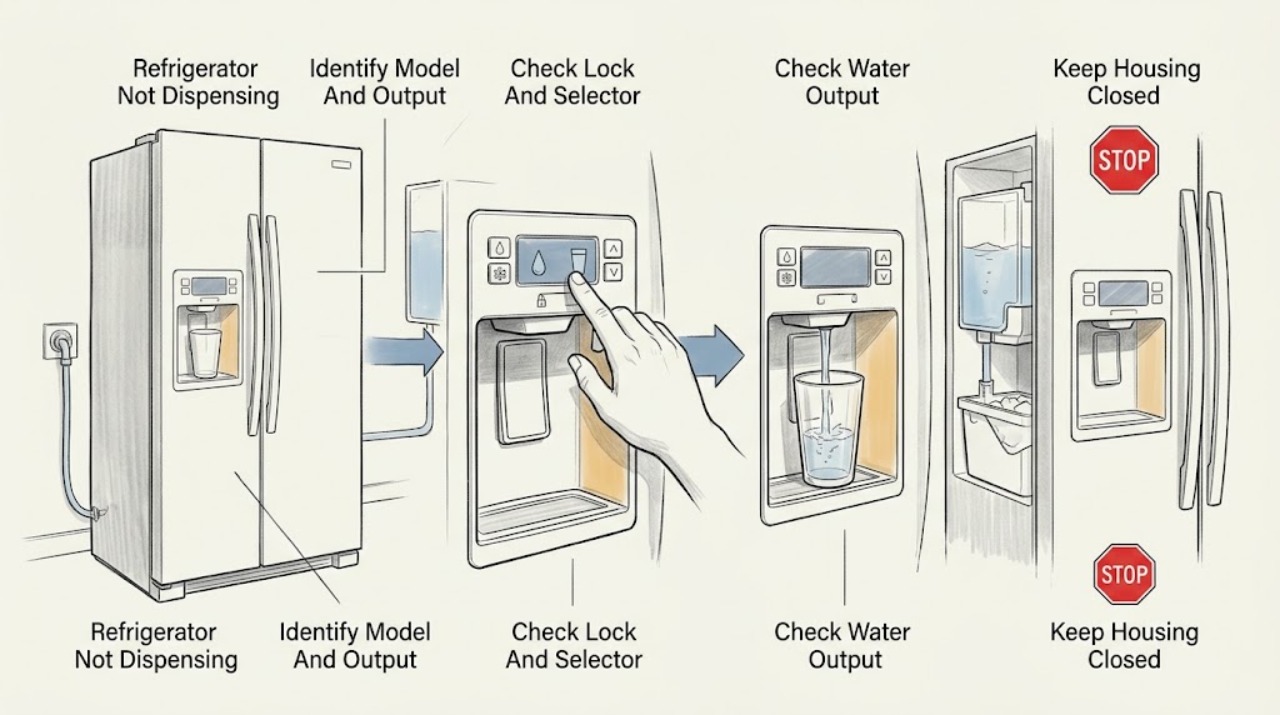
First identify the exact Hisense model and separate no water from no ice: a refrigerator may have an external through-door dispenser, an internal water dispenser, a separate ice maker, or no dispenser at all. On applicable models, make sure the control or child lock is not blocking the dispenser, select Water, Cubed, or Crushed as appropriate, and press the normal paddle or lever once. If water alone fails, inspect only the visible supply or reservoir condition and the filter status described by that model's manual; if ice alone fails, check whether the bucket is empty, clumped, or not seated. Hisense's HRF254N6TSE manual also says to flush a newly replaced filter and check for leaks, while its product material shows that dispenser and ice-maker layouts differ by model. Do not force the paddle, reach into the chute, chip ice with a sharp tool, disconnect pressurized tubing, or open the door panel. If water or ice is present but neither mode dispenses after safe external checks, or if there is a leak, hot connection, smoke, sparking, or repeated breaker activity, stop and arrange qualified service.
Before you begin
Safety first
- This article covers product-scope identification, normal controls, safe visible filter or reservoir and water-line observations, model-specific bucket handling, and external ice-path checks. Do not disconnect pressurized water, open panels, bypass a lock or sensor, reach into a chute, use sharp tools or hot water, run a drive without its bucket, or test live circuits.
Work through in order
Diagnostic checks
Use only checks that match the exact appliance or system and its official guide.
-
Check 1
Record the complete Hisense model and determine whether the refrigerator has an external dispenser, an internal water dispenser, an ice bucket, or no dispenser. Test only the normal controls and note whether water, Cubed ice, Crushed ice, or both outputs fail.
Expected result: The unit has an external ice-and-water dispenser, an internal water dispenser with a separate ice maker, a different documented layout, or no dispenser; the failed output is water, ice, or both.
Next step: Use the water, ice, or combined branch below with the exact model manual. Stop if the product identity or dispenser type cannot be confirmed.
Stop if: Do not apply a through-door procedure to an internal dispenser or standalone ice maker, and do not guess a part from the brand alone.
Why this matters
Why: Hisense uses more than one refrigerator dispenser architecture. An empty bucket is not the same symptom as ice remaining in a full bucket, and a refrigerator without a dispenser needs a different diagnosis.
-
Check 2
On the applicable model, check the display for a child or control lock, confirm the ice function is enabled if ice is being requested, select Water, Cubed, or Crushed as shown by the manual, and make one normal dispense request.
Expected result: The panel is locked, ice is switched off, the wrong output mode was selected, the display changes but no output occurs, or the controls do not respond.
Next step: Correct only a clearly identified normal control state in the exact manual and retest once. If the controls are enabled but one output still fails, continue with the corresponding water or ice check.
Stop if: Do not bypass a lock, hold a door switch, enter service diagnostics, force the paddle, or use an undocumented reset sequence.
Why this matters
Why: For HRF254N6TSE, Hisense states that the lock includes the dispenser and that the selected Water, Cubed, or Crushed mode controls the output. A control-state problem differs from a blocked water line or ice chute.
-
Check 3
If water is the failed output, inspect only accessible parts named by the exact manual: verify the Water mode, look for a visibly kinked supply line or mis-seated reservoir or filter, and check for fresh water around the filter area. Do not disconnect the line.
Expected result: The line or reservoir is visibly displaced, the filter was recently changed, the filter area leaks, water flow is weak or absent, or water conditions look normal while ice still works.
Next step: Follow the exact manual for reseating or replacing a model-matched filter and for flushing after replacement. Arrange plumbing or appliance service for persistent low flow, leaks, or an internal water component.
Stop if: Do not remove a pressurized connection, open the water valve assembly, place water near electrical parts, or operate with a persistent leak.
Why this matters
Why: A filter, reservoir, or visible supply condition can interrupt water delivery on models that use those parts. If ice works, the freezer's ice production is not the first suspect; if a leak is present, safe use takes priority.
-
Check 4
If ice is the failed output, observe whether the bucket is empty, contains loose ice, contains a clump, or is not fully seated. Check the exact model's normal Ice Off state and freezer setting; inspect the visible chute without inserting a hand or tool.
Expected result: The bucket is empty, the ice maker is off, the freezer or installation timing may not support available ice, ice is clumped or bridges the chute, or the bucket is full and correctly seated.
Next step: Use the exact manual to enable ice making, allow its documented production time, remove only loose accessible ice, or reseat the bucket as directed. Escalate a full-bucket failure instead of dismantling the chute.
Stop if: Do not reach into the chute, use a knife or metal pick, pour hot water into the ice path, run the auger with the bucket removed, or force the bucket.
Why this matters
Why: An empty bucket directs attention to ice production, water supply, or documented waiting time. A clump or seating issue is a physical ice-path problem. A full, clear, seated bucket with no output makes an internal dispensing fault more likely.
-
Check 5
If the problem began after filter replacement or water-line work, compare the installed filter with the exact manual, check that the filter is locked in place, and look for water at the filter tray or connection while the dispenser is idle. For the cited model, flush the line in the manual's staged cycles rather than holding the paddle continuously.
Expected result: The filter type or seating is uncertain, air remains after replacement, water leaks, the line is clear and dry, or the problem is ice-only with no recent water work.
Next step: Use the exact manual for the model-matched filter and flush procedure. Stop and arrange service for a continuing leak or if the model does not document owner filter work.
Stop if: Do not substitute an unverified filter, exceed the manual's procedure, disconnect tubing under pressure, or continue if water reaches electrical parts.
Why this matters
Why: Hisense's HRF254N6TSE instructions associate filter replacement with trapped air, possible drips, and a required leak check. This can explain weak or absent water delivery but does not prove a full-bucket ice-drive fault.
-
Check 6
After the safe external checks, document the model, failed output, selected mode, lock or Ice Off state, bucket condition, filter or reservoir timing, and any leak or abnormal sound. Do not remove the dispenser panel or perform live electrical testing.
Expected result: Water remains absent with a normal visible supply, ice remains in a correctly seated bucket but neither mode works, one mode repeatedly fails, or there is a leak, hot connection, smoke, sparking, or repeated breaker activity.
Next step: Arrange qualified Hisense appliance service and provide the exact model, output that fails, and observations. Use qualified plumbing or electrical service for the corresponding water or electrical problem.
Stop if: Stop using the dispenser for smoke, burning odor, sparking, a hot plug or outlet, damaged cord, water near electrical parts, or repeated breaker trips. Do not open panels or bypass sensors.
Why this matters
Why: The pattern may involve an internal valve, reservoir, auger or ejector, dispenser control, sensor, wiring, or another model-specific assembly. A hazard overrides ordinary dispensing diagnosis.
Use your observations
Decision map
Find the observation that best matches what you see, then follow the next safe action.
-
PATH 01Safety boundary
What you see
Ice works or is available, but water does not dispense from a model that documents a water dispenser.
Do this next
Check only the normal Water selection and accessible filter, reservoir, line, and leak conditions in the exact manual. Arrange qualified service for persistent low flow, an internal water part, or a continuing leak.
Why this path and its safety boundary
Why it matters: A selected mode, lock, filter or reservoir seating, visible supply condition, air after filter work, or internal water valve is more likely than an ice-bucket problem.
Safety stop: Do not disconnect pressurized tubing or operate with water near electrical parts.
-
PATH 02Safety boundary
What you see
Water works, but the ice bucket is empty or nearly empty.
Do this next
Confirm the documented Ice On state, check safe visible water conditions, and allow the exact manual's production period. Arrange appliance or plumbing service if no ice is produced.
Why this path and its safety boundary
Why it matters: This is primarily an ice-production or replenishment issue, not proof that the dispenser auger is broken. The ice function, freezer condition, recent installation, and water path need model-specific review.
Safety stop: Do not order a dispenser motor or dismantle the ice maker based only on an empty bucket.
-
PATH 03Safety boundary
What you see
Ice is present but clumped, the chute is visibly bridged, or the bucket is not seated.
Do this next
Remove only loose accessible ice, follow the exact bucket-removal instructions, reseat the bucket, clean any fallen water or ice, and make one normal test.
Why this path and its safety boundary
Why it matters: A physical ice-path or seating problem is more likely than a water-supply problem. Hisense provides model-specific bucket handling and warns against reaching into the chute.
Safety stop: Do not chip ice with a sharp tool, pour hot water into the chute, insert a hand or object, or force the bucket.
-
PATH 04Safety boundary
What you see
The bucket is full and seated, the visible chute is clear, controls are enabled, and neither Cubed nor Crushed dispenses.
Do this next
Keep the bucket and protective parts installed, record which modes fail, and arrange qualified Hisense refrigerator service.
Why this path and its safety boundary
Why it matters: An internal auger or ejector, control, sensor, wiring, or model-specific ice path is more likely than an empty-bucket production issue.
Safety stop: Do not run the drive with the bucket removed, bypass a sensor, open the door panel, or insert tools into the chute.
-
PATH 05Safety boundary
What you see
Water leaks toward electrical parts, the connection is hot, the cord is damaged, smoke or burning odor appears, sparking occurs, or the breaker trips.
Do this next
Stop dispensing and isolate water or power only from a safe accessible control; arrange qualified appliance, plumbing, or electrical service.
Why this path and its safety boundary
Why it matters: This is a plumbing or electrical safety event, not a routine dispenser jam.
Safety stop: Do not touch wet electrical parts, repeatedly reset a breaker, open panels, or continue operating with a persistent leak.
Helpful context
Understand the symptom
Start with the product architecture and the failed output
Do not assume every Hisense refrigerator dispenses both water and ice. Hisense's published materials show an external through-door ice-and-water design on HRF254N6TSE and an internal filtered water dispenser with a freezer-drawer ice maker on HRF266N6CSE1. Record the model from the product label, then note whether water, ice, or both fail and whether the bucket contains ice. Those observations determine whether to follow a water path, an ice-availability path, or a dispenser-output path.
Normal controls can block a request
On the HRF254N6TSE family, Hisense says the child or control lock includes the dispenser function. The same manual describes selecting Water, Cubed, or Crushed before pressing the lever. Other Hisense panels may use different labels or locations, so use the exact model manual and do not copy a key combination from another refrigerator.
Water-only failure points to the water path
If ice dispenses but water does not, focus on the model's water reservoir or supply, filter seating, visible line condition, and selected Water mode. The HRF254N6TSE manual says a replacement filter must be the same type supplied for the refrigerator, water should be flushed after replacement, and the filter area should be checked for leaks. These instructions are model-specific; do not remove a filter housing or disconnect tubing unless the exact manual permits it and the connection is safe.
Ice-only failure needs an ice-availability check first
If water works but ice does not, look at the bucket before blaming the dispenser drive. An empty bucket can reflect the ice maker being off, a warm freezer, a recent installation, or a water-supply issue. Ice in the bucket that is clumped, blocked at the chute, or not seated correctly is a different failure. Hisense warns against putting a hand or object into the chute and describes careful bucket handling for the cited model.
A full bucket with no output is a service boundary
When the exact controls are enabled, the bucket is seated, the chute is visibly clear, and neither ice mode dispenses, the remaining possibilities include a model-specific auger or ejector, sensor, dispenser control, or wiring fault. A mode that works for Cubed but not Crushed can indicate a mode-specific ice path, but it does not identify a universal replacement part. Keep the assembly intact and provide the model and failed mode to a qualified technician.
When checks do not resolve it
Need a professional?
Arrange qualified Hisense refrigerator service when a full, correctly seated ice bucket has no output after the exact control and visible chute checks; when a water dispenser remains dry with a correctly installed filter or reservoir and normal visible supply; when one mode repeatedly fails; or when an internal valve, reservoir, auger, ejector, sensor, control, or wiring would need access. Use qualified plumbing service for a leaking or pressurized water connection and qualified electrical service for a hot or damaged outlet, cord, or repeated breaker trip. Stop immediately for smoke, burning odor, sparking, water near electrical parts, or abnormal heat.
Safety scope: This article covers product-scope identification, normal controls, safe visible filter or reservoir and water-line observations, model-specific bucket handling, and external ice-path checks. Do not disconnect pressurized water, open panels, bypass a lock or sensor, reach into a chute, use sharp tools or hot water, run a drive without its bucket, or test live circuits.
Common questions
FAQ
Why does my Hisense refrigerator dispense water but not ice?
First determine whether the bucket is empty or contains ice. An empty bucket directs attention to the model's Ice On state, freezer and production conditions, and visible water path; a full bucket with a clear chute directs attention to seating, the selected mode, or an internal dispenser fault.
Why does my Hisense refrigerator dispense ice but not water?
Check the normal Water selection and only the accessible filter, reservoir, visible line, and leak conditions named by the exact manual. A recently changed filter may need correct seating and flushing. Persistent low flow or a leak needs qualified service.
Can I use the same Hisense dispenser instructions for every refrigerator model?
No. Hisense publishes both external ice-and-water and internal filtered-water arrangements. Use the exact model manual for controls, filter type, bucket handling, and water connections; do not assume a control sequence or part fits another model.
Can I clear a Hisense ice chute with a knife or hot water?
No. Keep hands and tools out of the chute, remove only loose accessible ice as the exact manual permits, and arrange service for an inaccessible or recurring blockage.
Read the exact guide
Official sources
- Hisense Cooling Support FAQsHisense UK · Hisense cooling products supported by the UK site; used for model identification and safety escalation, not to override a model manual.
- Hisense 26.6 cu. ft. French Door Refrigerator HRF266N6CSE1Hisense-USA · HRF266N6CSE1 model only; establishes a different dispenser architecture and not universal controls or parts.
- Hisense HRF254N6TSE Refrigerator Technical SpecificationsHisense-USA · HRF254N6TSE model only; used to establish a real Hisense dispenser product and not universal compatibility.
- Hisense HRF254N6TSE Refrigerator Owner's ManualHisense · HRF254N6TSE model; controls, dispenser layout, filter, and bucket instructions must not be assumed for other models.
Community feedback
Share a repair observation
Share a plain-text repair observation. Accepted observations are published automatically; this page may take a moment to update.