
On this page
Start here
Quick answer
First classify the symptom instead of treating every Hisense refrigerator problem as a failed compressor: no light, display, or sound points to supply or internal power; lights or a display with a warm cabinet points to controls, airflow, door sealing, recovery, or cooling; and an intermittent unit points to a setting, connection, or fault that needs service if it repeats. Safely verify the outlet and plug, confirm the exact model's cooling and temperature controls, clear accessible vents and door obstructions, and check that the gasket seals. Hisense specifically recommends verifying power, settings, unobstructed airflow, and door sealing; if the refrigerator remains inoperative or a hazard is present, stop and arrange qualified service rather than opening the cabinet.
Before you begin
Safety first
- The owner may make safe household power observations, consult the exact manual, check model-specific controls, clear accessible vents and door obstructions, and inspect or clean the gasket with a damp cloth. Electrical, internal control, fan, compressor, wiring, refrigerant, sealed-system, and inaccessible cabinet work require qualified service.
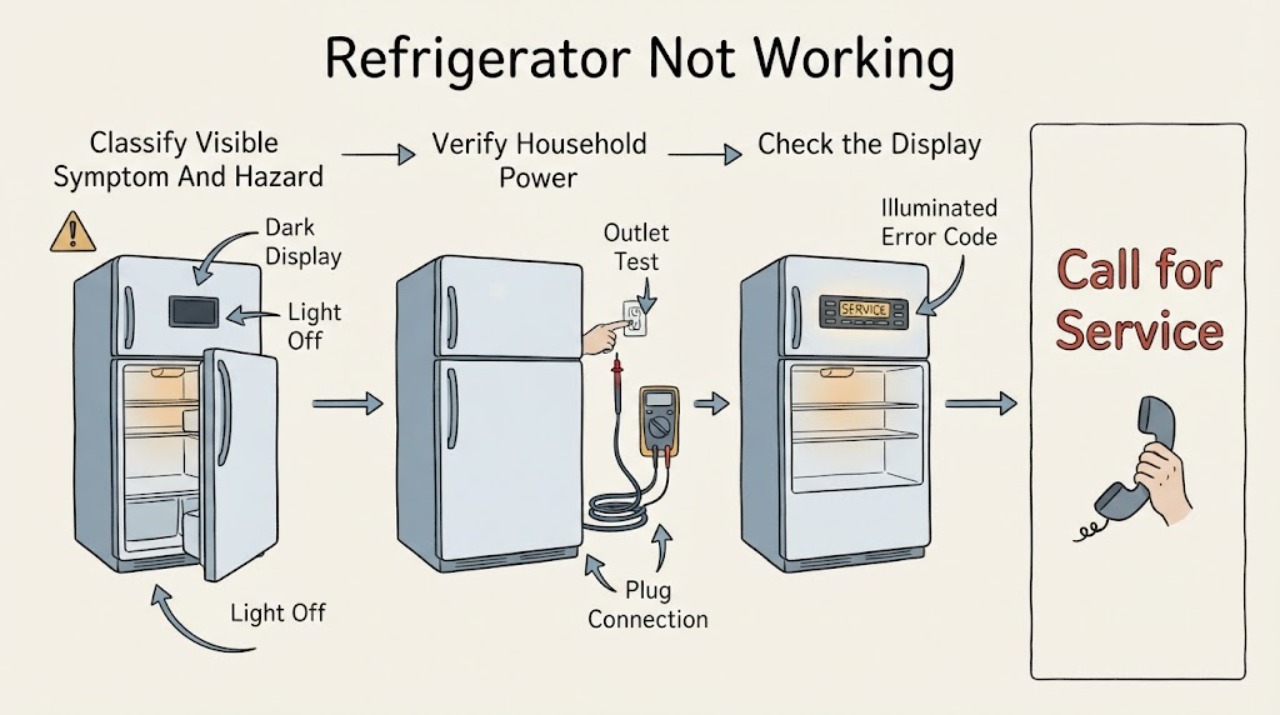
Work through in order
Diagnostic checks
Use only checks that match the exact appliance or system and its official guide.
-
Check 1
Without removing any panel, record whether the interior light, display, and buttons respond. Note whether either compartment is cold, whether there is a door-open alert, and whether the problem is constant or intermittent. Look and listen for smoke, burning odor, sparking, a hot or damaged plug or cord, water near electrical parts, or repeated breaker trips.
Expected result: Everything is dark and silent; lights or display work but the cabinet is warm; controls respond inconsistently; or an electrical or water hazard is present.
Next step: For any hazard, stop using the refrigerator and isolate power only if it can be done without touching a wet or damaged connection. Otherwise follow the matching safe external check below and do not open the cabinet.
Stop if: Do not repeatedly reset a tripping breaker, touch wet electrical areas, or remove a rear or control panel to see whether a component is running.
Why this matters
Why: A completely dark unit needs a supply and power-path check first. A responsive unit with no cooling belongs to a control, airflow, door, recovery, or cooling branch rather than the same diagnosis. A hazard makes continued operation unsafe.
-
Check 2
For a dark or intermittent unit, confirm the plug is fully seated in the required household outlet and use a normal safe household check to determine whether that outlet powers another suitable appliance. Check the accessible breaker or fuse once, without opening the electrical panel or changing wiring. Inspect the cord and plug visually for heat, cuts, looseness, or moisture.
Expected result: The outlet is dead; the breaker is tripped; the plug or cord is damaged or hot; another appliance also loses power; or the outlet and plug appear normal but the refrigerator remains dark.
Next step: Use only a safe household reset or a different suitable known-good outlet when permitted by the installation instructions. If the circuit trips again, the outlet is damaged, or the refrigerator stays dark on verified power, arrange an electrician or qualified appliance technician.
Stop if: Do not use an extension cord or adapter, bypass grounding, open the outlet or breaker panel, perform live testing, or keep cycling the circuit.
Why this matters
Why: A dead outlet or tripped circuit can explain a refrigerator with no visible response. A damaged or hot connection is a safety issue. Normal household power with a dark refrigerator makes an internal power, control, or wiring fault more likely, but does not identify it.
-
Check 3
If the light or display works, locate the model and serial number and read the matching Hisense manual or support page. Confirm the temperature setting is active and check only the exact model's documented cooling-off, demo, lock, vacation, or delayed-start state. Do not guess a button hold or reset sequence from a different refrigerator.
Expected result: The exact manual shows a cooling-off or special mode; controls are locked or not responding; settings are normal; or the model information and control state cannot be confirmed.
Next step: Exit a documented mode only as the exact manual says, make one permitted setting change, and record the time. If controls remain unresponsive or cooling does not resume after the model's documented recovery period, arrange service.
Stop if: Do not enter service mode, change hidden settings, repeatedly unplug and reconnect, or apply another Hisense model's sequence.
Why this matters
Why: A mode or lock can make a powered refrigerator appear not to work, while a normal documented state moves the investigation to airflow, sealing, recovery, or service. An unknown control layout cannot be diagnosed safely by trial and error.
-
Check 4
For a powered refrigerator that is warm, inspect accessible interior vents for containers or food blocking airflow. Check that the door closes without a protruding item and that the rubber gasket contacts the cabinet all around. Wipe the gasket and contact surface with a damp washcloth, press the gasket gently into place around the edges, and check the installation clearance without moving the appliance.
Expected result: A vent or door path is blocked; the gasket is dirty, folded, displaced, or torn; moisture or frost is present; or the external airflow and seal look normal.
Next step: Remove only accessible obstructions, restore the seal if it seats easily, minimize door openings, and allow the exact model's recovery guidance. If the gasket is damaged or the refrigerator remains warm, arrange service and protect perishable food.
Stop if: Do not use a sharp tool or heat on frost or the gasket, force the door, alter a damper or fan, or remove internal covers.
Why this matters
Why: Hisense identifies blocked airflow, warm food, an obstructed door, and poor sealing as relevant refrigerator checks. A clean, even seal and clear vents with persistent warmth make an internal cooling fault more plausible, not a specific failed part.
-
Check 5
After one safe power or exact-manual control correction, leave the setting unchanged and record when the refrigerator was restarted or adjusted. Monitor whether the light/display stays responsive, whether either compartment cools, and whether abnormal cycling, odor, heat, or noise appears. Use the exact manual for recovery expectations because no model is assigned.
Expected result: The refrigerator returns to normal; it powers on but stays warm; it repeatedly starts and stops; it loses power again; or a hazard appears.
Next step: Protect food, stop owner troubleshooting, and provide the technician with the model, symptom classification, timing, power observations, control state, door/gasket findings, and any hazard signs.
Stop if: Do not open the electrical or sealed refrigeration system, add refrigerant, probe energized parts, or keep resetting power.
Why this matters
Why: Successful recovery supports a temporary supply, control, loading, or sealing condition. Persistent warmth with normal external checks, repeated power loss, or abnormal cycling requires professional diagnosis; sound alone cannot identify a compressor, fan, relay, or sealed-system fault.
Use your observations
Decision map
Find the observation that best matches what you see, then follow the next safe action.
-
PATH 01Safety boundary
What you see
The interior light, display, and controls are all dark, and the refrigerator makes no normal operating response.
Do this next
Perform the single safe outlet, breaker, and cord check. If power is verified but the unit remains dark, arrange qualified electrical or appliance service.
Why this path and its safety boundary
Why it matters: Household power, plug, breaker, or an internal power/control fault is more likely than a refrigerator-only temperature problem.
Safety stop: Stop for heat, damage, moisture, smoke, sparking, or a circuit that trips again; do not open the appliance.
-
PATH 02Safety boundary
What you see
The light or display works, but one or both compartments are not cold.
Do this next
Verify the exact model's control state, clear accessible vents and door obstructions, check the gasket, and allow model-specific recovery. Arrange service if warmth persists.
Why this path and its safety boundary
Why it matters: A cooling-off or special control state, blocked airflow, poor door seal, recent warm load, or an internal cooling fault is possible; this is not the same as a completely dead refrigerator.
Safety stop: Do not remove covers, test fans or compressors, or infer a replacement part from temperature alone.
-
PATH 03Safety boundary
What you see
The refrigerator works at times, loses response, or returns after power is cycled, without an obvious obstruction or sealing issue.
Do this next
Record when the failure occurs, check the outlet and cord safely once, and use the exact model support route. Arrange service for repeated recurrence or any breaker trip.
Why this path and its safety boundary
Why it matters: An unstable household supply, control state, or internal electrical fault is possible. Repeated power cycling is not a diagnosis and can worsen a hazardous condition.
Safety stop: Do not bypass a breaker, use an extension cord, open the control area, or perform live electrical measurements.
-
PATH 04Safety boundary
What you see
The refrigerator has power, the controls appear normal, and a blocked vent, obstructed door, dirty gasket, moisture, or frost is visible.
Do this next
Clear the accessible obstruction, clean and gently reseat the gasket, minimize openings, and monitor recovery. Escalate if the seal remains uneven or the cabinet stays warm.
Why this path and its safety boundary
Why it matters: A user-accessible airflow or sealing condition is more likely than an immediate conclusion that the cooling system has failed.
Safety stop: Do not force the door, heat the gasket or frost, or remove internal air-path parts.
-
PATH 05Safety boundary
What you see
Power is verified, the exact model control state is normal, accessible vents and door sealing are satisfactory, and the refrigerator still does not operate or cool.
Do this next
Stop owner troubleshooting, keep food safe, and arrange qualified Hisense appliance service with the model and observation record.
Why this path and its safety boundary
Why it matters: An internal control, wiring, fan, compressor-start, or sealed-system fault remains possible, but the generic symptom cannot identify the failed component.
Safety stop: Do not open the rear cabinet, test energized parts, add refrigerant, or replace a part based only on this symptom.
Helpful context
Understand the symptom
What “not working” means on a refrigerator
A refrigerator can have lights or a display while cooling is disabled or not operating, so illumination alone does not prove that the cooling system is running. Conversely, a dark display can be a power problem, but it can also reflect a model-specific control state. Record what you can actually observe: interior light, display, buttons, compressor or fan sound, compartment temperature, and whether the problem is constant or intermittent.
Keep the model boundary visible
Hisense supports multiple refrigerator formats and asks owners to select a product category and find the model number for support. Without that model, do not apply a reset, showroom-mode exit, temperature value, or door-adjustment instruction copied from another unit. The checks below are external observations that do not require opening the appliance.
Protect food while diagnosing
If the cabinet is warming, minimize door openings and move perishable food to a known-cold appliance. A door that does not seal can also contribute to moisture, while blocked internal vents or warm food can affect temperature. These observations help separate a cooling complaint from a completely dead appliance, but they do not identify an internal electrical or sealed-system part.
Safety boundary
Stop conditions
- Stop immediately for smoke, burning odor, sparking, a hot or damaged cord or plug, exposed wiring, water near electrical components, or repeated circuit trips.
- Do not open the rear cabinet or control area, perform live electrical tests, touch the compressor or fan, or work on refrigerant tubing or the sealed system.
- Do not use an extension cord or adapter, bypass grounding, apply an unverified reset sequence, or repeatedly cycle power.
- If the refrigerator remains dark on verified power or remains warm after the exact model's permitted external checks and recovery guidance, protect perishable food and arrange qualified service.
Only after diagnosis
Potential parts
- door gasket or accessible grille component
Consider only if inspection confirms a damaged gasket or model-specific accessible grille after power, loading, airflow, and sealing checks.
Confirm the exact Hisense model and manufacturer's fit information before ordering. A warm refrigerator or visible gap does not prove which part is needed. - control, power, fan, or compressor-start component
Consider only after a qualified diagnosis confirms an internal component fault following safe external checks.
Internal parts are model-specific and may involve electrical or sealed-system hazards. Do not order or replace one from the broad symptom alone.
When checks do not resolve it
Need a professional?
Arrange qualified Hisense appliance service when the refrigerator stays dark despite verified household power, controls remain unresponsive, cooling does not return after the exact model's documented recovery period, power drops recur, the door or gasket cannot seal, or the unit repeatedly starts and stops. Contact an electrician for a hot, damaged, wet, sparking, or repeatedly tripping outlet or circuit. Provide the exact model and serial number, whether lights and display work, section temperatures, control state, timing, power observations, door and airflow findings, and any odor, heat, or noise.
Safety scope: The owner may make safe household power observations, consult the exact manual, check model-specific controls, clear accessible vents and door obstructions, and inspect or clean the gasket with a damp cloth. Electrical, internal control, fan, compressor, wiring, refrigerant, sealed-system, and inaccessible cabinet work require qualified service.
Common questions
FAQ
How can I tell whether my Hisense refrigerator has no power or is simply not cooling?
Check the interior light, display, and controls. If all are dark, verify the outlet, plug, cord, and accessible breaker once. If lights or the display work but the compartments are warm, check the exact model's control state, vents, door seal, and recovery conditions instead of treating it as a completely dead appliance.
What should I check first when a Hisense refrigerator is not working?
Classify what still works, then safely verify household power. For a powered but warm refrigerator, Hisense recommends checking settings, keeping airflow vents clear, avoiding warm loads, and ensuring the door seals. Use the exact model manual for any special mode or reset.
Why is my Hisense refrigerator light on but the refrigerator is warm?
A light only proves that some electrical functions respond. Cooling may be disabled by a model-specific mode, delayed after a change, or affected by blocked airflow, a poor door seal, a recent warm load, or an internal cooling fault. Check the exact model controls and accessible external conditions; do not open the cabinet.
When should I stop troubleshooting a Hisense refrigerator?
Stop for smoke, burning odor, sparking, a hot or damaged plug or cord, water near electrical parts, exposed wiring, or repeated breaker trips. Also stop external troubleshooting when verified power and model-specific settings are normal but the refrigerator remains dark or warm; protect food and arrange qualified service.
Read the exact guide
Official sources
- Hisense Support - For All Your Appliance Needs - Hisense USAHisense USA · Official Hisense USA support hub; it confirms model-based refrigerator support but does not establish a universal reset, control sequence, or compatible part for an unidentified model.
- Hisense Product & Support CentreHisense · Official Hisense support FAQ with generic refrigerator guidance; no model number is assigned, so control names, modes, recovery times, and internal procedures remain model-specific.
Community feedback
Share a repair observation
Share a plain-text repair observation. Accepted observations are published automatically; this page may take a moment to update.