
On this page
Start here
Quick answer
Stop using the refrigerator and do not keep resetting the breaker to test it. If there is water near the outlet or plug, smoke, a burning smell, sparking, a hot or damaged cord, or repeated trips, keep the appliance isolated and use qualified electrical or appliance service. From a dry, safe position, record whether the trip occurs as soon as the refrigerator is energized, when the compressor starts, during defrost, or after an ice-maker/dispenser event. Hisense installation guidance calls for a grounded outlet, no adapter or extension cord, and recommends a separate circuit for the refrigerator; do not change the breaker rating or open the appliance to investigate. [Source-backed: Hisense installation guidance specifies grounded power, no adapter/extension, and a separate refrigerator circuit when provided; it also says to disconnect power before installation or cleaning.]
Before you begin
Safety first
- The owner may stop use, isolate an accessible water supply, observe the breaker and external area from a dry safe position, record timing, and identify the model. Breaker, outlet, cord, internal power, compressor/start, defrost, control, water-feature, refrigerant, and energized diagnostic work require qualified service.
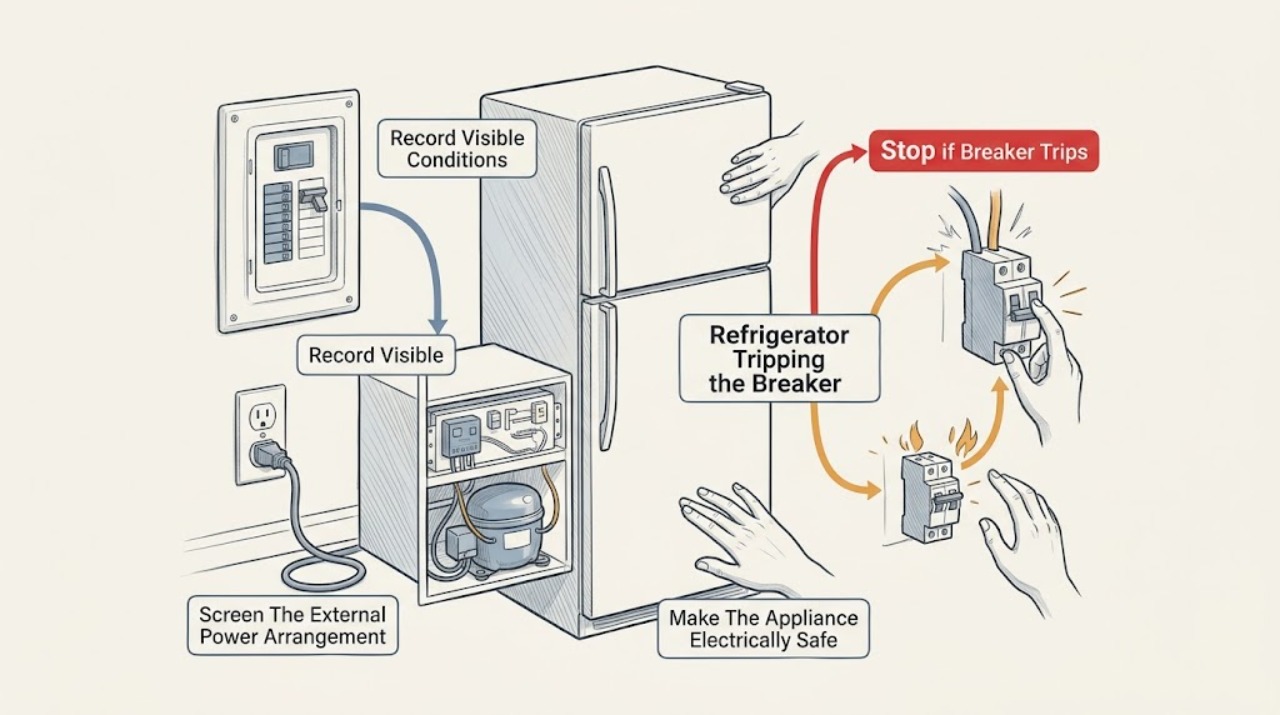
Work through in order
Diagnostic checks
Use only checks that match the exact appliance or system and its official guide.
-
Check 1
Stop operating the refrigerator and do not repeatedly reset the breaker. If the plug, outlet, floor, or cabinet area is wet, or there is smoke, burning odor, sparking, heat, or visible damage, keep clear and isolate power only from a dry, safe control point; do not touch a wet plug or reach behind the appliance.
Expected result: The breaker trips again without a deliberate test; electrical warning signs are present; water is near the supply; or the area is dry with no visible damage.
Next step: For any warning sign, leave the refrigerator isolated and arrange qualified electrical or appliance service. If the area is dry, document the breaker, outlet, cord, and timing from outside the cabinet before calling service.
Stop if: Do not reset the breaker repeatedly, disconnect a wet plug, touch exposed conductors, or use the refrigerator while standing water is present.
Why this matters
Why: Repeated tripping or any heat, smoke, spark, burning odor, or moisture near electrical parts is an immediate electrical/appliance safety condition. A dry appliance with no visible warning signs still has an unresolved fault; it is not cleared for repeated testing.
-
Check 2
Using what already happened, write down the last known sequence: the refrigerator was first plugged in, cooling normally, starting after a pause, defrosting, making ice, dispensing water, or idle. Note whether the trip was immediate or delayed and whether the refrigerator display or interior light had been operating.
Expected result: The trip was immediate on energizing; followed a compressor start or delay; coincided with defrost or an ice-maker/dispenser event; or occurred with no apparent refrigerator event.
Next step: Give the timing and model number to the service technician; do not create another trip to obtain a cleaner result. Use the exact manual to confirm whether the model has the suspected function.
Stop if: Do not force a defrost, start an ice-making cycle, run a dispenser, or switch circuits just to reproduce the trip.
Why this matters
Why: Immediate trips keep the supply, cord, plug, input protection, or primary power circuit in scope. A delayed or compressor-start trip keeps a load or start circuit in scope. A defrost or water-feature timing clue narrows attention to models equipped with that function. No timing clue means the external circuit still needs professional assessment.
-
Check 3
From a dry, accessible position, identify whether the refrigerator is plugged directly into a grounded wall outlet or into an adapter, extension cord, power strip, switched outlet, or circuit shared with other high-load appliances. Look only for a loose faceplate, discoloration, melted plastic, damaged cord jacket, or a plug that was already hot; do not remove the outlet cover or test it live.
Expected result: An adapter/extension/power strip is present; the circuit is shared; the outlet or cord shows heat or damage; or the connection appears to be a direct grounded outlet with no visible damage.
Next step: Keep the refrigerator off and report the arrangement to an electrician or appliance technician. Do not substitute a larger breaker or relocate the plug as a trial; any outlet or circuit work requires a qualified person.
Stop if: Do not use an adapter or extension cord, remove the ground pin, open the receptacle, or touch a hot, wet, loose, or discolored connection.
Why this matters
Why: An adapter, extension cord, shared load, damaged receptacle, or damaged cord can make the external supply part of the problem and must be corrected or assessed by a qualified person. A visually normal direct connection does not rule out an internal refrigerator fault or a hidden circuit fault.
-
Check 4
Without moving the refrigerator or opening panels, inspect the visible floor and cabinet perimeter for water, condensation, or a recent leak. If the model has an ice maker or dispenser and its water shutoff is safely accessible, leave that supply closed; do not disconnect tubing or restore water to test the breaker.
Expected result: Water is near the outlet or base; a leak followed an ice-maker/dispenser event; the floor is dry; or the refrigerator has no water-connected feature.
Next step: Keep power and any water supply isolated as appropriate and arrange service when water or a water-feature event is involved. Record the location and timing without wiping behind the cabinet or moving it.
Stop if: Do not reach behind the unit, pull it out, loosen a pressurized fitting, or handle wet electrical parts.
Why this matters
Why: Water near electrical equipment raises the urgency and may involve a water-feature or moisture-related fault. A dry floor does not exclude an internal electrical fault. A model without a water connection cannot have a water-line-triggered event, so the timing must be interpreted from its actual manual and symptoms.
-
Check 5
Find the exact model and serial information from the refrigerator label or existing records without moving the appliance, then retrieve its manual through Hisense support. Give the technician the model, breaker behavior, power arrangement, visible damage, water status, and whether the refrigerator had been cooling, defrosting, or using a water feature.
Expected result: The model manual is available; the model cannot be identified; the breaker holds but the refrigerator remains off; or the trip recurs after service attempts.
Next step: Arrange qualified Hisense appliance service and, when the outlet or branch circuit is implicated, a qualified electrician. Keep the refrigerator isolated until the cause is assessed.
Stop if: Do not remove covers, access the compressor or control board, replace an internal fuse, bypass a thermal or door switch, or perform live voltage or resistance tests.
Why this matters
Why: The manual can confirm whether the refrigerator has a defrost heater, ice maker, dispenser, inverter, or other model-specific circuit, but it cannot make an energized internal inspection safe. An unidentified or recurring fault needs a qualified diagnosis rather than a guessed replacement part.
Use your observations
Decision map
Find the observation that best matches what you see, then follow the next safe action.
-
PATH 01Safety boundary
What you see
The breaker opens as soon as the refrigerator is plugged in or power is restored, before normal cooling is observed.
Do this next
Leave the breaker and refrigerator isolated and arrange qualified electrical/appliance service. Provide the exact model and whether the outlet is grounded and dedicated.
Why this path and its safety boundary
Why it matters: A fault in the supply connection, cord/plug, input protection, or refrigerator primary power path is more concerning than a normal compressor run. The observation does not identify which component failed.
Safety stop: Do not keep resetting the breaker, change its rating, use an extension cord, or open the rear of the refrigerator.
-
PATH 02Safety boundary
What you see
The refrigerator initially has power, then the breaker opens after a delay or when a compressor start is heard or expected.
Do this next
Keep the appliance off and have an appliance technician and, if indicated, an electrician assess it. Do not attempt a restart cycle to compare timings.
Why this path and its safety boundary
Why it matters: A load-related, start-related, thermal, or branch-circuit problem is more likely than a simple unplugged appliance, but timing cannot distinguish a compressor, start device, control, or household-circuit defect.
Safety stop: Do not access the compressor, start device, capacitor, control board, or energized wiring.
-
PATH 03Safety boundary
What you see
The trip was associated with an automatic defrost interval or with ice-maker/dispenser use on a model that actually has that feature.
Do this next
Keep the appliance and any water supply isolated, obtain the exact manual, and arrange qualified service with the event timing. Do not force the feature to run again.
Why this path and its safety boundary
Why it matters: A model-specific defrost or water-feature circuit, moisture, or the branch circuit becomes relevant. A refrigerator without that feature cannot be diagnosed by borrowing another model's circuit layout.
Safety stop: Do not run the dispenser, force ice production, disconnect water tubing, or remove internal electrical covers.
-
PATH 04Safety boundary
What you see
The outlet, plug, cord, floor, or cabinet perimeter is wet, hot, discolored, melted, sparking, or associated with a burning odor.
Do this next
Keep clear, isolate power from a dry safe point if possible, and contact qualified electrical service; arrange appliance service as needed. Do not touch or dry an energized connection.
Why this path and its safety boundary
Why it matters: This is an electrical or fire-risk pattern regardless of whether the refrigerator itself caused the original trip. The external connection must not be treated as a harmless nuisance trip.
Safety stop: Do not reconnect the plug, reset the breaker, use the outlet for another appliance, or move the refrigerator to expose the area.
-
PATH 05Safety boundary
What you see
The breaker remains on, but the refrigerator has no light/display or does not run after the trip, and the outlet has not been professionally confirmed safe.
Do this next
Keep the refrigerator off, identify the exact model, and request qualified electrical/appliance diagnosis rather than trying multiple outlets or resets.
Why this path and its safety boundary
Why it matters: The appliance may still have a power connection, control, or internal fault, or the branch circuit/outlet may remain defective. A breaker that stays on is not a clearance to open the appliance.
Safety stop: Do not perform live outlet tests, use an adapter, bypass a switch or interlock, or open the power/control compartment.
Helpful context
Understand the symptom
Treat a tripping breaker as a safety symptom, not a reset instruction
A breaker opening may be protecting against an overload, a short, a ground fault, moisture, or a refrigerator fault. It is not safe to keep restoring power until the trip disappears. Hisense installation guidance requires grounded power, says not to use an adapter or extension cord, and recommends a circuit serving only the refrigerator. Those requirements are installation guidance rather than proof of a particular failed component, so use them to screen the external supply and leave internal diagnosis to a qualified professional.
The moment of the trip is the useful observation
Record the sequence without deliberately reproducing it: does the breaker open immediately when the refrigerator is connected, only after the compressor tries to start, during a defrost interval, or after an ice maker or dispenser event? A trip immediately on energizing keeps the supply, cord, filter, or input circuitry in scope; a delayed trip puts a load or moisture event in scope; a water-feature-linked trip is limited to models equipped with that feature. These are service-routing clues, not owner-level part diagnoses.
Stop at the cabinet boundary
An owner can document the breaker position, visible plug or cord condition, dry or wet floor, and whether other appliances share the circuit from a safe position. Do not pull out a heavy refrigerator, remove a rear or base panel, probe an outlet, bypass a breaker, replace a fuse with a larger one, or test energized wiring. Hisense directs owners to locate the exact product manual through its support page; give that model information to the service technician or electrician.
Safety boundary
Stop conditions
- Stop immediately for repeated breaker trips, smoke, burning odor, sparking, a hot or damaged plug/cord/outlet, water near electrical parts, or signs of melted insulation; isolate power from a dry safe point and call qualified service.
- Do not repeatedly reset the breaker, increase its rating, bypass a protective device, or use an adapter, extension cord, or power strip as a workaround.
- Do not move the refrigerator, remove rear/base covers, touch the compressor or control board, disconnect pressurized water tubing, or perform energized electrical tests.
- Do not force defrost, ice-making, or dispensing to reproduce the trip. If the exact model or circuit cannot be identified safely, keep the appliance isolated and escalate.
Only after diagnosis
Potential parts
- power cord, inlet protection, control or defrost component
Consider only after a qualified technician identifies the failed circuit; a breaker trip alone cannot justify ordering an internal part.
Electrical and defrost parts are model-specific and require safe isolation and qualified diagnosis. Do not replace an internal fuse or bypass a protective component. - compressor start component or water-feature electrical component
Relevant only when the exact model has the feature and qualified testing identifies that circuit as the cause of the trip.
Do not infer compressor, capacitor, relay, valve, or ice-maker fitment from timing alone; sealed-system and energized work require qualified service.
When checks do not resolve it
Need a professional?
Arrange qualified appliance service for any refrigerator that trips the breaker, especially when the trip recurs, occurs after compressor start or a model-specific feature, or leaves the refrigerator without power. Use a qualified electrician when the outlet, branch circuit, breaker, cord, plug, shared load, wet connection, heat, sparking, or burning odor is involved. Provide the exact model and serial information, the time and sequence of the trip, whether the refrigerator had a water connection, the external power arrangement, and photos taken from a safe stationary position.
Safety scope: The owner may stop use, isolate an accessible water supply, observe the breaker and external area from a dry safe position, record timing, and identify the model. Breaker, outlet, cord, internal power, compressor/start, defrost, control, water-feature, refrigerant, and energized diagnostic work require qualified service.
Common questions
FAQ
Should I keep resetting the breaker if my Hisense refrigerator trips it?
No. Stop using the refrigerator and record when the trip occurred. Repeated trips, heat, smoke, burning odor, sparks, damaged wiring, or water near the outlet require power isolation from a dry safe point and qualified electrical/appliance service.
Can I plug the Hisense refrigerator into an extension cord or another outlet to test it?
Do not use an extension cord, adapter, power strip, or a larger breaker as a workaround. Hisense installation guidance calls for a grounded outlet and recommends a separate circuit for the refrigerator. If the outlet or circuit is in question, have a qualified electrician assess it rather than moving the refrigerator or trying multiple connections.
What does it mean if the breaker trips when the compressor starts?
It keeps a load, start circuit, refrigerator control, or branch-circuit problem in scope, but timing does not identify the failed part. Keep the refrigerator off and give the exact model and timing to qualified appliance and, if needed, electrical service.
What if the trip happened while the ice maker or dispenser was being used?
Only refrigerators equipped with that feature can have a water-feature-linked event. Keep the water supply closed if it is safely accessible, do not run the feature again or disconnect tubing, and use the exact model manual and qualified service to assess the circuit and any moisture.
Read the exact guide
Official sources
- Hisense SupportHisense · Supports retrieving the exact manual and product information before applying any model-specific troubleshooting or service procedure.
- Hisense HQD20 Refrigerator User ManualHisense-USA · Applies to the HQD20 model family and only to refrigerators equipped with the documented water connection; it is not generalized to models without an ice maker or dispenser.
- Hisense LMT43M6AVE Refrigerator User ManualHisense-USA · Applies directly to the opened LMT43M6AVE manual; used only to illustrate that model functions and safety details vary, not as a universal repair procedure.
- Hisense Refrigerator Installation Requirements and User ManualHisense · Directly supports the opened HRFD635SW manual's installation and safety instructions. It is used for cross-model electrical safety principles, not to claim a particular circuit or part on every Hisense refrigerator.
Community feedback
Share a repair observation
Share a plain-text repair observation. Accepted observations are published automatically; this page may take a moment to update.