
On this page
Start here
Quick answer
For a Hisense HRF209N6CSE that fills or leaks water unexpectedly, first close the refrigerator's external water shutoff valve and stop using the dispenser and ice maker; if water is near an electrical connection, isolate power only when it can be done without touching a wet or damaged connection. Then identify where water appears: dispenser, ice maker, filter, rear supply connection, or underneath the cabinet. On a new installation, a brief first-use exhaust sound and water dripping after releasing the dispenser can be related to air in the line, and Hisense says to flush the filter and check for leaks; water that continues without a dispensing request, fills both the dispenser and ice maker while the door is closed, or persists after the shutoff is closed is not explained by normal flushing and needs qualified service. Verify only visible line and filter seating, cold potable supply, and the documented ice-maker setting; do not open panels, work on a pressurized line, or guess a water-valve or control-board replacement.
Before you begin
Safety first
- Keep the external water valve closed for uncontrolled filling or active leakage. Do not disconnect a pressurized line, remove rear or internal panels, probe a water valve, bypass the dispenser or ice-maker control, move the refrigerator, or use tape, glue, a clamp, or an unapproved replacement tube as a repair. If water is near electricity, do not touch the connection; isolate power only from a dry, safe position or obtain qualified help.
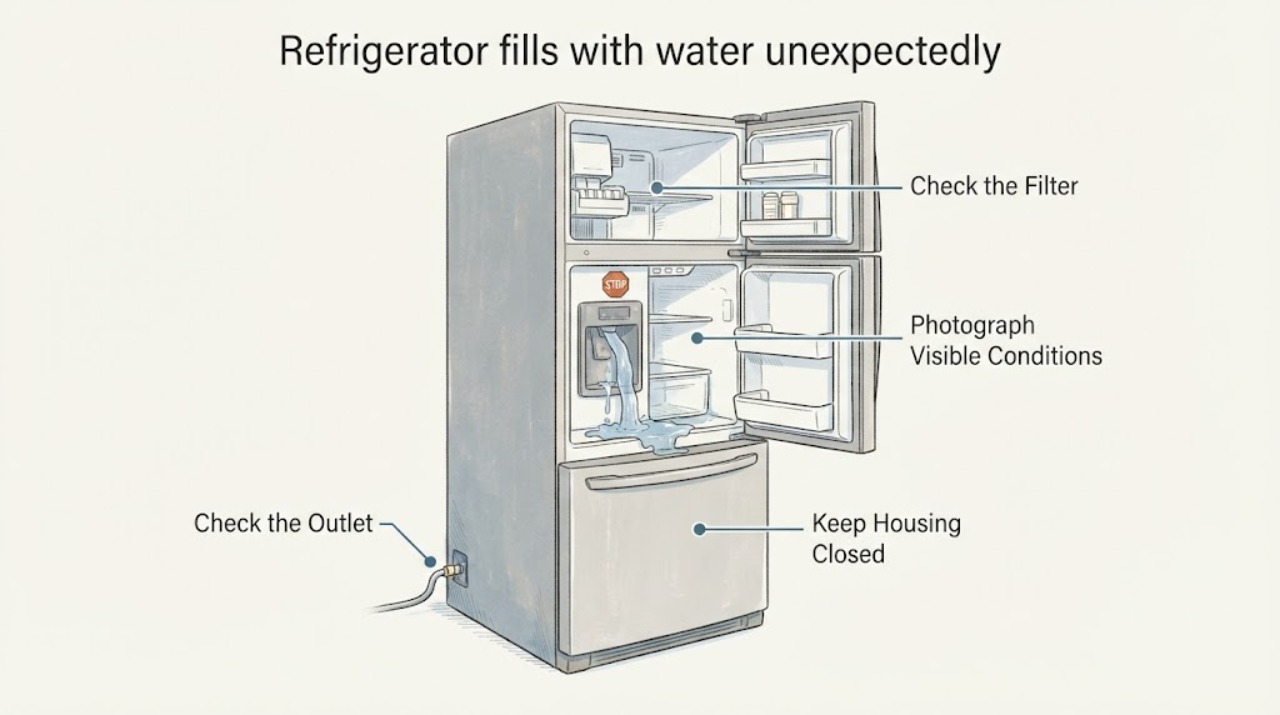
Work through in order
Diagnostic checks
Use only checks that match the exact appliance or system and its official guide.
-
Check 1
If water is currently flowing or pooling, close the refrigerator's external water shutoff valve before touching the refrigerator. Stop dispensing and turn the ice maker off using the documented Ice On/Off control if it can be done from a dry, safe position. If water is near a plug, cord, outlet, or other electrical connection, isolate power only if doing so does not require touching wet or damaged parts.
Expected result: The flow stops when the external water valve is closed, continues despite the valve being closed, or water is close to electrical equipment.
Next step: Keep the water valve closed, protect the floor and food, and arrange qualified appliance or plumbing service. Do not reopen the valve to reproduce the symptom or touch wet electrical connections.
Why this matters
Why: Stopping at the external valve separates an incoming supply or control problem from residual water already in the line. Water that does not stop, or a wet electrical area, is an immediate safety and service boundary rather than a valve-replacement diagnosis.
-
Check 2
With the supply isolated and the area dry, identify the first visible source without pulling the refrigerator or removing a panel: dispenser outlet or door area, ice-maker mold or ice bin, water-filter housing, rear connection that is already visible, or water underneath the cabinet. Photograph the water path and note whether the dispenser pad was pressed, the door was open, or the ice maker had just filled.
Expected result: Water is confined to the dispenser, the ice maker, the filter area, a visible supply connection, the floor under the cabinet, or more than one location.
Next step: Leave the supply closed and continue only with the visible, model-documented checks for that location. If the source is underneath or hidden, stop owner troubleshooting and request service rather than moving the appliance.
Why this matters
Why: The location determines which safe branch is relevant. A dispenser drip after a release or a first-use air purge is different from a filter or rear-connection leak; two locations filling at once point to a shared upstream control or installation issue but do not identify a particular component.
-
Check 3
For a new installation or a recently changed filter, compare the event with the HRF209N6CSE manual's first-use procedure: the water line must be connected to cold potable water, the filter and visible connections should be checked for leaks, and the dispenser should be flushed to remove trapped air and contaminants. The manual says the first dispenser activation may make an exhaust sound and that water can drip if air remains in the line.
Expected result: The event was limited to the first connection or filter change and stopped after the documented flush, or water still drips or fills without a dispensing request.
Next step: If the only symptom was the documented first-use air or residual drip and there is no leak, follow the manual's controlled flush guidance. If filling is uncommanded or leaks persist, keep the water valve closed and use service or the installer/warranty route.
Why this matters
Why: A brief first-use sound or residual drip can be consistent with air in a newly connected or filtered line. Uncommanded filling, ongoing pooling, or a repeat event after the line has been flushed is not established as normal by that guidance.
-
Check 4
Inspect only the accessible water line and filter area with the supply still closed: look for a visible kink, crushed tubing, a filter that is visibly out of position, or a connection that is visibly wet. Do not loosen a compression nut, disconnect tubing, reach behind the cabinet, or pressurize the system to search for a leak.
Expected result: A line is visibly kinked or crushed, the filter is not seated as the manual shows, a visible connection is wet, or all accessible areas are dry and correctly seated.
Next step: Correct only a plainly accessible, cool routing obstruction or reseat the filter exactly as the manual permits, then leave the supply closed until the area is dry and a qualified person can verify a persistent leak. Do not order a part from this observation alone.
Why this matters
Why: Hisense lists a crushed or kinked water line and an incorrectly installed filter as causes of dispenser problems, while its installation instructions require checking visible connections for leaks. These observations do not prove that an internal valve, hose, or control has failed.
-
Check 5
Separate the dispenser and ice-maker requests without forcing either mechanism. Record whether the dispenser releases water only while its pad is pressed or briefly afterward, whether the ice maker is set to Ice On, whether its bin is already full or blocked, and whether one or both areas fill while the doors remain closed.
Expected result: Only the dispenser drips, only the ice maker fills, neither is commanded but one fills, or both fill together.
Next step: Keep the external water valve closed for any uncommanded event. Provide the technician with the exact location, door state, command state, and whether the event affects one or both water-using functions.
Why this matters
Why: A short dispenser carryover after release can occur while air is being removed, and the ice maker has its own documented on/off and temperature/first-production conditions. Uncommanded filling in one area needs that path checked by service; simultaneous uncommanded filling is a stronger shared-control clue, not proof of a specific valve or board.
-
Check 6
If the problem is no longer actively leaking and the supply is still isolated, record the home's water setup without testing it: ordinary cold-water line or reverse-osmosis system, visible shutoff position, filter-change timing, and any recent installation work. The manual gives a pressure range for reverse-osmosis supply and warns that line routing and low pressure can affect operation; do not measure pressure or alter plumbing yourself.
Expected result: The refrigerator uses reverse osmosis, the line was recently installed or moved, a visible kink is present, or the supply setup is unknown.
Next step: Give the supply details and photos to the installer or Hisense service. Do not install a booster, change a shutoff, or open a connection to compensate for the symptom without model- and site-specific professional guidance.
Why this matters
Why: A new or restricted supply can explain delivery problems and first-use behavior, but low pressure does not explain water that continues without a request. Pressure and plumbing changes belong with a qualified installer or plumber, especially where the supply is shared or concealed.
Use your observations
Decision map
Find the observation that best matches what you see, then follow the next safe action.
-
PATH 01Next step
What you see
Water stops at the external shutoff, the event occurred during first connection or filter replacement, and the only remaining sign is a brief dispenser drip or air sound.
Do this next
Follow only the manual's controlled flush and leak-check procedure with the area dry and supervised. Keep the supply closed and call service if water continues to appear, the filter area leaks, or the event recurs without a command.
Why this path and its safety boundary
Why it matters: The sequence is compatible with residual air or first-use flushing described in the HRF209N6CSE manual, not proof of an uncontrolled water valve.
-
PATH 02Next step
What you see
Water fills or leaks from the dispenser or ice maker while its control is not being used, or both functions fill while the doors are closed.
Do this next
Leave the external water valve closed, turn the refrigerator off only through a safe dry isolation if needed, preserve photos of the water level and source, and arrange Hisense or qualified appliance service. Do not reopen the water supply for a test.
Why this path and its safety boundary
Why it matters: This is an uncommanded-fill branch. A shared upstream water-control or installation fault is possible, but the observation does not prove a particular valve, solenoid, or control board.
-
PATH 03Next step
What you see
The visible filter housing or rear connection is wet, or the line is visibly kinked or crushed, and no water is currently flowing after the shutoff is closed.
Do this next
Keep the water off, allow the area to dry, and have the installer or qualified service person correct and leak-check the connection using the exact manual and approved tubing. Do not tape, cut, clamp, or substitute tubing.
Why this path and its safety boundary
Why it matters: A visible installation, filter-seating, or line-routing issue is more likely than a confirmed internal control fault, but a connection should not be opened under pressure.
-
PATH 04Next step
What you see
The dispenser and ice maker are not commanded, the accessible line and filter look dry and correctly seated, and the event returns whenever the external water supply is opened.
Do this next
Keep the supply closed and arrange qualified Hisense appliance service with the model, event timing, source location, door/control state, filter history, and photos. Do not probe or replace internal parts.
Why this path and its safety boundary
Why it matters: The fault is beyond a safe external observation. An internal water-control, wiring, or command-path problem remains possible, but the exact failed component cannot be identified from this symptom.
Helpful context
Understand the symptom
This is a water-control and leak-safety problem, not automatically a cooling or compressor problem. On the HRF209N6CSE, the dispenser, filter, supply connection, and freezer ice maker are separate places to observe. Start with water isolation and the exact location of the water, then use the new-installation flushing guidance only when the water stops when the external shutoff is closed.
Do not leave an uncontrolled fill running while you investigate. Do not remove the rear cover, disconnect a pressurized tube, probe a valve, bypass a dispenser or ice-maker control, or use a temporary clamp or tape repair. If water reaches a plug, cord, outlet, or other electrical connection, keep hands and feet clear and use qualified help if safe isolation is not possible.
When checks do not resolve it
Need a professional?
Arrange Hisense or qualified appliance service when water fills without a command, both dispenser and ice maker fill together, a leak persists after the visible filter and line checks, water appears underneath or behind the cabinet, the source cannot be seen safely, or the event returns whenever the supply is opened. Use a qualified plumber for supply, shutoff, reverse-osmosis, or concealed plumbing work.
Safety scope: Keep the external water valve closed for uncontrolled filling or active leakage. Do not disconnect a pressurized line, remove rear or internal panels, probe a water valve, bypass the dispenser or ice-maker control, move the refrigerator, or use tape, glue, a clamp, or an unapproved replacement tube as a repair. If water is near electricity, do not touch the connection; isolate power only from a dry, safe position or obtain qualified help.
Have this ready
- Provide the exact HRF209N6CSE model, installation or filter-change timing, whether the dispenser pad or Ice On/Off control was used, whether the doors were closed, the first visible water location, whether one or both functions filled, the shutoff result, supply type, and clear photos taken after the water was isolated.
Common questions
FAQ
Is a little water after first connecting the HRF209N6CSE normal?
The manual says the first dispenser activation may make an exhaust sound, and that air remaining in the line can cause dripping until the system is flushed. That does not establish uncommanded filling or ongoing pooling as normal. Close the supply and call service if water continues without pressing the dispenser or if a connection leaks.
Why should I identify whether the dispenser or ice maker is the source?
The HRF209N6CSE manual documents a door dispenser, water filter, water-line connection, and freezer ice maker. A dispenser carryover, an ice-maker fill, a filter leak, and a rear connection leak have different safe next checks. If both fill while the doors are closed, record that as a shared symptom for service rather than naming a part.
Can I open the water line to see whether the valve is stuck?
No. Keep the external supply closed and do not disconnect a pressurized line or remove a panel. Hisense's installation guidance requires leak checks and says to discontinue use and contact service when leaks persist; internal water-control diagnosis belongs to qualified service.
Read the exact guide
Official sources
- Hisense 36 inch 21.2 CF French Door Refrigerator with Ice Maker Support - Guides & ManualsHisense USA · Opened the exact Hisense USA model-support page to confirm the model identity, refrigerator type, ice-maker configuration, and model-specific documentation route.
- 740说明书0323Hisense USA · Opened the official Hisense-hosted PDF in a browser; the manual explicitly lists HRF209N6CSE and covers its connected water line, filter, dispenser, and freezer ice maker.
Community feedback
Share a repair observation
Share a plain-text repair observation. Accepted observations are published automatically; this page may take a moment to update.