
On this page
Start here
Quick answer
When a Hisense washing machine displays an error, write down the exact code, the model and serial information, the cycle stage, and whether water is in the drum before trying to clear it. Code meanings vary by model, so use the fault table in the manual for that exact machine; do not apply a code meaning from a different Hisense washer. The manual may permit checks for the door, water inlet, drain hose or filter, foam, and load balance, followed by one documented restart. If the code returns, water is near electrical parts, the door is locked over standing water, or there is a leak, burning smell, overheating, spark, or breaker trip, stop and arrange qualified service.
Work through in order
Diagnostic checks
Use only checks that match the exact appliance or system and its official guide.
-
Check 1
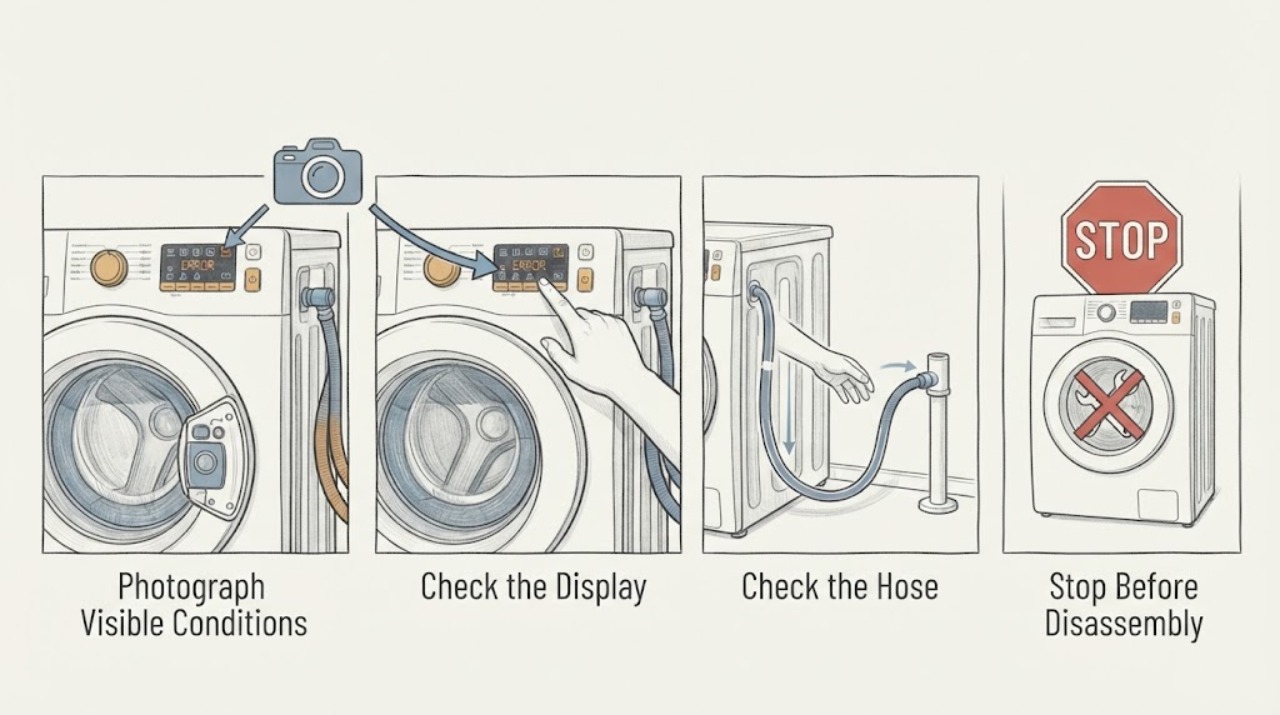
Photograph or write down the exact error characters, indicator symbols, cycle name, remaining time, and the point at which the washer stopped. Read the model and serial information from the rating label without moving or opening the appliance.
Expected result: You have a model identifier and a precise code such as the exact letter-number combination, rather than a description like an error or a flashing light.
Next step: Open the matching Hisense manual or product support page and use only the fault entry for that model; do not substitute a code definition from another washer.
Why this matters
Why: Hisense publishes different fault tables for different machines, so the model and exact display are needed before a code can be interpreted safely.
-
Check 2
With the drum stopped, note whether the door is fully closed, whether a lock or child-lock indicator is lit, and whether the display shows a paused state. Press Start/Pause only as the model manual directs; never pull or pry the door open.
Expected result: A door or lock message, a door that is not seated, or a paused display points to the door/control branch. If the door stays locked while water is visible, record that condition and stop.
Next step: Close the door and make one documented resume or restart attempt only when the drum is safe and no water or electrical hazard is present. Leave a persistent lock fault for a qualified servicer.
Why this matters
Why: Hisense fault tables distinguish door locking and unlocking faults, and operating instructions require the door to be closed and engaged for a program to run.
-
Check 3
For a code or stop associated with filling, inspect the accessible water tap and inlet hose from a dry standing position. Confirm the tap is open, the hose is not kinked or crushed, and the connections show no active leak; do not loosen a hose behind a wet machine.
Expected result: A closed tap, pinched hose, damaged hose, or no water entering during the fill stage supports a water-inflow branch. A normal visible supply does not rule out an inlet filter, valve, sensor, or control fault.
Next step: Correct only an obvious tap or hose-position issue without dismantling, then press Start/Pause once if the manual permits. If the code returns or the hose leaks, stop and arrange service.
Why this matters
Why: The Hisense F01 entry in the referenced table lists the tap, pressure, hose, and inlet-filter conditions, but the exact code meaning still belongs to the matched model manual.
-
Check 4
For a code or stop associated with draining, check whether water remains in the drum and inspect the visible drain hose for a kink, crushing, or obvious blockage. Keep the door closed if the level is high, and use a pump-filter or emergency-drain procedure only when the exact manual permits it, power is disconnected, and water can be contained safely.
Expected result: Standing water, a pinched hose, or a drain-filter warning supports a drainage branch. A clear visible hose with water still trapped points toward an internal pump, filter, sensor, or control issue.
Next step: Do not force the door or keep restarting a water-filled machine. Stop if water is near electrical parts or the manual's drain procedure is unclear, and arrange qualified service.
Why this matters
Why: The referenced Hisense tables identify F03 as a drainage fault on specific models and warn that the door and program may remain locked until the water condition is safe.
-
Check 5
Look through the door for heavy suds and review the detergent type and amount against the exact manual and detergent label. Do not add another chemical or repeatedly run the machine while foam is present.
Expected result: Persistent foam with a paused or slowly progressing program supports a defoaming or excess-foam branch; little foam with a hard fault points elsewhere.
Next step: Allow a documented defoaming process to finish and make one resume attempt if the manual says to do so. Persistent foam, overflow, or leakage requires service guidance.
Why this matters
Why: Hisense troubleshooting guidance says excess foam can pause a program, and some fault tables include overflow or excess-foam conditions; the code and model must determine the actual remedy.
-
Check 6
If the code appears during rinse or spin, check the load only when the drum has stopped and the door can unlock safely. Look for one heavy item, tangled laundry, or an unusually small or overloaded load; redistribute it without reaching into a moving drum.
Expected result: A balanced load that completes after one resume supports an unbalance correction. Repeated stopping with a normal load, violent movement, or a code that returns indicates a different fault.
Next step: Close the door and run one model-approved spin or resume attempt. If the drum bangs, will not turn, or the error returns, stop and arrange service.
Why this matters
Why: The referenced Hisense tables use Unb for an unbalance alarm and describe tangled or very light loads as possible causes on those model families.
-
Check 7
After completing only the checks listed for the exact code and model, switch the washer off using its normal control and restart it once if the manual permits. Do not repeatedly clear the display, reset the breaker, or run a new cycle to chase the code.
Expected result: The code disappears and the same program runs normally, or the same code returns at the same stage or immediately after startup.
Next step: Stop after the one restart and provide the exact code, model, stage, water level, load, and observations to an authorized Hisense service provider when the code persists.
Why this matters
Why: A single successful restart can clear a temporary disturbance, while a repeat code is evidence that the listed user checks did not resolve the fault.
-
Check 8
Compare the fault against the matched manual's full table instead of assuming that a familiar code has the same meaning on this washer. Keep the original photo or notes and check whether the code is listed as a water, drain, door, balance, overflow, foam, drying, or electronic-module condition for that exact model.
Expected result: The code is listed with a clear user remedy, or it is absent, ambiguous, or classified as an electronic or service fault.
Next step: Use only the listed low-risk remedy. If no exact entry exists or the table calls for service, leave the washer off and contact qualified support.
Why this matters
Why: Hisense code tables are model-specific; an absent or ambiguous code cannot be safely translated by a generic internet list.
Use your observations
Decision map
Find the observation that best matches what you see, then follow the next safe action.
-
PATH 01Next step
What you see
The exact code and model match a published water-inflow entry.
Do this next
Inspect the open tap, visible inlet hose, and any accessible inlet-filter condition described by that model manual; stop if there is a leak or the code returns.
-
PATH 02Next step
What you see
The exact code and model match a published drainage entry or water remains in the drum.
Do this next
Keep the door closed, inspect the visible drain hose, and use a safe manual drain only when the matched manual permits it and power is disconnected.
-
PATH 03Next step
What you see
The exact code and model match a door locking or unlocking entry.
Do this next
Check that the door is seated and the machine is not paused, but never force the lock; a persistent fault needs qualified service.
-
PATH 04Next step
What you see
The machine displays an unbalance entry during rinse or spin.
Do this next
When the door is safe to open, loosen or redistribute the load once and resume the model-approved spin; repeated imbalance requires service.
-
PATH 05Next step
What you see
The machine pauses with heavy suds or the matched table identifies excess foam or overflow.
Do this next
Do not add chemicals or force the cycle; allow the documented defoaming response and stop if overflow or persistent foam occurs.
-
PATH 06Next step
What you see
The code is absent from the exact model manual or its meaning conflicts with another Hisense list.
Do this next
Do not generalize the meaning; preserve the display photo and obtain model-specific Hisense support.
-
PATH 07Next step
What you see
The same code returns after the one model-documented restart.
Do this next
Stop using the washer and provide the exact code, model, cycle stage, water level, and observations to an authorized service provider.
-
PATH 08Next step
What you see
There is a leak, water near electrics, burning smell, overheating, spark, or a breaker trip.
Do this next
Stop the machine, keep clear of water and electrical parts, disconnect power only from a safe dry position if possible, and arrange qualified service.
Helpful context
Understand the symptom
An error display is a diagnostic clue, not a universal Hisense code dictionary. For example, the published fault tables used here show F01, F03, F13, F14, F24, and Unb with specific meanings on particular model families, while another model may use a different letter or number. Treat the code as valid only when the exact model manual confirms it.
Before touching a hose or filter, observe the machine's state. A locked door can be protecting you from hot water or a high water level. Do not force it open, reach into a moving drum, or work around a wet plug or control panel.
Most safe user checks are external: identify the model, read the code, confirm the door and controls, inspect visible water hoses, and check the load or foam. Internal electronics, valves, pumps, heaters, and lock mechanisms require model-specific professional diagnosis when the listed checks do not clear the fault.
Safety boundary
Stop conditions
- If water is near the plug, controls, or other electrical parts, do not touch the machine or wet surfaces; keep clear and arrange qualified help.
- If the door is locked over standing water or hot water, never force it open or use a generic emergency lever; follow the exact manual or call service.
- If you see an active leak, smoke, a burning or melted smell, overheating, a spark, or a breaker trip, stop the washer and arrange qualified service.
- If a code returns after the exact model's listed checks and one documented restart, do not keep resetting or running cycles.
- Do not remove electrical covers, reach into a moving drum, work on live wiring, or dismantle the pump, valve, heater, motor, or door lock as a home code-clearing step.
Only after diagnosis
Potential parts
- door lock or door-sensing component
Consider this category only when the exact model repeatedly reports a door lock or unlock condition after the door is physically seated and a technician confirms the fault.
Match the exact Hisense model and revision with the manufacturer or authorized servicer before selecting a part. - drain pump or drain filter component
This category is relevant only when the visible drain path is clear, water remains, and a qualified diagnosis confirms a pump or filter assembly fault.
Confirm model-specific fit and use the service procedure; do not open a wet or energized machine. - water inlet valve or inlet filter component
Consider this only when the matched manual identifies a water-inflow fault, the tap and hose are sound, and a technician confirms an inlet-side failure.
Verify the exact model, water configuration, and manufacturer fit information before ordering anything.
When checks do not resolve it
Need a professional?
Contact an authorized Hisense service provider when the code is not listed for the exact model, returns after the model-approved checks, identifies an electronic or internal fault, or appears with a leak, locked water-filled drum, overheating, scorching, sparking, or a breaker trip.
Have this ready
- Provide the model and serial information, an exact photo or transcription of the code, cycle stage, remaining time, water level, load condition, and any foam, leak, noise, heat, smoke, spark, or power-trip observation.
Common questions
FAQ
Can I use a generic Hisense error-code list?
No. Record the exact model and code, then use the fault table for that machine. The same-looking code can have different meanings or remedies across model families.
What should I do first when a Hisense washer shows an error?
Record the display, cycle stage, water level, and model information. Then check only the matching manual's entry for the door, water, drain, foam, balance, or restart condition.
Can I open a Hisense washer door while an error is displayed?
Do not force it. The lock may be protecting you from water or temperature conditions. If water remains, follow the exact manual's safe drain procedure or call service.
Should I reset the washer after an error?
Only use the restart sequence stated for the exact model, and make one controlled attempt after the listed checks. If the code returns, stop resetting and arrange qualified service.
What does F03 mean on a Hisense washing machine?
In the referenced Hisense tables, F03 is a drainage fault, but code meanings are model-specific. Confirm your exact model manual before acting, then check only the visible drain path and safe filter procedure it describes.
Read the exact guide
Official sources
- Hisense Washing Machine User ManualHisense · Hisense washing machine water-supply installation and hose guidance
- Support LaundryHisense UK · Hisense laundry support and model-specific manual lookup
- Hisense Manuals NZ | Product Manuals & Setup GuidesHisense New Zealand · Hisense washing machine product manual lookup
- Hisense USER’S OPERATION MANUALHisense · Hisense HCF8I1215HB washer dryer user manual
- Hisense Washing Machine User ManualHisense · Hisense washing machines with interruption, door, and restart guidance
- ERROR CODES AND TROUBLESHOOTINGHisense · Hisense HWFS1214PB-series washing machines
Community feedback
Share a repair observation
Share a plain-text repair observation. Accepted observations are published automatically; this page may take a moment to update.