
On this page
Start here
Quick answer
If a Hisense washing machine will not spin, first stop for a leak near electrics, wet plug or controls, burning smell, smoke, sparks, unusual heat, metal grinding, violent movement, or a breaker trip. With no hazard, check whether water remains, because a drain hose or pump filter restriction can prevent the spin phase. Then check the display for an Unb or door-lock indication, redistribute a tangled or overloaded load, confirm that the spin speed is not set to 0 or No Spin, and reduce excess foam by using the model- and detergent-approved dose. Clean the pump filter only when the water is cool, the machine is safely disconnected, and the exact manual permits it. Persistent no-spin after a clear drain path, balanced load, correct setting, and one safe documented restart needs Hisense or qualified appliance service.
Before you begin
Safety first
- This article supports only external observation and cool, ordinary-access drain or pump-filter cleaning explicitly permitted by the exact Hisense manual. Do not open panels, access the motor, drive, pump wiring, door lock, control, or live electrical parts; do not force a door or re-energize a hazardous washer.
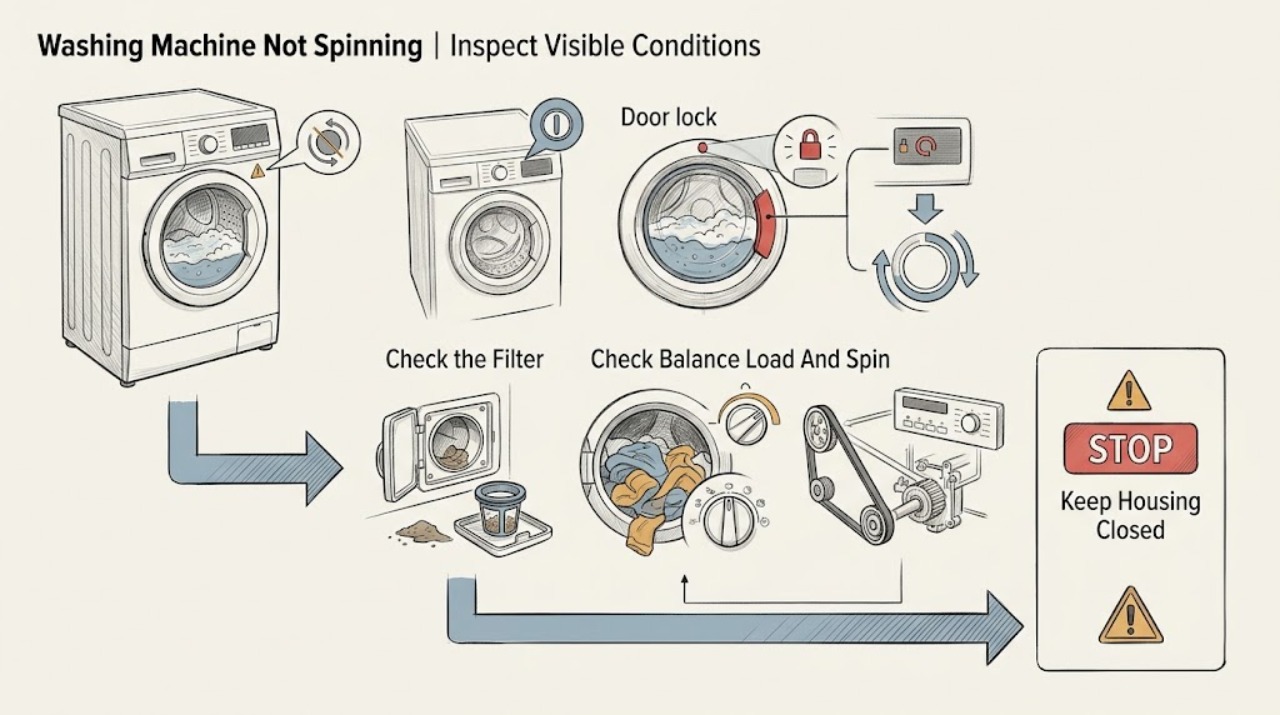
Work through in order
Diagnostic checks
Use only checks that match the exact appliance or system and its official guide.
-
Check 1
Stop the program and observe the washer from outside. Note whether the drum is full of water, the load is violently moving, the display shows a code or Unb, the door remains locked, or the appliance has leaked. Check the visible cord, plug, outlet, hoses, and floor without touching wet electrical equipment or reaching into the drum.
Expected result: Record normal dry surroundings with a quiet no-spin, standing water, a leak, wet plug or controls, burning smell, smoke, sparks, unusual heat, metal grinding, violent shaking, a damaged cord or outlet, or a breaker trip.
Next step: Keep the washer off and isolate power and water only from a safe accessible position for any hazard. If there is no hazard, record the display and water level, then continue with the drain and load checks.
Stop if: Do not force the door, reach into a moving drum, restart after smoke or burning, touch wet electrics, or reset a breaker repeatedly.
Why this matters
Why: Water left in the drum points toward drainage or a safety interlock; Unb or violent movement points toward load balance or installation. Leak, wet electrics, burning, smoke, sparks, abnormal heat, grinding, or a repeated trip is an immediate stop condition, not a spin adjustment.
-
Check 2
If the machine is cool, stable, dry around the electrical parts, and safely disconnected, inspect the visible drain hose for a kink or crushing and follow the exact manual's pump-filter procedure if access is provided. Use the specified emergency drain path or a shallow container, release water slowly, clean only the accessible filter, check its seal, and refit it firmly.
Expected result: Record an empty drum with a clear hose and filter, standing water, a kinked hose, lint or objects in the pump filter, a filter that will not seal, a blocked pump area, or a leak after refitting.
Next step: Correct only a visible hose kink or manual-permitted filter obstruction. Keep the washer off for a filter that will not seal, recurring standing water, a leak, or an inaccessible blockage, and arrange service.
Stop if: Do not open a hot, full, or pressurized filter, use tools deep in the pump, operate with the filter loose, or continue with a leaking hose or wet electrical area.
Why this matters
Why: Hisense lists a pinched drain hose and clogged drain filter as drainage-fault causes and says the pump filter may prevent spinning when blocked. A clear path that still leaves water or prevents spin suggests a pump, water-level, door, or control fault; a leak after filter work is a stop condition.
-
Check 3
With the drum stopped and the door safely unlocked, check the load for tangled heavy items, a single bulky item, overloading, or too little laundry to balance. Redistribute or remove items as the model manual permits, then confirm the selected spin speed is not 0 or No Spin and is suitable for the fabric. Do not add a test load if the original event included a safety hazard.
Expected result: Record a balanced suitable load and active spin setting, tangled or one-sided laundry, an overfilled drum, an underweighted load, or a deliberately selected low/no-spin setting.
Next step: Use a correctly sized, sorted load and the model's permitted spin setting once, only after the drain and safety checks pass. Stop and request service if the drum bangs, the fault returns, or the machine will not unlock or spin.
Stop if: Do not hold the door shut, run with transport supports or unstable feet, keep operating during violent movement, or exceed the model's load limit.
Why this matters
Why: Hisense describes balance detection that can reduce or stop spinning after repeated attempts and advises redistribution or adding suitable items for an underweighted load. A No Spin setting explains no rotation by design; a balanced load with a valid setting shifts attention to drainage, foam, door recognition, or service-level causes.
-
Check 4
Inspect the display for a door-lock fault, overflow or foam indication, or electronic code. Check that the door closes without laundry caught in the seal and review the detergent product and dose against the model and detergent instructions; do not add more detergent to a foamy load. Record whether the door is recognized and whether foam remains after the machine is stopped.
Expected result: Record a locked-door error, overflow or excessive foam, a cleanly closed door with a normal display, a zero/no-spin setting, an electronic code, or a door that cannot lock or unlock.
Next step: Use only the model-documented stop or restart once for a cancelable code and correct an accessible door obstruction or dosing error. Keep the washer off for overflow, a door that cannot lock or unlock, or a recurring code.
Stop if: Do not defeat the door lock, pour chemicals into foam, mix cleaners, open the control area, or continue a cycle with overflow or a damaged seal.
Why this matters
Why: A door that is not recognized can prevent the spin phase, and excessive foam can impair spin performance. Hisense directs recurring electronic, overflow, and door faults to service; a correct door and dose with no water or balance issue makes a drive, sensor, pump, or control fault more likely.
-
Check 5
After the drain path, load, spin setting, door, and dose have been checked and no hazard remains, use the exact manual's documented cancel or restart procedure once. Observe from outside and do not force a spin test; stop the cycle if the drum grinds, shakes violently, leaks, overheats, smells of burning, produces smoke or sparks, or trips the breaker.
Expected result: Record normal spin with a balanced load, a return of no-spin, water remaining, Unb or door code, a repeated electronic code, grinding or violent movement, a leak, burning smell, smoke, sparks, abnormal heat, or a breaker trip.
Next step: Leave the washer off and provide service with the model, water level, code, load, spin setting, foam, filter and drain findings, and restart result. Use qualified electrical or emergency help for a supply or fire hazard.
Stop if: Do not repeat restarts, run an empty spin solely to provoke the fault, test live circuits, open the cabinet, bypass protection, or re-energize after smoke, sparks, burning, abnormal heat, or a leak.
Why this matters
Why: A single recovery can reflect a temporary unbalance or cancelable state but does not prove the pump, drive, motor, sensor, heater, wiring, or control is sound. Any recurrence after safe checks requires qualified diagnosis; physical, water, electrical, or fire signs require immediate stop.
Use your observations
Decision map
Find the observation that best matches what you see, then follow the next safe action.
-
PATH 01Safety boundary
What you see
Water remains in the drum, an F03-type drainage indication appears, the drain hose is kinked, or the pump filter contains lint or objects.
Do this next
Keep the machine cool and disconnected, follow the exact manual's safe drain and filter procedure, and request service for a leak, recurring blockage, or a clear path that still will not drain.
Why this path and its safety boundary
Why it matters: The washer may inhibit spin until water is removed; a blocked filter or hose can also strain the drain system.
Safety stop: Do not open a hot or full filter or run with a loose filter.
-
PATH 02Safety boundary
What you see
The display shows Unb, the load is tangled, heavy on one side, overloaded, or too small to balance.
Do this next
Stop, unlock only when the manual allows, redistribute or reduce the load, and select a suitable spin setting once. Request service if violent movement or no-spin returns with a balanced load.
Why this path and its safety boundary
Why it matters: Balance control may reduce or stop the spin to protect the machine.
Safety stop: Do not hold the door, exceed capacity, or continue during violent shaking.
-
PATH 03Safety boundary
What you see
Spin is set to 0 or No Spin, or excessive foam remains after the wash.
Do this next
Use the model- and fabric-approved spin setting and correct the detergent dose for the next suitable load. Do not add more detergent to foam or mix products.
Why this path and its safety boundary
Why it matters: The selected setting intentionally suppresses spin, while foam can impair spin performance and leave water in fabric.
Safety stop: Do not exceed dose instructions or use unapproved chemicals.
-
PATH 04Safety boundary
What you see
The door cannot lock or unlock, an overflow or foam code appears, or the washer continues filling or pumping abnormally.
Do this next
Stop the program, close the water tap for continuing fill or overflow if safe, and arrange service for a recurring code or lock failure. Do not force the door.
Why this path and its safety boundary
Why it matters: A door, water-level, overflow, or control state can prevent safe spinning and may create a water hazard.
Safety stop: Do not bypass the interlock, open a pressurized door, or operate with overflow or a leaking seal.
-
PATH 05Safety boundary
What you see
The drain path is clear, the load is balanced, spin is enabled, foam and door state are normal, but the drum still will not spin or makes grinding or electrical symptoms.
Do this next
Keep the washer off and request Hisense or qualified appliance service with the complete observations. Do not open the cabinet or test live components.
Why this path and its safety boundary
Why it matters: A pump, drive, motor, sensor, wiring, or electronic control fault is possible and cannot be identified by external checks.
Safety stop: Do not keep restarting, run through grinding, or bypass a safety device.
-
PATH 06Safety boundary
What you see
There is a leak near electrics, wet plug or controls, burning smell, smoke, sparks, unusual heat, severe metal grinding, violent movement, damaged electrical equipment, or a breaker trip.
Do this next
Stop and isolate power and water only from a safe accessible position. Leave the area if smoke, fire, or a serious electrical hazard is present and obtain qualified appliance, electrical, or emergency help.
Why this path and its safety boundary
Why it matters: The washer or household supply may present a shock, fire, water, or mechanical hazard.
Safety stop: Do not touch wet or damaged electrical equipment, reset repeatedly, open the cabinet, or re-energize the washer.
Helpful context
Understand the symptom
A washer may refuse to spin for a reason
A no-spin symptom can be a deliberate response to water that has not drained, an unbalanced load, too much foam, a selected no-spin setting, or an unrecognized door lock. It can also indicate a pump, drive, sensor, or control fault. Start by observing the completed or interrupted cycle rather than forcing a spin or repeatedly restarting it.
Check drainage before touching the pump filter
Hisense manuals associate drainage faults with a pinched hose or blocked filter and note that the pump filter may need attention when the machine cannot start spinning. Water can spill during filter cleaning, so the machine must be cool and disconnected, with a suitable container and the exact manual's procedure. If water is near electrics or the appliance is leaking, stop and escalate.
Balance and foam are separate from a drive failure
The balance system can reduce or stop spin after repeated attempts with heavy or tangled laundry. Excessive foam can also impair spinning. Redistribute a safe load and correct dosing only within the model and garment instructions; if a suitable load still will not spin, do not open the cabinet to inspect the motor or control.
Safety boundary
Stop conditions
- Stop immediately for a leak near electrical parts, wet plug or controls, burning smell, smoke, sparks, unusual heat, severe metal grinding, violent movement, damaged cord or outlet, or a breaker that trips again.
- Do not force or bypass the door lock, reach into a moving drum, or open a hot, full, or pressurized pump-filter area.
- Do not run with a loose pump filter, leaking hose, unresolved standing water, damaged seal, or any water near electrical parts.
- Do not mix cleaning chemicals, use solvents or corrosive products, or add extra detergent to a foamy load.
- Do not open the cabinet, test live circuits, access the motor, drive, pump, wiring, or control, or repeatedly restart solely to reproduce no-spin.
Only after diagnosis
Potential parts
- washing-machine drain pump filter or filter seal
Consider this category only when the exact model's filter is damaged, cannot seal, or a qualified diagnosis confirms replacement after the drain path is clear.
Confirm the exact Hisense model and filter configuration; keep the machine off if the filter leaks. - washing-machine drain pump
Consider this category only after qualified testing confirms the pump fails to drain despite a clear hose and correctly fitted filter.
Confirm exact model fit and water-handling design; do not access pump wiring as a household step. - washing-machine door-lock assembly
Consider this category only when qualified diagnosis confirms that the door closes mechanically but the safety lock is not recognized.
Confirm exact model and safety function; never bypass the interlock. - washing-machine drive or motor component
Consider this category only after service diagnosis confirms a drive or motor fault with drainage, load balance, settings, and door state resolved.
Confirm exact model and motor or drive specification through Hisense or qualified service; do not open the cabinet.
When checks do not resolve it
Need a professional?
Request Hisense or qualified appliance service when the washer still will not spin after the cool filter and drain checks, a balanced load, a valid spin setting, correct foam and door checks, and one safe documented restart. Service is also required for recurring water, overflow, door, electronic, or Unb faults; a pump-filter leak; grinding; violent movement; or any suspected drive, motor, sensor, wiring, or control problem. Use qualified electrical or emergency help for smoke, fire, sparks, damaged electrical equipment, or a serious water hazard.
Safety scope: This article supports only external observation and cool, ordinary-access drain or pump-filter cleaning explicitly permitted by the exact Hisense manual. Do not open panels, access the motor, drive, pump wiring, door lock, control, or live electrical parts; do not force a door or re-energize a hazardous washer.
Common questions
FAQ
Why does a Hisense washing machine stop before spinning?
Check for water that has not drained, an Unb or door indication, a tangled or oversized load, excessive foam, and a 0 or No Spin setting. If the drain path, load, settings, door, and dose are correct but spin still fails, arrange service.
Can a blocked pump filter stop a Hisense washer from spinning?
Yes. Hisense manuals identify pump-filter cleaning when the appliance cannot start the spinning cycle. Disconnect power, let water cool, and follow the exact model procedure; keep the machine off for a leak, loose filter, inaccessible blockage, or recurring no-spin.
How should I handle an Unb message?
Stop the machine and redistribute tangled or one-sided laundry only when the manual allows the door to unlock. An underweighted load may need suitable additional items. Use a suitable spin setting once; request service if Unb or violent movement returns with a balanced load.
Can too much detergent prevent spinning?
Yes. Hisense guidance says excessive foam may impair spinning. Use the dose and low-foaming product specified for the exact model and detergent. Do not add more detergent to foam or mix cleaning products.
When is no spinning a serious safety problem?
Stop for a leak near electrical parts, wet plug or controls, burning smell, smoke, sparks, unusual heat, severe grinding, violent movement, damaged electrical equipment, or a breaker trip. Keep the washer off and obtain qualified appliance, electrical, or emergency help as appropriate.
Read the exact guide
Official sources
- Support LaundryHisense UK · Hisense UK laundry support page; model-specific controls and local service procedures vary.
- ERROR CODES AND TROUBLESHOOTINGHisense Australia Pty Ltd · Hisense Australia manual for HWFS1214PB; error codes and reset behavior vary by model.
- CLEANING THE PUMP FILTERHisense Australia Pty Ltd · Hisense Australia manual for HWFS7514S; access points and emergency-drain hardware vary by model.
- User Manual - HWF8I1015BHisense Australia Pty Ltd · Hisense Australia manual for HWF8I1015B; exact model capacity and controls vary.
Community feedback
Share a repair observation
Share a plain-text repair observation. Accepted observations are published automatically; this page may take a moment to update.