
On this page
Start here
Quick answer
First separate the symptom: does the interior lamp flicker when the door-open switch is moved, or are the refrigerator's control-panel indicators blinking too? Hitachi says a lamp that repeatedly turns on and off when the door switch is pressed may indicate poor switch contact; clean only visible dirt around the switch with a tightly wrung cloth, and arrange inspection if the behavior remains. Do not assume every Hitachi model has that switch—Hitachi says it is fitted only on models under 400 liters—and do not assume every lamp is a user-replaceable bulb. Hitachi states that models released from 2012 onward have a built-in LED lamp that owners cannot disassemble or replace; older incandescent-bulb models are replaceable only when the exact manual includes a lamp-replacement procedure and the correct part is available. If the control panel is blinking, identify the exact pattern and use the model manual because Hitachi treats panel blinking as a separate setting or appliance-trouble indication. Stop using the refrigerator and arrange qualified service for a burning smell, smoke, crackling, heat, exposed wiring, a damaged cord, moisture near electrical parts, flicker in multiple appliances, or a light that remains unstable after the safe external check. Never fit an unapproved commercial bulb or open the LED module.
Before you begin
Safety first
- Do not open an integrated LED or control module, bypass the door switch, use an unapproved lamp, probe live wiring, or continue operating after smoke, burning odor, arcing, damaged power, water near electrical parts, or repeated trips. Disconnect power only from a dry, safe, accessible point.
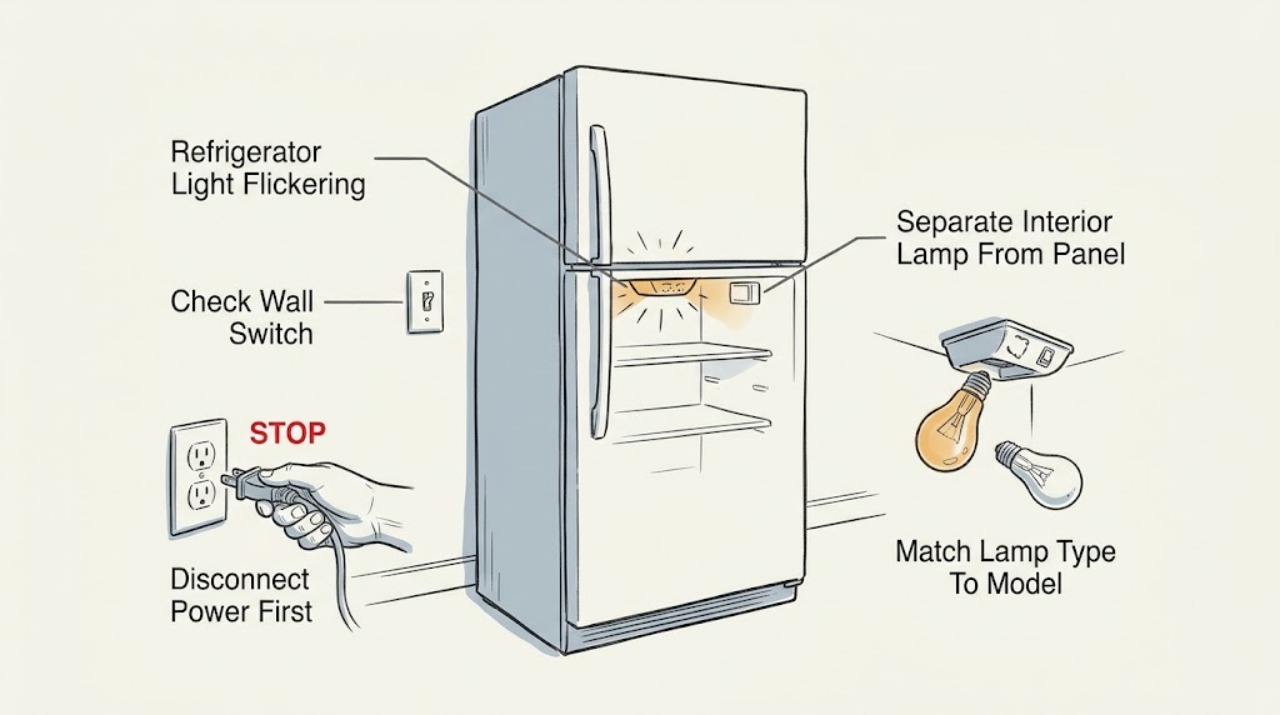
Work through in order
Diagnostic checks
Use only checks that match the exact appliance or system and its official guide.
-
Check 1
With the refrigerator operating normally and the area dry, open the door and observe whether the flicker is limited to the interior lamp or also appears in the control-panel indicators. Record whether the lamp changes when the door is moved slightly and write down the complete model number from the appliance label.
Expected result: Only the interior lamp flickers; the control panel also blinks; all indicators flicker; or the pattern cannot be observed safely.
Next step: Use the lamp-switch checks for an interior-only symptom. For panel blinking, record the exact pattern and consult the model manual before changing settings; arrange service if several functions are affected.
Stop if: Do not pull the refrigerator forward, remove covers, or continue if there is heat, odor, smoke, moisture, or damaged power.
Why this matters
Why: An interior-only symptom supports the lamp/door-switch path. Panel blinking can be a separate setting or refrigerator-trouble indication in Hitachi guidance, while multiple electrical symptoms need a supply/service boundary rather than a bulb diagnosis.
-
Check 2
If only the interior lamp flickers, look for the small protruding door-open switch at the door/cabinet interface without pressing it repeatedly or inserting anything. Hitachi says this switch is present only on models under 400 liters. With power left connected and hands dry, wipe visible dirt around the switch using a tightly wrung cloth, keeping moisture out of the appliance.
Expected result: A documented switch is visibly dirty; pressing it makes the lamp toggle repeatedly; no switch is present; or cleaning does not change the flicker.
Next step: After the external clean-up, observe once more without forcing the switch. If flicker remains or no switch is present, stop owner troubleshooting and arrange model-specific service.
Stop if: Do not bypass, bend, pry, or electrically test the switch; do not use a wet cloth or spray cleaner.
Why this matters
Why: Visible dirt can hold the switch in the wrong position. Repeated toggling when the switch is pressed can indicate poor contact. No switch means this model needs its own manual path; an unchanged symptom can be a lamp, wiring, or control fault.
-
Check 3
Use the exact model number in Hitachi's manual portal and check whether the interior-light section identifies a built-in LED or a replaceable incandescent bulb. Do not infer lamp type only from the refrigerator's appearance or purchase year; do not remove the lamp cover to inspect it.
Expected result: The model manual identifies a built-in LED, an older incandescent lamp with an explicit replacement procedure, or no lamp-replacement procedure.
Next step: For built-in LED or an undocumented lamp, leave the assembly closed and arrange service. For a documented older bulb, follow only that model's unpowered replacement procedure and use the specified part; stop if the lamp still flickers.
Stop if: Do not fit a generic commercial bulb, open an integrated LED module, or work with the refrigerator energized.
Why this matters
Why: Hitachi says models released from 2012 onward use an integrated LED that owners cannot disassemble or replace. Older lamps are replaceable only when the manual provides the procedure and the correct part is available; no procedure means service, not improvisation.
-
Check 4
If any control-panel lamp or display is blinking, record which symbols blink, whether all indicators blink together or in sequence, whether a key/lock or ice-making indicator is involved, and whether cooling remains normal. Do not reset the refrigerator repeatedly or use a code table from another Hitachi model.
Expected result: One setting lamp blinks, a lock/check indicator blinks, ice-related lamps blink, all lamps blink together, all lamps blink in sequence, or cooling/other functions are abnormal.
Next step: Use the exact model manual or Hitachi's matching support guidance for the recorded pattern. If the pattern persists, multiple functions fail, or cooling is abnormal, arrange service rather than experimenting with controls.
Stop if: Do not enter service mode, disconnect internal wiring, or continue if smoke, odor, heat, water, or electrical instability is present.
Why this matters
Why: Hitachi says panel blinking meanings depend on the specific lamp pattern and can indicate a setting, long-open door, demo mode, ice-making issue, or an internal problem. A panel pattern is not proof that the interior LED is defective.
-
Check 5
From a safe location, note whether lights or other appliances on the same supply also flicker, whether the refrigerator's cord or outlet is hot/damaged, and whether the refrigerator recently lost power. Do not unplug and replug repeatedly or move the refrigerator to another circuit as a test.
Expected result: Other appliances flicker too; only the refrigerator light flickers; the outlet/cord is hot, wet, loose, discolored, or damaged; or no supply symptom is visible.
Next step: For shared-supply or outlet/cord symptoms, stop using the affected circuit and call a qualified electrician. For an isolated refrigerator symptom, use the model-specific lamp path and arrange appliance service if it persists.
Stop if: Do not touch a wet/hot outlet, repair a cord, bypass protective devices, or perform live measurements.
Why this matters
Why: A multi-appliance or damaged-connection symptom raises a house-supply or electrical safety issue. An isolated interior-lamp symptom keeps the door switch, lamp type, wiring, and control path in view; neither observation identifies a safe DIY internal repair.
-
Check 6
After the one safe external check and exact manual lookup, classify the result without opening the refrigerator: the flicker stopped, it remains interior-only, the panel also blinks, or a safety/cooling symptom is present. Save the model and observed pattern for service.
Expected result: Cleaning the documented switch area stopped the flicker; the flicker persists; a built-in LED or undocumented lamp is involved; panel indicators blink; or odor, heat, smoke, damaged power, moisture, repeated trips, or cooling loss is present.
Next step: Monitor only a resolved, isolated symptom with no hazard. For persistent flicker or any hazard, keep the refrigerator closed as appropriate, disconnect power only from a dry safe location if necessary, and arrange qualified appliance or electrical service.
Stop if: Do not reopen an integrated lamp, bypass the door switch, fit an unapproved bulb, or restore power just to reproduce a hazardous flicker.
Why this matters
Why: A stopped symptom supports a dirty switch-contact area but does not prove the switch is healthy. Persistent or model-specific LED/panel behavior needs qualified diagnosis; safety or cooling symptoms override further lamp troubleshooting.
Use your observations
Decision map
Find the observation that best matches what you see, then follow the next safe action.
-
PATH 01Safety boundary
What you see
Only the interior lamp flickers, the model has a documented door-open switch, and pressing the switch causes repeated on/off behavior or visible dirt is present.
Do this next
Wipe only the visible switch area with a tightly wrung cloth and observe once. Arrange service if the flicker remains or returns.
Why this path and its safety boundary
Why it matters: A dirty or poor-contact door switch is more likely than an immediate LED-module failure.
Safety stop: Do not bend, bypass, pry, or electrically test the switch.
-
PATH 02Safety boundary
What you see
The model has no documented door switch, or the exact manual identifies a built-in LED lamp or gives no owner replacement procedure.
Do this next
Leave the lamp assembly closed and arrange qualified Hitachi appliance service. Do not order a generic bulb based on shape or voltage appearance.
Why this path and its safety boundary
Why it matters: The external switch-cleaning path does not apply; the lamp assembly, wiring, or control requires model-specific service.
Safety stop: Do not disassemble an LED module or work on the lamp while energized.
-
PATH 03Safety boundary
What you see
The exact manual identifies an older incandescent interior lamp and includes a lamp-replacement procedure and a specified available part.
Do this next
Disconnect power as the exact manual directs, use only the specified lamp, and stop if the socket, wiring, or lamp continues to flicker. Arrange service for any unresolved symptom.
Why this path and its safety boundary
Why it matters: A user-replaceable lamp path may apply, but only within that model's written procedure; flicker after the correct replacement still needs service.
Safety stop: Do not use an unapproved commercial bulb, work around moisture, or touch exposed wiring.
-
PATH 04Safety boundary
What you see
The control panel blinks in addition to, or instead of, the interior lamp.
Do this next
Record the exact pattern, consult the matching model support/manual, and arrange service for a persistent pattern or abnormal cooling/function.
Why this path and its safety boundary
Why it matters: Hitachi treats the panel pattern as a setting or trouble indication whose meaning changes with the lamps/symbols involved.
Safety stop: Do not apply a lamp repair or generic reset sequence to a panel fault.
-
PATH 05Safety boundary
What you see
Other appliances or room lights flicker too, or the refrigerator outlet/cord is hot, wet, loose, discolored, damaged, or accompanied by odor, smoke, crackle, or a breaker trip.
Do this next
Stop using the affected circuit and arrange qualified electrical service; keep the refrigerator disconnected only from a dry, safe, accessible point.
Why this path and its safety boundary
Why it matters: A supply, receptacle, cord, or broader electrical fault is possible and overrides interior-lamp troubleshooting.
Safety stop: Do not touch wet/hot electrical parts, repeatedly reset protection, or reconnect the refrigerator to another circuit as a test.
Helpful context
Understand the symptom
“Light flickering” can mean a lamp or a warning display
Watch the symptom with the door open without touching electrical parts. If only the interior lamp flickers when the small door switch is moved, follow the switch path. If several control-panel lamps blink, or the display flashes while the interior lamp changes, record the pattern and use the exact model manual; Hitachi treats those indications separately from a lamp fault.
The door switch is not present on every model
Hitachi describes a small protruding door-open switch on models under 400 liters. The lamp is pressed off when the door closes and released on opening. Dirt around that switch can hold it in the wrong position, and repeated on/off behavior while pressing it can point to poor contact. Larger or different models may use another lamp/control arrangement, so do not insert a tool or force a switch that is not clearly identified by the manual.
Lamp age and construction change the safe next step
Hitachi's support guidance separates built-in LED lamps on models released from 2012 onward from older incandescent-lamp models. A built-in LED module is not an owner bulb replacement. An older bulb is replaceable only if the exact manual says how and the correct part is available; a generic commercial bulb is not a safe substitute.
Do not turn a flicker into a live electrical repair
Stop and arrange service for smoke, burning odor, crackling, heat, exposed wiring, a damaged cord, moisture near electrical parts, or flickering that affects multiple appliances. Do not open the lamp cover or control panel, bypass the door switch, probe wiring, or install an unapproved bulb. The built-in LED, lamp wiring, power supply, and control board require model-specific service diagnosis.
Only after diagnosis
Potential parts
Only if the exact model has the documented switch and a qualified technician confirms poor contact or switch failure after visible cleaning.
Only for a model whose exact manual includes a replacement procedure and confirms the correct available lamp.
Only after qualified appliance diagnosis confirms the exact model and failed component.
When checks do not resolve it
Need a professional?
Call qualified appliance service when the interior lamp still flickers after the documented external switch check, the model has no switch, the lamp is an integrated LED, the exact manual has no replacement procedure, a panel pattern persists, or the flicker accompanies cooling or other function changes. Call a qualified electrician for a hot, wet, loose, damaged, or discolored outlet/cord, flicker affecting other appliances, or repeated protective-device trips. Stop immediately for smoke, burning odor, crackling, exposed wiring, or water near electrical parts.
Safety scope: Do not open an integrated LED or control module, bypass the door switch, use an unapproved lamp, probe live wiring, or continue operating after smoke, burning odor, arcing, damaged power, water near electrical parts, or repeated trips. Disconnect power only from a dry, safe, accessible point.
Have this ready
- Provide the exact model and serial information, whether the interior lamp or control panel flickers, the door-switch presence and cleaning result, lamp type and manual procedure status, blink pattern, timing, cooling result, outlet/cord condition, and any odor, heat, moisture, smoke, crackle, or breaker history.
Common questions
FAQ
Why does my Hitachi refrigerator light flicker when I open the door?
If only the interior lamp flickers when the door switch is pressed, Hitachi says poor switch contact is possible. On models that have the documented switch, wipe visible dirt around it with a tightly wrung cloth and observe once. If the flicker remains, arrange service; do not bypass or probe the switch.
Does every Hitachi refrigerator have a door light switch?
No. Hitachi says the small door-open switch is fitted only on models under 400 liters. Confirm the exact model and manual before applying switch advice; a model without that switch needs its own lamp/control diagnosis.
Can I replace a flickering Hitachi refrigerator LED?
Do not assume that you can. Hitachi says models released from 2012 onward have a built-in LED lamp that owners cannot disassemble or replace. Older incandescent-lamp models are replaceable only if the exact manual includes the procedure and the correct part is available. Otherwise arrange qualified service.
What if my Hitachi refrigerator control panel is blinking too?
Treat that as a separate panel indication, not automatically as a lamp failure. Hitachi says the meaning depends on which lamps or symbols blink and can relate to settings or a refrigerator problem. Record the exact pattern, use the matching model guidance, and arrange service for a persistent pattern or abnormal cooling.
Is it safe to install a generic bulb in a Hitachi refrigerator?
No. Hitachi warns that commercial interior lamps can create smoke or fire risk and limits replacement to the correct procedure and part for eligible older models. Do not fit a generic bulb or open an integrated LED module.
Read the exact guide
Official sources
- The refrigerator operation-panel display is blinkingHitachi Home Appliances Japan · Official Hitachi refrigerator support guidance in Japanese; panel names and patterns differ by model.
- The interior light does not turn on when the refrigerator door is openedHitachi Home Appliances Japan · Official Hitachi refrigerator support guidance in Japanese; exact switch and lamp behavior varies by model and region, so the model manual controls.
- Hitachi Home Appliances Instruction Manual SearchHitachi Home Appliances Japan · Official Hitachi manual portal; regional model availability and procedures vary, so owners must search the exact model.
Community feedback
Share a repair observation
Share a plain-text repair observation. Accepted observations are published automatically; this page may take a moment to update.