
On this page
Start here
Quick answer
Start by identifying whether the failed function is water, cubed ice, crushed ice, or both, and confirm that the Hitachi model actually has that dispenser architecture. Hitachi's official refrigerator FAQ covers separate Ice Dispenser and Water Dispenser functions, a Water Filter, and an Ice Bank; its instructions say that an automatic ice maker makes ice from a filled water tank and that the ice bank must be reinstalled with no gap at the bottom. A documented Hitachi R-W720P7M product page shows a tank-type water dispenser, a water tank with filter, and a movable twist ice tray, illustrating why the exact model matters. Check the dispenser lock or selection, fill and fully seat the model's water tank, inspect only the accessible filter and visible outlet for a blockage, and check that the ice bank or tray is correctly seated and not visibly packed with clumped ice. Use drinking water only and follow the exact manual for cleaning or filter replacement. If the tank is full and correctly seated but water still does not flow, the ice bank is clear but the auger or dispenser is silent, a valve, pump, sensor, wiring, or control would need access, or there is a leak, damaged cord, burning smell, or water near electrical parts, stop and arrange qualified Hitachi service. Do not remove door panels, bypass a lock, reach into a moving auger, or perform live electrical tests.
Before you begin
Safety first
- The user may identify the exact model and supported dispenser type, check the lock and selection, seat and clean a model-permitted water tank or filter, inspect a documented removable ice bank or tray, and check visible outlet or leak conditions with power safely isolated. Qualified service must handle door or cabinet panels, hidden tubing, valves, pumps, augers, controls, sensors, wiring, live tests, and internal electrical or water-path repairs.
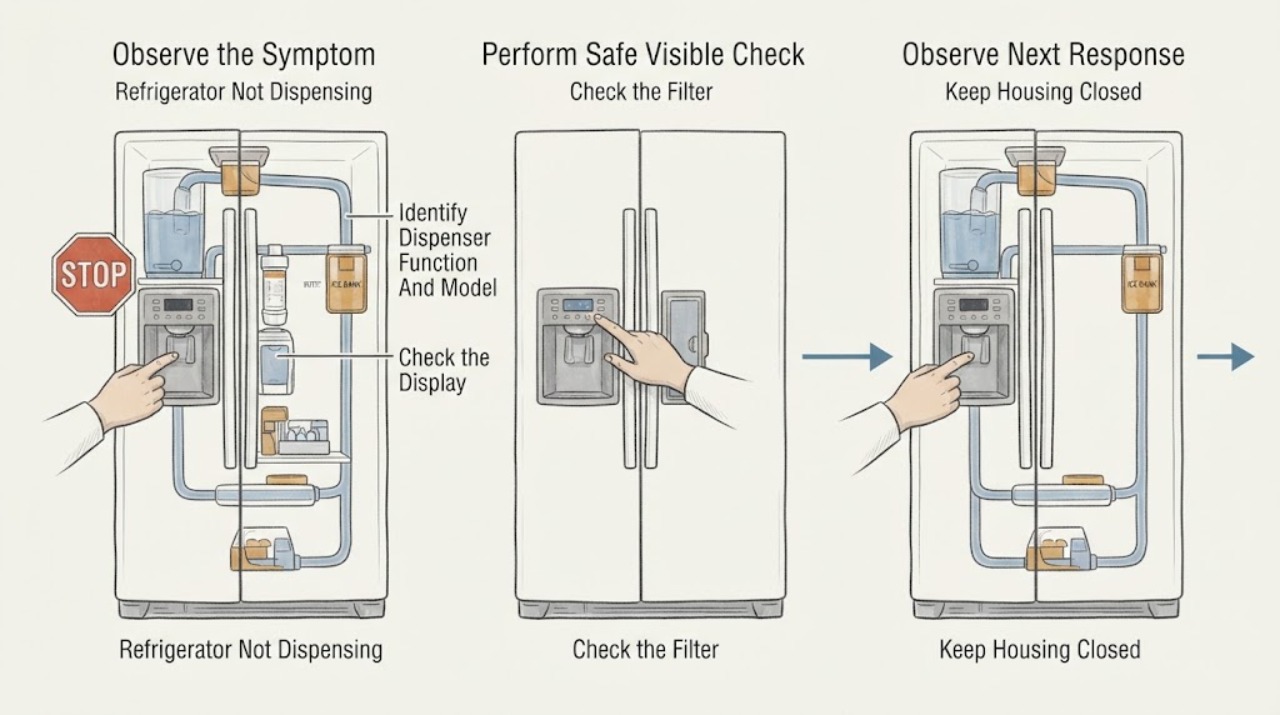
Work through in order
Diagnostic checks
Use only checks that match the exact appliance or system and its official guide.
-
Check 1
Record the complete Hitachi model and identify exactly what fails: water, cubed ice, crushed ice, or both. Look for the model's documented water tank, filter, ice bank, ice maker, dispenser lever, or control panel; do not assume a dispenser exists because the refrigerator is branded Hitachi.
Expected result: The model has a tank-type water dispenser, an ice bank or ice maker, a door dispenser, only a manual tray, or no matching dispenser information in its manual.
Next step: Continue only with the water or ice path that the exact model supports. If the model has no dispenser or its architecture cannot be verified, stop and use the model manual or qualified support rather than borrowing instructions from another Hitachi model.
Stop if: Do not remove panels, alter plumbing, or force an ice tray or dispenser that the exact manual does not identify.
Why this matters
Why: The repair path depends on the architecture. Hitachi documents both water and ice dispenser functions in its official FAQ, while the R-W720P7M page shows a tank-type water dispenser and movable twist ice tray; a manual-tray model cannot be diagnosed as a failed automatic dispenser.
-
Check 2
With the refrigerator intact, check the exact model's dispenser lock, child lock, selection button, and door-closed requirement. Select the function that failed and press the lever or pad only as the manual illustrates; do not hold it continuously to force a response.
Expected result: The lock is active, the wrong water/ice selection is lit, the control responds but no water or ice moves, or the control and dispenser are both unresponsive.
Next step: Clear the lock or select the correct function only as the exact manual permits, then make one brief test. If the control remains unresponsive or the door harness or panel would need access, arrange service.
Stop if: Do not bypass the lock, remove a door panel, short a switch, or test exposed wiring.
Why this matters
Why: A lock or selection state can prevent output without a mechanical failure. A responsive control with no output shifts attention to tank seating, filter, ice-bank, or dispenser-path checks; an unresponsive control can require model-specific control or wiring diagnosis.
-
Check 3
For a model with a removable water tank, remove and inspect it only as the exact manual shows. Confirm it contains drinking or mineral water, inspect the accessible filter and tank outlet for visible debris, and push the tank fully into its proper position. Clean or replace the filter only with the model-approved method and part.
Expected result: The tank is empty, not fully seated, filled with something other than water, the accessible filter or outlet is visibly clogged, or the tank and filter are clean and correctly seated.
Next step: Correct only the water type, visible debris, filter, or seating issue that the exact manual permits, then perform one brief water test. If water still does not flow, stop before accessing hidden tubing or valves.
Stop if: Do not insert tools into the tank outlet, use chemicals, force a filter, or apply this tank check to a plumbed-in model without matching documentation.
Why this matters
Why: Hitachi says that a tank can trigger the Tank Empty indication even when it is not empty if it is not pushed fully into position, and warns that pulp or tea leaves can clog the water tube. A clean, seated tank with no water output makes an internal valve, pump, tube, or control more likely.
-
Check 4
For a model with a removable ice bank or documented ice dispenser, turn off the ice function and inspect only the accessible ice container or chute. Look for clumped or melted-and-refrozen ice, an overfilled container, a visible obstruction, or a container that is not fully seated; remove and reinstall it only as the exact manual directs.
Expected result: Ice is clumped at the outlet, the ice bank or tray is not seated, the container is empty even though the maker is enabled, a visible obstruction is present, or the accessible path is clear.
Next step: Remove only loose, accessible ice as the exact manual permits, wipe and refit the bank if documented, and allow the model's ice maker to operate normally. If the auger or chute needs disassembly, arrange service.
Stop if: Do not reach into a moving auger, chip ice with a sharp tool, pour hot water into the chute, or force a stuck ice bank.
Why this matters
Why: A clump, poor seating, or an empty ice bank can stop dispensing without proving an auger or motor fault. Hitachi's FAQ specifically says an ice bank must be installed with no gap at the bottom after cleaning; a clear, correctly seated bank shifts suspicion to ice making or the internal dispenser drive.
-
Check 5
Inspect the dispenser nozzle, drip area, and any visible tank-to-outlet path for a cap left on, a kink, ice, debris, or a leak. Keep the floor and the area around the refrigerator's cord and outlet dry; do not pull out the refrigerator to reach hidden tubing.
Expected result: The outlet is visibly blocked, water drips continuously, the visible hose is kinked or disconnected, there is water near electrical parts, or the visible path is clear and dry.
Next step: Correct only a visible, model-permitted cap or routing issue with the dispenser off. For a leak, hidden path, or recurring water loss, close any model-provided water supply if safe, isolate power from a dry position, and arrange service.
Stop if: Do not disconnect hidden water lines, remove a door or rear panel, operate with water near the outlet, or keep dispensing to reproduce a leak.
Why this matters
Why: A visible obstruction or routing issue can stop output, while a leak near electrical parts is a safety stop. A clear visible path does not rule out a hidden valve, pump, tube, or door-line problem.
-
Check 6
After an accessible correction, refit every tank, filter, ice bank, or tray exactly, close the refrigerator door, and perform no more than one brief model-approved dispense test while remaining nearby. Test water and ice separately when both functions exist.
Expected result: Water dispenses normally, ice dispenses after the model's normal ice-making time, output is weak or intermittent, the dispenser only hums, or nothing responds.
Next step: Use the matching result branch. For persistent failure, leave the affected function off and arrange qualified Hitachi appliance service with the model and observations.
Stop if: Do not run repeated dispense cycles, leave the door open while forcing controls, or continue after a leak, hot cord, smoke, odor, or abnormal noise.
Why this matters
Why: A successful test after correct seating supports an accessible obstruction or assembly issue. Weak, intermittent, humming, or absent output after the checks points to an internal path, valve, pump, auger, sensor, control, or wiring fault rather than a reason to keep cycling.
-
Check 7
Stop owner troubleshooting when the exact model supports the failed dispenser, the lock and selection are correct, the tank/filter or ice bank checks are complete, and one safe test still gives no output or abnormal output.
Expected result: The tank is full and seated but water is absent, the ice bank is clear but the auger is silent or only hums, an error or leak returns, or the cause requires a door, rear, or internal panel to reach.
Next step: Keep the failed dispenser function off and arrange qualified Hitachi appliance service. Provide the complete model, failed output type, tank or ice-bank condition, lock response, sounds, and leak or display observations.
Stop if: No cabinet or door-panel removal, live electrical testing, lock bypass, auger forcing, hidden tubing repair, or deliberate leak test.
Why this matters
Why: An internal valve, pump, tube, filter head, auger motor, sensor, control, or wiring fault remains possible. The symptom cannot safely identify a replacement part from outside the cabinet.
Use your observations
Decision map
Find the observation that best matches what you see, then follow the next safe action.
-
PATH 01Safety boundary
What you see
The exact Hitachi model has no water or automatic ice dispenser, or its manual shows only a manual ice tray.
Do this next
Stop this path and use the exact model manual for ice making or water storage, or obtain qualified support if the feature identity is uncertain.
Why this path and its safety boundary
Why it matters: The not-dispensing intent does not match that appliance architecture. Hitachi's dispenser FAQ and R-W720P7M product page establish dispenser-equipped examples, not a universal feature.
Safety stop: Do not install or adapt a dispenser assembly from another Hitachi model.
-
PATH 02Safety boundary
What you see
The model has a removable water tank, but the Tank Empty indication is on, the tank is not fully seated, the water is unsuitable, or the accessible filter/outlet is visibly blocked.
Do this next
Use drinking or mineral water, clean or replace the model-approved filter, seat the tank fully, and make one brief test. Escalate if output remains absent.
Why this path and its safety boundary
Why it matters: Tank seating, water type, or an accessible blockage is more likely than an immediate internal valve failure. Hitachi warns that pulp or tea leaves can clog the tube and says the tank must be pushed fully into position.
Safety stop: Do not probe the tube, use chemicals, or apply this path to a different tank or plumbed design.
-
PATH 03Safety boundary
What you see
The model has an ice bank or automatic ice path and ice is clumped, the bank is not seated, or a visible outlet obstruction is present.
Do this next
Turn off the ice function, remove only loose accessible ice as documented, wipe and refit the bank or tray, and allow normal ice-making time before one test.
Why this path and its safety boundary
Why it matters: A removable-container or accessible ice blockage is more likely than an internal auger failure. Hitachi's FAQ requires no gap at the bottom when reinstalling the ice bank.
Safety stop: Do not chip ice, force the auger, pour hot water into the mechanism, or disassemble the chute.
-
PATH 04Safety boundary
What you see
The dispenser control is locked, the wrong water/ice selection is active, or the control responds inconsistently while the tank or ice bank appears correct.
Do this next
Clear the lock and select the intended function once as documented. Arrange service if the control remains unresponsive or requires panel access.
Why this path and its safety boundary
Why it matters: A control state can prevent output, but inconsistent response after the exact model's unlock and selection procedure can indicate a switch, sensor, control, or door-wiring fault.
Safety stop: Do not short a switch, bypass a lock, or remove a control or door panel.
-
PATH 05Safety boundary
What you see
The supported dispenser has correct selection, a full and seated tank or clear seated ice bank, no visible blockage, and still does not dispense; or a leak reaches the floor, cord, or outlet.
Do this next
Stop using the affected function, isolate power only from a dry safe position for a water hazard, and arrange qualified Hitachi appliance or electrical service.
Why this path and its safety boundary
Why it matters: An internal valve, pump, tube, auger, sensor, control, or wiring fault is more likely. Water near electrical parts is an immediate safety stop, not a dispenser experiment.
Safety stop: No hidden-line repair, cabinet opening, live test, repeated cycling, or operation while leaking.
Helpful context
Understand the symptom
Confirm the dispenser architecture first
Not every Hitachi refrigerator dispenses water or ice. Some models use a removable internal water tank, some have an ice bank or an automatic ice maker, and some have only a manual ice tray. The official R-W720P7M page documents a tank-type water dispenser and movable twist ice tray, while Hitachi's FAQ discusses water and ice dispenser functions and an ice bank. Use the complete model number and its manual before applying any control, tank, filter, or ice-path instruction.
Water and ice are different failure paths
A full water tank with no water output points toward seating, the accessible filter, or the visible water path. Water dispensing can work while ice does not, because ice also depends on the ice maker, ice bank, and its outlet path. Conversely, an empty or poorly seated tank can affect an automatic ice maker. Do not assume that a water-tank instruction describes a plumbed-in model or that an ice-bank instruction describes a twist-tray model.
Use only accessible cleaning and seating checks
Hitachi's FAQ says to use drinking or mineral water in the tank and warns that pulp or tea leaves can clog the water tube. It also gives an ice-bank removal and refit check, including removing water and ensuring no gap at the bottom after installation. Follow those steps only when the exact model has the same removable parts. Keep hands away from an auger or chute and do not force a frozen assembly.
Hidden valves and controls are service work
A correctly filled and seated tank or clear ice bank does not prove that an internal valve, pump, solenoid, auger motor, sensor, control, or door wiring is healthy. Do not remove a door panel, bypass a dispenser lock, apply power to an exposed mechanism, or open a water line inside the door. Arrange qualified service when the accessible checks do not restore the correct function.
Safety boundary
Stop conditions
- Confirm the exact Hitachi model and dispenser architecture before using any tank, filter, ice-bank, or control instruction; models without that feature follow a different diagnosis.
- Keep hands and tools out of an auger, chute, door mechanism, and hidden water path. Do not chip ice, force a stuck container, or bypass a dispenser lock.
- Stop for a leak near the cord or outlet, standing water, a hot or damaged cord, smoke, burning odor, sparks, or abnormal electrical noise; isolate power only from a dry safe position.
- Do not remove door or rear panels, disconnect hidden tubing, perform live electrical testing, or repair valves, pumps, controls, wiring, or internal dispenser drives yourself.
Only after diagnosis
Potential parts
- water filter
Consider this category only when the exact model documents a replaceable filter, the accessible filter is blocked or expired, and the water-output symptom matches the filter check.
Confirm the complete model and the manufacturer's fit information. Do not assume a filter from another Hitachi tank or plumbed system fits. - water tank, cap, or visible tank seal
Consider this category only when a documented removable-tank model has a cracked, missing, warped, or leaking tank or cap after correct seating and cleaning are verified.
Tank shape, filter head, cap, and seals are model-specific. A tank replacement does not diagnose a hidden valve, pump, or tube fault. - ice bank, ice tray, or dispenser container
Consider this category only when the exact model identifies a removable ice bank or tray and it is cracked, missing, or cannot seat with the required clearance after visible ice is removed.
An R-W720P7M-style twist tray is not interchangeable with an ice-bank or door-chute assembly; verify the exact model. - dispenser valve, pump, auger, control, or door wiring service
Consider these service categories only after the exact supported architecture, lock, tank/filter or ice-bank, and visible outlet checks are correct but output remains absent or abnormal.
These are internal electrical, water-path, or drive components. Qualified service must diagnose the fault and verify model compatibility; the user should not perform live tests or bypass protection.
When checks do not resolve it
Need a professional?
Arrange qualified Hitachi appliance service when a supported dispenser still fails after the exact model's lock, selection, tank/filter or ice-bank, and visible outlet checks; when output is weak or intermittent, the auger or pump only hums, a hidden tube or valve needs access, or a leak recurs. Stop immediately for water near electrical parts, smoke, burning odor, sparks, abnormal heat or electrical noise, or a hot or damaged cord.
Safety scope: The user may identify the exact model and supported dispenser type, check the lock and selection, seat and clean a model-permitted water tank or filter, inspect a documented removable ice bank or tray, and check visible outlet or leak conditions with power safely isolated. Qualified service must handle door or cabinet panels, hidden tubing, valves, pumps, augers, controls, sensors, wiring, live tests, and internal electrical or water-path repairs.
Common questions
FAQ
Why is my Hitachi refrigerator not dispensing water?
Confirm the exact model has a water dispenser, then check its lock and selection. For a removable-tank model, use drinking or mineral water, inspect the accessible filter, and push the tank fully into place. Hitachi warns that pulp or tea leaves can clog the tube. If a full, seated tank still produces no water, arrange qualified service rather than accessing hidden tubing or valves.
Why does the Hitachi ice dispenser not work while water does?
Water and ice use different paths. Confirm the model has an automatic ice maker or ice bank, check the lock and ice selection, and inspect only the accessible ice container for clumping or poor seating. Hitachi says a cleaned ice bank must be reinstalled with no gap at the bottom. A clear, correctly seated bank with no output needs service for the internal drive or control.
Does every Hitachi refrigerator have a water or ice dispenser?
No. Hitachi's official pages document dispenser-equipped examples, including a tank-type water dispenser on the R-W720P7M, but specifications and features vary by model. Check the complete model manual or product page first; a refrigerator with only a manual ice tray does not have an automatic dispenser fault.
What water can I put in a Hitachi refrigerator dispenser tank?
Hitachi's FAQ says to use drinking or mineral water only and warns that pulp or tea leaves can clog the water tube. Use the exact model guide for any filter-cleaning or tank-care procedure, and stop if the tank or visible connection leaks.
When does a Hitachi refrigerator dispenser need service?
Arrange service when the supported model's lock, selection, correctly seated tank or filter, ice bank or tray, and visible outlet checks do not restore output, or when the dispenser hums, leaks, or needs hidden access. Stop immediately for water near electrical parts, smoke, odor, sparks, abnormal heat, or a damaged cord or plug.
Read the exact guide
Official sources
- RefrigeratorsArçelik Hitachi Home Appliances Sales Malaysia Sdn. Bhd. · Official Hitachi refrigerator FAQ for supported models in the Malaysia market; it demonstrates dispenser features and gives model-family guidance, but does not prove that every Hitachi refrigerator has the same architecture.
- R-W720P7MArçelik Hitachi Home Appliances Sales Malaysia Sdn. Bhd. · Official product page for the specific Hitachi R-W720P7M model; it establishes one dispenser-equipped architecture and must not be generalized to unidentified Hitachi models.
Community feedback
Share a repair observation
Share a plain-text repair observation. Accepted observations are published automatically; this page may take a moment to update.