
On this page
Start here
Quick answer
Stop resetting the breaker repeatedly. From a dry, safe position, note whether the trip occurs immediately when the refrigerator is plugged in, only when the compressor or fan starts, during defrost, or after the cabinet has been moved or exposed to water. Check only that the plug is fully seated in the correctly rated grounded outlet and that no adapter, extension cord, damaged plug, crushed cord, water, or nearby heat/moisture is visible. Do not substitute another appliance's breaker rating or perform a live test. A one-time trip after an external power interruption is different from a repeat trip, which can indicate the supply, cord, insulation, compressor/start circuit, fan, defrost, control, or wiring. Leave the refrigerator disconnected and arrange qualified Hitachi service or an electrician for a repeat trip; if refrigerant tubing is damaged, Hitachi warns to stay away from the appliance, avoid flames and electrical appliances, ventilate, and contact service.
Before you begin
Safety first
- This article covers model identification, trip timing, dry external observation, and ordinary outlet/cord/clearance checks only. Do not move the refrigerator, open panels, change protective-device ratings, work on powered wiring, bypass protection, or handle refrigerant.
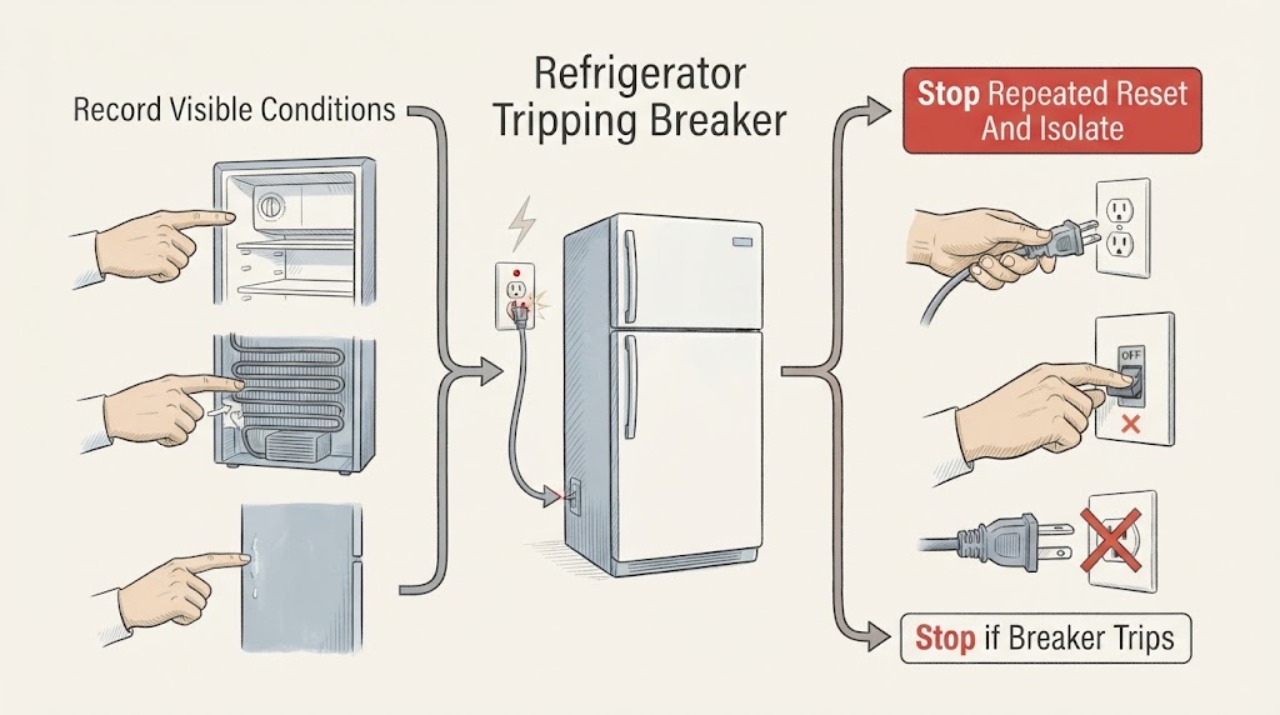
Work through in order
Diagnostic checks
Use only checks that match the exact appliance or system and its official guide.
-
Check 1
Read the full Hitachi model and serial information without moving the refrigerator. Record whether the breaker trips at plug-in, as cooling starts, during defrost, after several minutes, or only when an ice/dispenser function operates; note whether the light/display works and whether the cabinet is warm.
Expected result: The model is known or unknown; the trip is immediate, delayed, event-specific, or unpredictable; the appliance is wet, damaged, or otherwise hazardous.
Next step: Use the matching branch below and exact model manual. Protect perishable food if cooling has stopped and do not keep reconnecting the refrigerator to collect more observations.
Stop if: Stop for smoke, burning odor, sparks, a hot/damaged cord or outlet, water near electrical parts, refrigerant-tubing damage, or a breaker that will not remain on.
Why this matters
Why: Trip timing separates a supply/cord/insulation pattern from an appliance-start, defrost, or control pattern, but cannot identify an internal part. Hitachi support is model-specific.
-
Check 2
After a trip, leave the refrigerator disconnected. If the plug and floor are dry and access is safe, unplug by holding the plug; otherwise keep away from the wet or damaged area and use qualified electrical help. Do not reset the breaker more than the safe household procedure permits and never keep cycling it to test the refrigerator.
Expected result: The breaker holds with the refrigerator disconnected, trips again with the refrigerator disconnected, or the plug, outlet, cord, or floor is wet/damaged.
Next step: Arrange an electrician for a household breaker/outlet or wiring issue and Hitachi-authorized appliance service for an appliance-specific trip. Keep the refrigerator off until the cause is assessed.
Stop if: Do not touch wet power equipment, restore power to a wet appliance, use an adapter/extension cord, or repeatedly reset a tripping device.
Why this matters
Why: A breaker that trips with the appliance disconnected points to household supply or outlet protection; a repeat trip only when the refrigerator is connected points toward the appliance or its cord. Either repeat pattern needs qualified diagnosis.
-
Check 3
From a dry position, verify that the refrigerator is connected to the correctly rated grounded outlet specified by the model. Look for a loose or damaged plug, crushed or cut cord, scorching, moisture, a shared portable socket, adapter, or extension cord; do not remove outlet covers or make measurements.
Expected result: The outlet/cord is visibly damaged or wet, an adapter/extension is present, the breaker rating or outlet is uncertain, or the external power path appears sound.
Next step: Stop using a damaged or uncertain power path and have a licensed electrician correct it. If the external path is sound but the refrigerator alone trips, leave it disconnected and arrange Hitachi service.
Stop if: Do not replace a breaker or fuse with a different rating, bypass grounding, use an extension cord, open the outlet or wiring.
Why this matters
Why: Hitachi warns that damaged or loose plugs/outlets, wet handling, inadequate or non-rated power, and damaged cords can create fire or shock hazards. A sound-looking outlet does not rule out an internal appliance fault.
-
Check 4
Without moving the refrigerator, inspect for water exposure, blocked ventilation, direct sunlight or nearby heat, contact with a wall, a door left ajar, or food blocking cold-air vents. Record whether the cabinet had just been installed, moved, defrosted, or loaded with warm food; do not reach behind the unit.
Expected result: The refrigerator is wet or near water, ventilation is blocked, it is touching a wall/heat source, a door or gasket is not sealing, vents are blocked, or it was recently installed/restarted.
Next step: Remove only an accessible obstruction or heat source without moving the appliance. If power is isolated and the installation must be corrected, use qualified help; do not reconnect solely to see whether cooling improves.
Stop if: Do not pull or tilt the refrigerator, reach under its base, remove panels, or continue operating with water near power.
Why this matters
Why: Hitachi identifies clearance, heat, door/gasket, blocked vents, food load, and first-use recovery as cooling influences. They may explain warmth but do not make a repeat breaker trip normal.
-
Check 5
Use the exact manual to determine whether the model has a compressor restart delay or automatic defrost. Do not reconnect merely for a test; if a qualified person has confirmed the supply is safe, record whether the refrigerator starts normally after the documented delay, trips as the compressor/fan starts, or trips during defrost.
Expected result: The compressor starts after a model-specific delay, the refrigerator is temporarily warm during defrost/first use, the breaker trips at compressor or fan start, or the trip recurs without a clear event.
Next step: Stop reconnection attempts after a repeat trip and provide the timing to Hitachi service or an electrician. Use only a model-manual waiting period that is explicitly documented for the exact model.
Stop if: Do not force a compressor start, bypass an inverter or defrost control, open covers, or work on a start circuit.
Why this matters
Why: Hitachi documents restart delay, automatic defrost, and normal compressor/fan sounds on specific models. A repeat trip synchronized with a start or defrost event is an appliance/electrical-service symptom, not a user reset procedure.
-
Check 6
After the refrigerator remains disconnected, document the model, breaker/outlet behavior, trip timing, cord condition, water/heat exposure, and cooling symptoms. Tell the technician whether the breaker trips with the appliance disconnected or only when connected; do not reproduce the trip intentionally.
Expected result: The household device trips independently, the refrigerator alone trips, the trip is repeatable at compressor/defrost start, cooling is also absent, or any smoke, odor, sparking, wetness, or tubing damage exists.
Next step: Use a licensed electrician for the household supply and Hitachi-authorized appliance service for the refrigerator. If refrigerant tubing is damaged, ventilate without touching the unit and follow emergency/service guidance.
Stop if: Do not open panels, replace internal parts, handle refrigerant, perform powered testing, bypass protection, or restore power after a hazardous trip.
Why this matters
Why: Possible causes include household wiring, outlet protection, cord insulation, compressor/start or inverter circuit, fan, defrost heater/control, sensor, PCB, or refrigerant-system fault. External symptoms cannot safely choose one.
Use your observations
Decision map
Find the observation that best matches what you see, then follow the next safe action.
-
PATH 01Safety boundary
What you see
The household breaker or earth-leakage device trips even while the Hitachi refrigerator remains unplugged.
Do this next
Leave the refrigerator disconnected and have a licensed electrician inspect the outlet, circuit, and protective device.
Why this path and its safety boundary
Why it matters: The household outlet, circuit, moisture, or breaker protection is more likely than a refrigerator compressor fault.
Safety stop: Do not keep resetting the device, change its rating, or use another outlet as a workaround without electrical assessment.
-
PATH 02Safety boundary
What you see
The breaker trips immediately when the refrigerator is connected, before normal cooling begins.
Do this next
Leave the refrigerator unplugged and arrange Hitachi-authorized appliance service; have an electrician check the outlet if its condition is uncertain.
Why this path and its safety boundary
Why it matters: A cord/plug, insulation, input filter, control, or other appliance-side electrical fault is more likely; the exact part cannot be identified externally.
Safety stop: Do not reconnect repeatedly, use an adapter/extension cord, or open the rear/control cover.
-
PATH 03Safety boundary
What you see
The breaker holds while unplugged but trips when the compressor/fan starts or during a repeatable cooling/defrost event.
Do this next
Record the event and keep the unit disconnected. Arrange Hitachi appliance service and qualified electrical service if the circuit also behaves abnormally.
Why this path and its safety boundary
Why it matters: A start, inverter, fan, defrost, control, wiring, or insulation fault is possible; a model-specific compressor delay does not make a repeat trip safe.
Safety stop: Do not force a start, bypass defrost/inverter protection, or work on the powered circuit.
-
PATH 04Safety boundary
What you see
The refrigerator is warm but the breaker has not repeated a trip, and there is a visible setting, door, airflow, clearance, first-use, or defrost condition.
Do this next
Use the exact manual for settings and allow its documented recovery/defrost period; arrange service if cooling remains absent or a trip occurs.
Why this path and its safety boundary
Why it matters: A cooling-performance condition is more likely than a breaker fault, but model controls and recovery periods still apply.
Safety stop: Do not keep changing settings, block vents, move the unit, or reconnect after any repeat trip.
-
PATH 05Safety boundary
What you see
Water reaches the cord/outlet, the plug or cord is scorched/damaged, smoke or burning odor appears, or refrigerant tubing is damaged.
Do this next
Do not touch the refrigerator. If a refrigerant pipe is damaged, stay away, avoid flames and electrical appliances, ventilate the room when safe, and contact authorized service; use emergency electrical assistance for a live hazard.
Why this path and its safety boundary
Why it matters: Shock, fire, or flammable-refrigerant risk overrides all troubleshooting.
Safety stop: Do not restore power, move the unit, operate switches near a suspected gas leak, or attempt a repair.
Helpful context
Understand the symptom
The timing of the trip is the first useful clue
Record whether the breaker trips at plug-in, when cooling starts, only after several minutes, during a defrost event, or when a door/dispenser/ice function is used. A trip at the outlet points toward supply, cord, or insulation; a trip synchronized with a compressor or defrost event needs appliance diagnosis. Timing narrows the path but does not identify a part.
Use the exact model and market manual
Hitachi refrigerators differ in inverter/compressor, automatic ice maker, energy-saving, control, and protection features. Hitachi's official support resources are model-based, and its Thailand FAQ separates one-compartment cooling, airflow, energy-saving, door/gasket, and internal damper/sensor/PCB concerns. Do not borrow a reset or breaker procedure from another Hitachi model.
Only ordinary external checks are appropriate
Inspect the plug, cord, outlet, breaker label, visible water, and cabinet clearance from a dry, safe position. Hitachi warns against damaged or loose plugs/outlets, wet-hand handling, and water that can impair insulation. Do not remove a rear cover, measure energized voltage, substitute a fuse or breaker rating, or move the refrigerator to reach wiring.
Cooling symptoms can coexist with an electrical fault
A refrigerator that is also warm may have a setting, blocked vent, door-seal, clearance, or normal first-use/defrost condition, but a breaker that trips again changes the priority to electrical safety. Hitachi explains that airflow, doors, clearance, defrost, and compressor behavior vary by model; these checks never justify opening the compressor or control compartment.
Refrigerant and internal circuit work are not DIY checks
Hitachi manuals warn not to damage the refrigerant circuit and, for flammable refrigerant models, to stay away from the appliance and avoid flames or electrical appliances if a pipe is damaged. They also prohibit owner disassembly and direct malfunctioning units to service. A breaker trip is not a safe invitation to test a compressor, inverter, defrost heater, fan, or wiring.
Safety boundary
Stop conditions
- Stop resetting the breaker after a repeat trip. Leave the refrigerator disconnected and arrange qualified appliance or electrical service.
- Stop for smoke, burning odor, sparks, a hot/scorched or damaged plug/cord/outlet, water near electrical parts, or a breaker that trips with the refrigerator disconnected.
- Do not use adapters or extension cords, bypass grounding, change a breaker/fuse rating, open panels, or perform live electrical tests.
- Do not damage or handle the refrigerant circuit. If a refrigerant pipe is damaged, stay away, avoid flames and electrical appliances, ventilate when safe, and contact authorized Hitachi service.
- Do not force compressor or defrost starts, bypass protection, or replace internal electrical, inverter, compressor, fan, heater, sensor, control, or wiring parts from the symptom alone.
Only after diagnosis
Potential parts
- model-specific power cord or plug assembly
Consider only when qualified electrical service confirms cord/plug insulation or termination damage and the exact model part is identified.
Cord, plug, grounding, and regional ratings are model/market dependent; do not splice or substitute by appearance. - model-specific compressor start/inverter or control component
Consider only when an authorized technician confirms a trip synchronized with compressor/start operation and diagnoses the component.
Inverter and compressor systems differ across Hitachi models; a breaker trip does not identify the failed part. - model-specific defrost heater, sensor, fan, or control
Consider only after service confirms a repeatable defrost or fan-related trip and rules out the household circuit.
Defrost, fan, sensor, and PCB assemblies are model-specific; do not bypass or work on them.
When checks do not resolve it
Need a professional?
Arrange Hitachi-authorized appliance service when the refrigerator alone repeatedly trips the breaker, when the trip occurs at compressor/fan or defrost start, when cooling is also absent, or when internal access is needed. Arrange licensed electrical service when the breaker trips with the refrigerator disconnected or the outlet, cord, grounding, or circuit is uncertain. Treat smoke, sparks, burning odor, hot/damaged power equipment, water near electricity, or refrigerant-tubing damage as immediate stop-use conditions.
Safety scope: This article covers model identification, trip timing, dry external observation, and ordinary outlet/cord/clearance checks only. Do not move the refrigerator, open panels, change protective-device ratings, work on powered wiring, bypass protection, or handle refrigerant.
Common questions
FAQ
Should I keep resetting the breaker on a Hitachi refrigerator?
No. After a repeat trip, leave the refrigerator disconnected. Determine whether the household device trips while the refrigerator is unplugged and arrange qualified electrical or Hitachi appliance service.
Why does the breaker trip when my Hitachi refrigerator starts?
A compressor/start, inverter, fan, wiring, or supply fault is possible. Record whether the trip is synchronized with startup, but do not force a start, open a cover, or work on the powered circuit.
Can a defrost cycle cause a Hitachi refrigerator to trip?
Automatic defrost changes temperature and sounds, but a repeat breaker trip during defrost is not a normal user-reset condition. Leave the unit off and arrange model-specific service.
What if my Hitachi refrigerator is warm but the breaker is not tripping?
Check only the exact model's temperature setting, door seal, blocked vents, clearance, heat exposure, and first-use or defrost recovery. Persistent warmth or any later trip needs service.
What should I do if water or a refrigerant pipe is involved?
Do not touch the wet or damaged refrigerator or restore power. For suspected refrigerant-pipe damage, stay away, avoid flames and electrical appliances, ventilate when safe, and contact authorized Hitachi service.
Read the exact guide
Official sources
- RS38KPT User ManualHitachi · Exact Hitachi RS38KPT manual; its circuit and timing details are model/market specific, but the safety boundary is useful for comparable Hitachi refrigerators.
- Hitachi Refrigerators SupportHitachi · Official Hitachi Japan refrigerator support index; use the exact model and market support path.
- R-KWC570KS Instruction ManualHitachi Home Appliances · Exact R-KWC570KS manual for Singapore/Asia; control and electrical requirements are not universal to every Hitachi model.
- Refrigerators: Support FAQsArçelik Hitachi Home Appliances Sales (Thailand) · Official Hitachi Thailand refrigerator FAQ; exact controls and features vary by model and market.
Community feedback
Share a repair observation
Share a plain-text repair observation. Accepted observations are published automatically; this page may take a moment to update.