
On this page
Start here
Quick answer
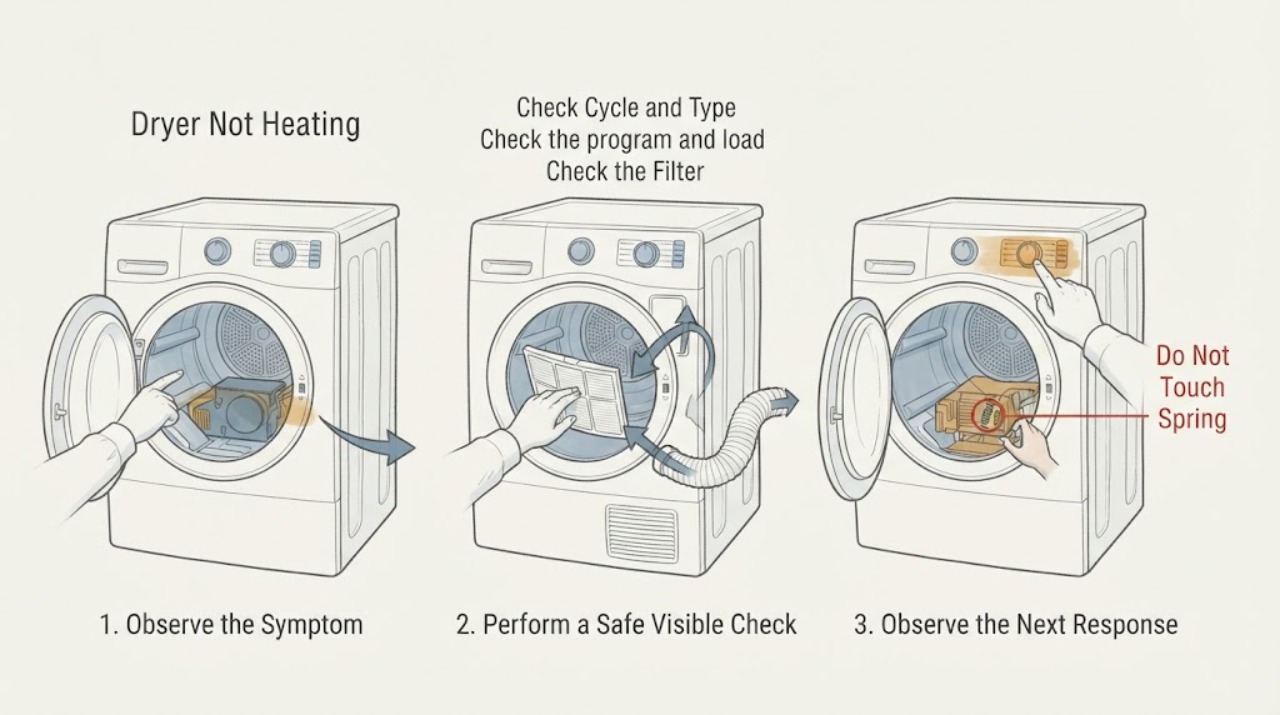
First determine whether the dryer truly has no heat or whether it is a Hoover heat-pump model that warms gradually and does not feel hot when the door is opened. Check the selected program, load size, lint filter, condenser filter, vent hose, outside vent, water tank, and room conditions according to the exact model manual. Hoover says a blocked filter can prevent heating, a blocked or kinked vent can stop heat from escaping, and a heat-pump dryer may take time to feel warm and may not work correctly in a cold room. Disconnect the dryer before examining accessible parts. If airflow is restricted, clothes are scorching, the cabinet or cord is hot, there is a burning smell or smoke, or cleaning and model-approved checks do not restore drying, stop using the dryer and arrange qualified service.
Work through in order
Diagnostic checks
Use only checks that match the exact appliance or system and its official guide.
-
Confirm whether the dryer type and timing explain the low heat
Find the exact product code and identify whether the Hoover dryer is heat pump, condenser, or vented. Note the program, load size, whether the drum tumbles, how long the cycle has run, whether the exhaust or clothes feel warm, and whether a warning light or message appears. Do not repeatedly open the door to test temperature.
Expected result: Hoover says heat-pump dryers can take time to feel warm and may not feel hot when the door opens. A dryer that never warms after a complete appropriate cycle, or a vented or condenser dryer with no heat at all, supports a fault branch rather than a heat-pump expectation.
Next step: If the model is heat pump, continue with the room, filter, condenser, and program checks before judging heat. If there is genuinely no heat or drying remains poor, continue with airflow and service-boundary checks.
Why this matters
Why: The heat technology and test timing change what normal warmth feels like; a brief cool feeling is not enough to condemn a heater.
-
Check the program and load conditions
Use the model manual to confirm that the selected cycle and heat setting suit the fabric and load. Avoid testing an automatic sensor cycle with only one small item, and do not overload the drum. Note whether the dryer stops after a few minutes, runs normally but leaves clothes damp, or completes with no warmth.
Expected result: Hoover advises that sensor-dry cycles may stop early with a very small load, while a wrong program or excessive load can make drying appear ineffective. A suitable load on an approved time or sensor program that still produces no heat points beyond the load-setting branch.
Next step: Choose one model-approved program and a suitable load for a supervised confirmation only after the filter and airflow conditions are safe. If the result is still cold or damp, proceed to filter and vent checks.
Why this matters
Why: A short or unsuitable cycle can imitate a heating failure, but it cannot explain a burning smell, scorching, or an electrical symptom.
-
Clean the lint filter and accessible condenser filter
With the dryer disconnected and cool, remove the door lint filter and clear fluff as the manual directs. If the model has a lower condensing filter, use the manual to remove it, clean the foam and mesh as permitted, and dry all washable parts fully before refitting. Do not remove covers that expose the heater, fan, or wiring.
Expected result: Hoover states that a blocked fluff filter can prevent a dryer from heating and directs users of applicable models to clean the condensing filter. A filter visibly packed with fluff is a plausible airflow cause; clean filters with persistent no heat point toward another fault.
Next step: Refit only completely dry filters and perform one supervised test. If there is still no heat, poor drying, a warning, or rapid overheating, stop using the dryer and arrange qualified service.
Why this matters
Why: Air must move through the drying system for heat and moisture removal; cleaning an accessible filter can restore airflow but does not prove that an internal heater, heat-pump circuit, or sensor is healthy.
-
Inspect the vent hose and outside outlet when fitted
For a vented model, with power disconnected, inspect the rear vent hose for a kink, crush, disconnection, or visible fluff blockage. Check the outside grille or flap for lint, debris, or an obstruction without entering an unsafe area. Do not pull a stacked or heavy machine forward alone and do not alter permanent ductwork unless the manual allows it.
Expected result: Hoover says a blocked or kinked vent hose prevents air from escaping and can stop the dryer heating properly. Weak outside airflow with a restricted hose supports a vent-path branch; a clear vent does not rule out an internal blower or heater problem.
Next step: Correct only an accessible kink or obstruction that can be fixed safely and in accordance with the model instructions. If airflow remains weak, the hose is inaccessible, or heat does not return, stop and arrange qualified vent or appliance service.
Why this matters
Why: The heater and moisture path depend on ventilation; a blocked exhaust can produce both no effective heat and poor drying.
-
Check room temperature, water tank, and airflow conditions
Confirm the dryer is in an environment allowed by the model manual, especially if it is a heat-pump unit in a garage or other cold room. For condenser or heat-pump models, check whether the water tank is full and whether the condenser area has a maintenance warning. Keep ventilation openings clear and do not heat the appliance with an improvised source.
Expected result: Hoover says heat-pump dryers may not become warm in a cold room and that applicable models can require an empty water tank and clean condensing filter for effective operation. A cold room, full tank, or maintenance warning can explain poor drying without proving a failed heater.
Next step: Move or operate the unit only as the installation manual permits, empty the tank and clean accessible filters if indicated, then run one suitable supervised test. Persistent no heat or a returning warning needs service.
Why this matters
Why: Drying performance depends on the model's ambient and moisture-removal conditions; the exact manual controls which user checks apply.
-
Record the electrical supply and any safety symptom
From a safe position, note whether the display and drum motor operate, whether the breaker or plug fuse has operated, whether the cord or outlet is warm, and whether the dryer stops after a few minutes. Do not repeatedly reset a breaker, substitute a fuse, use an extension cord against the manual, or open the electrical compartment.
Expected result: A working drum with no heat after clean airflow checks can indicate an internal heater, thermal protection, sensor, control, compressor, or heat-pump fault. A hot connection, smoke, burning odor, sparks, or repeated breaker event is an electrical safety branch.
Next step: Stop immediately and seek qualified help for any electrical or burning symptom. For a clean, cool, powered dryer with persistent no heat, provide the model and test history to an appliance technician rather than opening panels.
Why this matters
Why: External observations help service triage, but no user check can safely identify an energized heater or control fault from the outside.
-
Run one supervised confirmation after a safe correction
Only after correcting a program, load, filter, tank, room, or accessible vent condition, run one model-approved supervised cycle. Stay nearby and observe the drum, airflow, heat progression, drying result, display, and any odor. Stop immediately if heat rises sharply, clothes scorch, airflow falls, smoke or burning smell appears, or the dryer shuts down again.
Expected result: Normal gradual warmth and drying after the correction supports an external condition. No heat, persistent damp clothes, a warning, repeated shutdown, or overheating after the correction indicates an unresolved fault.
Next step: Disconnect the dryer and arrange qualified service when the confirmation fails. Do not bypass thermal protection, run repeated cycles, or remove panels to continue testing.
Why this matters
Why: One controlled test distinguishes a corrected maintenance or setup issue from an internal heater, heat-pump, sensor, control, or airflow failure without repeated overheating cycles.
Use your observations
Decision map
Find the observation that best matches what you see, then follow the next safe action.
-
PATH 01Next step
What you see
The dryer is a heat-pump model, warms gradually, dries normally, and has no warning, smell, or abnormal temperature.
Do this next
Allow the model's full cycle and follow its room-temperature, filter, and condenser guidance. Do not judge heat by opening the door early.
-
PATH 02Next step
What you see
The lint filter, condenser filter, water tank, vent hose, or outside grille is visibly restricted or a maintenance warning is active.
Do this next
Disconnect and correct only the accessible manual-approved condition, dry and refit washable parts, then perform one supervised test. Persistent no heat or poor drying needs service.
-
PATH 03Next step
What you see
The dryer operates in a cold room or garage and is a heat-pump model that does not warm or dry effectively.
Do this next
Check the exact model's ambient requirements and move or warm the room only as the installation guidance allows. Do not use an improvised heat source or continue if other faults are present.
-
PATH 04Next step
What you see
A vented or condenser dryer remains cold after the correct program, suitable load, clean filters, and clear airflow path.
Do this next
Keep the dryer out of use and arrange qualified diagnosis of the heater, thermal protection, fan, sensor, control, or heat-pump components as applicable.
-
PATH 05Next step
What you see
Smoke, burning smell, scorching, sparks, a hot or damaged cord or outlet, exposed wiring, or repeated breaker operation is present.
Do this next
Stop immediately, disconnect only if safe, keep clear, and seek qualified help from a safe location. Do not restart or disassemble the dryer.
Helpful context
Understand the symptom
A heat-pump dryer may not feel hot
Hoover explains that a heat-pump dryer does not need to become very hot inside the drum and can take time to feel warm. Opening the door early can make a normally operating heat-pump appliance seem cold. By contrast, a traditional vented or condenser dryer that never warms clothes, has weak airflow, or leaves them wet after a normal cycle needs a different diagnosis. Identify the dryer type and program before assuming the heater has failed.
Stop before cleaning or moving the dryer
Stop the cycle, disconnect the appliance as the model instructions require, and allow hot surfaces to cool. Do not open panels, bypass a thermal device or door switch, probe energized wiring, or reach into a fan or heater. Smoke, a burning smell, sparks, a hot or damaged cord or outlet, scorching, or repeated breaker operation is an immediate stop-use condition.
Only after diagnosis
Potential parts
- lint or condenser filter and filter housing
Consider this only when the exact model's filter or housing is damaged and cannot maintain the required airflow after cleaning.
Filter and housing designs vary by model; verify the exact product code and do not run without required filters. - vent hose or external vent component
Consider this only when qualified inspection confirms a damaged, collapsed, or incompatible hose or external vent path.
Vent routing and materials must match the model and installation requirements; do not create an unsafe exhaust path. - heater, thermal protection, or temperature sensor
Consider this only after qualified testing confirms an internal heating or safety-control fault for the exact model.
Electric and heat-pump systems differ; never bypass thermal protection or fit an unverified part. - fan, compressor, or heat-pump component
Consider this only when a technician confirms a heat-pump, fan, compressor, or airflow fault after accessible checks are complete.
Heat-pump and fan components are model-specific and require qualified service access.
When checks do not resolve it
Need a professional?
Arrange qualified Hoover dryer service when the correct program, load, room, clean filters, water tank, and accessible vent path do not restore drying or warmth; when a heat-pump unit remains ineffective in a suitable room; when a warning or repeated shutdown returns; or when the dryer overheats. Stop immediately for smoke, burning smell, scorching, sparks, a hot or damaged cord or outlet, exposed wiring, or repeated breaker operation. Do not open panels, bypass thermal protection, or test energized wiring.
Common questions
FAQ
Why does my Hoover heat-pump dryer not feel hot?
Hoover says heat-pump dryers do not need to feel very hot and can take time to warm. Check the model type, room conditions, filter, condenser, and program before treating a cool drum as a failure.
Can a dirty filter make a Hoover dryer stop heating?
Yes. Hoover says a blocked fluff filter can prevent heating, and applicable condenser models also need a clean condensing filter. Disconnect first, clean only as the manual allows, and stop if no heat returns.
Can a blocked vent hose cause no heat?
Yes. Hoover explains that a blocked or kinked vent prevents air from escaping and can stop a dryer heating properly. Inspect only an accessible hose and outside vent, and arrange service if airflow remains restricted.
Why does my Hoover dryer stop after a few minutes?
A very small load can make some sensor cycles stop early, and a cold room or maintenance restriction can also affect operation. Use the exact model guidance and a suitable load; repeated shutdown or no drying needs service.
When should I stop using a Hoover dryer with no heat?
Stop for smoke, burning smell, scorching, sparks, a hot or damaged cord or outlet, exposed wiring, repeated breaker operation, or severe overheating. Also stop after clean filters and airflow checks fail; do not open panels or bypass thermal protection.
Read the exact guide
Official sources
- Tumble Dryer TroubleshootingHoover Advice Centre · Model-specific troubleshooting, manuals, product-code lookup, power checks, filters, heating, and maintenance routing
- Not drying the clothesHoover Advice Centre · Lint filter, vent hose, cold-room, load-size, and sensor-cycle checks for poor drying
- Not heating upHoover Advice Centre · Heat-pump expectations, lint filter, vent hose, condenser filter, room conditions, and disconnect-before-examining safety guidance
- Why does my Hoover heat pump dryer not get hot?Hoover Advice Centre · Gradual warmth, cold-room conditions, and why a heat-pump drum may not feel hot when opened
Community feedback
Share a repair observation
Share a plain-text repair observation. Accepted observations are published automatically; this page may take a moment to update.