
On this page
Start here
Quick answer
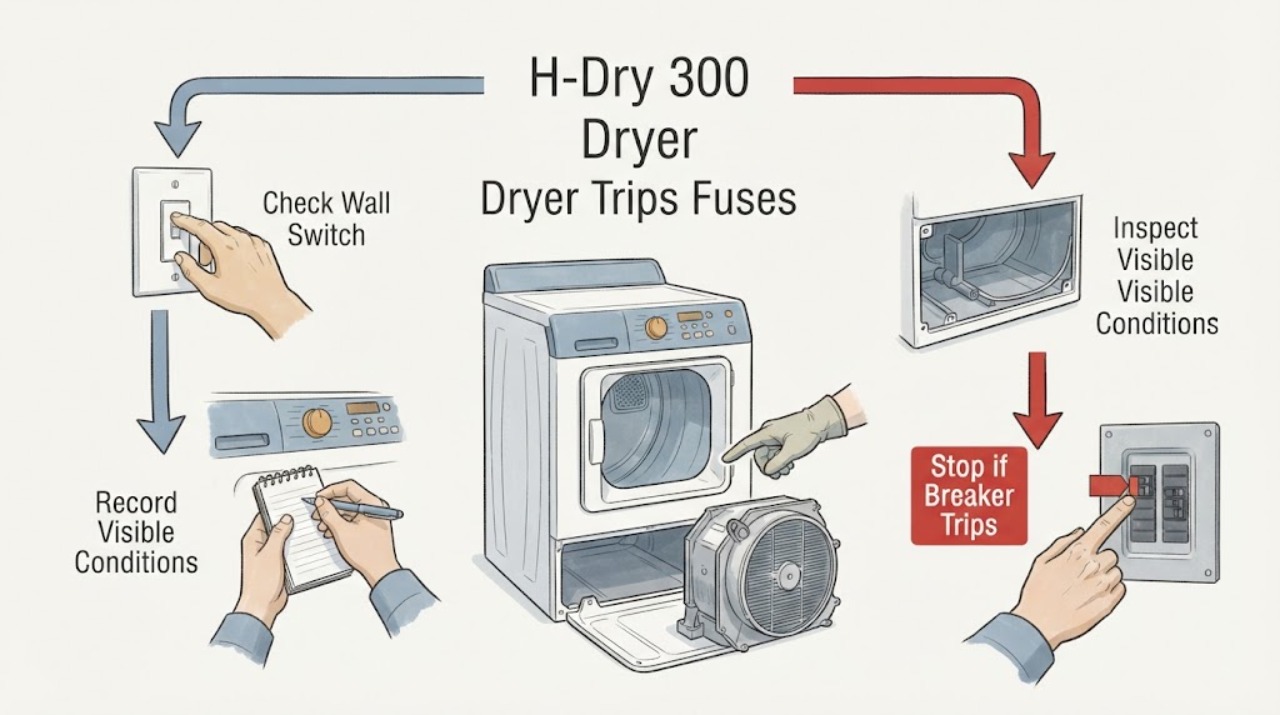
Stop using the Hoover H-Dry 300 after any fuse, breaker or RCD trip. Unplug it at the plug when safe, do not keep resetting protection or run another empty cycle, and do not take live measurements or bypass a fuse. Hoover identifies H-Dry 300 as a condenser-dryer family and directs owners to model-specific documentation, but the opened guidance does not prove that operating briefly without the condenser caused a later trip. When the appliance is unplugged and cool, record the exact product code and confirm only that the correct condenser is present and correctly refitted according to its exact manual. If the protection trips again, there is heat, burning smell, smoke, water or visible damage, leave it disconnected and arrange qualified appliance/electrical service.
Work through in order
Diagnostic checks
Use only checks that match the exact appliance or system and its official guide.
-
Check 1
Stop the dryer, switch off the socket if that can be done without touching a hot, wet or damaged area, and unplug it by the plug when safe. Do not reset the breaker/RCD repeatedly, replace a fuse to keep testing, bypass protection or perform a live electrical measurement.
Expected result: The plug, socket or surrounding area is hot, wet, scorched, smoky or has a burning smell, or the protection will not remain reset with the dryer disconnected.
Next step: Keep the dryer disconnected, keep clear of damaged or wet electrical parts, and contact a qualified electrician or appliance service. If there is active smoke or fire, use the local emergency procedure.
Why this matters
Why: Those are electrical or fire-risk warning signs, not a user-level condenser adjustment. A trip that repeats is also not evidence that the appliance is safe to run.
-
Check 2
With the appliance unplugged and cool, record the exact model/product code from its information plate and note when the protection operated: on plug-in, at start, after a few seconds, when paused, or at another point. Do not use the family label alone to select a manual or part.
Expected result: A complete code is available and the trip timing can be described, or the plate/code cannot be read.
Next step: Use the exact code in Hoover's model-specific documentation or give it to service. If the code is unavailable, stop at the family-level safety guidance and do not guess a model procedure.
Why this matters
Why: The code is needed to scope the correct Hoover manual and condenser arrangement. Timing helps a technician but does not prove which internal circuit or component is involved.
-
Check 3
Only while unplugged and cool, look at the condenser access area from outside. Confirm that the correct condenser is present, visibly intact and refitted/closed as the exact manual requires; do not reach into wiring, remove panels or operate the dryer with the condenser missing.
Expected result: The condenser is missing, cracked, badly blocked, wet, or its correct refitting cannot be confirmed; alternatively it appears present and the access area is closed.
Next step: If its condition or fit is uncertain, leave the dryer unplugged and use the exact manual or service. Even if it looks normal, do not run an empty-cycle retest after a trip; arrange service if protection has operated.
Why this matters
Why: A missing or damaged condenser leaves the appliance in an unsuitable condition for further operation, but the opened Hoover pages do not establish that this alone caused an electrical trip. A visually normal condenser also does not clear the dryer after a protection event.
-
Check 4
Write down the protection type that operated (plug fuse, breaker or RCD), whether the event happened with the condenser reinstalled, any smell/noise/smoke or water, and whether the filter or condenser had just been cleaned. Do not repeatedly start, pause or empty-test the dryer to reproduce it.
Expected result: The trip recurs when the dryer is connected or started, or there is an odor, smoke, water, unusual noise or visible damage; alternatively there is only one historical trip with no further test performed.
Next step: Give the exact product code and this event record to Hoover-authorized appliance service and, where the household protection or socket is implicated, a qualified electrician. Keep the dryer disconnected until they assess it.
Why this matters
Why: A recurring trip or accompanying physical warning requires diagnosis beyond external maintenance. A single historical event still cannot be assigned a component cause from the opened sources.
Use your observations
Decision map
Find the observation that best matches what you see, then follow the next safe action.
-
PATH 01Next step
What you see
The socket/plug is hot or scorched, there is smoke, burning odor, water near electrics, or the household protection trips again.
Do this next
Leave the dryer unplugged and arrange qualified electrical/appliance service; do not reset or bypass protection to continue testing.
Why this path and its safety boundary
Why it matters: The symptom has crossed the safe external-check boundary and may involve the appliance supply or household electrical installation.
-
PATH 02Next step
What you see
The condenser is missing, damaged, wet or cannot be confirmed as correctly refitted for the exact product code.
Do this next
Keep it disconnected and use the exact manual or Hoover service to establish the correct condenser condition; do not run it to find out whether it trips again.
Why this path and its safety boundary
Why it matters: The dryer is not in a verified operating configuration, although the available Hoover guidance does not prove that this condition caused the electrical trip.
-
PATH 03Next step
What you see
The correct condenser appears present and the dryer still trips a fuse, breaker or RCD when connected or started.
Do this next
Stop all testing, keep the plug disconnected, and provide the exact model code and trip timing to qualified appliance service; have the socket/protection checked if other appliances are affected.
Why this path and its safety boundary
Why it matters: The condenser's appearance does not clear the appliance, and the trip cannot be narrowed to a heater, motor, wiring or control component from these observations.
-
PATH 04Next step
What you see
There was one historical trip, no physical warning is present, and no further powered test has been attempted.
Do this next
Do not perform an empty-cycle retest. Confirm the exact manual/model route and ask Hoover-authorized service whether the dryer should be inspected before it is powered again.
Why this path and its safety boundary
Why it matters: The event remains unresolved; the time relationship to the missing condenser is useful history but is not proof of direct causation.
Helpful context
Understand the symptom
Treat the trip as an electrical stop condition
A fuse, breaker or RCD trip is a protection event. The safe next step is to stop the dryer and preserve the observations, rather than repeatedly restoring power to see whether it will run. The timing after the condenser was removed is relevant history, but it is not a diagnosis of the condenser, heater, motor or control system. Hoover's service guidance points users to model-specific documentation and says to disconnect from the mains before examining a dryer.
Use the exact H-Dry 300 product code
H-Dry 300 is a product family; Hoover's opened product page is for the HLE C10TG-80 condenser variant and provides the route to its manual. Read the rating or information plate on the assigned appliance and use that exact code before relying on a condenser location, cleaning instruction or replacement part. Do not transfer an instruction from a visually similar H-Dry model.
Common questions
FAQ
Did running the Hoover H-Dry 300 without its condenser definitely cause the fuse to trip?
It cannot be established from the opened Hoover guidance. The missing-condenser operation is important history, but a later protection trip can only be diagnosed after model-specific inspection; do not infer a failed heater, motor, wiring or control from timing alone.
Should I refit the condenser and run an empty cycle to see if it trips again?
No. Unplug the dryer when safe, confirm the exact model and condenser condition only while it is cool and disconnected, and do not repeatedly reset protection or run another test after a trip. Ask qualified service to decide whether it is safe to power again.
What information should I give Hoover service?
Provide the complete product code from the information plate, the protection type that operated, whether the condenser was absent or refitted, the exact timing of the trip, and any heat, odor, smoke, water or unusual noise. Hoover directs owners to model-specific documentation and service routes.
Read the exact guide
Official sources
- H-Dry 300 (Condenser) Tumble Dryer - White - 10kg (HLE C10TG-80)Hoover · Opened Hoover's official H-Dry 300 product page. It confirms the H-Dry 300 family has a condenser variant and shows the HLE C10TG-80 product code and user-manual route. The task has no complete product code, so this source does not prove a universal internal design or a direct cause of fuse trips.
- Condenser Dryer Tumble Dryer Help and Advice from HooverHoover Service · Opened Hoover's official condenser-dryer advice page. It supports disconnecting before examination, external filter/condenser maintenance and service escalation for repeated stopping or fuse-related symptoms. It does not establish that operating without a condenser caused this task's trip or identify an internal failed part.
- Tumble Dryer TroubleshootingHoover Service · Opened Hoover's official service advice centre. It supports using the model/product information plate, disconnecting the appliance from mains before examination, and treating fuse or switch-off symptoms as service-routing information. It does not diagnose the assigned trip or authorize live electrical work.
Community feedback
Share a repair observation
Share a plain-text repair observation. Accepted observations are published automatically; this page may take a moment to update.