
On this page
Start here
Quick answer
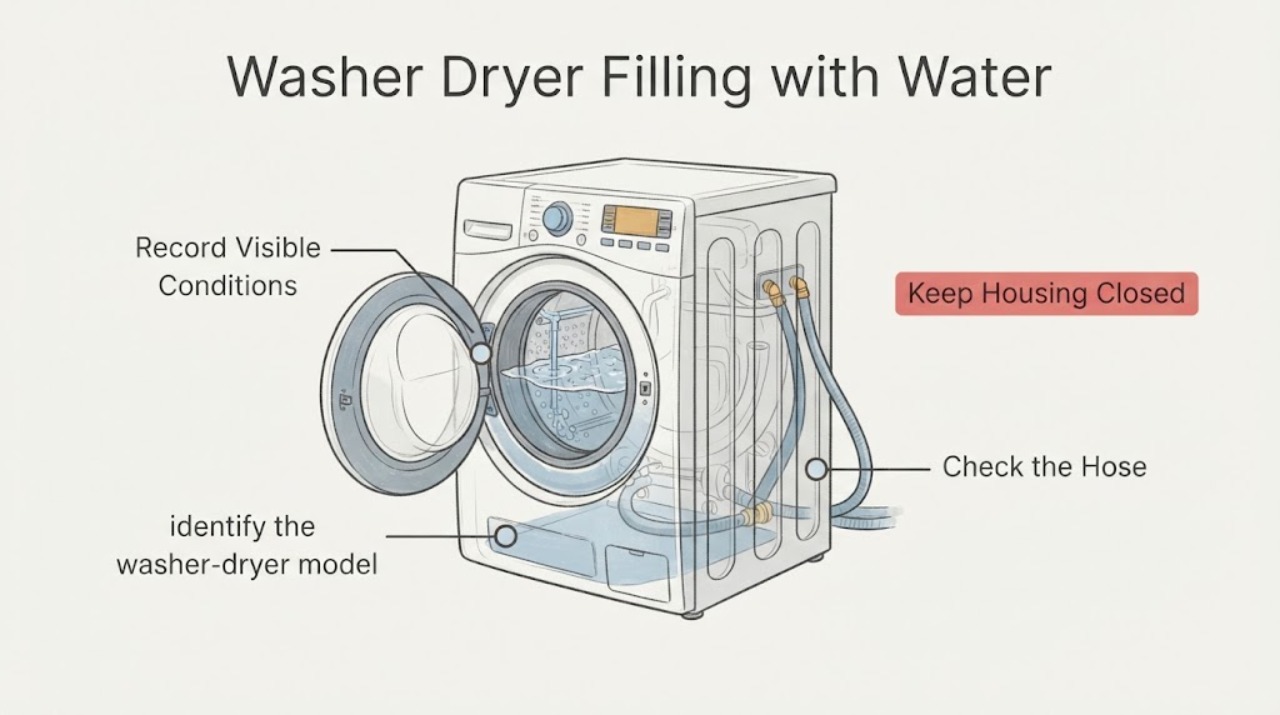
First identify when the water enters. Hoover says a brief intake through the soap dispenser at the start of a drying programme is normal for the specific washer-dryer models listed on its Advice Centre page, but that statement should not be extended to an unidentified model. Clean water entering while the machine is idle, water continuing after the expected fill, a rising drum level, or an external leak needs a safer response: turn off the water supply, disconnect the appliance from the mains before examining it, and follow the exact model manual or Hoover support path. Only check a hose, drain route, or inlet filter when the matching manual confirms the access and procedure; do not assume an inlet valve or other internal part is faulty.
Work through in order
Diagnostic checks
Use only checks that match the exact appliance or system and its official guide.
-
Check 1
Record exactly when water enters: at the start of a wash, at the start of a drying programme, while the appliance is idle, or continuously after the programme stage has passed.
Expected result: The intake is brief and tied to one programme stage, or it occurs while the machine is unused, continues unexpectedly, makes the drum level rise, or produces a visible leak.
Next step: Use the exact model manual for the relevant programme. If water enters while idle, keeps flowing, the level rises, or water is outside the cabinet, move to the shutoff and service boundary rather than testing internal parts.
Why this matters
Why: The timing separates a possible programme function from the separate Hoover support scenario of clean water entering an unused machine. The Hoover dryer-start article is limited to its listed models, so timing alone does not prove that an unidentified model is operating normally.
-
Check 2
If the water appears only when a drying programme starts, identify the washer-dryer model from its rating label and compare it with Hoover's listed model scope and the exact manual.
Expected result: The model is one of the models covered by Hoover's dryer-start article and the water stops after the brief initial intake, or the model is unknown/not listed or the intake continues.
Next step: Treat a brief, leak-free intake as a model-confirmed programme characteristic only after that scope check. If the model is not confirmed or the water continues, use its manual/support path and the external checks below.
Why this matters
Why: For the listed models, Hoover states that a brief fill through the soap dispenser at the start of drying is normal. That source does not establish the same behaviour for every Hoover washer dryer.
-
Check 3
For clean water entering while the machine is not in use, close the cold-water supply tap, disconnect the appliance from the mains before examining it, and inspect the visible fill-hose connection and surrounding floor for drips.
Expected result: Closing the tap stops further entry and there is no visible hose or connection leak, or water continues/has already leaked onto the floor.
Next step: Keep the water supply off and do not use the appliance if water continues, the drum level rises, or a leak is present. Arrange model-specific service; do not infer an inlet-valve or control fault from this external observation.
Why this matters
Why: Hoover's model-specific clean-water guidance directs the user to shut off the water, disconnect power before examination, check the fill-valve connection and later check for drips. Ongoing entry, a leak, or a rising level is not a condition to leave unattended.
-
Check 4
Only if the exact model manual confirms the same accessible inlet-filter procedure, disconnect the cold fill hose after the supply is off and inspect the visible mesh at the hose/valve connection for debris; rinse and refit it only as that manual instructs.
Expected result: The matching manual confirms the procedure and the accessible mesh is visibly dirty, or the model/procedure cannot be confirmed or the filter is not safely accessible.
Next step: Use only the confirmed model procedure and check for drips after reconnecting. If the model is unknown, the filter is inaccessible, or clean water still enters while idle, stop and use Hoover support or a qualified engineer.
Why this matters
Why: Hoover's clean-water page describes a debris-contaminated inlet-valve filter for the listed models and a careful rinse/reconnect route, but the page is model-scoped. It is not evidence that the same filter access or cause applies to every Hoover washer dryer.
-
Check 5
From outside the cabinet, inspect the drain hose and drain connection for a kink, displacement, visible blockage, or an installation arrangement that does not match the exact manual, especially if incoming water seems to disappear or the drum does not retain its expected level.
Expected result: The hose and connection match the manual and are clear, or a kink, loose connection, visible blockage, or incorrect routing is present.
Next step: Correct only an accessible hose or connection in the manner shown by the exact manual, then run the manual-approved test while watching for leaks. If the water still disappears, the machine leaks, or the route requires cabinet access, stop and arrange service.
Why this matters
Why: Hoover's drain and setup guidance supports external checks of hose routing, connections, visible blockages, and leak checks. These observations can explain a drain-path or installation problem, but they do not prove an internal pump, valve, or sensor failure.
Use your observations
Decision map
Find the observation that best matches what you see, then follow the next safe action.
-
PATH 01Next step
What you see
Water enters briefly through the dispenser only when drying starts, then stops and there is no leak.
Do this next
Confirm the rating-label model against the page and its exact manual. If it is not covered, obtain model-specific guidance before relying on this explanation.
Why this path and its safety boundary
Why it matters: Hoover documents this as normal for the specific models named on its dryer-start Advice Centre page; the evidence is not a brand-wide rule for an unidentified model.
-
PATH 02Next step
What you see
Clean water enters while the washer dryer is idle, or water keeps entering after the expected programme stage.
Do this next
Turn off the water supply and disconnect mains power before examination. Check only the externally accessible hose/filter route confirmed by the exact manual; keep the appliance out of service if the symptom persists.
Why this path and its safety boundary
Why it matters: This is outside the documented brief dryer-start behaviour and matches the separate Hoover support scenario of clean water entering when the machine is not in use; a model-specific inlet/filter or service assessment is needed.
-
PATH 03Next step
What you see
Water level does not stay as expected, or water seems to drain away while filling, with no confirmed external leak.
Do this next
Inspect the visible drain hose and connection against the exact manual, correct only an accessible routing or connection issue, and arrange service if the level still falls or the hose path cannot be verified.
Why this path and its safety boundary
Why it matters: A drain-hose or installation-path issue is possible, but Hoover's general guidance does not establish an internal component diagnosis from this observation alone.
-
PATH 04Next step
What you see
The drum level rises unexpectedly, water reaches the floor, or water continues after the supply tap is closed.
Do this next
Keep the water supply off, disconnect mains power only if it can be done without contacting water, avoid further use, and arrange qualified service. Do not open the cabinet or attempt live electrical or water-valve work.
Why this path and its safety boundary
Why it matters: The appliance has an active water or leak hazard that cannot be safely narrowed to a part from an unknown model and should not be left running.
Helpful context
Understand the symptom
Start with the timing
“Filling with water” describes several different observations on a washer dryer. A short intake at the beginning of a drying programme can be a normal feature on the Hoover models named in the Advice Centre article. Water entering while the appliance is unused, continuing well beyond the expected programme stage, or appearing on the floor is a different decision. Because this task has no model number, use the rating-label model and its exact manual to confirm the programme behaviour before treating any timed fill as normal.
Keep checks external and safe
Hoover's model-specific support distinguishes clean water entering while the machine is not in use from other washer-dryer symptoms and gives a water-supply, hose, filter, leak, and engineer path for the listed models. Hoover's general setup and drain guidance supports checking visible water and drain connections against the manual. It does not justify opening an unidentified machine or naming an internal valve, sensor, or control fault.
When checks do not resolve it
Need a professional?
Call Hoover support or a qualified appliance engineer if the exact model and programme behaviour cannot be confirmed, if clean water enters while idle, if filling continues unexpectedly, if the drum level rises, if water leaks, or if the remaining check would require opening the cabinet. Keep the water supply off and disconnect mains power before examination; do not work on the appliance while water is present.
Common questions
FAQ
Is it normal for a Hoover washer dryer to take water when drying starts?
It can be normal for the specific models named in Hoover's Advice Centre article: the article describes a brief fill through the soap dispenser at the start of a drying programme. Check the exact model before applying that explanation to an unidentified Hoover washer dryer.
Why is clean water entering the drum when the washer dryer is not being used?
Hoover's model-specific support describes this symptom and points to a possible debris-contaminated water-valve filter, with water shutoff, power disconnection, hose/filter checks, leak checks, and engineer escalation. The procedure and cause must be confirmed for the exact model.
Should I replace the inlet valve or pressure switch?
Not from this symptom alone and not without a matching model diagnosis. First shut off water, disconnect mains power before examination, record when the water enters, and use the exact Hoover manual or support route. Internal component testing or replacement belongs to qualified service.
What should I do first if the washer dryer is filling and leaking?
Turn off the water supply and stop using the appliance. Disconnect mains power only when it is safe to do so without contacting water, check only visible hoses and connections, and arrange service if the leak or unexpected filling remains.
Read the exact guide
Official sources
- How to set up your washing machine: A complete guide – Hoover UKHoover Home / Hoover UK · Supports external fill/drain connection, water shutoff and leak checks; it does not establish a model-independent internal fault or exact washer-dryer routing.
- why does my hoover washer fill up when im not using it?Hoover Service · Supports the listed-model symptom, turning off the cold-water supply, disconnecting mains before examination, checking the fill-valve hose/filter route, checking for drips, and engineer escalation.
- Dynamic Next WDMT413AI2 - Washer Dryer Help and Advice from HooverHoover Advice Centre · Supports the model-scoped distinction between dryer-start filling, clean water in the drum, drain/installation symptoms, and external fill-pipe/filter checks; it does not establish those details for every Hoover washer dryer.
- How to Drain Water from a Washing Machine – Hoover UKHoover Home / Hoover UK · Supports external safety, drain-hose/filter visibility checks, water removal, and professional escalation; exact washer-dryer access and hose routing remain model-specific.
- Fills with water when the dryer programe starts - Hoover Advice CentreHoover Advice Centre · Supports a brief water intake through the soap dispenser at the start of a drying cycle for the listed Hoover washer-dryer models; it is not a universal rule for every Hoover model.
Community feedback
Share a repair observation
Share a plain-text repair observation. Accepted observations are published automatically; this page may take a moment to update.