
On this page
Start here
Quick answer
Start by reducing the load: a Hoover washer dryer can wash more laundry than it can dry, so a full wash load may have too little room to dry efficiently. Check that a drying programme and suitable time or automatic setting were actually selected, and that the load was spun well before drying. Sensor-dry programmes may not work well with only one item. If clothes remain wet, the drum never warms, a drying error returns, the machine stops with water inside, or there is smoke, a burning smell, a leak, or a power fault, stop using the appliance and arrange qualified service. Do not open the cabinet or guess at a heater, sensor, or control part.
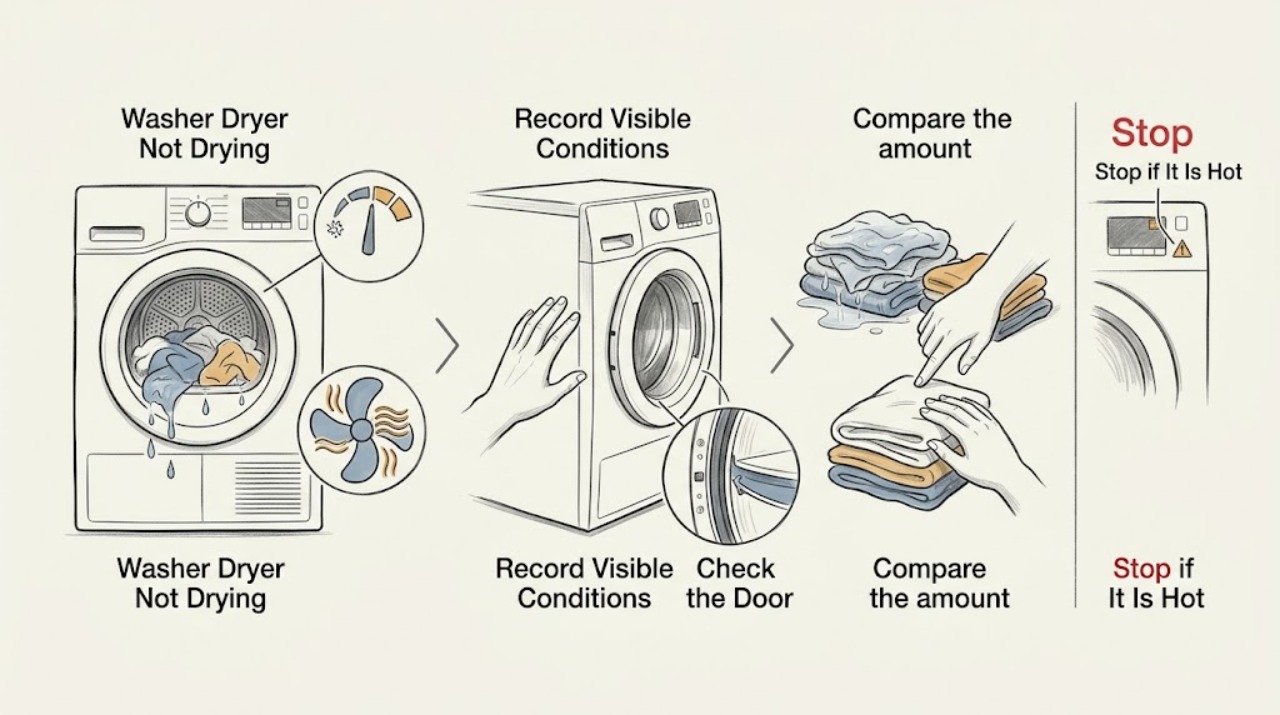
Work through in order
Diagnostic checks
Use only checks that match the exact appliance or system and its official guide.
-
Check 1
Stop and record the exact drying programme, selected time or dryness setting, load size, and whether the clothes were spun before drying. Note whether the drum tumbles, whether the cycle ends normally or stops with water, whether the display shows an error, and whether there is any warmth, smoke, burning smell, or leak.
Expected result: The machine used a wash-only or unsuitable programme, the load is wet but the cycle ran normally, the machine stops with water, or the drum is cold or shows an error.
Next step: For smoke, burning smell, leaks, damaged power parts, repeated trips, or an error that returns, keep the washer dryer out of service and arrange qualified help. Otherwise continue with load capacity and programme checks.
Why this matters
Why: A wrong programme or an incomplete spin can leave clothes wet without proving the heater is faulty. A cold drum, a recurring error, water remaining, or any hazardous symptom points to an unresolved drying, drain, airflow, electrical, or control fault.
-
Check 2
Compare the amount in the drum with the dry-load limit in the model manual, not just the washing capacity. Remove part of a full wash load and leave the remaining items loose enough to tumble; do not run the drying programme with a tightly packed drum.
Expected result: The wash load was larger than the dry-load allowance, or the smaller load still remains wet after an appropriate drying cycle.
Next step: Run one model-appropriate drying cycle with the reduced load if there is no safety symptom. If the result does not improve, do not keep extending cycles; continue with the spin and programme checks and plan service if needed.
Why this matters
Why: Hoover explains that a washer dryer's drying capacity is always smaller than its washing capacity because clothes need more room to dry efficiently. A smaller load that still fails to dry shifts suspicion toward spin extraction, programme selection, airflow, or an appliance fault.
-
Check 3
Check the clothes immediately after the wash or spin stage. If they are dripping or unusually heavy, select the model's appropriate spin-only or spin programme with a balanced load, only if the door is closed and no leak, error, or abnormal noise is present. Do not force the door or reach into a moving drum.
Expected result: The clothes become less wet after a successful spin, the load remains very wet because spin was skipped or aborted, or the machine cannot drain or spin normally.
Next step: Use the correct drying cycle after a successful balanced spin. If spin is repeatedly aborted, water remains, the pump/filter warning appears, or the machine makes abnormal noise, stop and follow the model's drain guidance or arrange service rather than using repeated dry cycles.
Why this matters
Why: Hoover's washer-dryer manual says laundry that was not correctly spun can be too wet for the dry phase and points to a spin programme. An unbalanced load or incomplete drain can reduce or stop spin, leaving too much water for drying.
-
Check 4
Confirm that the selected cycle is a drying cycle and that its time or automatic dryness option is suitable for the fabric and load. If using a sensor-dry option, do not test it with only one item; add a suitable load or choose the model's time-dry option as described in the manual.
Expected result: The selected programme was not the intended dry cycle, the sensor cycle had only one item, the drying time was too short, or the programme and load are appropriate but clothes remain wet.
Next step: Correct the programme, load, or time once and observe the result. If the drum remains cold or the clothes are still wet with correct settings, keep the appliance out of service and arrange repair; do not remove panels to inspect the heater or sensor.
Why this matters
Why: Hoover lists the correct drying programme and sufficient time or automatic setting as checks, and says sensor-dry cycles are not suitable for drying one item. A correct cycle with a suitable load that remains wet points away from a simple setting problem.
-
Check 5
With the appliance off and disconnected, check only model-approved external maintenance items: the drain-pump filter and drain connection for a blockage if the machine stops with water, and the door seal or detergent drawer for visible buildup. Follow the exact manual, contain water, and keep the filter securely closed; washer dryers may not have a separate fluff filter.
Expected result: Water remains because a drain path or filter is blocked, visible buildup is affecting the seal or drawer, the maintenance items are clear, or a drying fault remains with normal drainage.
Next step: Clear only the accessible obstruction using the model procedure and secure the filter before any retry. If the issue persists, the filter leaks, water cannot be contained, or internal work would be needed, stop and arrange qualified service.
Why this matters
Why: Hoover's guides distinguish washer dryers from tumble dryers by noting that washer dryers do not have a fluff filter, while its manuals link incomplete spin and drying performance to drainage and load conditions. A clear drain path with continued no-dry behavior makes an internal heater, sensor, fan, or control fault more likely.
-
Check 6
After the load, spin, programme, and external drain checks are normal, make one supervised drying attempt with a reduced, balanced load. Stop immediately if the drum stays cold, the cycle stops, an error returns, smoke or a burning smell appears, water leaks, or the cabinet becomes abnormally hot.
Expected result: The load dries normally, or the no-dry symptom or unsafe condition returns.
Next step: For recurrence, stop using the washer dryer and provide the model, programme, load, spin result, drainage findings, error, and temperature observations to authorized service. Do not keep running longer cycles to compensate.
Why this matters
Why: A normal result after correcting capacity, spin, or programme supports an operating-condition cause but does not prove the internal drying system is healthy. A repeatable no-dry or safety symptom after the basic checks requires diagnosis by a qualified technician.
Use your observations
Decision map
Find the observation that best matches what you see, then follow the next safe action.
-
PATH 01Safety boundary
What you see
There is smoke, a burning smell, a leak, a damaged cord, repeated power interruption, abnormal heat, or a recurring fault code.
Do this next
Stop immediately, disconnect power only if the plug and area are dry and safe, close the water supply if appropriate, and arrange qualified help. Do not open the cabinet or run another drying cycle.
Why this path and its safety boundary
Safety stop: Continue with the load-capacity, spin, programme, and external drainage checks.
-
PATH 02Safety boundary
What you see
The wash load exceeds the model's dry capacity, or the clothes were not spun sufficiently.
Do this next
Reduce the load and use the appropriate balanced spin before one drying attempt; stop if water remains or the machine cannot spin normally.
Why this path and its safety boundary
Safety stop: Check the drying programme, time or sensor setting, and model-specific external maintenance path.
-
PATH 03Safety boundary
What you see
A correct drying cycle with a suitable load still leaves the clothes wet or the drum cold.
Do this next
Keep the appliance out of service and arrange authorized repair for the heater, sensor, airflow, pump, or control diagnosis; do not guess a part or open panels.
Why this path and its safety boundary
Safety stop: Return to normal use cautiously, keeping loads within the dry capacity and stopping if the symptom returns.
Helpful context
Understand the symptom
Not drying can mean several different things: the machine may be running a wash-only or unsuitable cycle, the load may be too large for the drying capacity, the clothes may still contain too much water after spin, or the drying system may not be heating or circulating air. The load, selected programme, and whether the drum becomes warm separate these paths.
Hoover's Advice Centre is model-specific. Check the product code and use the exact manual for any cycle names, sensor options, or maintenance access. Disconnect the appliance from mains power before examining it, and stop rather than investigating internally if there is smoke, a burning smell, a leak, repeated power interruption, or a damaged cord.
When checks do not resolve it
Need a professional?
Stop for persistent wet clothes with a cold drum, recurring error, water left in the drum, smoke, burning smell, leak, power fault, abnormal heat, or any internal repair need.
Have this ready
- Provide the model or product code, selected drying programme and setting, wash and dry load sizes, spin result, whether the drum warmed, drainage and filter observations, error code, and any smell, noise, leak, or power symptom.
Common questions
FAQ
Why does my Hoover washer dryer wash but not dry a full load?
The drying capacity is smaller than the washing capacity, so a load that washes successfully may be too full to dry. Remove part of the load and use the dry limit and programme in the exact model manual.
Can poor spinning cause a Hoover washer dryer not to dry?
Yes. If clothes leave the wash dripping wet because spin was skipped, aborted, or unbalanced, the dry phase has too much water to remove. Check the drain and load balance, then use the appropriate spin programme before one drying attempt.
Why does a Hoover sensor-dry programme not dry one item?
Hoover's washer-dryer guide says sensor-dry cycles are not suitable for drying one item. Use a suitable load or the model's time-dry option as specified by the manual; persistent no heat or wet clothes need service.
Read the exact guide
Official sources
- Hoover Washer Dryer Dynamic 8+5 WDYN 855D Instruction Manual - Product Code 31004778Hoover · Official Hoover washer-dryer manual for a particular product code; use the assigned model's manual for exact cycle names and limits.
- Won't dryHoover Advice Centre · Official Hoover support article covering multiple washer-dryer product codes; exact dry capacity and cycle controls vary by model.
- Washer Dryer Appliance Advice CentreHoover · Official Hoover washer-dryer troubleshooting index; select the exact product code for model-specific advice.
Community feedback
Share a repair observation
Share a plain-text repair observation. Accepted observations are published automatically; this page may take a moment to update.