
On this page
Start here
Quick answer
Do not keep running the washer if it is violently shaking, making metal-on-metal noise, leaking, smelling of burning, sparking, overheating, or tripping the breaker. First note whether water remains in the drum: a Hoover washer generally will not spin until it can drain. If the drum is empty, check that Spin has not been excluded, the chosen quick cycle is not intentionally using a low spin, the door closes, and the load is not a single heavy item or badly unbalanced. With power disconnected and a shallow dish ready, clean the pump filter only if the exact model instructions permit access and there is no unsafe water or electrical condition. Redistribute a safe load and retry one appropriate spin cycle. If the pump filter or drain hose is clear but water remains, the machine repeatedly cancels spin, the drum scrapes, or the motor/control fault persists, stop and arrange qualified Hoover service.
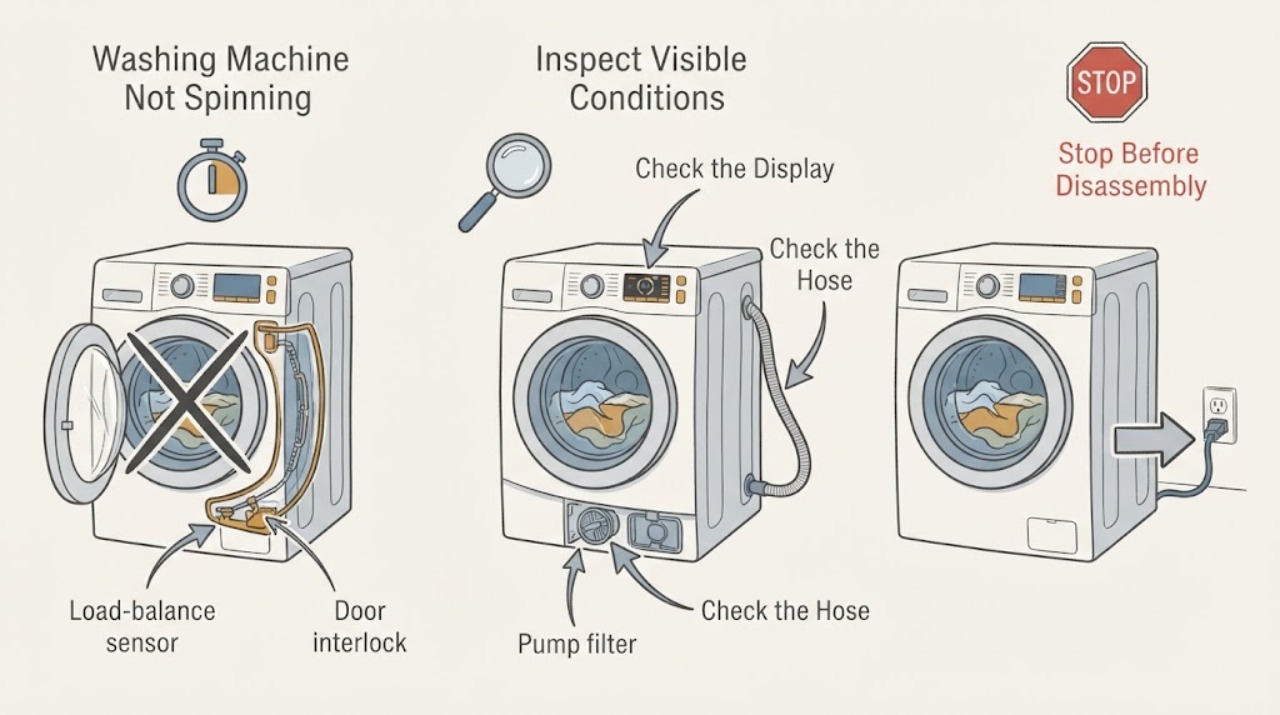
Work through in order
Diagnostic checks
Use only checks that match the exact appliance or system and its official guide.
-
Check 1
Stop the programme and observe from a safe position. Check whether the drum is still moving, water is visible, the cabinet is shaking or walking, a metal scraping or banging sound is present, or water is on the floor. Also stop for burning smell, smoke, sparks, abnormal heat, a damaged cord, or a breaker that trips again.
Expected result: Water remains, the machine is violently unstable or making metal noise, there is a leak or electrical/fire symptom, or the drum is empty and quiet.
Next step: For a hazard, stop using the washer, keep clear of wet electrical areas, isolate power only from a safe dry position, and arrange qualified help. If the drum is empty and there is no hazard, continue with the setting and load checks; if water remains, follow the drainage branch.
Why this matters
Why: Standing water can prevent the spin stage, while severe movement or metal noise can damage the appliance or surroundings. Odor, sparks, heat, water near electricity, and repeat trips are safety faults rather than ordinary spin settings.
-
Check 2
With the washer stopped, check the display and programme controls for Spin Exclusion, a zero or low spin selection, a quick-wash programme, or a cycle that has not reached its final spin. Compare the label and options with the exact Hoover manual before selecting a suitable spin or normal wash programme.
Expected result: Spin is disabled or reduced by the selected option, a quick cycle is designed for a lower spin, or the selected programme should provide a normal spin.
Next step: Choose one appropriate programme and run it only when the washer is stable, dry, and free of unsafe symptoms. If spin remains absent, record any code and continue to the water and load checks rather than repeatedly changing settings.
Why this matters
Why: Hoover states that some options turn spin off and some quick cycles intentionally use a low-speed spin, leaving clothes wetter without indicating a component failure. A normal spin programme that still cancels needs the next diagnostic branch.
-
Check 3
Check for water through the door glass or by the cycle state, without opening a locked door. If water remains, inspect the external drain hose for a kink or restriction and verify the household waste connection is not obviously blocked. If the exact model provides safe access to a pump-filter flap, disconnect the appliance from the mains, place a shallow dish and cloth below it, and clean the filter only according to that model's instructions.
Expected result: Water drains after the hose or filter path is addressed, the filter is blocked or contains debris, or water remains despite an accessible path being clear.
Next step: After safe drainage, close the filter and run one suitable spin cycle. If water remains, do not force the door or keep opening the filter; turn off the water supply if needed and arrange qualified service.
Why this matters
Why: Hoover links a no-spin symptom to incomplete drainage and directs owners to the pump filter; residual water can spill when the filter is opened. Persistent water after accessible checks points to a deeper pump, hose, or installation fault.
-
Check 4
If the drum is empty of standing water and the machine is safe, inspect the load through the door before restarting. Separate a single bulky or heavy item, spread clothing evenly, and remove only loose objects that are visibly caught in the door or drum area. Do not reach into a moving drum or add items while the machine is running.
Expected result: The load is very small, a heavy item is concentrated on one side, clothing or an object is visibly caught, or the load is reasonably balanced.
Next step: Redistribute the safe load and try one appropriate spin cycle. If the washer shakes violently, repeats the no-spin result, or makes metal noise with a balanced load, stop and arrange service.
Why this matters
Why: Hoover's balance sensor can redistribute a load, reduce the spin, or cancel it when balance cannot be restored. A balanced load that still produces scraping, grinding, or no rotation makes a mechanical or drive fault more likely.
-
Check 5
Review whether detergent or foam was excessive and whether the washer shows a code or unusually long cycle. Use the detergent quantity and programme guidance in the exact manual; do not add more detergent to compensate for wet clothes. Record the code exactly instead of guessing what it means.
Expected result: There is heavy foam, a code associated with drain or motor behavior, or no foam and no code.
Next step: Allow the programme to finish only when there is no hazard, then use the model manual for the recorded code. If the code returns or spin remains absent after the load and drain checks, stop repeated cycles and arrange service.
Why this matters
Why: Hoover manuals identify excessive foam as a condition that can abort the spin stage. A code or repeated long cycle can distinguish a control decision from a physical drain, motor, or sensor issue, but the code meaning is model-dependent.
-
Check 6
After correcting only an identified setting, load, foam, or accessible drain issue, perform one final normal spin test while staying nearby. Do not test with an empty machine if the manual does not call for it, and do not continue if there is scraping, burning odor, leakage, smoke, sparks, overheating, or a breaker trip.
Expected result: The drum reaches a stable spin and drains, or it fails to spin, stops repeatedly, scrapes, leaks, overheats, or trips power.
Next step: If the result is unsafe or the no-spin fault returns, stop using the washer and arrange qualified Hoover service. Provide the model, programme, water level, load pattern, filter and hose observations, codes, and any noise or electrical symptom.
Why this matters
Why: A successful spin after a distinct correction supports a programme, load, foam, or drain explanation. Failure after those checks points toward the door interlock, pump, motor, belt or drive, wiring, control, or another model-specific fault that needs qualified diagnosis.
Use your observations
Decision map
Find the observation that best matches what you see, then follow the next safe action.
-
PATH 01Next step
What you see
Water remains in the drum or the washer cannot complete drainage.
Do this next
Check the external hose and use the exact model's safe pump-filter procedure with power disconnected. If water persists, do not force the door or repeatedly run spin; arrange service.
-
PATH 02Next step
What you see
Spin is disabled, a low-spin option is selected, or a quick programme intentionally limits spin.
Do this next
Select one suitable programme or spin setting from the exact manual and try once when the washer is safe. If it still will not spin, continue with drainage and load checks.
-
PATH 03Next step
What you see
The load is very small, a single bulky item, or visibly unbalanced.
Do this next
Stop the programme, redistribute the safe load, and try one suitable cycle. Repeated severe shaking or no-spin with a balanced load requires service.
-
PATH 04Next step
What you see
Heavy foam is present or the washer reports a code.
Do this next
Use the exact manual for detergent and code guidance, record the code, and avoid repeated cycles. Escalate if the code returns or spin remains absent.
-
PATH 05Next step
What you see
The balanced, drained washer still makes metal scraping, grinding, or repeated drive noise, or the drum never rotates.
Do this next
Stop using it and arrange qualified service. Do not remove covers or attempt a motor, belt, bearing, wiring, or interlock repair.
-
PATH 06Next step
What you see
There is violent movement, leaking water, burning smell, smoke, sparks, abnormal heat, a damaged cord, or a breaker trip.
Do this next
Stop immediately, keep clear of water and electrical areas, isolate power only from a safe dry position, and use appropriate emergency help for fire or immediate danger. Arrange qualified service before any further test.
Helpful context
Understand the symptom
A no-spin Hoover washer is often protecting the load
The symptom is not always a failed motor. A Hoover washer can cancel or reduce spin when water has not drained, the load-balance sensor cannot distribute a small or heavy load, the selected programme limits spin, or excess foam interrupts the spin stage. Sorting the symptom by water level, load behavior, and selected setting prevents an unnecessary internal repair attempt.
Model names, filter locations, programme labels, and error messages vary. The actions below keep the owner checks external and model-directed. Never bypass a door lock, reach into a moving drum, or work on a wet appliance that is still connected to power.
When checks do not resolve it
Need a professional?
Call qualified Hoover service if the washer will not spin after safe drainage, one appropriate setting check, balanced loading, and a single corrected-cycle test., Arrange service for persistent standing water, a blocked internal drain, repeated codes, metal scraping or grinding, a drum that never rotates, or a door or pump area that cannot be safely accessed., Stop immediately for violent shaking, leaks near electrical parts, burning smell, smoke, sparks, abnormal heat, damaged wiring, or a repeat breaker trip; use appropriate emergency help for fire or immediate danger.
Common questions
FAQ
Why does my Hoover washing machine finish with wet clothes?
Check whether water remains, Spin is disabled or reduced, a quick cycle was selected, the load is too small or unbalanced, or excess foam interrupted the spin. If the washer is drained and balanced but still will not spin, arrange service.
Can water left in the drum stop the spin cycle?
Yes. Hoover identifies incomplete drainage as a no-spin cause. Check the external drain path and, only with power disconnected and the exact model instructions available, the pump-filter access. Persistent water needs qualified help.
Why does my Hoover washer spin sometimes but not every time?
A small or heavy load can be detected as unbalanced, so the balance sensor may reduce or cancel that spin. Redistribute a safe load and try once. If a balanced load still fails, service is needed.
Could the selected programme be the reason there is no full spin?
Yes. Some settings exclude spin and some quick programmes use a lower spin speed by design. Check the exact manual and garment-care guidance before selecting a normal spin-capable cycle.
What if my Hoover washer is noisy or shakes during spin?
Stop if it is violently moving or making metal scraping or grinding sounds. A small or unbalanced load can cause vibration, but persistent severe movement or metal noise should not be tested repeatedly and needs service.
When should I stop troubleshooting a Hoover washer that will not spin?
Stop for leaking water, burning smell, smoke, sparks, abnormal heat, damaged wiring, a repeat breaker trip, severe shaking, or persistent water. Do not bypass the door lock or remove covers; arrange qualified appliance service.
Read the exact guide
Official sources
- Check the drain pump filter is cleanHoover Advice Centre · Hoover washing-machine models covered by the support article; filter access and procedure vary
- Load is too small or unbalancedHoover Advice Centre · Hoover models listed on the support article; exact load limits and programmes vary
- Hoover Washing Machine Dynamic 11+ 8 Pulse DYN 11146P8CH Instruction Manual - Product Code 31005616Hoover · The DYN 11146P8CH manual; use the exact model manual for other Hoover appliances
- Not spinningHoover Advice Centre · Hoover washing machines and washer dryers covered by the Advice Centre page; controls and programme behavior vary by model
Community feedback
Share a repair observation
Share a plain-text repair observation. Accepted observations are published automatically; this page may take a moment to update.