
On this page
Start here
Quick answer
First identify whether the smell is ordinary food or stagnant-water odour, a new-appliance or detergent smell, or a burning/electrical smell. For a non-burning odour, stop the cycle, let hot steam dissipate, and use the exact Hotpoint manual to clean the accessible filter assembly and trap, remove visible food residue, and check for standing water. Hotpoint says a clogged base filter or a trapped or kinked waste hose can prevent proper emptying, and its dishwasher guidance recommends an empty hot maintenance cycle with the specified limescale product for applicable integrated models. Use only a dishwasher-safe cleaner and the model instructions; do not pour chemicals directly into the base or improvise a mixture. Confirm that the filter is locked back in place before any cycle. If water remains, the odour returns after safe maintenance, a leak or error appears, or the smell is burning, acrid, or electrical, stop using the dishwasher and arrange qualified Hotpoint service. Do not remove the pump guard, open panels, work on wiring or heating parts, or run the appliance with a missing or loose filter.
Before you begin
Safety first
- This article covers safe shutdown, cool-down, accessible filter and residue cleaning, external drain-route observation, correct filter refitting, and model-approved empty maintenance. Pumps, heaters, sensors, controls, wiring, hidden plumbing, panels, and live tests require qualified service.
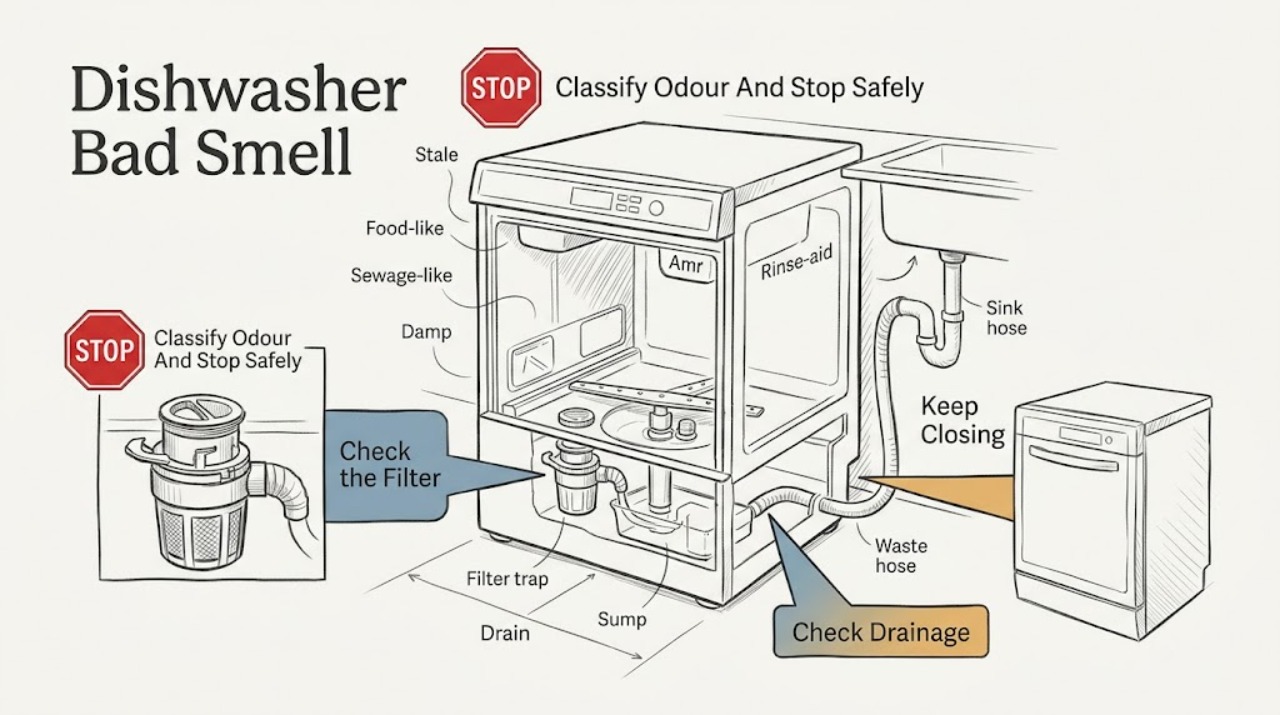
Work through in order
Diagnostic checks
Use only checks that match the exact appliance or system and its official guide.
-
Check 1
If a cycle is running, stop it using the model's normal control and wait for hot steam to clear before opening the door. Identify whether the smell is food-like or stale, sewage-like or damp, detergent or limescale, new-plastic, or burning/electrical. Note any standing water, leak, smoke, unusual noise, error indication, or hot exterior.
Expected result: The odour is ordinary and there is no heat or leak, water remains in the base, the smell is burning or electrical, or smoke, sparking, or a visible leak is present.
Next step: For a non-burning odour, isolate power before maintenance and continue with the filter and drainage checks. For burning, smoke, sparking, serious leak, or electrical damage, leave the appliance isolated and arrange qualified service.
Stop if: Do not reach into hot water or steam, restart a dishwasher with a burning or electrical smell, or continue using it with exposed wiring, smoke, sparking, or water at electrical parts.
Why this matters
Why: Food or stagnant-water odour supports an accessible filter, residue, or drain-path check. Burning, smoke, sparking, a leak near electrical parts, or abnormal heat is a safety stop; it is not a cleaning-cycle symptom.
-
Check 2
After the appliance is off and cool enough to handle, remove the racks only as needed and inspect the accessible filter assembly and trap using the exact Hotpoint manual. Look for food residue, grease, paper, glass, or a filter that is clogged, loose, or missing. Clean only with running water and a non-metallic brush where the manual permits, then lock every filter back into position.
Expected result: Food residue or grease is trapped, the filter is clogged or loose, the trap contains debris, the filter is missing, or the filter assembly is clean and correctly locked.
Next step: Remove accessible residue, rinse and refit the filter exactly as documented, and verify that it is secure before running any programme. Arrange service if the filter cannot be seated, is damaged, or the trap obstruction is not safely accessible.
Stop if: Do not operate without filters, with a loose filter, remove the wash-pump protection, use metal tools near the filter, or reach into a hidden pump or energized sump.
Why this matters
Why: Hotpoint's daily guide says the filters capture food residues and must remain clean and correctly fitted so wastewater can flow away. Residue in the filter or trap can provide a direct source of odour and restrict drainage.
-
Check 3
With power isolated and the door safe to open, observe whether water remains in the base after a completed drain programme. From the accessible area, check that the waste hose is not kinked, trapped, or installed incorrectly, and that the under-sink waste connection is open and not visibly blocked. Do not disconnect a hose or access the pump unless the exact manual explicitly provides a safe user procedure.
Expected result: Standing water remains, the hose is kinked or trapped, the sink spigot connection is blocked or still capped, the base is dry, or the drain path appears clear but the smell persists.
Next step: Correct only an obvious external hose-routing or under-sink connection issue, then run the model-approved drain or maintenance programme with the filter fitted. Escalate if water remains or the path is clear but the odour returns.
Stop if: Do not pull out an integrated appliance, loosen plumbing under standing water, probe the pump, or continue operation if water is reaching electrical connections.
Why this matters
Why: Hotpoint links failure to empty with the waste hose, under-sink spigot, and base filter. Stagnant water makes a drain or plumbing issue more likely; a dry base with continuing odour shifts suspicion toward residue, moisture retention, detergent, or an internal fault.
-
Check 4
Inspect the accessible tub bottom, door edge, rack area, and spray-arm holes for food, grease, paper, or detergent residue. Turn the spray arms only by hand when the appliance is disconnected and the model permits access; remove visible deposits with a small non-metallic brush and ensure the arms can rotate freely after refitting.
Expected result: Residue is present in the tub, filter area, or spray-arm holes; a spray arm is obstructed or cannot rotate; excess foam or detergent film is present; or the accessible interior is clean.
Next step: Remove only visible residue, refit the spray arm as the manual shows, and use the correct dishwasher detergent dose. Do not introduce household cleaners or run a chemical cycle unless the exact manual permits it.
Stop if: Do not use sharp metal tools, dismantle the spray-arm feed path, touch a heating element while hot, or continue if the arm, tub, or heater is damaged.
Why this matters
Why: Food residue and restricted spray circulation can leave organic material behind and contribute to odour. Excess foam can result from unsuitable or excessive detergent and can interfere with washing and draining. A clean accessible interior makes plumbing or internal service causes more likely.
-
Check 5
Once the filter is locked, visible residue is removed, and the drain path is not obviously blocked, check the exact Hotpoint manual for an empty hot or self-clean programme and approved limescale or dishwasher-cleaning product. Run only the documented empty maintenance cycle, then observe whether the smell and any sediment or standing water are gone.
Expected result: The model supports an empty hot maintenance cycle, the smell disappears after the cycle, the smell returns, water or sediment remains, or an error, leak, smoke, or abnormal heat appears.
Next step: Repeat maintenance only at the model's stated interval and with the specified product. If the smell returns, water remains, or an error or leak appears, stop routine cycles and arrange service.
Stop if: Do not mix cleaners, use bleach or unapproved chemicals, pour cleaner directly into the base unless the manual says to, or open the door into hot steam without caution.
Why this matters
Why: Hotpoint recommends an empty hot setting with its limescale product for applicable integrated models, and an official daily guide recommends a monthly high-temperature programme to reduce odour and sediment. A failed maintenance cycle or new safety symptom points beyond routine hygiene.
-
Check 6
After safe external checks, record the full model or 12NC, the odour description and timing, filter and drain findings, whether standing water remains, the maintenance product and programme used, and any error lights, leak, heat, noise, or cycle failure. Do not remove panels or attempt pump, heater, sensor, or control repairs.
Expected result: The smell is gone, the smell persists without a safety symptom, water remains or the dishwasher will not drain, an error indicates a pump/heater/control issue, or burning, smoke, sparking, or a leak is present.
Next step: Return to normal use only when the dishwasher drains, has no abnormal heat or smell, and all filters are correctly fitted. Otherwise keep it isolated and contact Hotpoint or a qualified dishwasher engineer with the model and observations.
Stop if: Do not continue operation for burning or electrical odour, smoke, sparks, water near wiring, repeated leaks, damaged insulation, or an unresolved internal fault.
Why this matters
Why: A resolved odour supports residue or maintenance as the cause. Persistent odour with standing water can involve the pump, hose installation, or internal drain path; error codes can identify model-specific component faults. Burning, smoke, sparking, or leaks require immediate isolation.
Use your observations
Decision map
Find the observation that best matches what you see, then follow the next safe action.
-
PATH 01Safety boundary
What you see
The smell is food-like, stale, or sour; visible residue is in the filter, trap, tub, or spray arms; and there is no smoke, abnormal heat, or serious leak.
Do this next
Isolate power, clean the accessible filter and trap with a non-metallic brush as the manual directs, remove visible residue, refit the filter securely, and use an approved empty maintenance cycle if documented.
Why this path and its safety boundary
Why it matters: Food residue or a dirty filter assembly is more likely than a failed heater or control, and the filter can also restrict wastewater flow.
Safety stop: Do not run without filters, remove the pump guard, or use unapproved chemicals or sharp tools.
-
PATH 02Safety boundary
What you see
The smell is sewage-like or damp and water remains in the base, the waste hose is kinked or trapped, the under-sink spigot is blocked or capped, or the filter is clogged with food.
Do this next
Correct only an obvious external hose or sink-connection issue, clean and lock the filter, then use the model-approved drain or maintenance programme. Arrange service if water remains or the path is not safely accessible.
Why this path and its safety boundary
Why it matters: Incomplete drainage or plumbing installation is more likely than a simple surface smell; stagnant water can keep reintroducing odour.
Safety stop: Do not disconnect plumbing under standing water, pull out an integrated dishwasher alone, or operate if water is near electrical connections.
-
PATH 03Safety boundary
What you see
The dishwasher drains normally, there is no burning symptom, and the smell is associated with infrequent use, visible sediment, limescale, excess foam, or an unsuitable or excessive detergent dose.
Do this next
Use the exact Hotpoint manual to select an empty hot or self-clean cycle and an approved limescale or dishwasher cleaner; correct detergent dosing and repeat only at the stated maintenance interval.
Why this path and its safety boundary
Why it matters: Routine hygiene, mineral deposits, or detergent residue is more likely than a pump or electrical failure, but the cleaner and cycle must be model-approved.
Safety stop: Do not mix cleaning products, pour chemicals into the sump unless documented, use bleach indiscriminately, or continue if the smell is acrid or burning.
-
PATH 04Safety boundary
What you see
The smell began immediately after installation or after a component or packing material was introduced, but there is no smoke, melting, leak, or abnormal heating.
Do this next
Check the exact manual for first-use instructions, confirm all packing and installation materials are removed by the installer, and contact Hotpoint if the smell is strong, persists, or is accompanied by heat or cycle problems.
Why this path and its safety boundary
Why it matters: A model-specific new-appliance or installation condition is possible, but the generic topic does not prove that such an odour is normal for every Hotpoint model.
Safety stop: Do not continue using the appliance if the smell becomes burning, electrical, or chemical, or if plastic is deforming or a leak appears.
-
PATH 05Safety boundary
What you see
The smell is acrid, burning, or electrical, or it occurs with smoke, sparking, a hot plug or cabinet, a leak, repeated error, pump/heater fault, or a breaker trip.
Do this next
Stop the dishwasher, isolate power from a dry and safe position, close the water supply if safe and relevant, and arrange qualified Hotpoint service. Provide the model, error indication, and symptom timeline.
Why this path and its safety boundary
Why it matters: An internal electrical, heating, pump, wiring, or water-ingress fault is possible; continued cleaning cycles cannot safely identify it.
Safety stop: Do not restart, remove panels, touch wiring or heating parts, bypass a leak or safety device, or perform a live test.
Helpful context
Understand the symptom
Separate food odour from a drain problem
A food-like or stale smell often comes from residue in the filter assembly, trap, tub, or spray arms. A sewage-like smell together with water left in the base points more strongly toward incomplete drainage or a plumbing connection. Hotpoint models differ in filter layout and controls, so record the model and use its manual before removing any component.
Use a model-approved empty maintenance cycle
Hotpoint's integrated-dishwasher support recommends an empty hot setting with its limescale product for smell prevention on applicable models, while an official daily guide recommends an empty high-temperature programme at least monthly to reduce odour and sediment. These are model- and product-specific instructions: follow the exact manual, use only a dishwasher cleaner intended for the appliance, and never mix products or pour an unapproved chemical into the sump.
Burning smell and leaks change the safe response
Do not treat an acrid, burning, or electrical smell as ordinary limescale. Stop the cycle and isolate the appliance from a dry, safe position. A persistent leak, error indication, heating fault, pump fault, or smell that returns after the filter and drain checks needs the exact model's service route rather than panel removal or a live test.
Safety boundary
Stop conditions
- Stop immediately for burning or electrical smell, smoke, sparks, melted plastic, a hot plug or damaged cord, water near electrical parts, or a repeated breaker trip.
- Do not reach into hot water or steam, open panels, touch heating parts, inspect live wiring, bypass a safety device, or attempt pump, heater, sensor, or control repair.
- Do not run the dishwasher without its filters or with a loose filter, and do not remove the wash-cycle pump protection described in the manual.
- Do not mix limescale products, bleach, vinegar, detergent, or other cleaners, and do not pour an unapproved product directly into the base or sump.
- Stop and arrange service for persistent standing water, repeated leaks, an unresolved drain blockage, or an odour that returns after model-approved maintenance.
When checks do not resolve it
Need a professional?
Arrange qualified Hotpoint dishwasher service when the filter, accessible residue, external drain route, detergent use, and model-approved maintenance cycle do not remove the smell; when standing water remains, the dishwasher will not drain, an error indicates a pump/heater/control problem, or a leak recurs. Stop immediately for burning or electrical odour, smoke, sparks, melting, a hot or damaged cord, water near electrical parts, or repeated breaker trips.
Safety scope: This article covers safe shutdown, cool-down, accessible filter and residue cleaning, external drain-route observation, correct filter refitting, and model-approved empty maintenance. Pumps, heaters, sensors, controls, wiring, hidden plumbing, panels, and live tests require qualified service.
Common questions
FAQ
Why does my Hotpoint dishwasher smell like food or sewage?
Food residue in the filter, trap, tub, or spray arms can create a stale smell. A sewage-like smell with water left in the base points more toward incomplete drainage, a kinked waste hose, or an under-sink connection problem. Check only accessible parts with power isolated and follow the exact model manual.
How do I clean a Hotpoint dishwasher filter for a bad smell?
Use the exact Hotpoint manual to remove the accessible filter assembly, inspect the trap, and clean it under running water with a non-metallic brush where permitted. Remove food residue, refit every filter correctly, and never run the dishwasher without filters or with a loose filter.
Can standing water cause a Hotpoint dishwasher to smell bad?
Yes. Standing water can keep reintroducing a damp or sewage-like odour. Hotpoint says to check the base filter, waste hose routing, and under-sink waste connection when the dishwasher will not empty. Persistent water after those safe external checks needs service.
Should I run an empty hot cycle to remove a Hotpoint dishwasher smell?
For applicable integrated Hotpoint models, official guidance recommends an empty dishwasher on a hot setting with the specified limescale product; an official daily guide also recommends a monthly high-temperature programme. Confirm the exact model and product instructions first, and do not mix cleaners.
What if my Hotpoint dishwasher smells like burning plastic or electricity?
Stop the cycle and isolate power from a dry, safe position. Do not run another test or remove panels. Burning or electrical odour, smoke, sparks, melting, a hot plug, or a leak near electrical parts requires qualified Hotpoint service.
Can I use bleach, vinegar, or household cleaner in my Hotpoint dishwasher?
Do not assume a household cleaner is safe. Use only the cleaning product and empty-cycle procedure specified by the exact Hotpoint manual; do not mix products or pour unapproved chemicals into the base. Hotpoint's support specifically names its limescale product for applicable models.
Read the exact guide
Official sources
- 400011299548 EN Daily Reference GuideHotpoint · Official Hotpoint daily guide for the model identified in the document; filter layout, programmes, and maintenance details are model-specific examples, not universal instructions.
- Integrated Dishwasher Troubleshooting & RepairHotpoint UK Appliances Limited · Official Hotpoint UK support page for integrated dishwashers; the limescale product, hot setting, and maintenance procedure must be confirmed for the user's exact model and product region.
- Hotpoint Service Help and AdviceHotpoint UK Appliances Limited · Official Hotpoint UK service hub; service availability and exact procedure depend on model and region.
- What Do Hotpoint Dishwasher Error Codes Mean?Hotpoint UK Appliances Limited · Official Hotpoint UK error-code guide; codes and LED sequences are model- and interface-specific and must not be generalized without the exact model.
Community feedback
Share a repair observation
Share a plain-text repair observation. Accepted observations are published automatically; this page may take a moment to update.