
On this page
Start here
Quick answer
First decide whether this is the small clean-water amount normally left around the rear tub outlet, drain water coming back from the sink, or fresh water entering while the dishwasher is idle. For the exact Hotpoint HDA3740G02SA, the GE parts portal identifies the model and links its owner and installation manuals; use those documents rather than a generic valve or pump procedure. If the water level is rising, reaches the filter or floor, or continues with a cycle stopped, close the dishwasher's water-supply shutoff and keep the dishwasher off. From a dry position, note whether water stops when the supply is closed, inspect only the visible air gap, sink/disposer connection, and drain-hose routing, and do not remove the kickplate, disconnect a pressurized line, or pull out the built-in unit. Persistent filling after the supply is isolated, drain backflow, a leak, or water near wiring requires qualified service or a plumber.
Before you begin
Safety first
- Do not remove the kickplate or sump cover, disconnect an inlet or drain hose under pressure, open the motor-pump assembly, bypass a float or door latch, perform live electrical tests, or pull out the built-in dishwasher with water present. Keep the water supply closed and power isolated when a leak reaches electrical parts, the cord is damaged, smoke or burning odor appears, or the tub is filling rapidly.
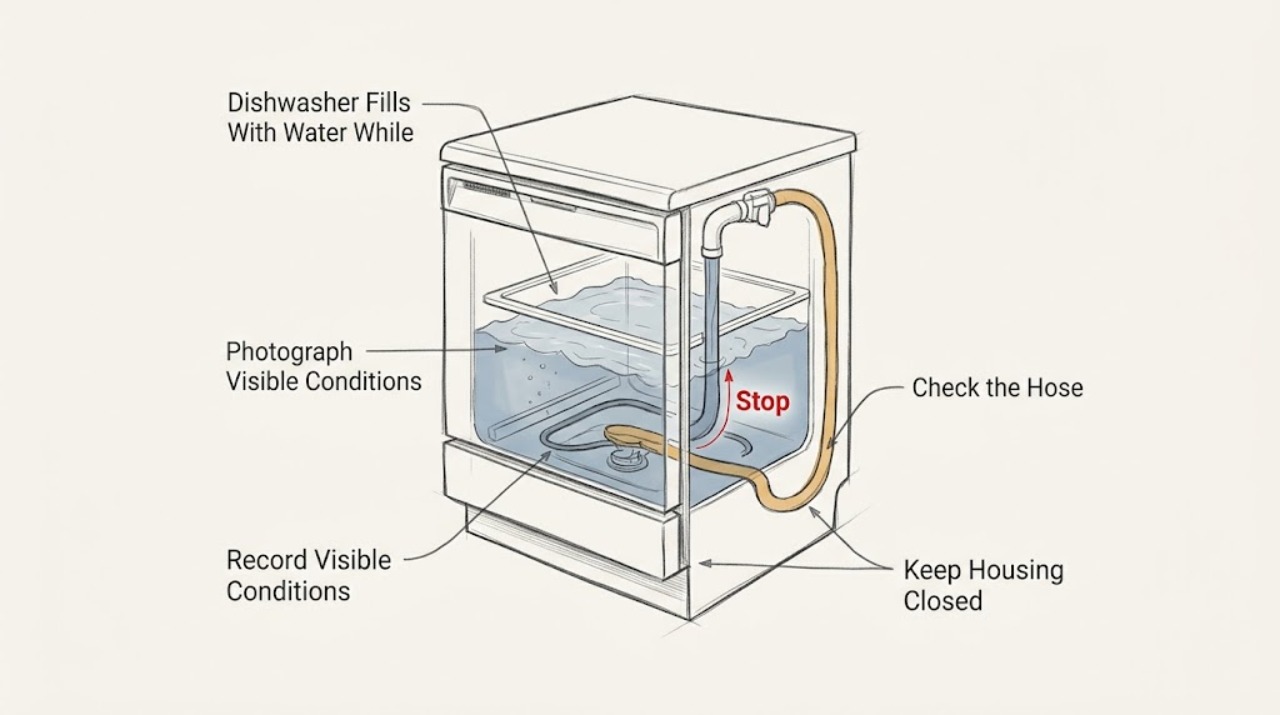
Work through in order
Diagnostic checks
Use only checks that match the exact appliance or system and its official guide.
-
Check 1
If the dishwasher is running, stop it using the normal control and wait for hot water or steam to clear. Photograph the full model label and record whether the water is clean or dirty, the level and location in the tub, when it first appears, whether it rises while idle, and whether the unit was last used about twice a month as described. If the level is rising or a leak is active, close the dishwasher water-supply shutoff from a dry, safe position and leave the appliance off.
Expected result: Only a shallow clean pool surrounds the rear outlet, water covers more of the tub or reaches the filter, dirty water returns, or clean water continues to enter while the dishwasher is idle.
Next step: Keep the dishwasher off when the level is rising, a leak is present, or water is near electrical connections. Continue only with the visible checks below; do not run a test cycle to force an overflow.
Stop if: Do not touch hot water or steam, open the lower enclosure, move the built-in dishwasher, or handle water near the cord, outlet, or wiring.
Why this matters
Why: The linked HDA-series manual treats a small clean amount at the rear outlet as normal residual water. A rising level, dirty return, or fresh water entering outside a cycle is not explained by that normal condition and needs a supply-versus-drain observation.
-
Check 2
With the dishwasher idle and its water-supply shutoff accessible, note the water level, close the shutoff fully without loosening any connection, and recheck from outside after the appliance has remained off. Do not disconnect the inlet hose or remove the valve. Record whether clean water stops accumulating, continues, or was already present before the shutoff was closed.
Expected result: Water stops after the supply is closed, water continues with the supply closed, or the result is uncertain because the shutoff cannot be safely identified or operated.
Next step: Leave the supply closed and arrange appliance service if the water stops but returns when the supply is reopened. If water continues with the supply closed, inspect the visible drain route and household sink connection, and use a plumber when the plumbing path is not safely accessible.
Stop if: Do not work on a pressurized connection, remove the kickplate, pull out an integrated dishwasher, or restart it while the water source or leak is unresolved.
Why this matters
Why: Stopping after supply isolation makes fill-side seepage or an upstream water path more plausible; continued water makes drain backflow, trapped residual water, or another plumbing route more plausible. Neither result proves a particular valve, pump, or control part.
-
Check 3
From a dry position under the sink, inspect only the visible dishwasher drain hose, its high-loop or air-gap route, the sink or disposer connection, and the surrounding cabinet for a kink, sag, loose end, standing water, or obvious backup. Do not disconnect the drain hose or probe the sink connection.
Expected result: The sink or disposer is slow or backed up, the air gap is visibly blocked, the hose is kinked or sagging, the hose connection is loose, or the visible drain path is clear and dry.
Next step: Correct only an obvious visible routing issue or clear an accessible air gap according to the exact manual. Use plumbing service for a slow sink, disposer, or household drain; arrange appliance service if the external path is clear but water returns.
Stop if: Do not pour drain chemicals into the dishwasher, remove the base or sump cover, loosen plumbing under standing water, or operate with a leak.
Why this matters
Why: The HDA-series troubleshooting guidance links failure to pump out with a clogged drain, an air gap, or a sink/disposer that does not drain. A drain-side restriction can return water to the dishwasher even when the fill system is closed; a clear visible path shifts concern toward an internal check valve, hose, or appliance fault without selecting one.
-
Check 4
After the appliance is cool, off, and dry externally, compare the amount of water with the rear-outlet area described by the owner manual. Look through the open door for water spanning the tub floor, dirty or greasy water, suds, food debris, or a waterline that is visibly higher than the small rear-outlet pool. Do not reach into the sump, pump, or wiring.
Expected result: The water is a small clean pool at the rear outlet, it covers the tub floor or is dirty, suds are present, or the level changes between observations without a cycle running.
Next step: For normal residual only, dry the visible area and record the baseline before the next use. For dirty or rising water, keep the supply closed and arrange service or plumbing diagnosis; do not use a chemical cleaner as a test.
Stop if: Do not scoop water toward electrical areas, remove the filter or sump guard, use sharp tools, or restart to see whether the level rises faster.
Why this matters
Why: A small clean rear-outlet pool is the manual's normal residual condition. Dirty water or a broad/rising pool points toward incomplete drainage or backflow; a changing clean level while idle keeps an inlet-side seepage question open. Suds can hold water and are not evidence of a failed pump.
-
Check 5
Use the exact HDA3740G02SA owner and installation manuals from the model portal to identify the drain arrangement, controls, and any owner-level reset or drain instruction. If the dishwasher is used only occasionally, note whether it completed a full drain on the last use and whether water appeared before any new cycle. Do not substitute a procedure from a different Hotpoint or GE dishwasher.
Expected result: The exact manual matches the label and documents the visible drain arrangement, the manual is unavailable or differs from the label, or the dishwasher has a persistent idle-water condition after a documented drain.
Next step: Follow only the matching manual's user-level instruction once. If water returns, a shutoff changes the result, the drain route is not accessible, or the manual cannot be matched, keep the supply closed and arrange qualified Hotpoint service or a plumber as indicated.
Stop if: Do not open enclosure panels, test live voltage, bypass a float or latch, disconnect a hose under pressure, or operate with water near electrical parts.
Why this matters
Why: The exact model portal confirms the HDA3740G02SA documentation route, while the linked HDA-series manual covers a family of controls and features that can vary. Persistent water after a confirmed drain is an appliance or plumbing diagnosis, not a reason to guess a valve or pump.
Use your observations
Decision map
Find the observation that best matches what you see, then follow the next safe action.
-
PATH 01Next step
What you see
Only a small amount of clean water surrounds the rear tub outlet, the level does not rise while idle, and there is no dirty water, leak, odor, or water near electrical parts.
Do this next
Record the level as the baseline before the next use. If the amount grows, spreads across the tub, or changes while idle, close the supply and return to the supply-versus-drain branch.
Why this path and its safety boundary
Why it matters: This matches the HDA-series manual's normal residual-water condition used to keep the water seal lubricated, not a basin-filling failure.
-
PATH 02Next step
What you see
Clean water accumulates while the dishwasher is idle and stops after the under-sink dishwasher shutoff is closed.
Do this next
Leave the water supply closed, keep the dishwasher out of use, and arrange qualified Hotpoint service. Do not remove or test the inlet valve yourself.
Why this path and its safety boundary
Why it matters: A fill-side seepage or upstream supply path is more likely than drain backflow, but the observation does not identify whether a valve, connection, or control is responsible.
-
PATH 03Next step
What you see
Water appears or continues after the supply is closed, and the sink/disposer, air gap, or visible drain hose shows a backup, kink, sag, loose routing, or other restriction.
Do this next
Use plumbing service for a blocked sink, disposer, or air-gap path and correct only visible hose routing from the manual. Keep the dishwasher off if water remains or reaches the enclosure.
Why this path and its safety boundary
Why it matters: Drain backflow or a household plumbing restriction is more likely than a continuously filling inlet, although an internal drain check or hose issue remains possible.
-
PATH 04Next step
What you see
The supply is closed, the visible drain path is clear, but the tub develops a broad or dirty pool, the dishwasher did not complete its last drain, or water returns repeatedly.
Do this next
Keep the appliance off and arrange qualified Hotpoint dishwasher diagnosis with the model, water level and cleanliness, shutoff result, last-cycle timing, drain observations, and photos. Do not remove the bottom assembly.
Why this path and its safety boundary
Why it matters: An internal drain restriction, check-valve path, pump, or another appliance fault is possible, but no part is proven from the idle-water symptom.
-
PATH 05Next step
What you see
Water reaches the floor or electrical area, a hose or cabinet leaks, the cord or plug is wet or damaged, smoke or burning odor appears, or the water level is rising rapidly.
Do this next
Stop immediately, close the water supply if safe, isolate power only from a dry safe position, keep people away from wet electrical areas, and arrange qualified appliance or electrical service. Use emergency help for an active fire or immediate danger.
Why this path and its safety boundary
Why it matters: The condition has crossed the ordinary observation boundary and presents water, electrical, fire, or property-damage risk.
Helpful context
Understand the symptom
A little water is not the same as a basin filling
The linked Hotpoint/GE owner manual says a small amount of clean water around the outlet at the back of the tub keeps the water seal lubricated. That normal residual should not spread across the tub floor, rise between uses, smell like wastewater, or appear as a steadily increasing level. Because this HDA3740G02SA is used only about twice a month, record the water level immediately after a completed drain and again before the next use instead of assuming every drop means a failed valve.
Separate supply seepage from drain backflow
When water appears while the dishwasher is idle, closing the accessible supply shutoff is a useful low-risk observation. If clean water stops accumulating after the supply is closed, a fill-side seepage or upstream supply issue becomes more plausible; do not dismantle the inlet valve. If water still appears with the supply isolated, look for sink or disposer drain backflow, an air-gap problem, or another plumbing path. The shutoff observation is not a license to remove the bottom panel or disconnect plumbing under water.
When checks do not resolve it
Need a professional?
Arrange qualified Hotpoint dishwasher service when clean water returns after the supply is reopened, the tub fills while idle, water remains after a documented drain, the visible drain path is clear but backflow continues, or diagnosis requires the inlet valve, pump, check-valve path, float, control, wiring, or enclosure access. Use a plumber for a blocked sink, disposer, air gap, or household drain.
Safety scope: Do not remove the kickplate or sump cover, disconnect an inlet or drain hose under pressure, open the motor-pump assembly, bypass a float or door latch, perform live electrical tests, or pull out the built-in dishwasher with water present. Keep the water supply closed and power isolated when a leak reaches electrical parts, the cord is damaged, smoke or burning odor appears, or the tub is filling rapidly.
Have this ready
- Provide the exact HDA3740G02SA model and serial information, label and console photos, the water's cleanliness and level, whether it appears while idle, the result of closing the supply shutoff, last-cycle drain behavior, sink/disposer and air-gap observations, drain-hose routing, and any leak, odor, heat, noise, or electrical symptom.
Common questions
FAQ
Is a little water in the bottom of the Hotpoint HDA3740G02SA dishwasher normal?
A small amount of clean water around the rear tub outlet can be normal because the HDA-series manual says it keeps the water seal lubricated. Water that spreads across the tub, rises between uses, is dirty, or reaches the floor is not the same baseline condition.
What should I do if clean water enters the dishwasher while it is off?
Close the dishwasher's accessible water-supply shutoff from a dry position and leave the unit off. If accumulation stops, a fill-side seepage or supply path is more likely; arrange service without removing the inlet valve. If it continues with the supply closed, inspect only the visible drain route and use a plumber for household drain backflow.
Can infrequent use cause water to appear in the dishwasher?
The linked HDA-series manual says an infrequently used dishwasher can be set to fill and pump out periodically to keep the seal moist. That maintenance note does not explain a rising tub while idle; a rising level still needs the supply-shutoff and drain-backflow distinction.
Should I replace the water inlet valve or drain pump?
Not from the symptom alone. A shutoff observation can separate a fill-side pattern from continued drain-side water, but it cannot identify a specific part. Keep the supply closed when water returns or rises and have qualified service verify the exact model and cause.
Read the exact guide
Official sources
- Owner's Manual - ADW1000, GSD1000/GSD2000/GSD3000/GSD4000, HDA1000/HDA2000/HDA3000 Series DishwashersGE Appliances / Hotpoint · Official manufacturer-hosted HDA-series manual linked from the exact HDA3740G02SA model page. It supports normal residual water, infrequent-use fill/pump-out guidance, and drain troubleshooting at the documented family scope; it does not authorize internal disassembly.
- Model Search | HDA3740G02SAGE Appliances Parts · Official GE Appliances Parts model page that explicitly identifies the assigned Hotpoint HDA3740G02SA dishwasher and links its owner and installation documents; it is used for exact identity, not as permission to open the appliance or guess a part.
- DW Install for pdfGE Appliances / Hotpoint · Official manufacturer-hosted installation document linked from the exact HDA3740G02SA model page; used only for the installation/manual identity boundary and safe external drain-routing context.
- Dishwashers - Troubleshooting TipsGE Appliances · Official manufacturer dishwasher guidance used for the common drain-side distinction: normal small rear-outlet residual water versus a blocked air gap, sink, disposer, or household drain. It is not used to infer an HDA3740G02SA-specific part.
Community feedback
Share a repair observation
Share a plain-text repair observation. Accepted observations are published automatically; this page may take a moment to update.