
On this page
Start here
Quick answer
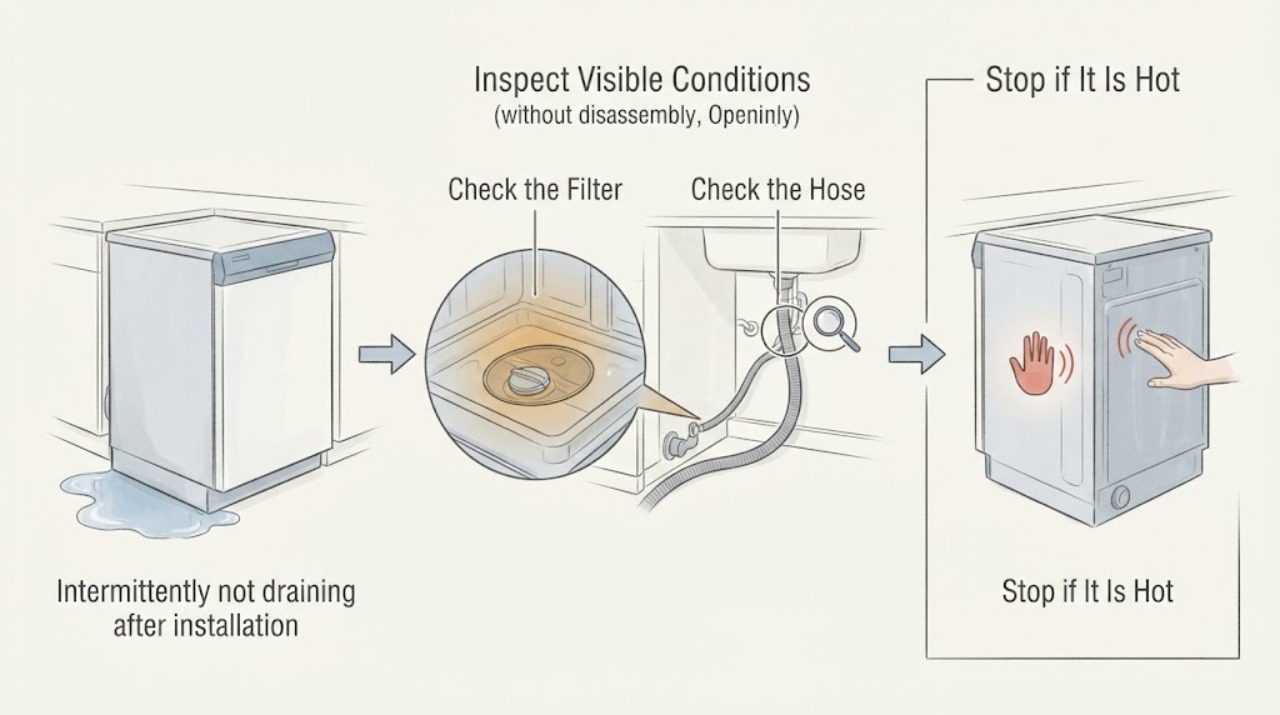
The Hotpoint LTB 4M116 is a built-in dishwasher, so intermittent draining after installation should be checked at the accessible filter, the visible waste-hose route, and the under-sink dishwasher connection before anyone pulls the appliance from its cabinet. With the dishwasher switched off and unplugged, check whether the cycle actually ended, inspect and refit the user-accessible filter, and look for a kinked or trapped drain hose. Hotpoint's LTB 4M116 instructions specify a drain-hose height of 40–80 cm, removal of the sink-spigot bung or membrane, and a secure waste connection; an installation restriction can therefore appear only on some cycles. If the filter, visible hose and sink branch are clear but water remains or the fault returns, leave the integrated appliance off and arrange qualified service rather than opening the pump or guessing a replacement part.
Work through in order
Diagnostic checks
Use only checks that match the exact appliance or system and its official guide.
-
Check 1
Before moving the dishwasher, record the full model and any market or product-code suffix from the data plate, the programme, the point at which it stops, the water level, and the exact display or flashing LED pattern. Observe from a normal standing position whether the sink itself drains normally.
Expected result: Water remains after a cycle, the interruption is only intermittent, the sink drains normally or slowly, the tub is empty, or a particular code/light sequence returns.
Next step: Use the exact model/manual and the relevant branch below. Do not start by ordering a pump or by pulling the integrated dishwasher out of its cabinet.
Stop if: Stop immediately for an active leak or overflow, smoke, burning smell, sparks, a hot or damaged cord, repeated breaker trips, or water near electrical parts.
Why this matters
Why: The water level and timing distinguish an actual drain-path symptom from a programme or interface report. The LTB 4M116 manual warns that controls and indicator layouts can vary by model, so an unverified LED pattern cannot be translated safely.
-
Check 2
Switch the dishwasher off and unplug it before examination. Following the LTB 4M116 instructions, remove only the accessible filter assembly, inspect it for food or other visible debris, rinse it with water and a non-metallic brush if needed, and refit every filter correctly. Keep a towel or shallow container ready for residual water.
Expected result: The filter is blocked, loose, damaged or missing, the filter area is clear, or residual water is hot, contaminated or too deep to handle safely.
Next step: Use the dishwasher only with the filter assembly correctly installed. If the filter is damaged, the sump cannot be inspected safely, or the symptom persists, keep power off and arrange service.
Stop if: Do not reach into the pump, probe the sump, use sharp tools to dig for debris, run without filters, or work while the appliance is connected to power.
Why this matters
Why: The model manual lists a clogged filter as a direct cause of water not draining. A clear filter only removes one accessible possibility; it does not prove that the protected pump or hidden sump passage is healthy.
-
Check 3
With power disconnected, inspect only the visible drain-hose route at the cabinet or under-sink area for a sharp kink, crushing, sagging, or a height that is inconsistent with the LTB 4M116 installation instructions. Do not pull the integrated appliance forward just to reach a hidden section.
Expected result: The hose is visibly trapped, kinked, crushed, routed too low or otherwise stressed, or the route cannot be seen without moving the dishwasher.
Next step: Correct only an obvious accessible kink without stressing a connection. If the hose is hidden, damaged or still fails to drain after a visible correction, stop and have the integrated installation inspected by a qualified technician.
Stop if: Do not drag or tilt the built-in dishwasher, disconnect a wet or pressurized connection, straighten a hose by force, or restart with water around the plug or socket.
Why this matters
Why: The LTB 4M116 manual specifies a 40–80 cm outlet-hose height and says the hose must not be bent or compressed. A marginal installation fault can cause intermittent drainage as flow and hose position change; a hidden restriction remains unverified.
-
Check 4
If the drain hose joins the sink plumbing, inspect the dishwasher branch externally with power off and a bowl or towel ready. Confirm that the sink-waste spigot's blanking bung or membrane was removed during installation and look for an accessible food or grease obstruction; do not dismantle a leaking fitting.
Expected result: The dishwasher branch is still blanked, visibly obstructed, loose or leaking, the sink basin drains slowly, or the branch appears clear while the sink drains normally.
Next step: Have an installation or plumbing issue corrected with power off and water contained. If the connection is sound but the tub remains full, leave the appliance off and arrange qualified appliance service.
Stop if: Do not cut plumbing, force a fitting, loosen a leaking valve, disconnect the hose, or reconnect power while water is present near the socket or appliance wiring.
Why this matters
Why: Hotpoint specifically identifies a retained spigot bung or a blocked under-sink connection as a reason a dishwasher will not empty. A clear sink does not prove that the dishwasher branch is open, and a clear branch does not prove the internal pump path is sound.
-
Check 5
Compare the exact display or LED sequence only with the LTB 4M116 manual or Hotpoint's official dishwasher code page. Treat F03 or the published LED1+LED2 drain-timeout pattern as a drain-system clue, not as proof of a failed pump; do not enter a service mode or repeat cycles to force the code.
Expected result: The model-matched material confirms a drain timeout, a different code, an overflow indication, an unknown LED sequence, or no code while water remains.
Next step: For a persistent F03 or any other recurring code after the external checks, give the technician the exact model, code, water level, hose/filter findings and installation history. Use the overflow branch immediately if water is escaping.
Stop if: Do not bypass an anti-flood device, remove the base, inspect an impeller with tools, probe connectors or perform live electrical tests.
Why this matters
Why: Hotpoint separates F03 water-drain failure/timeout from F01 anti-flooding overflow, F02 fill-valve, F04 thermostat, F06 fill-timeout and other categories. A code narrows the service path but does not identify a user-replaceable component.
-
Check 6
After the filter, visible hose and sink-branch checks, document whether the tub actually empties, whether the interruption returns on the same or different programmes, and whether any abnormal pump noise, silence, leak or overflow is observed. Do not deliberately reproduce a leak or keep running a machine with standing water.
Expected result: The tub empties after an installation correction, the fault returns intermittently, the tub stays full despite a clear accessible path, the pump sounds abnormal or silent, or water escapes.
Next step: Leave the dishwasher disconnected for hazards and arrange qualified Hotpoint/appliance service with the exact model and documented observations. A repair-or-replace decision should follow inspection and the appliance's actual condition, not a guessed component or a price assumption.
Stop if: Do not repeatedly restart, pull out the integrated appliance, tilt it, open the pump/base, or continue use with a leak, overflow, burning smell, sparks or water near electrics.
Why this matters
Why: A recovered drain after correcting the visible route supports an installation or external obstruction. Persistent standing water can involve a hidden hose restriction, drain pump, pump wiring, water-level sensing or control; the symptom cannot safely identify which one.
Use your observations
Decision map
Find the observation that best matches what you see, then follow the next safe action.
-
PATH 01Next step
What you see
The dishwasher drains after the filter is correctly refitted or an obvious accessible hose kink or sink-spigot restriction is corrected.
Do this next
Document the corrected condition and monitor normal cycles without moving the appliance. If intermittent standing water returns, arrange service and report the installation change.
Why this path and its safety boundary
Why it matters: An accessible obstruction or installation condition is more likely than a confirmed internal pump failure, especially when the fault began after the dishwasher was fitted in a new place.
-
PATH 02Next step
What you see
The filter, visible hose and under-sink dishwasher branch are clear, but water remains or a matching F03 drain-timeout indication returns.
Do this next
Keep the integrated dishwasher off and arrange qualified service with the exact model/product code, code or LED pattern and all external-check results.
Why this path and its safety boundary
Why it matters: The remaining possibilities include a hidden hose restriction, protected drain pump, wiring, water-level sensing or control issue. F03 does not select a pump part by itself.
-
PATH 03Next step
What you see
The sink drains normally but the dishwasher branch is blanked, loose, leaking or obstructed, or the hose route is hidden behind the cabinet.
Do this next
Have the under-sink or integrated installation corrected by a qualified person with power off and water contained; do not force the appliance out.
Why this path and its safety boundary
Why it matters: The dishwasher can fail to empty through its dedicated installation branch even when the sink basin is clear. A concealed route cannot be verified without moving the built-in appliance.
-
PATH 04Next step
What you see
There is active leakage or overflow, water near electrical parts, smoke, burning smell, sparks, repeated breaker trips, or a fault is reported as F01 anti-flood rather than F03.
Do this next
Stop the programme. Disconnect power only if it is safe to reach the plug or breaker without contacting water, close the water supply if water is continuing to enter, protect nearby electrics and arrange qualified service.
Why this path and its safety boundary
Why it matters: This is a water-safety or electrical-safety branch, not an ordinary filter-cleaning problem.
-
PATH 05Next step
What you see
The tub is empty but a different code or LED pattern is present, or the dishwasher stops before a drain stage on some programmes.
Do this next
Record the sequence exactly and match it to the exact manual. Do not apply the F03 path or order drain parts until the code and water-level symptom agree.
Why this path and its safety boundary
Why it matters: An empty tub alone does not establish a drain failure. Hotpoint assigns separate paths to fill, heating, wash-pump, anti-flood and communication indications, and the LTB 4M116 manual says indicator layouts vary.
Helpful context
Understand the symptom
Why a new installation can fail intermittently
Hotpoint's LTB 4M116 manual identifies this as a built-in 14-place dishwasher and gives installation-specific drain routing: the outlet hose should be 40–80 cm above the floor, free of bends or compression, and connected to an unrestricted sink waste with its sealing bung or membrane removed. A hose that is only marginally trapped, a sink spigot that is still blanked, or an integrated appliance that was not fully seated can behave differently as the hose fills or the cabinet shifts. The symptom is not proof that the drain pump has failed.
Start with the water level and exact model identity
Record the complete data-plate model as LTB 4M116 or any additional market suffix, the selected programme, when the interruption occurs, whether the tub is full or nearly empty, and the exact display or LED pattern. Hotpoint's manuals state that controls and indicators can vary by model; do not copy an LED sequence from another dishwasher. A tub that is empty but reports a fault is a different decision from standing water after a drain stage.
When checks do not resolve it
Need a professional?
Arrange qualified Hotpoint or appliance service when the accessible filter, visible hose and sink branch are clear but standing water or a recurring drain code remains; when the pump area, wiring, base or hidden hose would need access; or when an integrated dishwasher must be moved. Provide the complete model/product code, installation history, programme, water level, code or LED sequence and the results of the safe external checks. Do not make a repair-or-replace decision from a guessed pump, a cross-model code table or a price assumption.
Common questions
FAQ
Why would the Hotpoint LTB 4M116 drain only sometimes after being installed in a new place?
An installation restriction can be intermittent: a drain hose may be trapped or routed at the wrong height, or the dishwasher branch on the sink waste may still have a bung or membrane. Check only the visible route and accessible sink connection with power off; do not pull the integrated appliance.
Does an F03 or a flashing drain light prove that the drain pump needs replacement?
No. Hotpoint describes F03 as a water-drain failure or timeout and first directs attention to the drain pipe and under-sink plumbing. A persistent code after those checks needs model-specific service; it does not prove which internal component failed.
Can I pull out the integrated dishwasher to straighten the hose?
Not as a first user check. The LTB 4M116 manual says water and electrical connections should be performed by a qualified technician, and a built-in appliance can expose water or electrical hazards when moved. Escalate if the hose cannot be inspected without moving it.
Read the exact guide
Official sources
- Instructions for use: LTB 4M116Hotpoint · Official Hotpoint/Whirlpool-hosted manual for the LTB 4M116 built-in dishwasher; use any additional model or market suffix on the data plate to select the matching manual where available.
- Hotpoint Dishwasher Error CodesHotpoint · Official Hotpoint dishwasher code reference used only to distinguish drain timeout and overflow from other code families; exact LED layouts must be matched to the appliance manual.
- Hotpoint Service Integrated Dishwasher RepairHotpoint · Hotpoint's official integrated-dishwasher support page; used for filter, waste-hose and under-sink spigot checks, not as proof of an internal component failure.
Community feedback
Share a repair observation
Share a plain-text repair observation. Accepted observations are published automatically; this page may take a moment to update.