
On this page
Start here
Quick answer
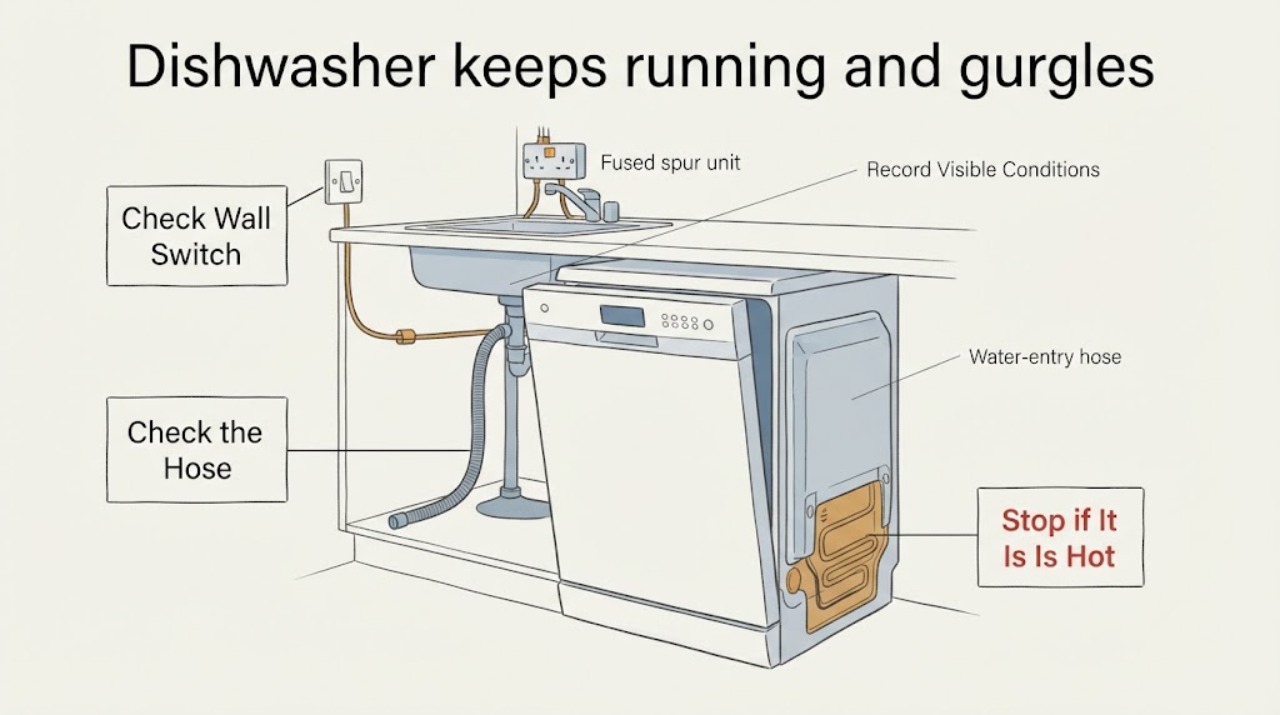
A Hotpoint LFT228A that keeps running after a cycle should have ended, or that gurgles and pumps while supposedly switched off, needs a safe state check rather than repeated resets. Do not open the fused spur, remove its fuse carrier, pull the integrated dishwasher, or test live wiring. From a dry, safe position, confirm that the correctly identified appliance isolator is off and record whether the sound, controls, or water level actually change. If water slowly enters while the machine is off, or sink discharge is followed by gurgling and pump-out, a drain backflow or water-entry path is possible; if power restoration resumes a cycle with no new selection, record that as a persistent control/cycle-state symptom. Keep the appliance out of use and arrange qualified appliance service, with an electrician involved if the isolation point or wiring is uncertain.
Work through in order
Diagnostic checks
Use only checks that match the exact appliance or system and its official guide.
-
Check 1
Stop selecting cycles and write down the exact timeline: when the LFT228A was last started, when it should have ended, whether the sound is a low gurgle, pump-like hum, drain rush, or harsh noise, and whether it occurs during a wash, drain, or while no cycle is selected. Do not run another cycle just to reproduce it.
Expected result: The sound is confined to a documented wash or drain phase, persists with no cycle selected, or appears periodically while the tub is supposed to be idle.
Next step: Use the water-state and isolation checks below, then keep the machine off if the sound is persistent, harsh, or accompanied by water or electrical symptoms.
Stop if: Stop immediately for smoke, burning odor, sparks, a hot or damaged cable, leaking water near electrics, severe scraping, or movement of the integrated appliance.
Why this matters
Why: A phase-linked sound can be water or motor operation, but a persistent no-cycle symptom or periodic pump-out is not explained by ordinary end-of-cycle noise. The timing determines whether to investigate water movement or an apparent control/isolation problem.
-
Check 2
From a dry, safe position, identify the fused spur or protective device that actually supplies this dishwasher and switch it off only by its normal external control. Do not remove the fuse carrier, open the spur, open a distribution board, touch wiring, or use a meter. Note whether any dishwasher display, pump sound, or other appliance changes.
Expected result: The dishwasher becomes completely silent with the correct isolator off, or the sound appears to continue and the correct supply cannot be confidently identified.
Next step: Leave the appliance isolated. If the correct isolator is uncertain or wiring is abnormal, use a qualified electrician; otherwise give the appliance technician the exact isolation result and timeline.
Stop if: Do not continue if the spur is hot, damaged, wet, loose, buzzing, or cannot be operated without contacting exposed electrical parts.
Why this matters
Why: No dishwasher motor or pump should be assumed to operate without its supply. If the sound continues, the point may be wrong, the sound may be water/drain related, or isolation may be unsafe or uncertain; this is not a basis for opening the appliance.
-
Check 3
With power isolated and without moving the integrated dishwasher, look only at the visible tub water level and the accessible area under the sink. Note whether water rises while the machine is off, whether a gurgle or pump-out follows sink discharge, and whether the visible drain hose is kinked, crushed, or routed contrary to the exact manual. Do not loosen a water or drain connection.
Expected result: Water slowly returns while off, the tub or sump fills and then gurgles/pumps out, sink use precedes the sound, or no water-level change is visible.
Next step: If water is entering or a leak is present, close the dishwasher water tap from a safely accessible position and leave the machine isolated. Have a qualified appliance technician or plumber assess the drain arrangement; do not pull or tilt the appliance.
Stop if: Do not touch wet electrical areas, reach into standing water, remove the sump or pump cover, or conduct a test by running the sink or dishwasher repeatedly.
Why this matters
Why: Water movement while off makes a drain backflow or water-entry path more plausible than a normal cycle sound. Hotpoint also identifies waste-hose installation, the under-sink waste-spigot connection, and an accessible base filter as relevant to emptying problems; a visible hose fault does not prove which internal part failed.
-
Check 4
If the appliance is dry and power remains isolated, inspect only the visible under-sink waste connection and the base filter area if the exact LFT228A manual authorizes access. Look for a trapped or kinked waste hose, an unremoved or blocked waste-spigot connection, or accessible food residue. Do not dismantle the integrated unit or add chemicals.
Expected result: A visible waste route is kinked or incorrectly connected, the authorized filter is blocked or loose, or those visible paths are clear.
Next step: Correct only a visible routing issue or refit the filter exactly as the model manual states. If the tub fills, the sound returns while idle, or the appliance still will not finish, leave it off and call service.
Stop if: Do not slide, tilt, disconnect, or force an integrated dishwasher, and do not reach toward the pump, wiring, or concealed hose connections.
Why this matters
Why: Hotpoint says these visible drainage conditions can prevent emptying. Correcting a plainly visible, owner-accessible routing issue may remove a drain restriction, but a clear path with continued gurgling or unexpected pump activity remains a service symptom.
-
Check 5
If there is no leak, smoke, odor, heat, or electrical concern, record what happens after one authorized return to service only if the exact manual or technician permits it: does the LFT228A resume a previous cycle without a new selection, complete normally, immediately pump, or remain silent? Do not use repeated power cycling as a test.
Expected result: A previous cycle resumes with no new selection, the pump starts immediately, the cycle completes normally, or the symptom returns after the single observation.
Next step: Keep the dishwasher out of use if it resumes unexpectedly, runs beyond the normal cycle, or pumps while idle. Give service the exact model, spur state, water state, cycle selection, and timing.
Stop if: Do not reset repeatedly, open the door into hot water or steam, enter a hidden service mode, or continue if any hazardous symptom appears.
Why this matters
Why: Resuming without a new selection is a control/cycle-state observation that is distinct from a drain backflow; immediate pumping with changing water level points back to the water path. Neither observation identifies a control board, valve, pump, or programmer for replacement.
-
Check 6
Prepare the service handoff: photograph the LFT228A model label and 12NC if visible without moving the unit, record the fused-spur arrangement, the exact sound and phase, water-level changes, sink-drain timing, visible hose/filter findings, and any prior work. Do not name a replacement part from the symptom.
Expected result: The issue is persistent, returns after the visible checks, or involves a leak, unexplained pump activity, unexpected cycle resumption, or uncertain electrical isolation.
Next step: Arrange Hotpoint or qualified appliance service; use a qualified electrician for any fused-spur, breaker, cable, or isolation concern. Keep the dishwasher isolated until assessed.
Stop if: Do not restore power to a wet or damaged installation, pull the integrated machine, or perform live or internal tests.
Why this matters
Why: The exact timeline distinguishes drain/backflow, water-entry, supply isolation, and control-state possibilities while avoiding an unsupported component diagnosis.
Use your observations
Decision map
Find the observation that best matches what you see, then follow the next safe action.
-
PATH 01Next step
What you see
The sound stops when the correctly identified fused spur is switched off, and no water level changes while the dishwasher is isolated.
Do this next
Leave the dishwasher off and arrange model-specific service if it was running without a valid selection or beyond its expected cycle. Do not repeat the cycle to confirm.
Why this path and its safety boundary
Why it matters: The observation is consistent with an electrically powered dishwasher activity, but it does not identify whether the prior cycle state, a drain pump, or a control fault caused it.
-
PATH 02Next step
What you see
Gurgling or pump-out occurs while the machine is off, water slowly returns to the tub/sump, or sink discharge precedes the sound.
Do this next
Close the appliance water tap if safely accessible, keep power isolated, and have the drain installation and appliance checked by a qualified technician or plumber. Do not pull or tilt the integrated unit.
Why this path and its safety boundary
Why it matters: This matches the distinctive water-movement pattern reported for an exact LFT 228 A and makes drain backflow or another water-entry path more plausible than a normal wash sound; the community suggestion of a high-loop check is not a confirmed repair.
-
PATH 03Next step
What you see
The visible waste hose, under-sink spigot connection, and manual-authorized filter area show a restriction or incorrect routing, with no electrical or leak hazard.
Do this next
Correct only the plainly visible issue as the exact manual permits. If unexpected pumping, gurgling while idle, or an uncompleted cycle remains, stop and request service.
Why this path and its safety boundary
Why it matters: Hotpoint's guidance makes a visible drain-path issue a reasonable first explanation for poor emptying, but it does not prove that the internal pump or another part is faulty.
-
PATH 04Next step
What you see
The correct isolation point is uncertain, the spur is damaged/hot/wet, or the sound appears to continue after switching it off.
Do this next
Do not touch the spur or wiring. Keep clear and obtain qualified electrical help, then appliance service if the LFT228A symptom remains.
Why this path and its safety boundary
Why it matters: This is an electrical-isolation or source-identification hazard, not permission to open the fused spur or dishwasher. The sound could also be water moving in the drain system or another appliance.
-
PATH 05Next step
What you see
After power is safely restored once, the LFT228A resumes a previous cycle without a new selection, runs indefinitely, or immediately pumps again.
Do this next
Stop repeated testing, isolate the appliance if safe, and provide service with the full timeline, water state, model/12NC, and spur result.
Why this path and its safety boundary
Why it matters: This is a persistent control/cycle-state or water-path symptom. The exact Reddit report documents the same kind of unexpected resumption, but it has no confirmed repair outcome; no board, valve, pump, or programmer is established.
-
PATH 06Next step
What you see
There is a leak, water near electrics, smoke, burning odor, sparks, a hot cable/spur, a repeated protective-device trip, or the integrated appliance moves.
Do this next
Stop using it. Isolate power and water only from a safe, dry position without touching damaged parts, then obtain urgent qualified appliance/electrical help.
Why this path and its safety boundary
Why it matters: Water, fire, electrical, and installation hazards override sound or cycle diagnosis.
Helpful context
Understand the symptom
Treat the fused spur as an isolation question, not a repair point
The LFT228A is identified on Hotpoint's official model page, but the page is a parts lookup rather than a diagnosis. Hotpoint's manuals portal says to locate the exact product document using the first five model digits or 12NC. Because this dishwasher is hardwired, do not remove a fuse, open the spur, expose terminals, or assume that a nearby switch controls this appliance. If the sound continues with the correctly identified isolator off, the observation may be a wrong isolation point, another appliance or drain making the sound, or water-driven pump activity observed before isolation; it is not proof that a dishwasher component can run without power.
Separate water backflow from a control or cycle-state symptom
Two exact LFT 228 A community reports give different timelines. One reports slow water ingress into the sump while the dishwasher is off, followed by a gurgle and periodic pump-out; a reply suggests checking whether the drain hose has a high loop before treating the water valve as a possibility. The other reports the appliance resuming a cycle after a fused spur was off for a week. These observations are useful routing clues, not proof of a failed valve, pump, board, or programmer. Watch the water state and the timing of sink discharge separately.
Only use visible, model-authorized checks
Hotpoint's current dishwasher guidance points to visible waste-hose installation, the under-sink spigot connection, and the accessible base filter for an emptying problem. Those checks do not authorize pulling an integrated LFT228A, tilting it, dismantling the pump or sump, or making a live voltage test. Water near electrical parts, a hot cable, burning smell, smoke, sparks, or a leak changes the task to immediate isolation and qualified service.
When checks do not resolve it
Need a professional?
Call qualified Hotpoint or appliance service when the LFT228A resumes a cycle without a new selection, runs beyond its expected cycle, pumps or gurgles while idle, water returns while off, the tub remains full, visible drain checks do not resolve the issue, or any internal pump, valve, control, or wiring fault is suspected. Use a qualified electrician for a hot, damaged, wet, uncertain, or incorrectly identified fused spur or supply.
Have this ready
- Provide Hotpoint LFT228A and any visible 12NC, the hardwired/fused-spur arrangement, exact isolation result, cycle selection and stage, sound description, water-level changes, sink-drain timing, visible waste-hose/spigot/filter observations, leaks or odors, and the complete before/after timeline.
Common questions
FAQ
Can a Hotpoint LFT228A pump run when the fused spur is off?
Do not assume that it can. Confirm from a dry, safe position that the correct appliance isolator is off, without opening the spur or testing live wiring. If the sound remains, it may be water moving in the drain system, another appliance, or an uncertain isolation point; use qualified electrical and appliance help rather than opening the dishwasher.
Why does the LFT228A gurgle and pump while it is switched off?
An exact LFT 228 A community report describes slow water entering the sump while off, followed by gurgling and pump-out. That pattern makes drain backflow or another water-entry path worth checking, but it does not prove a water valve or pump failure. Keep the machine isolated and have the drain arrangement assessed.
What should I check under the sink?
Only inspect visible routing from a safe position: Hotpoint directs owners to correct waste-hose installation, the under-sink waste-spigot connection, and the accessible base filter for an emptying problem. Do not loosen connections, pull an integrated LFT228A, tilt it, or reach into the pump or sump.
Should I replace the pump, water valve, or control board?
No. The exact reports provide timelines, not a confirmed repair, and Hotpoint's visible drainage guidance does not identify an internal part from a gurgle. Give service the model/12NC, isolation result, water state, sink timing, cycle behavior, and any visible drain findings.
Read the exact guide
Official sources
- Dishwasher filling with water when offReddit r/Appliances · Exact Hotpoint LFT 228 A community report of off-state water ingress, gurgling, and pump-out; community evidence only.
- Get Hotpoint Appliance Manuals - Quick & Easy Downloads - HotpointHotpoint UK Appliances Limited · Hotpoint LFT228A manual lookup and exact model/12NC document identification; model-specific instructions remain required before access or reset.
- Spare part for model LFT228A - 37490380000 - HotpointHotpoint UK Appliances Limited · Exact Hotpoint LFT228A model identity and manufacturer parts/model lookup; the page is not an internal fault diagnosis.
- Dishwasher Troubleshooting & Repair ServiceHotpoint UK Appliances Limited · Hotpoint LFT228A topic evaluated against current Hotpoint dishwasher drainage and supply guidance; exact LFT228A behavior remains manual-dependent.
- Hotpoint LFT228AReddit r/appliancerepair · Exact Hotpoint LFT228A community report of not stopping, gurgling, fused-spur isolation, and unexpected cycle resumption; community evidence only.
Community feedback
Share a repair observation
Share a plain-text repair observation. Accepted observations are published automatically; this page may take a moment to update.