
On this page
Start here
Quick answer
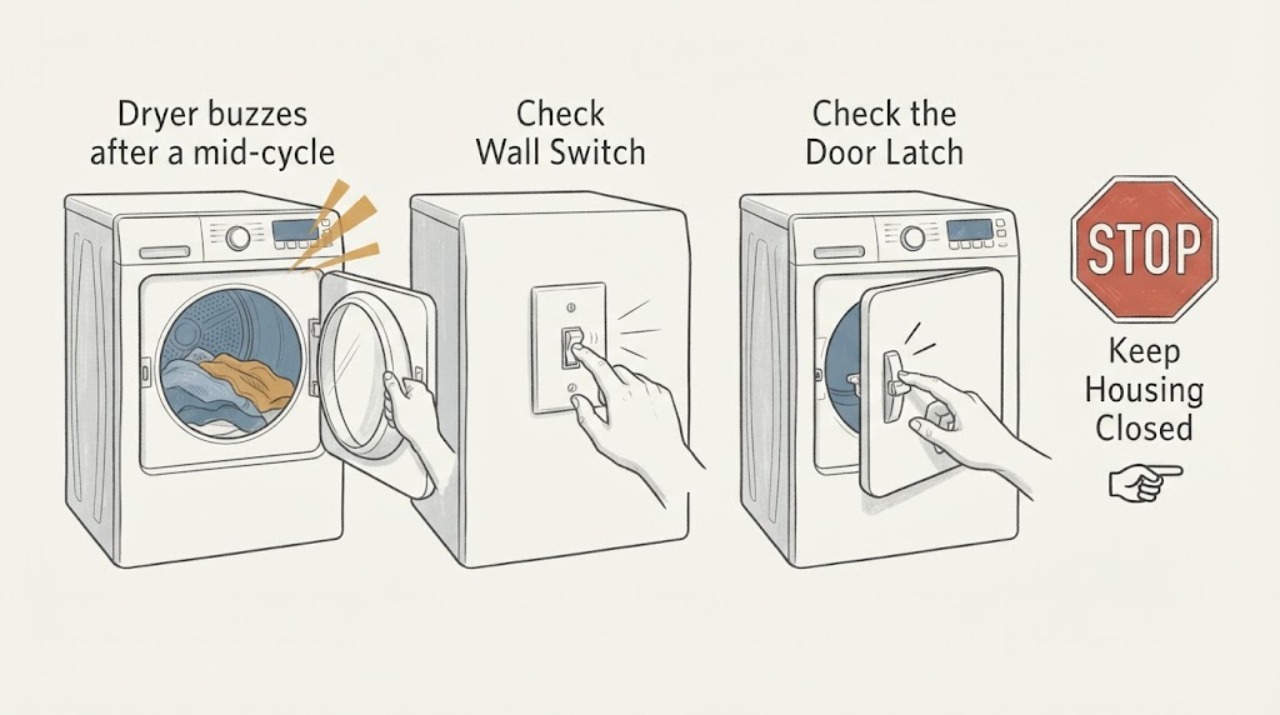
Stop using this older Hotpoint electric dryer. If opening the door during a cycle left a low buzz, left the heating element visibly energized, and the drum would only turn after the cabinet was tapped or the drum was moved, do not tap it, spin it, or run another test. GE/Hotpoint-family guidance says opening the door stops the dryer and that a dryer that will not start should be screened only through accessible power, control, and door checks. A heater remaining energized while the drum is stopped is an abnormal safety signal, not proof of a bad motor, relay, belt, or control board. Leave the dryer de-energized and arrange qualified service; report that a cold start may work but a mid-cycle door opening produced the buzz and delayed restart.
Work through in order
Diagnostic checks
Use only checks that match the exact appliance or system and its official guide.
-
Check 1
Leave the dryer off and, only if the plug and receptacle are dry and undamaged, disconnect it at the accessible plug or switch off its household breaker. Do not remove a cover or touch the heater, wiring, or terminal area.
Expected result: The dryer is now fully de-energized without a spark, odor, heat, damaged cord, or repeat breaker trip; or a hazard appears while disconnecting it.
Next step: Keep it out of use and arrange qualified appliance service. If there is smoke or an active electrical hazard, leave the area and follow local emergency guidance; do not handle the appliance.
Why this matters
Why: A safe shutdown preserves the boundary for this report. A damaged connection, burning smell, smoke, unusual heat, or another trip is an electrical stop, not a restart opportunity.
-
Check 2
Write down the already observed sequence without reproducing it: whether a cold start worked, whether the door was opened mid-cycle, whether the buzz began immediately, whether the heater was visibly glowing, and whether tapping or moving the drum was used.
Expected result: The fault is limited to a mid-cycle door opening and cold starts were previously normal; or the dryer also buzzes or fails from a cold start.
Next step: Give the complete sequence to the technician and explicitly say that no further tapping, drum movement, or repeat tests were performed. Keep the model and serial tag information available.
Why this matters
Why: A mid-cycle-only trigger is a useful event correlation but does not identify a motor, switch, relay, belt, or board. Failure from a cold start broadens the service symptom rather than making a part diagnosis.
-
Check 3
From outside the unplugged dryer, look at the door edge, hinge area, and visible latch opening for a loose item or obvious damage. Do not press the latch, hold it closed, or try to make the dryer run with the door interlock defeated.
Expected result: The door closes normally with no visible obstruction; it springs back, will not seat, has a damaged hinge or latch area; or the door was closed but the buzzing/no-start condition remained.
Next step: If the door cannot close or the latch area is damaged, keep the dryer off and request service. If it looks normal, do not retry; report the intact visible door and the prior mid-cycle event.
Why this matters
Why: A visible closure problem can explain a start inhibit, while a normal-looking door does not clear the abnormal heater-and-buzz sequence. The observation cannot distinguish an internal lock, control, motor, or heater fault.
-
Check 4
Without restoring power, record whether the controls had been dark, lit but unresponsive, or able to select a cycle before the dryer buzzed. Check only the accessible household breaker position once; do not remove the power-cord cover or perform electrical measurements.
Expected result: The panel was dark, the breaker is tripped or trips again, the controls light but cannot start, or the controls previously selected a cycle while the drum stayed stopped.
Next step: Leave the dryer off and give the technician the panel and breaker observations. A recurring trip, damaged cord, or scorched connection requires an immediate electrical service boundary.
Why this matters
Why: A dark panel or supply event points to the supply/control path; lit controls with a stopped drum after a heater-on buzz require internal diagnosis. None of these observations proves a specific component.
-
Check 5
After the appliance is confirmed de-energized, clean only the user-accessible lint filter and note whether the external exhaust path is visibly crushed or blocked; do not open the cabinet or run the dryer to test airflow.
Expected result: The lint filter is blocked, the external duct is visibly restricted, or both are clear.
Next step: Correct only the accessible lint-filter issue. Leave the appliance off and have a qualified technician assess the heater-control and drum-drive behavior before any return to service.
Why this matters
Why: Restricted airflow can contribute to overheating and longer drying, but it does not safely explain a heater remaining energized while a stopped drum buzzes. A clear path also does not rule out an internal fault.
Use your observations
Decision map
Find the observation that best matches what you see, then follow the next safe action.
-
PATH 01Next step
What you see
The heating element was visibly glowing while the drum was stopped and the dryer was only buzzing after the mid-cycle door opening.
Do this next
Keep the dryer disconnected and arrange qualified service. Do not tap the cabinet, move the drum, close the door to force a restart, or perform another live or powered test.
Why this path and its safety boundary
Why it matters: This is the high-risk branch in this report. The official material says a door opening stops the dryer, but it does not authorize identifying or replacing the internal heater, motor, relay, or control from this observation.
-
PATH 02Next step
What you see
A cold start previously worked, but the buzzing/no-start condition appeared only after opening the door mid-cycle.
Do this next
Give the technician the exact timing and stop using the dryer; do not reproduce the mid-cycle event to demonstrate it.
Why this path and its safety boundary
Why it matters: The door-interruption event is a meaningful diagnostic distinction from a general no-start, but it still does not establish which internal path failed.
-
PATH 03Next step
What you see
The controls are dark, a breaker trips again, or the cord/receptacle shows heat or damage.
Do this next
Do not reset repeatedly or touch the damaged connection. Keep the circuit/appliance off and obtain qualified electrical or appliance service; use emergency procedures for smoke or fire.
Why this path and its safety boundary
Why it matters: This is an electrical-supply safety branch, not a drum-drive troubleshooting branch.
-
PATH 04Next step
What you see
The controls light and the door appears closed, but the dryer still buzzes or will not start; the heater was not confirmed energized.
Do this next
Do not bypass the door switch or guess at a motor, belt, relay, or control board. Keep the dryer off and arrange qualified service.
Why this path and its safety boundary
Why it matters: The no-start symptom remains unresolved. Official GE guidance limits user checks to accessible controls, door, plug, and household supply, then recommends repair when those do not correct it.
-
PATH 05Next step
What you see
The issue is only dampness or slow drying, with no buzzing, no stopped-drum heater glow, and a normal cycle start.
Do this next
Do not merge the symptoms into a single part diagnosis. If the buzzing/heater-on event recurs, stop use immediately and request service.
Why this path and its safety boundary
Why it matters: That is a different drying-performance complaint from this high-risk no-start sequence; airflow and load checks may be relevant, but the reported buzzing event is not explained by it.
Helpful context
Understand the symptom
This is not the same as an ordinary cold-start problem. The event sequence matters: the door was opened during a running cycle, the dryer buzzed instead of restarting, the heating element was seen glowing, and tapping or moving the drum eventually changed the result. The available official GE/Hotpoint-family material supports the safe operating boundary and accessible checks, but it does not identify an internal failed part for this exact older model. Treat the combination as an unresolved electrical and drive-control fault.
Do not use the delayed restart as a workaround. A dryer that can start cold but becomes a buzzing, heater-on, no-drum condition after a door opening needs a technician to inspect the complete start, door-interruption, drum-drive, and heater-control behavior with the correct service documentation. Do not order a motor, relay, belt, or heater from the symptom alone.
When checks do not resolve it
Need a professional?
Arrange qualified Hotpoint/GE-family dryer service before using the appliance again when the heater was seen glowing while the drum was stopped, the dryer buzzed after a mid-cycle door opening, tapping or moving the drum appeared to restore operation, the door will not latch, the controls are unresponsive, or a breaker/cord/receptacle shows a problem. Supply the full model DLB1550BDLWH, serial information, the cold-start versus mid-cycle difference, the visible heater behavior, and the fact that no further powered tests were performed.
Common questions
FAQ
Can I tap the dryer again if that made it start?
No. A tap changing a buzzing, heater-on, stopped-drum condition is an event clue, not a safe repair. Stop use and report it to a qualified technician.
Does the glowing heater prove the motor or relay is bad?
No. It shows an abnormal combination that needs internal diagnosis; the available official guidance does not support naming a failed motor, relay, belt, heater, or control board from the symptom alone.
What should I tell the repair technician?
Give the exact model and serial information, whether a cold start worked, that the door was opened mid-cycle, when the buzz began, whether the heater was visibly glowing while the drum was stopped, and whether the dryer was disconnected afterward.
Read the exact guide
Official sources
- GE Appliances Profile Dryers Owner's ManualGE Appliances · Use for the family-level rule that opening the door stops operation, restarting requires closing the door and selecting start, maintenance requires disconnection, and a malfunctioning or partially disassembled dryer must not be operated. Exact controls and parts remain model-specific.
- Dryer - Drum Does Not TurnGE Appliances · Supports stopping maintenance work before service, distinguishing a freely turning drum or heavy-load symptom, and escalating unresolved no-turn behavior. It does not identify the cause of a buzzing heater-on event.
- Dryer - Will Not Run or StartGE Appliances · Use only accessible checks: plug, closed door, cycle selection, start control, visible door-switch condition, and household supply. Do not infer an internal part or use this page to authorize a live test on DLB1550BDLWH.
Community feedback
Share a repair observation
Share a plain-text repair observation. Accepted observations are published automatically; this page may take a moment to update.