
On this page
Start here
Quick answer
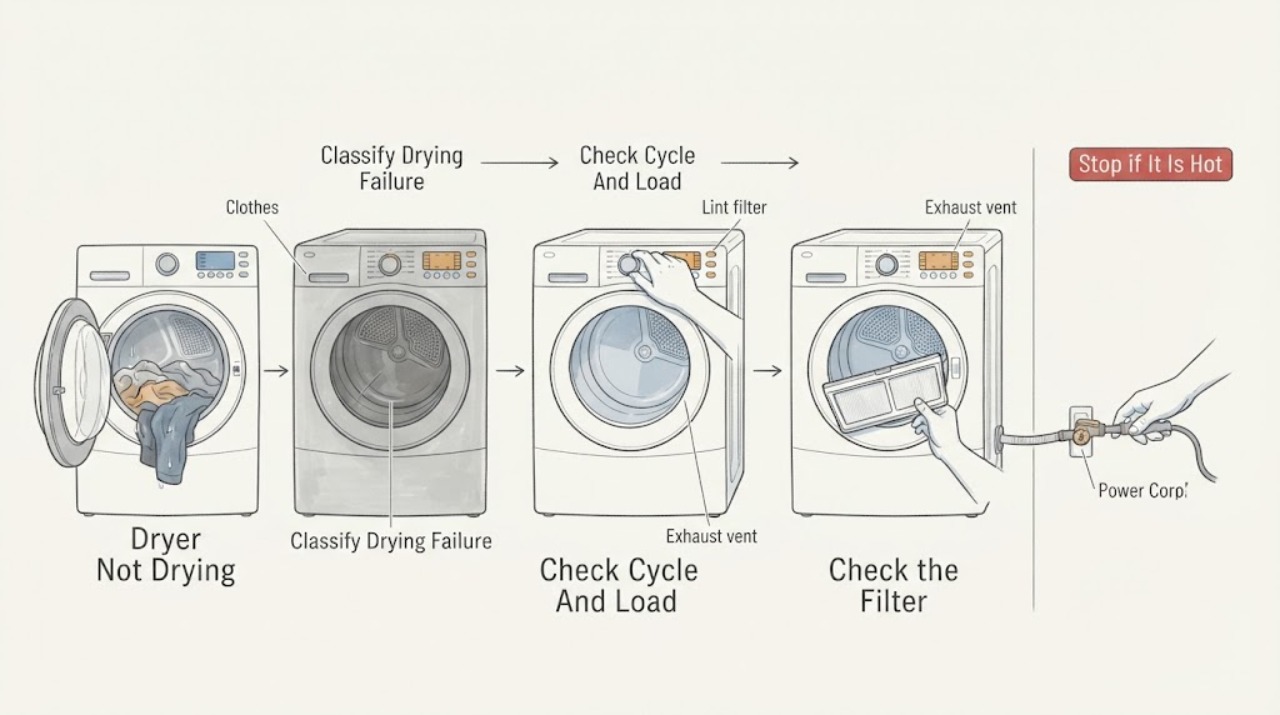
When a Hotpoint dryer is not drying, first separate a long cycle from a no-heat problem: note whether the drum tumbles, whether the load is warm, and whether clothes leave the washer unusually wet. Use the correct dry cycle and load size, clean the lint filter, and inspect the exhaust path and outside wall cap for kinks or blockage. An electric dryer can run with partial power yet fail to heat, while a gas dryer needs its supply and a clear, correctly installed vent; never disconnect a gas dryer's vent for testing. If airflow is restricted, the dryer is unusually hot, there is a gas smell, a burned connection, smoke, or drying remains poor after the safe external checks, stop and arrange qualified dryer service.
Work through in order
Diagnostic checks
Use only checks that match the exact appliance or system and its official guide.
-
Check 1
Run the dryer only long enough to identify its behavior, staying nearby: note whether the drum tumbles, whether the load becomes warm, whether the cycle ends early, and whether clothes are damp everywhere or only in heavy items.
Expected result: Record the cycle and temperature setting, drum movement, warmth, moisture pattern, unusual noise or odor, and whether the dryer is gas or electric.
Next step: Use the heat-supply branch for a cold load and the load or vent branches for a warm but damp load; stop for a safety symptom.
Stop if: Stop immediately for smoke, a burning smell, gas odor, sparks, a hot power connection, or a dryer that becomes unusually hot.
Why this matters
Why: Tumbling without warmth points toward heat supply or control; warmth with damp clothes points toward airflow, load, setting, or moisture-sensing conditions. A drum that does not turn is a different mechanical fault than slow drying.
-
Check 2
Check that the selected cycle is a heat-producing dry cycle rather than air fluff or cool down, choose the fabric and dryness setting recommended for the load, and dry one appropriately sized wash load without mixing very heavy and very light items.
Expected result: Record whether the load is oversized, too small to tumble and contact sensors, heavily weighted toward towels or other dense items, or leaving the dryer slightly damp at the end of an energy-saving sensor cycle.
Next step: Adjust only the documented cycle or dryness level and compare one similar load; continue to the lint and vent checks if the result remains poor.
Stop if: Do not use a higher heat setting than the fabric allows, overload the drum, or continue if the dryer smells burned or overheats.
Why this matters
Why: GE Appliances says cycle, fabric, temperature, load size, fabric type, and moisture level change drying time. A setting or load mismatch can mimic a dryer fault even when heat and airflow are normal.
-
Check 3
With the dryer stopped and cool, remove and clean the lint filter as the model instructions allow, wash away fabric-softener residue when appropriate, and make sure clothing or storage items are not blocking the dryer front or floor-level air inlet.
Expected result: Record whether the filter is coated or packed with lint, airflow through the filter is restricted, the filter is damaged or missing, or the front intake is blocked.
Next step: Restore the filter correctly and inspect the exhaust path; do not run the dryer without its filter or with a damaged filter unless the manual specifically permits the test.
Stop if: Stop if lint has entered the cabinet, the filter will not seat, the dryer is hot to the touch, or cleaning would require opening panels.
Why this matters
Why: GE Appliances identifies lint-filter residue, a blocked front, and restricted airflow as contributors to poor drying and heat buildup. A clean filter with poor exhaust flow shifts attention to the duct and wall cap.
-
Check 4
From safe external access, inspect the exhaust hose for kinks, collapse, crushed sections, or unsuitable material, then check the outside wall cap or damper for lint, nests, snow, ice, or another obstruction without reaching into the appliance.
Expected result: Record whether the hose is restricted, the wall cap opens freely, airflow outside is weak, the duct route exceeds the installation instructions, or moisture collects around the door.
Next step: Clear only accessible external obstructions and arrange proper duct cleaning or correction according to the installation instructions; keep a gas dryer's vent connected during operation.
Stop if: Do not operate a gas dryer with its vent disconnected, enter a concealed duct that needs specialist cleaning, or continue running a dryer that overheats.
Why this matters
Why: GE Appliances states that a restricted or improperly routed vent prevents hot moist air from leaving, increases drying time, and can make the dryer hot or cause condensation. Weak outside airflow supports a venting problem rather than a part diagnosis.
-
Check 5
For an electric Hotpoint dryer that tumbles but does not heat, check the external dryer breaker or fuse and compare the installation requirements with the exact model instructions; do not remove the rear terminal-block cover.
Expected result: Record whether a breaker is partially tripped, trips again, the receptacle or cord shows heat damage, or the supply appears normal while the dryer remains cold.
Next step: If the breaker trips, the cord or connection is damaged, or the dryer remains cold with normal external power, leave it off and arrange qualified electrical or appliance service.
Stop if: Do not open the terminal block, touch conductors, change breaker size, or repeatedly reset a tripping circuit.
Why this matters
Why: GE Appliances notes that an electric dryer can run on partial supply but fail to heat, and that burned, loose, or frayed cord or terminal connections need service rather than a casual reconnection.
-
Check 6
For a gas Hotpoint dryer that tumbles without heat, confirm only from the appliance's normal operating position that the gas supply is on for a new installation and that the selected cycle is a heat-producing dry cycle; do not open the burner or gas connection.
Expected result: Record whether the line was off, the dryer runs with the correct dry setting but remains cold, or any gas smell is present.
Next step: If the line is on and there is still no heat, leave the dryer off and arrange qualified appliance service; if gas odor is present, leave the area and follow local gas-emergency guidance.
Stop if: Do not ignite a gas smell, test for leaks with a flame, disconnect the vent, or remove burner components.
Why this matters
Why: GE Appliances identifies the gas supply and cycle selection as external checks. If the supply is on and a gas dryer still does not heat, the manufacturer directs the owner to service rather than internal ignition work.
-
Check 7
After the safe external checks are complete and the dryer is cool, run one appropriately sized, supervised load with the correct cycle and the exhaust system fully connected and unobstructed.
Expected result: Record whether the load warms and dries at a normal rate, outside airflow is present, the dryer remains at a normal operating temperature, or the same symptom returns.
Next step: Stop further testing and arrange qualified service if the issue persists or any safety symptom appears; provide the technician the heat, airflow, load, and breaker or gas observations.
Stop if: Do not leave the dryer unattended, run a gas dryer without its vent, or continue a cycle with smoke, gas odor, burning smell, or abnormal heat.
Why this matters
Why: A normal result supports a setting, load, filter, or venting explanation. Persistent damp clothes, no heat, weak exhaust, or excessive heat indicates that the dryer or installation needs professional diagnosis.
Use your observations
Decision map
Find the observation that best matches what you see, then follow the next safe action.
-
PATH 01Safety boundary
What you see
The drum tumbles and the load becomes warm, but clothes remain damp or the cycle takes much longer than expected.
Do this next
Correct the load and cycle, clean the filter, and inspect the complete exhaust path and outside cap.
Why this path and its safety boundary
Why it matters: Load size, fabric mix, washer moisture, lint, vent restriction, and dryness settings are more likely than a complete heater failure.
Safety stop: Arrange service if airflow remains weak, the dryer becomes unusually hot, or drying is still poor after the vent path is corrected.
-
PATH 02Safety boundary
What you see
An electric dryer tumbles but the load stays cold.
Do this next
Check only the external breaker and model installation requirements; leave the dryer off and arrange qualified service for a cold load or damaged connection.
Why this path and its safety boundary
Why it matters: A partially tripped breaker, incorrect supply, damaged cord or terminal connection, cycle setting, or internal heating fault may be involved.
Safety stop: Do not open the terminal block or change electrical protection.
-
PATH 03Safety boundary
What you see
A gas dryer tumbles with the correct dry cycle and the supply is on, but the load stays cold.
Do this next
Leave the dryer off and arrange qualified appliance service; keep its vent connected during any operation.
Why this path and its safety boundary
Why it matters: The remaining cause requires gas-appliance diagnosis and is not a user burner or ignition adjustment.
Safety stop: For gas odor, leave the area and follow local emergency guidance; do not use flames or electrical switches near the odor.
-
PATH 04Safety boundary
What you see
The outside cap has weak airflow, the hose is kinked or obstructed, moisture condenses around the door, or the dryer is hot to the touch.
Do this next
Stop the dryer, correct accessible external obstructions or arrange duct cleaning and routing correction according to the model installation instructions.
Why this path and its safety boundary
Why it matters: The exhaust path is not removing hot, moist air effectively and can prolong drying and increase heat or lint buildup.
Safety stop: Do not continue operating while overheating, and never disconnect a gas dryer's vent to improve the symptom.
-
PATH 05Safety boundary
What you see
The load remains wet after the correct cycle, clean filter, external airflow checks, and applicable power or gas checks.
Do this next
Leave the dryer off if no-heat or excessive-heat symptoms remain and schedule qualified dryer service with the model, fuel type, test results, and safety observations.
Why this path and its safety boundary
Why it matters: A heater, thermostat, sensor, motor, control, installation, or remaining airflow fault may need professional testing; the symptom alone does not identify a part.
Safety stop: Do not replace internal parts, bypass safety devices, or continue repeated test cycles.
Helpful context
Understand the symptom
Start with heat, tumbling, and the moisture coming from the washer
A dryer can run while not producing heat, or it can heat normally but take too long because air cannot leave the drum. The starting load matters too: GE Appliances notes that fabric type, load size, and how wet clothes are after the washer change drying time. If water can be squeezed from the load, check the washer's spin result before blaming the dryer.
Airflow is a performance and safety check
The lint filter, exhaust hose, outside wall cap, and duct route all affect moisture removal. A kinked or obstructed vent can leave the dryer hot and clothes damp, while a blocked lint path can allow lint and heat to build up. Keep the dryer front clear, use only the vent material and routing allowed by the model's installation instructions, and do not operate a gas dryer with its vent disconnected.
Electric and gas dryers have different no-heat branches
An electric Hotpoint dryer may tumble with incomplete supply while failing to heat, so the external breaker and model installation requirements matter. A gas dryer needs the gas supply on and the correct dry cycle; if it runs but still does not heat, GE Appliances directs the owner to service. Do not open a terminal block, burner area, or gas system as a user troubleshooting step.
Safety boundary
Stop conditions
- Stop using the dryer for smoke, burning smell, gas odor, sparks, a hot or damaged power connection, unusually high cabinet temperature, or lint inside the cabinet.
- Do not open electrical terminal blocks or burner areas, change breaker protection, bypass safety devices, test gas leaks with a flame, or operate a gas dryer without its vent connected.
- Arrange qualified appliance or electrical service when the dryer still does not heat, a breaker trips again, airflow remains poor after external checks, or drying remains ineffective.
When checks do not resolve it
Need a professional?
Request qualified dryer service when a Hotpoint dryer stays cold, overheats, has damaged wiring, trips a circuit, has gas odor, or continues to leave clothes wet after the cycle, load, lint filter, exhaust, and model-specific supply checks.
Have this ready
- Give the professional the exact model, gas or electric type, selected cycle, drum and heat behavior, load moisture, lint and vent findings, outside airflow, and breaker or gas-supply observations.
Common questions
FAQ
Why is my Hotpoint dryer running but not drying clothes?
Check whether the load is warm, then verify the dry cycle, load size, lint filter, exhaust hose, outside wall cap, and moisture left by the washer. A warm but damp load often needs an airflow or load correction; a cold load needs the electric or gas no-heat branch.
Can a Hotpoint electric dryer run without heating?
Yes. GE Appliances notes that an electric dryer can run with partial power but not heat. Check only the external breaker and model installation requirements; leave it off for repeated trips, damaged connections, or persistent no heat and arrange service.
What should I check if my Hotpoint gas dryer does not heat?
Confirm the correct dry cycle and, for a new installation, that the gas supply is on. If the dryer runs but still does not heat, arrange qualified service. Never test a gas dryer with its vent disconnected, and stop for gas odor.
Read the exact guide
Official sources
- Dryer - Electrical Requirements and Breaker SizeGE Appliances · Hotpoint-supported dryer model-specific electrical and breaker requirements
- Dryer - Hot to the Touch or SweatsGE Appliances · Hotpoint dryer heat buildup, venting, wall cap, load, and service boundary
- Dryer - Things To Check For A Venting IssueGE Appliances · Hotpoint dryer exhaust duct, wall cap, airflow, location, and gas-dryer safety
- Electric Dryer - Runs But Does Not HeatGE Appliances · Hotpoint-supported electric dryer no-heat, cycle, airflow, supply, and cord-safety guidance
- Gas Dryer - Runs But Does Not HeatGE Appliances · Hotpoint-supported gas dryer no-heat, cycle, airflow, gas-supply, and service guidance
- Dryer - Taking Too Long To Dry Clothes or Not Drying at AllGE Appliances · Hotpoint dryer load, cycle, lint, airflow, washer-moisture, and slow-dry troubleshooting
Community feedback
Share a repair observation
Share a plain-text repair observation. Accepted observations are published automatically; this page may take a moment to update.