
On this page
Start here
Quick answer
If an AEG dryer leaves clothes damp, start with the load and airflow: spin the laundry well, do not overload it, choose a programme that matches the fabric and care label, and clean the lint filters carefully after each cycle. For a condenser or heat-pump dryer, clean the condenser and compartment as the model manual allows; for a vented dryer, check that the exhaust hose is not blocked or folded. A heat-pump dryer can feel cooler and take longer than an older vented or condenser dryer, so judge it by the selected programme and drying result rather than a brief touch test. If the dryer remains cold on a documented timed check, shows an error, smells of burning, trips power, or still dries poorly after safe cleaning and settings checks, stop using it and arrange an authorised service visit.
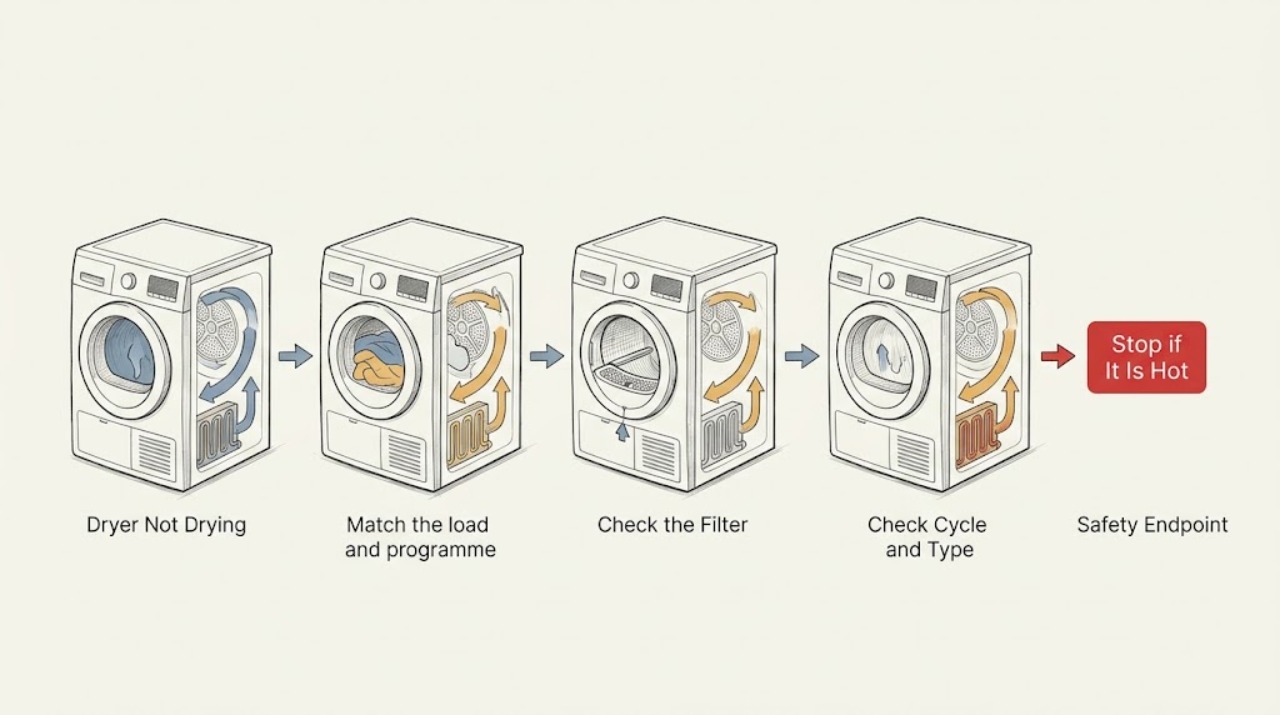
Work through in order
Diagnostic checks
Use only checks that match the exact appliance or system and its official guide.
-
Match the load and programme to the drying result
Check the care labels and the selected AEG programme, then compare the actual dry-load amount with the manual's limit. Separate very thick items from light fabrics, untangle the load, and confirm the washing machine spun it well before drying; do not add more items simply to make the drum look full.
Expected result: The load is mixed or overloaded, laundry entered the dryer very wet, the programme does not match the fabric, items are already nearly dry, or the load and programme are appropriate.
Next step: Run a smaller, well-spun, correctly sorted load on the programme recommended by the manual and compare the result. If it remains damp, continue with the filter and condenser checks.
Stop if: Do not dry items the manual excludes, exceed the load limit, or continue if the dryer smells of burning, becomes unusually hot, or shows a warning.
Why this matters
Why: Overloading restricts warm-air circulation and mixed thicknesses dry unevenly. An unsuitable humidity-controlled programme may finish early with a small or nearly dry load, while very wet laundry can require more time. A suitable load and programme make airflow or heating checks more meaningful.
-
Clean the user-accessible filter and condenser path
Switch the dryer off and follow the exact manual procedure to remove lint from the filter after the cycle. For a condenser or heat-pump model, inspect and clean the user-accessible condenser and compartment as directed; hold the filter toward light or use the manual's airflow check rather than judging it only by appearance. Do not remove cabinet panels or reach past guards.
Expected result: The filter is coated or blocked, water does not pass through a washable filter as expected, the condenser is visibly clogged, a filter is damaged, or the accessible airflow path is clean.
Next step: Clean and refit the parts according to the model manual, then run one correctly sized test load. If the result remains poor or a filter cannot be made permeable, request authorised service.
Stop if: Do not run the dryer without required filters, use sharp tools to clear them, wash a part the manual does not permit washing, or open the housing to reach the condenser or heater.
Why this matters
Why: Restricted filters or condenser passages reduce airflow and can cause poor drying or prevent the machine from heating effectively. A damaged or still-blocked filter needs replacement or service. A clean accessible path shifts attention to load, exhaust, programme, room conditions, or internal heating.
-
Check the exhaust route and room conditions by dryer type
If the AEG dryer is vented, inspect the visible exhaust hose for a blockage, sharp fold, or collapse without disconnecting hot or internal ducting. For any dryer, check that the room is within the range stated in the manual and that a built-in installation has the required ventilation and clearance; do not move a heavy appliance alone or dismantle an enclosure.
Expected result: A vent hose is folded or blocked, the dryer is tightly enclosed, the room is unusually cold or hot, ventilation is adequate, or the dryer type does not use an exhaust hose.
Next step: Correct only an obvious, safe external obstruction or restore the documented ventilation arrangement, then retest once. Call service if the hose, enclosure, or room conditions cannot be safely corrected or the result does not improve.
Stop if: Do not operate with a crushed duct, blocked vent, inadequate clearance, unstable installation, or an enclosure that requires cabinet removal to inspect.
Why this matters
Why: A restricted exhaust route or unsuitable room can prevent moisture and heat from leaving correctly and can extend drying or stop heating. Adequate airflow and room conditions make an internal fault more likely if damp results continue.
-
Check dryness options and moisture-sensing clues
Use the model manual to identify whether the selected programme is time-controlled or humidity-controlled and review its dryness level, Dry Plus, remaining-moisture, or delay settings if present. Clean the user-accessible drum ribs and moisture-sensing strips only when the manual identifies them for your model; do not scrape or remove sensor parts.
Expected result: The dryness level is low, a delay or unsuitable programme is selected, the load is nearly dry or very mixed, sensor strips or drum ribs have residue, or the documented settings are appropriate.
Next step: Choose the manual's appropriate programme and dryness target for a well-spun, sorted load, then retest once. If the cycle still stops early or leaves clothes damp, record the setting and request service.
Stop if: Do not bypass a sensor, change hidden service settings, use solvents not approved by the manual, or continue if the dryer displays an error or behaves abnormally.
Why this matters
Why: A low dryness target, delayed start, wrong programme, residue on sensing surfaces, or a load with uneven moisture can produce a poor result without a failed heater. Appropriate settings and clean accessible sensors narrow the problem toward airflow, temperature, or an internal fault.
-
Use one documented heat observation to set the service boundary
After cleaning and with the dryer empty or loaded exactly as the model instructions require, select a documented timed programme and observe the result without opening the cabinet. If the manual permits checking warmth during the cycle, open the door only as instructed and use a brief, careful observation; do not touch heating parts or assume a heat-pump drum should feel very hot.
Expected result: The drum becomes appropriately warm for the dryer technology, it stays cold, an error code or flashing light appears, the cycle ends unexpectedly, or the dryer trips power or smells of burning.
Next step: Stop after the single observation, record the programme and code or light pattern, unplug the dryer if the manual or safety condition requires it, and arrange an authorised service visit when the result is abnormal.
Stop if: Do not continue operating after smoke, burning odor, sparking, repeated trips, an unusually hot cabinet, damaged cord, or a persistent cold drum; do not remove panels or test live components.
Why this matters
Why: Warmth consistent with a heat-pump or condenser model suggests the heating path is operating and returns the focus to load, airflow, programme, or sensing. A persistently cold drum, error, early termination, electrical trip, or burning odor can indicate an internal heating, control, or safety fault.
Use your observations
Decision map
Find the observation that best matches what you see, then follow the next safe action.
-
PATH 01Safety boundary
What you see
The load is overloaded, very wet, mixed in thickness, nearly dry, or paired with an unsuitable programme or dryness target.
Do this next
Sort and spin the laundry, reduce the load, and select the programme and dryness option specified by the model manual before one controlled retest.
Why this path and its safety boundary
Safety stop: Do not exceed the load limit, dry unsuitable items, or continue after a warning, burning odor, or abnormal heat.
-
PATH 02Safety boundary
What you see
The lint filter or condenser remains blocked, the vent hose is folded or obstructed, or the installation lacks the required airflow.
Do this next
Clean or restore only the user-accessible airflow path according to the manual, then retest once; arrange service if the part is damaged or the obstruction is not safely accessible.
Why this path and its safety boundary
Safety stop: Do not run without required filters, dismantle ducting or cabinetry, or reach into the heater or fan housing.
-
PATH 03Safety boundary
What you see
The dryer is a heat-pump model, the cycle is progressing, and the drum feels less hot than an older dryer but the airflow and programme are otherwise appropriate.
Do this next
Allow the selected programme to complete without repeated door openings and judge the final drying result; check the manual for the model's expected cycle behavior.
Why this path and its safety boundary
Safety stop: Do not add high heat, alter service settings, or continue if the dryer produces smoke, burning odor, an error, or abnormal overheating.
-
PATH 04Safety boundary
What you see
The drum remains cold on a documented check, an error or warning repeats, the programme ends unexpectedly, or cleaning and settings do not improve drying.
Do this next
Stop using the dryer, record the exact code or indicator pattern and programme, and request an authorised technician to diagnose the heating, control, sensing, and safety systems.
Why this path and its safety boundary
Safety stop: Do not open the cabinet, test live components, bypass a safety device, or keep cycling an appliance with a heating or electrical fault.
-
PATH 05Safety boundary
What you see
The dryer trips power, has a damaged cord or plug, smells of burning, smokes, sparks, or becomes unusually hot.
Do this next
Stop use and disconnect power only if the plug and area are safe to reach; keep clear and arrange qualified appliance or electrical service.
Why this path and its safety boundary
Safety stop: Do not touch damaged or wet electrical parts, reset repeatedly, move a hot appliance, or continue a cycle to collect more evidence.
Helpful context
Understand the symptom
A damp load is not always a failed heater
AEG dryers use different technologies. A heat-pump model is designed to dry at a gentler, lower temperature and may need more time than a vented or conventional condenser model. A programme can also end with a cooling period, and a humidity-controlled programme may respond differently to a small or already nearly dry load. Check the programme, fabric mix, load size, and moisture result before concluding that the heater has failed.
Restore airflow before suspecting an internal part
Warm, moisture-laden air must move through the load and, on condenser or heat-pump models, through the filter and condenser path. A filter can look clean while still being blocked; AEG suggests checking whether it can be seen through or whether water passes through it as appropriate to the model. Clean only the user-accessible areas described in the manual. Do not remove panels or reach the heater, fan, compressor, or wiring.
Treat a cold drum or error as a service boundary
Once safe airflow and programme checks are complete, a documented timed check can show whether the drum becomes warm under the model's instructions. If it stays cold, an internal heat-source or control fault becomes more likely. Disconnect the dryer and arrange authorised service for persistent cold operation, an error code, a burning smell, repeated electrical trips, damaged wiring, or any condition that makes continued use unsafe.
Only after diagnosis
Potential parts
- dryer lint filter or condenser filter
Consider this category only if the exact model's filter is damaged or remains blocked after the manual's cleaning method and a qualified diagnosis confirms replacement is appropriate.
Confirm the exact AEG model and filter design; no fit or replacement is assumed from damp laundry alone. - dryer heating or moisture-sensing component
Consider this category only after authorised service confirms a cold-drum, sensing, or heating fault following the safe load, airflow, programme, and documented heat checks.
Confirm the exact model and service diagnosis before selecting any internal component; internal repair is not a homeowner troubleshooting step.
When checks do not resolve it
Need a professional?
Request an authorised AEG service visit when the dryer remains damp after a correctly sorted and spun load, clean user-accessible filters and condenser, suitable ventilation, and correct programme settings; when the drum stays cold on a documented check; or when an error repeats. Stop use and seek prompt appliance or electrical help for smoke, burning odor, sparking, repeated trips, a damaged cord or plug, or unusual overheating.
Common questions
FAQ
Why is my AEG dryer running but leaving clothes damp?
Common causes include a blocked filter or condenser, an overloaded or poorly spun load, an unsuitable programme or dryness level, restricted exhaust airflow, poor room conditions, or a sensing or heating fault. Start with the load and user-accessible airflow path before requesting service.
Why does my AEG heat-pump dryer not feel very hot?
Heat-pump dryers operate at lower temperatures and can take longer than older dryer types, so a brief cool-feeling period is not proof of failure. Judge the completed programme and drying result; request service if the drum stays cold on a documented check or an error appears.
How often should I clean the AEG dryer filter?
AEG's support guidance says to clean the filter carefully after each drying cycle. A filter can appear clean while still being blocked, so use the model manual's airflow or washing check and replace it only when the exact model and diagnosis support that decision.
What should I do if my AEG dryer is still cold after cleaning?
Check the selected programme, load, vent or condenser path, and documented error indications once. If the drum remains cold on the model's timed check, or the dryer trips power or smells of burning, stop using it and arrange an authorised technician rather than opening the cabinet.
Read the exact guide
Official sources
- Tumble dryer has no powerAEG Support · Supports distinguishing a start or power symptom from a drying-result issue, checking door and settings, safe reset, filter/condenser condition, error indications, and service boundary.
- Tumble dryer not drying, not drying properly, too long dryingAEG Support · Supports the main checks for load, programme, filter, condenser, exhaust hose, ambient conditions, grounding, reset, error codes, heat observation, and authorised service.
- Tumble dryer's drying results are poor and laundry is damp after dryingAEG Support · Supports explaining lower heat and longer heat-pump cycles, dryness-level and load checks, filter/condenser cleaning, avoiding overload, and service escalation.
- Tumble dryer displays error message E60 and does not heat upAEG Support · Supports ventilation and filter checks, the distinction between a cold drum and a functioning heat source, and technician escalation for a dryer that does not heat.
Community feedback
Share a repair observation
Share a plain-text repair observation. Accepted observations are published automatically; this page may take a moment to update.