
On this page
Start here
Quick answer
If a Beko dryer leaves clothes damp after a full cycle, begin with the load and airflow rather than replacing a part. Check that the clothes were spun adequately, the program matches the fabric, the drum is neither overloaded nor so lightly loaded that the sensor cannot read it, and wet items were not added mid-cycle. Then clean the lint filter and, where fitted, the condenser or heat-pump filter; clear the front ventilation grille and inspect a vent hose for kinks or blockage. Empty a full water tank, keep a direct-drain hose unkinked, and clean the drying sensors only by the model's instructions. Beko says persistent dampness after these checks can mean the dryer is not generating enough heat or needs an engineer. Do not open electrical covers, bypass a safety device, or work on the heating or refrigerant circuit.
Before you begin
Safety first
- This article covers only ordinary-access loading, program, filter, ventilation, sensor, tank, hose, and model-approved condenser or evaporator maintenance. It does not authorize cabinet removal, live electrical work, thermal-safety bypass, heater or motor testing, pump disassembly, or heat-pump/refrigerant access.
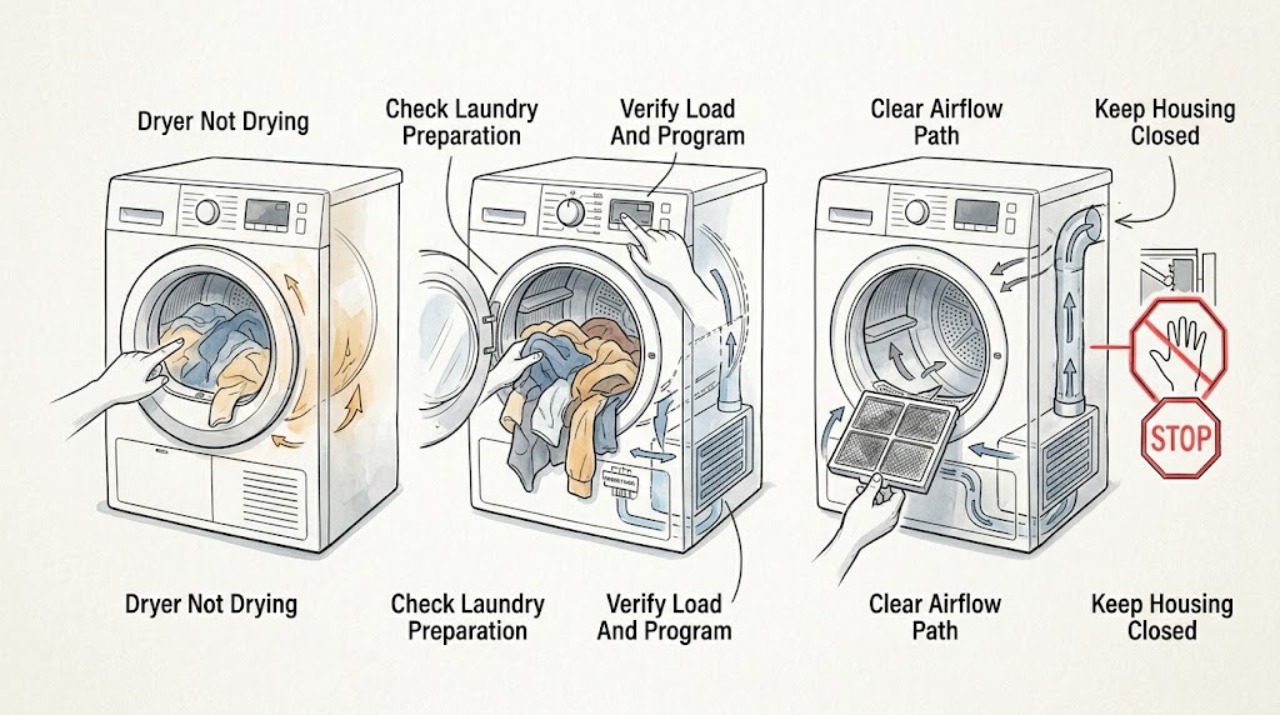
Work through in order
Diagnostic checks
Use only checks that match the exact appliance or system and its official guide.
-
Check 1
Before the next cycle, check the wash spin result and separate tangled items; confirm every item is labeled suitable for tumble drying and select a program that matches the fabric and desired dryness.
Expected result: Record whether the load is dripping or merely damp, tangled, mixed with a fabric that needs a different program, or already appropriate for the selected cycle.
Next step: Run a compatible load on the program specified by the exact Beko manual and compare the result after the cycle; do not add more wet items mid-program.
Stop if: Do not dry items prohibited by their care labels or items with rubber, solvent, flammable residue, or other materials excluded by the model manual.
Why this matters
Why: A load that begins with excess water or a program that does not match the fabric can leave clothes damp without a dryer fault. A correct preparation with the same result moves the diagnosis toward airflow, sensing, heat, or a moisture-path issue.
-
Check 2
Check that the drum is not overloaded, not so lightly loaded that the sensor cannot read the load, and that the selected program has fully started; leave room for garments to tumble freely.
Expected result: Record whether items are packed tightly, moving freely, too few for a sensor cycle, or held because the program was not started or an unsuitable cycle was selected.
Next step: Reduce or rebalance the load according to the exact manual, choose a suitable cycle, and run it without adding wet laundry partway through.
Stop if: Do not exceed the model's stated capacity, bypass the door switch, or force the drum when it is jammed.
Why this matters
Why: Beko says overloading restricts tumbling and airflow, while its guide notes that under-loading may prevent some sensors from detecting dryness. A program that has not started or is not appropriate can mimic poor drying.
-
Check 3
With the dryer stopped and cool, clean the lint or fluff filter and its housing as the Beko manual permits; inspect the front ventilation grille and, on a vented model, check the hose for a kink or blockage without opening the cabinet.
Expected result: Record a clean filter and open grille; lint-packed filter pores or housing; blocked or kinked vent hose; or a vent path that the model does not have.
Next step: Clean and fully dry the filter before reinstalling it, remove only external obstructions, and run a compatible test load; use the exact model guide for any vent cleaning beyond ordinary access.
Stop if: Do not run the dryer with a missing or wet filter, dismantle the vent or cabinet, or use a sharp tool to clear lint near wiring or a heater.
Why this matters
Why: Beko states that lint buildup reduces drying performance and that blocked or kinked venting can trap moist air and leave clothes damp. A clean external path with persistent dampness points to the next branch rather than repeated filter washing.
-
Check 4
If the dryer is a condenser or heat-pump model, inspect the condenser, filter drawer, condenser filter, or evaporator filter only through the access and cleaning procedure described for that model; allow removed parts to dry completely before refitting.
Expected result: Record whether the relevant filter or condenser is visibly lint-loaded, the cleaning warning is active, the unit is clean, or the component cannot be accessed without removing a cover or forcing a latch.
Next step: Clean only as the exact Beko instructions permit, refit locks and covers securely, then run a compatible test load; request service when the part is inaccessible, damaged, or still blocked after correct cleaning.
Stop if: Do not pressure-clean electrical components, bend fins, run with the kickplate or filter unsecured, or access a heat pump or refrigerant circuit.
Why this matters
Why: Beko identifies blocked condenser and heat-pump filter components as causes of longer drying or damp clothes. A clean, correctly refitted path shifts concern toward heat, sensing, fan, control, or another internal fault.
-
Check 5
Clean the drying sensor surfaces only if the model has them and its manual allows it; then check whether the water tank is full and whether a direct-drain hose, if fitted, is twisted or kinked.
Expected result: Record clean or residue-covered sensor surfaces, a full or empty tank, a warning indicator, a collapsed drain hose, or no sensor/tank/drain feature on this model.
Next step: Use the exact manual's sensor-cleaning method, empty and refit the tank only when the program is stopped, or restore a clear drain hose; then repeat a suitable test load.
Stop if: Do not remove a tank while the program is running, use metal tools or unapproved solvents on sensors, or open the pump or drain assembly.
Why this matters
Why: Beko says dirty sensors can reduce drying performance, while a full tank can stop some dryers and a kinked direct-drain hose can prevent normal operation. A clean sensor and clear moisture path do not rule in a heater fault, but they move the diagnosis beyond routine maintenance.
-
Check 6
After the dryer is cool, observe one complete compatible cycle from outside the cabinet: note whether the drum turns, whether the load warms as expected for the selected technology and program, and whether the cycle stops early or shows a warning.
Expected result: Classify the result as drum does not turn; drum turns but remains cold; drum turns and warms but clothes remain damp; cycle stops with a tank or filter warning; or abnormal noise, smell, smoke, or overheating appears.
Next step: Record the model, program, load, warning, and observed behavior and arrange qualified Beko appliance service when the dryer remains damp, cold, immobile, or abnormal after the supported checks.
Stop if: Stop immediately for smoke, burning smell, sparking, exposed wiring, a damaged cord, severe overheating, water near electrical parts, or any need to remove panels.
Why this matters
Why: No tumbling, no heat, or a repeated warning after the relevant user check points to a motor, belt, heater, sensor, control, airflow, or other internal issue. Heat-pump dryers may feel less hot than conventional types, so temperature alone does not identify a failed heater. Safety symptoms require immediate stopping.
Use your observations
Decision map
Find the observation that best matches what you see, then follow the next safe action.
-
PATH 01Safety boundary
What you see
Laundry enters dripping wet, is tangled, includes unsuitable fabrics, or was assigned a program that does not match the load.
Do this next
Use an appropriate wash spin, separate the load, follow care labels, and run a correctly selected cycle without adding wet items partway through.
Why this path and its safety boundary
Why it matters: The drying result may be limited by preparation or cycle selection rather than a dryer component.
Safety stop: Do not dry prohibited fabrics or use a heat setting that conflicts with the garment care label.
-
PATH 02Safety boundary
What you see
The drum is packed tightly, or the load is so small that a sensor program cannot reliably detect moisture.
Do this next
Adjust the load within the model's capacity and use a suitable program; compare the result with the prior cycle.
Why this path and its safety boundary
Why it matters: Restricted tumbling or insufficient sensor contact can produce damp results without proving a heater failure.
Safety stop: Do not overload the drum or bypass a sensor or door interlock.
-
PATH 03Safety boundary
What you see
The lint filter is clogged, the front grille is obstructed, or a vent hose is kinked or blocked.
Do this next
Clean and dry the filter, clear only external obstructions, correct a hose kink, and rerun a compatible load; use service for hidden or damaged ductwork.
Why this path and its safety boundary
Why it matters: Restricted airflow can trap moist air and reduce drying performance.
Safety stop: Do not run without a filter or dismantle the cabinet or duct near electrical or heating parts.
-
PATH 04Safety boundary
What you see
A condenser, filter drawer, condenser filter, or heat-pump evaporator filter is lint-loaded or its cleaning warning is active.
Do this next
Follow the exact model procedure, let cleaned components dry completely, refit them securely, and test again; arrange service if cleaning cannot be completed safely.
Why this path and its safety boundary
Why it matters: Beko identifies these components as maintenance points that can cause longer drying or damp clothes when blocked.
Safety stop: Do not bend fins, pressure-clean electrical parts, or open the heat-pump or refrigerant circuit.
-
PATH 05Safety boundary
What you see
The water-tank warning is active or the tank is full, or the direct-drain hose is kinked or collapsed.
Do this next
Stop the program, empty and refit the tank or correct the drain hose as the exact manual permits, then restart the appropriate program.
Why this path and its safety boundary
Why it matters: The dryer may stop, interrupt drying, or fail to remove condensed moisture until the water path is restored.
Safety stop: Do not remove the tank during a running program or open the pump and drain assembly.
-
PATH 06Safety boundary
What you see
The load, program, airflow, filters, sensor, and water path are correct, but the drum remains cold, does not turn, stops repeatedly, or clothes stay damp after a full cycle.
Do this next
Stop DIY diagnosis, record the exact model and observed cycle behavior, and arrange qualified Beko appliance service.
Why this path and its safety boundary
Why it matters: A heater, motor, belt, fan, sensor, control, or another internal component may be involved; the symptom does not identify a safe replacement part.
Safety stop: Do not remove panels, test live wiring, bypass thermal protection, or replace a heater, belt, sensor, motor, or board without exact model diagnosis.
Helpful context
Understand the symptom
A damp load does not always mean the dryer has failed
Laundry can enter the dryer too wet, remain tangled, exceed the usable load, or be placed on a program that is not intended for the fabric. Beko also notes that an underloaded drum may not give some sensors enough material to detect dryness. Compare the load, program, and result after the clothes have cooled rather than judging one warm item by touch alone.
Airflow and moisture removal determine drying performance
Lint filters, condenser or heat-pump filters, front grilles, and a vent hose all affect how damp air leaves or is processed. A full water tank or a kinked direct-drain hose can stop or interrupt some dryers. Maintenance access differs by Beko model, so use the exact manual for the filter, condenser, evaporator, tank, and hose procedure, and reinstall every dry filter and cover before use.
Know when the next step is service
If the drum turns but remains cold, the machine stops with clean filters and an empty tank, or clothes stay damp after the supported checks, the remaining possibilities include the heater, sensor, fan, control, motor, or another internal component. These are not identified reliably by a single symptom. Stop at the ordinary-access boundary and arrange Beko or qualified appliance service.
Safety boundary
Stop conditions
- Stop for smoke, burning smell, sparking, exposed wiring, a damaged cord or plug, severe overheating, or water near electrical parts.
- Do not remove cabinet panels, test live terminals, bypass a door switch or thermal safety, or improvise a heater, motor, sensor, or control repair.
- Do not run the dryer with a missing, wet, damaged, or unsecured filter, condenser, kickplate, tank, door, or vent connection.
- Do not use metal tools, unapproved solvents, sharp objects, or excessive force on sensors, filters, condenser fins, seals, latches, or ductwork.
- If the dryer remains cold, does not tumble, stops repeatedly, or leaves clothes damp after the supported checks, stop using it and arrange qualified appliance service.
When checks do not resolve it
Need a professional?
Arrange Beko or qualified appliance service when correct loading, program selection, lint and airflow checks, condenser or heat-pump maintenance, sensor cleaning, and water-path checks do not restore drying; when the drum does not turn or remains cold; when a warning recurs; or when diagnosis would require a panel, live electrical test, heater, motor, fan, control, pump, or heat-pump/refrigerant access. Use the exact model manual and regional Beko support route for the next step.
Safety scope: This article covers only ordinary-access loading, program, filter, ventilation, sensor, tank, hose, and model-approved condenser or evaporator maintenance. It does not authorize cabinet removal, live electrical work, thermal-safety bypass, heater or motor testing, pump disassembly, or heat-pump/refrigerant access.
Common questions
FAQ
Why is my Beko dryer running but leaving clothes damp?
Check the load and program, lint filter, venting, condenser or heat-pump filter, drying sensor, and water path. Beko lists restricted airflow, overload, unsuitable programs, sensor condition, and filter maintenance as possible contributors. If the drum turns but remains cold or dampness persists after these checks, arrange service.
Can an overloaded Beko dryer fail to dry clothes?
Yes. Beko says overloading restricts airflow and prevents clothes from tumbling properly, and its guide says the load needs room to move. Reduce the load according to the exact manual and do not add wet items during a program.
How often should I clean a Beko dryer's lint filter?
Beko recommends cleaning the fluff or lint filter after every use in its UK FAQ. Exact removal and washing instructions depend on the model; let a washed filter dry completely before reinstalling it and keep the housing clear.
What should I check on a Beko heat-pump dryer that is not drying?
Check the load, lint filter, ventilation, drying sensor, and the heat-pump evaporator or filter using the exact model procedure. Beko says the evaporator and its filter should be checked and cleaned periodically because their condition can reduce drying performance. Do not open the heat-pump or refrigerant circuit.
Can a full water tank stop a Beko dryer from drying?
On models that collect condensate in a tank, yes. Beko's support guide says to empty and replace a full tank, while its manual warns that the machine may stop during a later cycle when the tank is full. Stop the program before removing the tank and follow the exact manual.
When should I call a technician for a Beko dryer that is not drying?
Arrange service if correct loading, program, filter, vent, condenser or evaporator, sensor, tank, and drain checks do not restore drying; if the drum does not turn or stays cold; if a warning recurs; or if the next step would require opening panels or testing a heater, motor, fan, pump, control, or heat-pump system.
Read the exact guide
Official sources
- My clothing is not drying in my tumble dryerBeko UK · Beko UK support FAQ; exact maintenance intervals and access depend on the installed model and regional manual.
- How to troubleshoot potential problems when your tumble dryer is not workingBeko UK · Beko UK support guide; electrical and control details vary by model and region.
- What to check if your tumble dryer is not drying properlyBeko UK · Beko UK support guide; use the exact dryer manual for the installed model and dryer type.
- Dryer User ManualBeko · Beko DU 7111 PA user manual; it is model-specific supplemental evidence, not a universal instruction for every Beko dryer.
- How to fix a tumble dryer that's not dryingBeko · Beko US support article; cleaning access and instructions vary by model, so the exact manual controls.
Community feedback
Share a repair observation
Share a plain-text repair observation. Accepted observations are published automatically; this page may take a moment to update.