
On this page
Start here
Quick answer
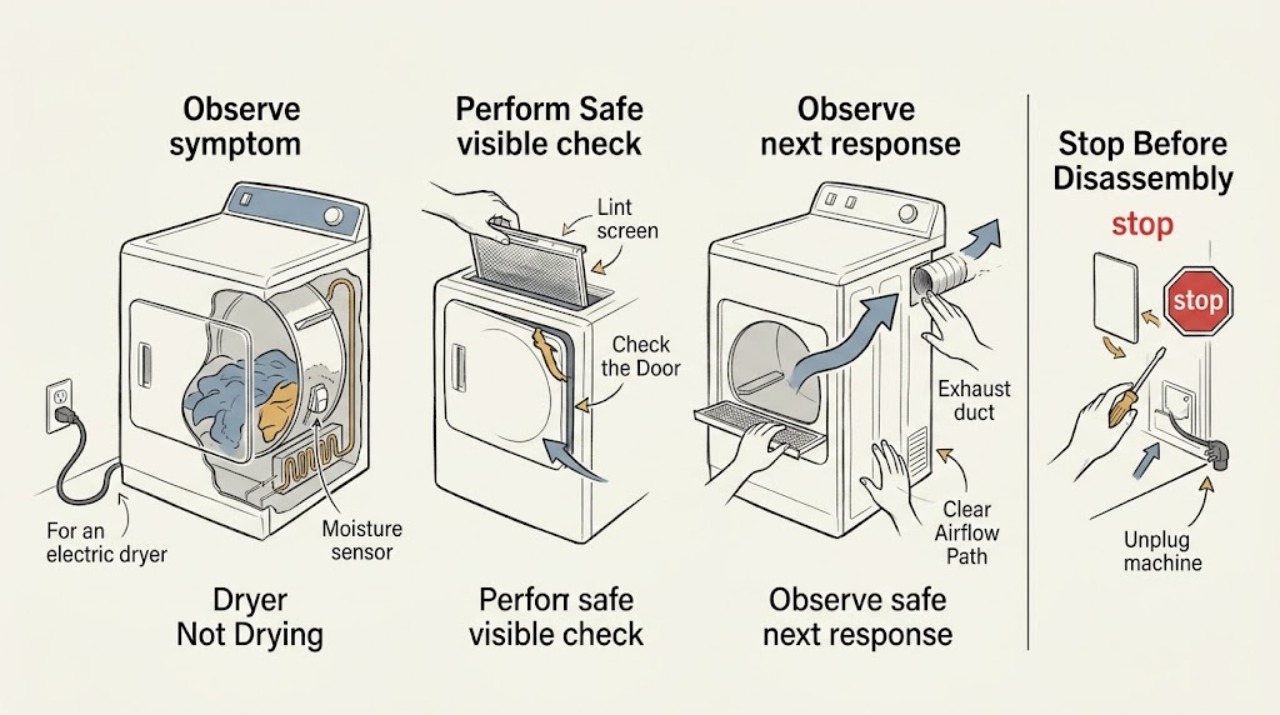
First separate a no-heat problem from a warm-but-damp problem. Run the empty dryer on a heated timed cycle for five minutes and feel inside when you open the door. If it is not heating, stop at the cycle, power, gas-supply, and model-specific service checks. If it is warm but clothes remain damp, clean the lint screen, inspect the vent hose and outside hood for restriction, use an appropriate automatic or timed cycle, and reduce an overloaded or mixed load. Persistent long dry times, an airflow code, unusual heat, or no heat needs professional service after the safe external checks.
Work through in order
Diagnostic checks
Use only checks that match the exact appliance or system and its official guide.
-
Check 1
Empty the drum, select a heated timed cycle, run it for five minutes, open the door, and feel the air and drum carefully without touching a heater or other internal part.
Expected result: The inside is warm, or it remains cool; the drum may still be turning in either case.
Next step: If cool, stop after the external power or gas checks and arrange service. If warm, clean the lint path and test exhaust airflow before changing parts.
Stop if: Stop immediately for gas odor, smoke, scorching, an unusually hot cabinet, or a damaged cord or vent.
Why this matters
Why: A cool drum on a heated cycle indicates a heat-source, power, gas-supply, or control problem. Warm air shifts the investigation toward vent restriction, cycle selection, load, or moisture sensing.
-
Check 2
For an electric Amana dryer, confirm the plug is secure and check that both dryer circuit breakers are on; for a gas model, verify the external gas shutoff is open only if there is no gas odor and the valve is readily accessible.
Expected result: A breaker is tripped, the plug or cord is damaged, the gas shutoff is closed, or the external supply appears normal.
Next step: Reset a tripped breaker only once if there is no smell, heat damage, or visible fault, then repeat the heat test. If it trips again or the supply is normal but there is no heat, stop and arrange qualified service.
Stop if: Stop for repeated breaker trips, a damaged cord or outlet, gas odor, or any need to loosen wiring or gas fittings.
Why this matters
Why: Amana notes that electric dryers use two sides of the household supply and that a gas dryer can tumble without heating when its gas shutoff is closed. A normal external supply does not prove that the heater or internal circuit is sound.
-
Check 3
Clean the lint screen, then with the dryer unplugged inspect the accessible vent hose and wall connection for lint, crushing, kinks, or an obstruction. Reconnect only a sound hose, run a short test, and feel airflow at the outside hood from a safe position.
Expected result: The screen or hose is blocked, the hose is crushed or kinked, the outside flap opens with weak airflow, or airflow is strong while the load still stays damp.
Next step: Clean the removable lint path and accessible vent connection. Arrange professional vent cleaning or inspection for a long, concealed, damaged, or obstructed run; do not push tools deep into an unknown wall path.
Stop if: Stop if lint is densely packed, the vent is hot or damaged, the outside hood is inaccessible, or cleaning would require disassembly beyond the accessible hose and filter.
Why this matters
Why: Restricted exhaust prevents moist air from leaving and can cause warm clothes to remain damp, excess heat or humidity near the dryer, and an airflow warning. Strong external airflow makes a load, cycle, sensor, or heat-performance check more relevant.
-
Check 4
Dry a similar-fabric, moderate load on the cycle intended for that fabric. Avoid Air Only or Air/Fluff when heat is expected, separate heavy towels from light garments, and leave enough room for items to tumble freely.
Expected result: The test load dries normally, remains damp only on an automatic cycle, contains mixed heavy and light items, or the load is tightly packed and cannot tumble.
Next step: Use the model's manual for cycle and dryness options. If one appropriate cycle dries normally, the prior issue was use or load related. If every cycle remains damp, continue to leveling and service checks.
Stop if: Stop if the drum does not tumble, the door or seal is damaged, or clothing is contacting a hot or damaged area.
Why this matters
Why: Air-only cycles do not add heat. Mixed or overloaded loads can extend drying, while a cycle that senses humidity may end early when the load is too small, unsuitable, or not tumbling correctly.
-
Check 5
Check the display for an airflow or fault code and verify that the dryer stands level using the model instructions; record the code and the result of the heat and airflow tests before requesting service.
Expected result: An AF or F4E3 airflow code appears, an F# E# control code appears, the dryer is not level, or no code is present but all suitable loads remain damp.
Next step: For an airflow code, return to the vent inspection and professional vent cleaning boundary. For an F# E# code, no-heat condition, or persistent failure after airflow and cycle checks, arrange qualified service with the model and serial information.
Stop if: Stop if a code is accompanied by smoke, gas odor, scorching, a repeated breaker trip, or unusual mechanical noise.
Why this matters
Why: Amana associates AF/F4E3 with restricted airflow and an F# E# code with a control problem requiring service. Poor leveling can keep clothes from contacting moisture sensors during automatic cycles; persistent damp loads after external checks need diagnosis.
Use your observations
Decision map
Find the observation that best matches what you see, then follow the next safe action.
-
PATH 01Next step
What you see
The empty heated-cycle test stays cool.
Do this next
Check only the accessible electric two-breaker supply or gas shutoff as applicable; if those are normal, stop and arrange appliance service.
-
PATH 02Next step
What you see
The dryer is warm but clothes remain damp.
Do this next
Prioritize lint-screen cleaning, exhaust airflow, load size, cycle choice, and leveling before suspecting an internal heater or control part.
-
PATH 03Next step
What you see
The outside hood has weak airflow or the vent hose is kinked, crushed, or lint-filled.
Do this next
Clean accessible lint and arrange a professional inspection for the concealed or damaged vent path; do not continue normal loads through a severely restricted vent.
-
PATH 04Next step
What you see
A sorted moderate load dries on the correct heated cycle but the original load did not.
Do this next
Keep fabrics and load sizes compatible, avoid Air Only when heat is expected, and follow the model's cycle guidance.
-
PATH 05Next step
What you see
AF or F4E3 appears.
Do this next
Treat it as an airflow restriction and inspect the lint screen, hose, wall path, and outside hood; arrange vent cleaning if the path is not fully accessible.
-
PATH 06Next step
What you see
An F# E# code persists, or the dryer remains ineffective after heat, airflow, cycle, and load checks.
Do this next
Stop user troubleshooting and provide the model, code, symptoms, and completed checks to qualified service.
Helpful context
Understand the symptom
“Not drying” can mean the drum turns with no heat, or that the dryer produces heat but cannot move moist air out fast enough. Those faults look similar at the end of a cycle but lead to different checks. Start with the heat observation, then inspect airflow and the way the load is being sensed and tumbled.
Before looking behind the dryer, unplug it. Keep the dryer out of use if you smell gas, see scorching, the cabinet becomes unusually hot, the vent or wall connection is damaged, or lint is accumulating heavily. Do not open the heater, gas system, terminal block, or control enclosure as a first-line check.
Safety boundary
Stop conditions
- Stop using the dryer for gas odor, smoke, scorching, an unusually hot cabinet, visible lint fire risk, a damaged cord or vent, or repeated breaker trips.
- Unplug before inspecting the vent or any accessible rear connection; do not open the heater, gas controls, terminal block, or control enclosure as a routine check.
- Stop and arrange professional service when no heat persists after the external supply check, an F# E# code appears, the drum will not tumble, or damp loads persist after airflow and cycle checks.
When checks do not resolve it
Need a professional?
Arrange appliance service when the empty heated-cycle test produces no heat after the applicable external power or gas check., Arrange vent cleaning or inspection when airflow remains weak, the vent run is concealed or damaged, or an AF/F4E3 warning returns., Use Amana model-specific service when an F# E# code, unusual noise, recurring damp loads, or a fault beyond external checks remains.
Common questions
FAQ
How can I tell whether my Amana dryer is heating?
Run the empty dryer on a heated timed cycle for five minutes, then open the door and feel inside. A cool result calls for the external power or gas check and then service; a warm result points first to airflow, load, or cycle performance.
Why are my clothes warm but still damp?
Restricted exhaust airflow is a leading possibility. Clean the lint screen, inspect the accessible hose and wall connection, and check airflow at the outside hood. Also test a sorted, moderate load on the proper cycle.
Can the selected cycle make an Amana dryer leave clothes wet?
Yes. Air Only or Air/Fluff does not add heat, and automatic cycles can perform poorly with unsuitable loads or sensing conditions. Use the model guidance and a cycle appropriate for the fabric and load.
What does AF or F4E3 mean on an Amana dryer?
Amana associates AF/F4E3 with restricted airflow, such as a blocked lint screen or vent, a crushed or kinked hose, or too many turns. Inspect the entire accessible exhaust path and arrange vent inspection if the warning returns.
Read the exact guide
Official sources
- Not DryingAmana Product Help · Official Amana troubleshooting for lint, airflow, cycle, level, dryness settings, and static-reduction behavior; the article keeps model-specific settings conditional.
- Error Codes in DryersAmana Product Help · Official Amana error-code table used only for the airflow and control-code decision branches; other codes require the model manual.
- Dryer is Not HeatingAmana Product Help · Official Amana guidance for distinguishing no heat from drying-performance problems and for accessible electric/gas supply checks; internal electrical and gas repairs remain outside the user boundary.
- Dryer is not Drying or Experiencing Long Dry TimesAmana Product Help · Official Amana guidance for dryers that leave items damp or take too long; supports the heat test, load/cycle checks, airflow inspection, and service boundary.
Community feedback
Share a repair observation
Share a plain-text repair observation. Accepted observations are published automatically; this page may take a moment to update.