
On this page
Start here
Quick answer
If a Bosch dryer is running but leaves clothes damp, first use the programme intended for the fabric and load. Switch the dryer off before cleaning the lint filter, then inspect the moisture sensor near the filter and wipe away residue with a damp cloth; Bosch also identifies blocked vents or air inlets as causes of long drying times. On condenser models, follow the model manual for the condensation container and air-cooler indicators. If the dryer is not getting warm, a heating element, thermal fuse, thermostat, or timer fault may be involved and Bosch directs that diagnosis to an expert. Stop using the dryer for burning or chemical odors, a damaged cord, smoke, overheating, or any other electrical or fire hazard, and arrange qualified service.
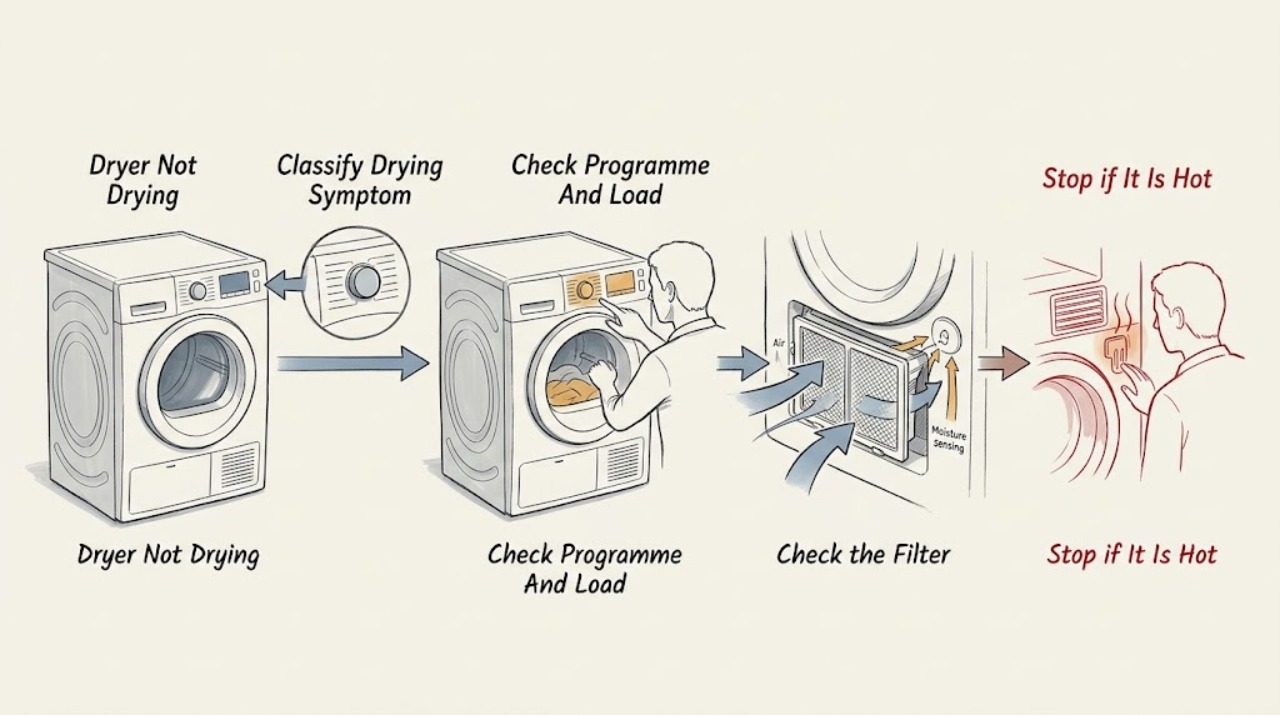
Work through in order
Diagnostic checks
Use only checks that match the exact appliance or system and its official guide.
-
Check 1
Run or review one normal load and note whether the Bosch dryer tumbles, whether the load feels warm near the end, whether the programme ends early, and whether the clothes are uniformly damp or only heavy items remain wet.
Expected result: The drum turns and the load is warm but damp, the cycle stops unusually early, or the drum turns without any warmth.
Next step: For warm-but-damp results continue with programme/load, filter, sensor, and airflow checks. For no warmth, do not open the cabinet; use the professional-service branch.
Stop if: Stop immediately for smoke, burning or chemical odor, unusual overheating, a damaged cord, sparks, or another fire/electrical hazard.
Why this matters
Why: Warm but damp laundry keeps the diagnosis on programme, load, sensing, lint, or airflow. No warmth moves the issue to the heating/service branch; an early stop can also be associated with sensing, airflow, or a fault condition.
-
Check 2
Compare the selected drying programme with the fabric-care label and the model manual, then retry with a normally sized, sorted load. Do not assume that a short or delicate programme should produce the same dryness as a longer programme.
Expected result: The result improves with a programme suited to the fabric or with a different load, or the load remains damp despite an appropriate programme.
Next step: Keep the programme and load combination that matches the care label. If the result is unchanged, switch the dryer off and clean the lint filter before the next test.
Stop if: Do not dry items that the care label excludes, or laundry contaminated with flammable solvents, oil, wax, grease, or paint.
Why this matters
Why: Improvement identifies a programme, fabric, load-size, or moisture-content mismatch rather than proof of a failed part. No improvement sends the check to airflow and moisture sensing.
-
Check 3
Switch the dryer off and let hot items cool. Remove and clean the lint filter according to the model manual, clearing visible lint, dust, or hair without damaging the filter.
Expected result: The filter is visibly loaded or the Bosch manual calls for washing it; after cleaning, airflow and drying improve or remain unchanged.
Next step: Reinstall the dry filter correctly and run the same controlled load. If the filter was already clear and the result is unchanged, continue to the moisture-sensor and vent checks.
Stop if: Stop if the filter frame, housing, cord, or surrounding area is damaged, scorched, wet near electrical parts, or unusually hot.
Why this matters
Why: A loaded filter can impede airflow and contribute to incomplete drying or overheating. Improvement after cleaning supports restricted airflow; no change means the vent, sensor, condensation path, or heating path still needs consideration.
-
Check 4
With the dryer off and cool, locate the moisture sensor by the lint-filter area using the model manual. Wipe accessible residue from the sensor with a damp cloth; Bosch's guide also permits a little white vinegar for limescale or detergent residue. Do not use abrasive material or dismantle the cabinet.
Expected result: A visible film is removed and the next comparable load dries normally, or the dryer still stops early or leaves the load damp.
Next step: Repeat only the same controlled load after the sensor is dry. If the symptom persists, inspect only the external vent/air-inlet path and model-specific container indicators.
Stop if: Stop if the sensor or wiring appears loose, damaged, corroded, scorched, or inaccessible without removing panels.
Why this matters
Why: Residue can affect the sensor's reading and cause an unsuitable stop or dryness result. No improvement means the remaining cause is more likely programme/load, airflow, condensation handling, or a component fault.
-
Check 5
Inspect the external vent outlet and accessible air inlet for lint, obstruction, or a kink, keeping the path clear. If this is a condenser model, check the condensation-container or air-cooler indicator and follow the exact model manual; do not reach into an internal heat exchanger or duct.
Expected result: The outlet stream is weak or blocked, the air inlet is obstructed, or a model-specific container/air-cooler indicator is active; after the accessible correction, drying improves or remains unchanged.
Next step: Clear only the accessible obstruction and empty or clean the named component exactly as the manual directs, then repeat the same load. If airflow is clear and the result remains poor, use the service branch.
Stop if: Stop if clearing the path requires cabinet access, the outlet is hot or damaged, there is lint accumulation that cannot be safely reached, or the dryer overheats.
Why this matters
Why: Blocked airflow reduces the warm-air exchange needed for drying. A container or air-cooler indication can stop or degrade drying on applicable models, but an indicator alone does not identify a universal part failure.
-
Check 6
If the drum turns but the dryer never becomes warm after the accessible checks, switch it off, unplug it if safe, and record the programme, load, indicator, and whether the breaker changed state. Do not test live voltage, bypass a thermal device, or open the cabinet.
Expected result: The dryer remains cold, a breaker trips, an error appears, or the dryer works only intermittently; alternatively it heats normally after an external maintenance correction.
Next step: Arrange qualified Bosch appliance service and provide the model/E-Nr., symptom timing, indicator or error text, and results of the safe checks. Do not order a part from the symptom alone.
Stop if: Stop using the dryer for smoke, burning/chemical odor, sparking, melted insulation, repeated breaker trips, water near electrical parts, or any suspected fire or shock hazard.
Why this matters
Why: Persistent no-heat or electrical symptoms can involve the heating element, thermal fuse, thermostat, timer, wiring, or control system. Bosch states that an expert should determine the source; an external maintenance correction does not prove a component is healthy.
Use your observations
Decision map
Find the observation that best matches what you see, then follow the next safe action.
-
PATH 01Next step
What you see
The drum turns and the load is warm, but clothes are damp at the end.
Do this next
Check programme/load, lint filter, moisture sensor, and external airflow in that order.
-
PATH 02Next step
What you see
The cycle ends early or stops before the load is dry.
Do this next
Clean the accessible moisture sensor and lint filter, verify the programme and load, then check airflow; persistent early stops need service.
-
PATH 03Next step
What you see
The lint filter, air inlet, or vent outlet is blocked or the outlet airflow is weak.
Do this next
Clear only the accessible path according to the manual and repeat the same load. Escalate if the obstruction is internal or drying remains poor.
-
PATH 04Next step
What you see
A condensation-container or air-cooler indicator is active on a model that has those components.
Do this next
Empty or clean the indicated accessible component exactly as the model manual directs; do not infer a replacement part from the indicator alone.
-
PATH 05Next step
What you see
The drum turns but there is no warmth after programme, filter, sensor, and airflow checks.
Do this next
Stop user troubleshooting and arrange qualified service for heating-element, thermal-fuse, thermostat, timer, wiring, or control diagnosis.
-
PATH 06Next step
What you see
There is smoke, burning or chemical odor, sparking, damaged insulation, overheating, or repeated breaker tripping.
Do this next
Stop the cycle, disconnect power only if it is safe to do so, keep clear of the appliance, and arrange qualified service; do not restart it to test.
Helpful context
Understand the symptom
Separate a drying-result problem from a heating problem
A Bosch dryer that tumbles and becomes warm but finishes with damp laundry is usually a programme, load, sensing, lint, or airflow question. A dryer that tumbles with no warmth is a different path: Bosch lists possible heating-element, thermal-fuse, thermostat, or timer faults and recommends expert diagnosis. Note whether the drum turns, whether the cycle completes, and whether the laundry or exhaust feels warm without opening the cabinet.
Use the result of each check to choose the next check
Do the accessible maintenance checks in order and change only one condition at a time. A clean filter or vent that restores normal drying points to restricted airflow; a clean sensor that changes an early stop points to residue affecting moisture detection. If these checks do not change the result, preserve the symptom for the service technician instead of guessing at a replacement part.
Safety boundary
Stop conditions
- Do not open the cabinet, bypass a thermal or door safety device, or make live electrical measurements.
- Disconnect power and stop using the dryer for smoke, burning or chemical odor, sparks, melted insulation, repeated breaker trips, or water near electrical parts.
- Do not continue operating a dryer suspected to be defective; let qualified service diagnose internal heating, wiring, or control faults.
When checks do not resolve it
Need a professional?
Call qualified Bosch appliance service when the dryer remains cold, continues to stop early, or still leaves clothes damp after the correct programme, clean filter, clean accessible sensor, and clear external airflow have been verified., Arrange service immediately for smoke, burning or chemical odor, sparking, a damaged power cord, repeated breaker trips, overheating, or any suspected electrical or fire hazard.
Common questions
FAQ
Why is my Bosch dryer running but not drying completely?
Start with the selected programme and load, then clean the lint filter, wipe residue from the accessible moisture sensor, and check the external vent or air inlet for blockage. Bosch lists these as common checks before professional support.
Can a dirty moisture sensor make a Bosch dryer stop early?
It can affect the dryness reading. Bosch says limescale or detergent residue may cover the sensor; with the dryer off and cool, wipe the accessible sensor with a damp cloth and a little white vinegar, following the model manual.
What should I check if my Bosch dryer has no heat?
Confirm the symptom without opening the cabinet. Bosch lists a possible heating element, thermal fuse, or timer motor issue and recommends an expert determine the cause, so persistent no-heat is a service path rather than a live-testing task.
How does a blocked vent affect Bosch dryer drying?
A blocked vent outlet or air inlet restricts the warm-air path and can lengthen drying or leave clothes damp. Inspect and clear only the accessible external path; internal duct cleaning or cabinet access belongs to service.
Should I keep running the dryer if it smells hot or trips the breaker?
No. Stop the cycle and disconnect power only if safe, then arrange qualified service. Smoke, burning odor, damaged insulation, overheating, sparks, and repeated breaker trips are stop conditions, not symptoms to test by repeated operation.
Read the exact guide
Official sources
- Dryer Troubleshooting: Dryer is not getting warm or heating up at allBosch Home Appliances · Bosch dryer no-heat troubleshooting and service boundary
- Bosch Dryer Troubleshooting & Repair Guide | Bosch – Fix Common Dryer ProblemsBosch Home Appliances · Bosch dryer troubleshooting and repair guidance
- Dryer troubleshooting: Dryer is not drying clothes completelyBosch Home Appliances · Bosch dryer incomplete-drying troubleshooting
Community feedback
Share a repair observation
Share a plain-text repair observation. Accepted observations are published automatically; this page may take a moment to update.