
On this page
Start here
Quick answer
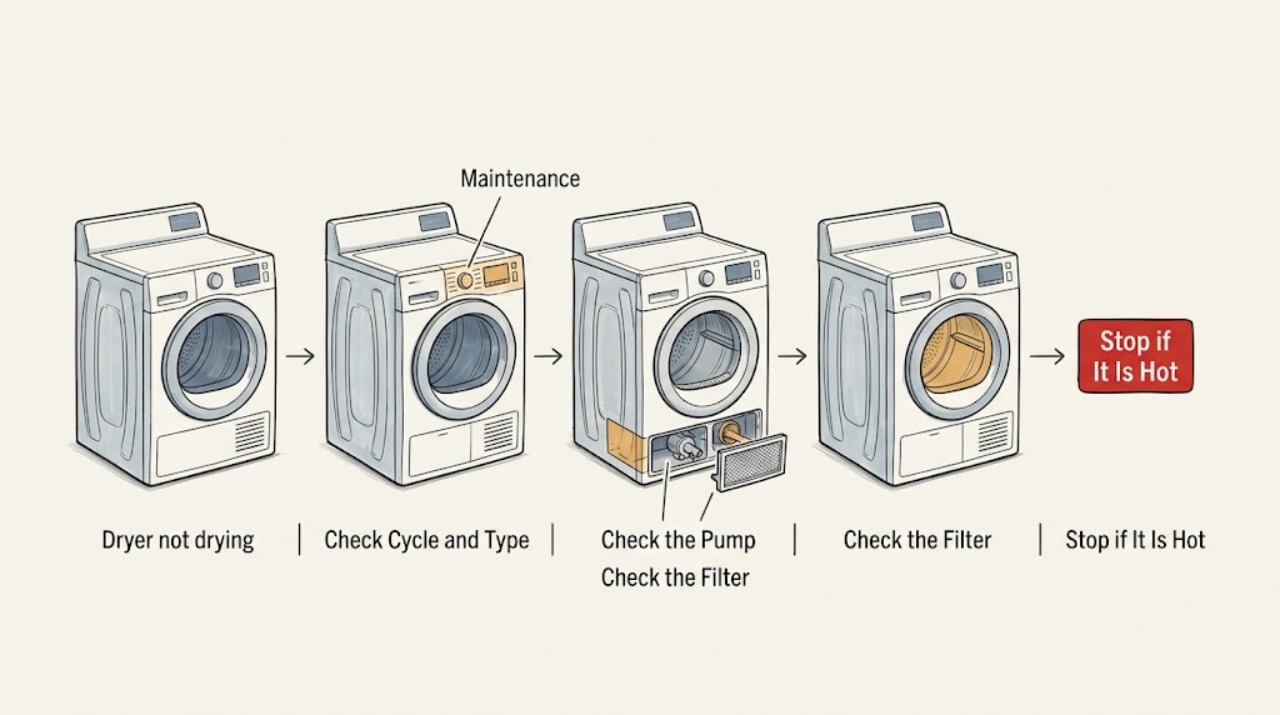
Treat a Bosch 800 Series display that appears as E:00 followed by -63 as an unresolved model-specific fault, not as a universal Bosch E63 meaning. The exact E-Nr. is essential: Bosch sells 800 Series dryers on different platforms, including ventless heat-pump and ventless condensation models, so a vent-hose explanation cannot be assumed. Photograph the complete display, record whether the drum runs and whether the load is warm or cold, and identify the rating-label E-Nr. before clearing anything. With the dryer off and cool, perform only the matching manual's accessible care checks—clean and refit the lint filter, check the load and moisture-sensor area, and inspect the visible condensate path if your model has one. Bosch's public US dryer list does not define the combined E:00 / -63 display; if the code returns, drying stops, or the dryer overheats, smells burnt, sparks, or trips power, stop using it and request Bosch service. Do not translate E:00 from a Bosch washer, call -63 a blocked vent without proving a vented model, remove panels, or test heater circuits.
Work through in order
Diagnostic checks
Use only checks that match the exact appliance or system and its official guide.
-
Check 1
Before resetting the dryer, photograph the entire display and transcribe the punctuation and order exactly: E:00, -63, E:63, a filter symbol, or another character. Record the complete rating-label E-Nr., FD/serial information, country, dryer type if printed, whether the drum turns, and when the code appears.
Expected result: The display is a repeatable E:00 followed by -63, a different code, or an incomplete/uncertain character sequence; the E-Nr. may still be missing.
Next step: Keep the photo and E-Nr. for the exact Bosch manual or service request. Do not use a washer E:00 table or a generic E63 part diagnosis.
Stop if: Stop immediately for smoke, burning odor, sparks, excessive heat, a damaged cord, or a repeated breaker trip.
Why this matters
Why: The opened Bosch US support hub does not define the combined E:00 / -63 display, and the exact 800 Series platform is not established by the series name alone. The public matching case also shows that similar-looking reports can receive conflicting vented and ventless interpretations.
-
Check 2
Classify the dryer from the exact E-Nr. and installation, not from the 800 Series badge: check whether the matching Bosch documentation calls it a heat-pump, condensation, or another platform and whether it is ventless. Do not pull the appliance out or inspect a rear duct unless the model instructions explicitly require a safe external check.
Expected result: The exact model is one of Bosch's ventless 800 Series platforms, a vented platform, or still cannot be matched to Bosch documentation.
Next step: Use the matching model manual for filter, condenser/heat-exchanger, condensate, and airflow instructions. If the E-Nr. cannot be matched, keep the dryer out of service and ask Bosch to identify the code.
Stop if: Do not remove the rear cover, cut an access opening, disconnect a duct, or move a stacked or heavy dryer alone.
Why this matters
Why: Bosch's official 800 Series examples include a ventless heat-pump model and a ventless condensation model. A vent-hose blockage theory is therefore not a valid first conclusion for an unidentified 800 Series dryer.
-
Check 3
With the dryer switched off and cool, perform only the accessible care steps Bosch documents for the matched platform: clear and correctly refit the fluff filter, use a suitable load and cycle, confirm the door closes and any child lock is not preventing a cycle, and clean the accessible moisture-sensor area without abrasives.
Expected result: The filter is blocked or misfitted, the load is overfilled or unsuitable, the door/lock prevents the cycle, the moisture sensor has residue, or all accessible checks are normal.
Next step: Correct only the documented accessible condition and make one supervised normal-use observation if no hazard or recurring code is present. If the code returns or drying remains poor, arrange Bosch service.
Stop if: Do not run without the filter, use a wet or damaged filter, use abrasives or steel wool on the sensor, or reach into the blower/heater area.
Why this matters
Why: Bosch identifies these conditions as common contributors to long or unsatisfactory drying. They can explain damp clothes but do not decode E:00 / -63 or prove a heater, heat pump, sensor, or control failure.
-
Check 4
Record the drying result without opening the cabinet: whether the load is warm or cold at the end, whether the cycle ends early or runs unusually long, whether the drum turns normally, whether water is present in an accessible condensate container, and whether E:00 / -63 appears at start, during heat, or at the end.
Expected result: The load is cold and damp, warm but damp, the cycle ends early, the drum does not turn, a condensate warning or water issue is visible, or the code returns at the same stage.
Next step: Give Bosch the stage, temperature impression, load, E-Nr., and display photo. Use only the exact manual's accessible condensate or filter step; do not guess a vent, heater, sensor, or pump part.
Stop if: Stop use for excessive heat, smoke, burning odor, melted lint or plastic, water near electrical parts, or a damaged cord.
Why this matters
Why: Warm-but-damp laundry can reflect programme, load, filter, sensor, or moisture-management conditions; cold laundry, no drum movement, or a recurring paired code needs a model-specific service diagnosis. A visible condensate issue may be user-addressable only when the exact manual says so.
-
Check 5
If the display returns after the documented external checks, leave the dryer off and request qualified Bosch service. Preserve the original code photo and note whether the dryer is ventless, rather than accepting an online claim that -63 always means a blocked hose or a failed heating element.
Expected result: The code clears once and stays away, returns immediately or on the next drying cycle, or the exact model remains unidentified.
Next step: Ask the technician to identify the code for the exact E-Nr., document the test result, and separate a confirmed failure from a part changed as a guess.
Stop if: Do not remove panels, test live heater or compressor circuits, bypass thermal or door safety controls, or continue operating a dryer that overheats or smells burnt.
Why this matters
Why: Bosch provides model-specific documentation and service routes, but the opened general US dryer list does not establish E:00 / -63. The public case contains conflicting suggestions and cannot select a component.
Use your observations
Decision map
Find the observation that best matches what you see, then follow the next safe action.
-
PATH 01Next step
What you see
The complete display is confirmed as E:00 followed by -63, but the E-Nr. or dryer platform is unknown.
Do this next
Keep the dryer off if it is not drying or the code recurs, identify the rating-label E-Nr., and use only the matching Bosch manual or service route.
Why this path and its safety boundary
Why it matters: The code remains unresolved at the 800 Series level. Bosch's public US dryer list does not define this combined display, and the series includes different ventless platforms.
-
PATH 02Next step
What you see
The exact model is a ventless Bosch 800 Series dryer and the accessible filter, load, door/lock, and moisture-sensor checks are normal, but clothes remain damp or E:00 / -63 returns.
Do this next
Stop repeated testing and request Bosch diagnosis using the exact E-Nr. and display photo. Do not open the heat-pump or condenser enclosure.
Why this path and its safety boundary
Why it matters: A generic external vent-hose explanation is less applicable; a heat-pump, condenser, airflow-through-the-appliance, sensor, control, or other model-specific fault remains possible without identifying one component.
-
PATH 03Next step
What you see
The exact matched manual documents an accessible filter, sensor, condensate, or load correction, and the dryer completes a normal supervised cycle with no returning code.
Do this next
Keep the model documentation and original code photo. Stop and call Bosch service if the paired display returns or drying degrades again.
Why this path and its safety boundary
Why it matters: The corrected external condition may have contributed to the drying result, but a cleared display does not establish the meaning of -63 or prove an internal repair.
-
PATH 04Next step
What you see
The dryer is cold and damp, stops early, fails to turn, overheats, smells burnt, sparks, leaks near electrical parts, or trips the breaker while E:00 / -63 is present.
Do this next
Stop the dryer, isolate power only from a dry safe position, keep clear of the hazard, and obtain qualified Bosch appliance or electrical service.
Why this path and its safety boundary
Why it matters: The symptom is no longer a routine drying-result check; thermal, mechanical, water, fire, or electrical safety takes priority and the display still does not identify a part.
Helpful context
Understand the symptom
Why E:00 and -63 must stay together until the model is known
The matching public case describes an 800 Series dryer showing E:00 followed by -63, not a simple standalone E63. Bosch's US dryer support hub lists several other dryer code families but does not define that combined display. The 800 Series name also spans different ventless designs, so the code should be logged exactly and matched to the rating-label E-Nr. rather than decoded from a search result or a washer code.
What not drying can still be checked safely
Bosch's dryer guidance supports low-risk checks such as the selected programme, load size, fluff filter, door/child-lock state, and accessible moisture-sensor area. These checks can explain damp laundry, but they do not establish the meaning of E:00 / -63 or justify opening a heat-pump, condenser, heater, or control enclosure.
When checks do not resolve it
Need a professional?
Arrange Bosch service when E:00 / -63 returns after the exact model's accessible checks, the E-Nr. cannot be matched, drying remains poor, the drum does not turn, or the platform is unknown. Stop immediately for excessive heat, smoke, burning odor, sparks, melted lint or plastic, water near electrical parts, a damaged cord, or a repeated breaker trip; isolate power from a dry safe position and use qualified appliance or electrical help. Do not translate E:00 from a washer, assume -63 means a vent blockage or heater failure, remove panels, test live circuits, bypass thermal/door safety controls, or cut an access opening.
Common questions
FAQ
Does E:00 followed by -63 mean a blocked vent hose?
Not safely at the 800 Series level. Bosch's public US dryer list does not define the combined display, and Bosch 800 Series examples are ventless. Identify the exact E-Nr. and platform before considering any airflow explanation.
Could -63 mean a failed heating element?
The display alone does not prove that. A public case contains that suggestion for a ventless dryer, but it does not provide a model-matched Bosch confirmation. Do not remove panels or test heater circuits yourself.
What can I check while the dryer is not drying?
Using the exact model manual, check the selected cycle, load size, accessible fluff filter, door/child-lock state, and moisture-sensor area. Bosch recommends qualified repair if these checks do not resolve the result or the code returns.
Why is the exact E-Nr. necessary?
The 800 Series name covers different Bosch dryer platforms, including ventless heat-pump and condensation models. The E-Nr. selects the correct manual and prevents applying a washer, another series, or another platform's code meaning.
When should I stop using the dryer?
Stop for a returning code with unresolved drying, excessive heat, smoke, burning odor, sparks, melted lint or plastic, water near electrical parts, a damaged cord, or a breaker trip. Keep it isolated and use qualified Bosch appliance or electrical service.
Read the exact guide
Official sources
- Bosch Dryers Troubleshooting & Repair | Bosch - Owner Support – Error Codes, Parts, Cleaning & MaintenanceBosch · Opened Bosch's official US dryer support hub. It lists current dryer code categories E01/02, E03, and E12 and model-specific manual/service routes, but it does not define the combined E:00 / -63 display.
- 800 Series Compact Condensation DryerBosch · Opened official Bosch US product page as a second concrete 800 Series platform example; it is not evidence that the assigned dryer is this exact model.
- Code d'erreur sur mon sèche-lingeBosch · Opened official Bosch France dryer error-code index. It confirms E63 is a named code entry in that regional dryer support taxonomy but does not establish the assigned E:00 / -63 meaning or US model applicability.
- Dryer is not dryingBosch · Opened official Bosch dryer troubleshooting guidance for safe symptom-level checks; use the matching regional/model manual for exact platform instructions.
- 800 Series Heat Pump Dryer Pearl SteelBosch · Opened official Bosch US product page as one concrete 800 Series platform example; it is not evidence that every 800 Series dryer shares this design or code behavior.
- Bosch Dryer -63 E:00 error codesReddit · Opened exact Reddit permalink as a lived-experience comparison only. The thread has conflicting vented/ventless interpretations and is not an official code definition or repair instruction.
Community feedback
Share a repair observation
Share a plain-text repair observation. Accepted observations are published automatically; this page may take a moment to update.