
On this page
Start here
Quick answer
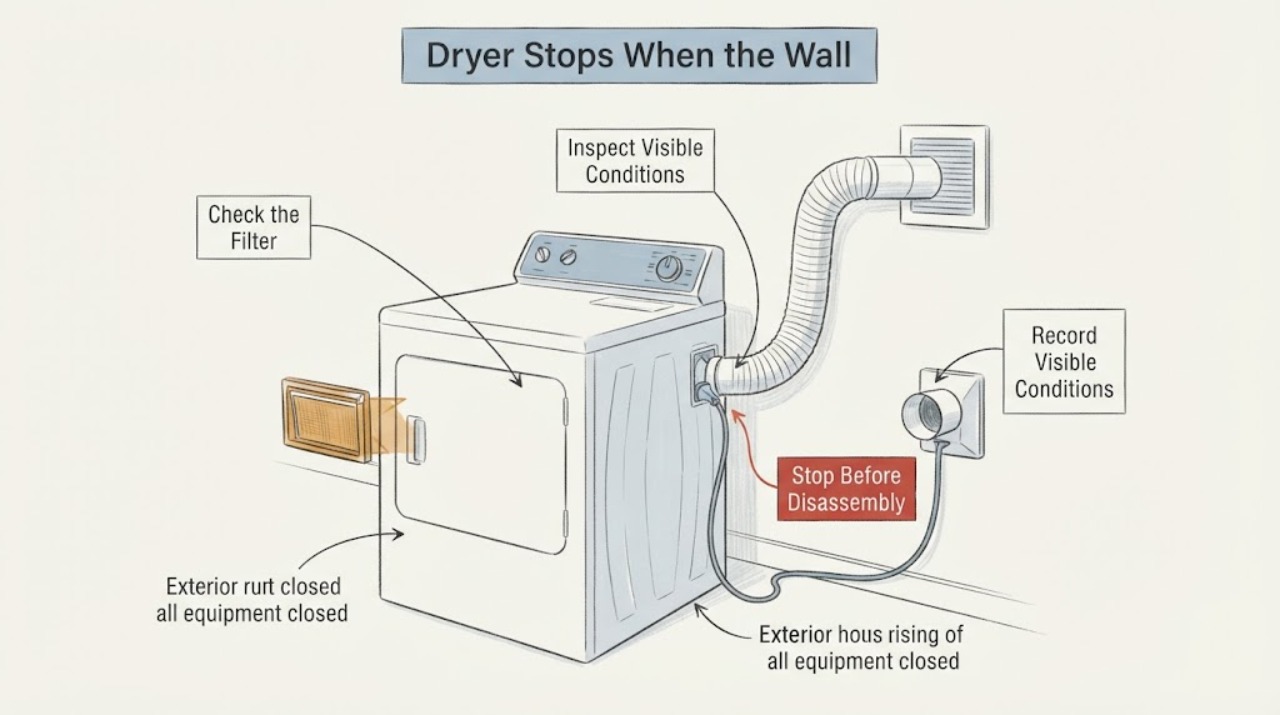
When a Hotpoint vented dryer runs with the hose disconnected but stops as soon as it is connected to the wall vent, restricted airflow in the accessible hose, wall duct or outside outlet is a leading possibility because reconnecting the vent adds the exhaust path. That symptom does not identify the exact blockage or prove an internal part has failed. Stop and unplug before moving the appliance or inspecting the hose, clean the lint filter, check the accessible hose for crushing or kinks, and look at the outside outlet for visible blockage. Do not use the dryer with the hose disconnected as a workaround. If the accessible path is clear but the dryer still stops, or if there is smoke, a burning smell, abnormal heat or an electrical symptom, stop using it and arrange qualified service.
Work through in order
Diagnostic checks
Use only checks that match the exact appliance or system and its official guide.
-
Check 1
Stop the dryer and unplug it before moving the cabinet or handling the hose. Record the two conditions: it runs with the wall hose disconnected, then stops after the hose is connected. Do not keep running it disconnected as a workaround.
Expected result: The stop occurs only after the exhaust hose is connected, or the dryer also stops with the hose disconnected.
Next step: If the symptom is connection-dependent and there is no smoke, odor, abnormal heat or electrical symptom, continue with the separate external airflow checks below. If it stops in both conditions or shows a safety symptom, leave it unplugged and arrange qualified service.
Why this matters
Why: A stop that appears only when the exhaust path is connected points toward an airflow restriction being exposed by the external vent path, but it does not prove the restriction location. Stopping in both conditions is not explained by the wall vent alone and needs broader service assessment.
-
Check 2
Remove and clean the lint filter as Hotpoint directs. With the appliance unplugged, inspect the hose from the dryer to the wall only from the outside for crushing, a sharp bend, collapse, lint buildup or an object blocking the opening; do not reach into the cabinet or dismantle the dryer.
Expected result: The filter is packed with lint, or the hose is visibly crushed, kinked, collapsed or obstructed; alternatively, the filter and accessible hose are clear.
Next step: Clean the filter and correct only an obvious, safe hose-routing problem without forcing the cabinet against the wall. If the hose cannot be made free of crushing or the blockage is inside the wall path, stop and arrange qualified vent cleaning or service.
Why this matters
Why: Lint and a restricted or crushed hose reduce the airflow the vented system needs. A clear filter and visible hose do not prove that the concealed wall duct is clear.
-
Check 3
From outside the home, look at the wall exhaust termination while the dryer is off. Check for visible lint, debris, a stuck flap or another obstruction, and confirm that reconnecting the hose has not pushed the dryer tight against the wall and pinched it. Do not enter the wall duct or use tools to probe it.
Expected result: The exterior outlet is visibly blocked or its flap cannot open, the hose is pinched after the appliance is pushed back, or the exterior appears clear.
Next step: Remove only loose, visible debris that can be reached safely with the dryer off and unplugged, then restore a non-crushed hose route. If the duct is inaccessible, long, damaged or still suspect, use a qualified vent professional rather than opening the dryer or bypassing a safety control.
Why this matters
Why: A visible obstruction or pinched hose can explain why the dryer stops only under connected-vent load. An apparently clear outlet does not establish that the full wall duct is clear; hidden buildup or a concealed restriction remains possible.
-
Check 4
If the filter, accessible hose and exterior termination are clear, retrieve the exact model manual using the appliance label and arrange qualified Hotpoint service or vent inspection if the connected-vent stop returns. Give the technician the model, whether the hose was connected, the timing of the stop and any heat or odor symptoms.
Expected result: The external vent path is clear but the dryer still stops when connected, or the dryer has smoke, a burning odor, abnormal heat, sparking or repeated electrical tripping.
Next step: Keep the dryer out of service and seek qualified appliance/electrical help. Unplug only if it is safe to approach; do not repeatedly restart it, bypass a thermal or safety control, remove panels or test internal wiring.
Why this matters
Why: The remaining cause cannot be safely separated from internal airflow, thermal, motor or control problems by the symptom alone. Smoke, burning odor, abnormal heat and electrical symptoms make continued operation unsafe.
Use your observations
Decision map
Find the observation that best matches what you see, then follow the next safe action.
-
PATH 01Next step
What you see
The dryer runs with the hose disconnected but stops only after the hose is connected, and the hose is visibly crushed or the outside outlet is visibly blocked.
Do this next
With the dryer unplugged, correct only the safe external hose routing or remove loose visible outlet debris. Do not keep using the dryer with the hose disconnected; stop and obtain vent service if the restriction is inside the wall or the stop returns.
Why this path and its safety boundary
Why it matters: The connected exhaust path has an observable restriction that can account for the symptom, although it does not prove there is no additional internal problem.
-
PATH 02Next step
What you see
The lint filter, accessible hose and outside termination are clear, but the dryer still stops when the wall vent is connected.
Do this next
Leave the dryer out of service and arrange a qualified vent inspection and Hotpoint service using the exact model from the appliance label. Do not guess or replace a thermostat, motor, sensor or control.
Why this path and its safety boundary
Why it matters: A concealed duct restriction or an internal dryer issue remains possible; the public symptom guidance does not identify a specific internal part.
-
PATH 03Next step
What you see
The dryer stops in either hose configuration, or it stops with smoke, a burning smell, abnormal heat, sparking or repeated electrical tripping.
Do this next
Stop using it, unplug only if safe to do so, and obtain qualified appliance/electrical help. Do not restart it to reproduce the symptom or bypass any safety device.
Why this path and its safety boundary
Why it matters: This is not a simple connected-vent comparison and may indicate a safety or electrical condition that cannot be diagnosed from the outside.
Helpful context
Understand the symptom
A vented Hotpoint dryer is designed to expel warm, moist air through a vent or hose. If it runs only when the hose is disconnected, reconnecting the wall path is changing the airflow load. That makes a crushed hose, blocked duct or obstructed outside outlet a useful first direction to check, but the symptom alone cannot identify the exact restriction or rule out an internal fault.
Hotpoint's public troubleshooting guidance is symptom-based: clean the lint filter after every use, inspect the vented system for blockages, and check that the hose is not blocked or crushed. Apply only the checks that are visible and accessible for your installation. The wall duct may need a qualified vent professional if it cannot be inspected safely.
This topic has no model number, so do not transfer a model-specific airflow limit, control sequence or replacement part from another Hotpoint dryer. Use the appliance label and Hotpoint's manual lookup for the exact model before any model-specific service decision.
When checks do not resolve it
Need a professional?
Arrange qualified Hotpoint service when the dryer continues to stop with the accessible vent path clear, when the wall duct cannot be safely inspected, or when the symptom is accompanied by smoke, burning odor, abnormal heat or electrical tripping. A qualified vent professional may be needed for a concealed or restricted wall duct. Do not order an internal part from this symptom alone.
Common questions
FAQ
Why does the Hotpoint dryer run when the vent hose is disconnected?
Reconnecting the hose restores the full exhaust path, so a crushed hose, blocked wall duct or obstructed outside outlet may only show up under that airflow load. This is a useful clue, not proof of the exact restriction or an internal part failure.
Can I leave the vent hose disconnected so the dryer keeps running?
No. Do not use a disconnected hose as a workaround. A vented dryer is intended to expel warm, moist air through its vent system; find and correct the external restriction or arrange qualified service.
What should I check first?
Unplug the appliance, clean the lint filter, inspect the accessible hose for crushing or kinks, and look for visible blockage at the outside termination. If the concealed wall duct or the dryer itself still needs diagnosis, use the exact model manual and qualified service.
Read the exact guide
Official sources
- Tumble Dryer Troubleshooting - Quick Fixes & TipsHotpoint · Hotpoint tumble-dryer troubleshooting, lint-filter and vent hose/duct checks, safety and professional service guidance.
- Hotpoint Appliances Safety NoticesHotpoint · Hotpoint safety-notice model lookup and instruction to unplug and refrain from using an affected appliance.
- Vented Tumble DryersHotpoint UK Appliances Limited · Hotpoint vented-dryer exhaust purpose, vent/hose routing and maintenance guidance.
- Hotpoint Service Tumble Dryer RepairHotpoint · Hotpoint tumble-dryer service routing and trained-engineer boundary.
- Get Hotpoint Appliance Manuals - Quick & Easy DownloadsHotpoint · Hotpoint exact-model manual lookup for tumble dryers and other appliances.
Community feedback
Share a repair observation
Share a plain-text repair observation. Accepted observations are published automatically; this page may take a moment to update.