
On this page
Start here
Quick answer
A Hotpoint refrigerator drain problem must be matched to the refrigerator configuration before anyone tries to clear it. GE Appliances' official support identifies ice on a freezer floor, water under fresh-food pans or recurring water on the floor as possible signs of a clogged defrost drain, but it says drain access varies by side-by-side, bottom-freezer and top-freezer model. First unplug the refrigerator before maintenance, identify the exact model and locate the water safely. If the manual permits access to a visible side-by-side drain hole, the documented method is to let ice thaw and flush with a bulb baster using hot tap water and baking soda; do not use boiling water, sharp tools or force. Bottom-freezer units generally require service to reach the drain, and many other models require service. If the water is from a supply valve or fill line, shut off the refrigerator water supply and arrange repair instead of treating it as a drain clog.
Before you begin
Safety first
- Unplug before maintenance or cleaning, keep water away from electrical components, do not use boiling water or sharp tools, do not remove concealed panels without model-specific instructions, and shut off the refrigerator water supply for a supply-line leak.
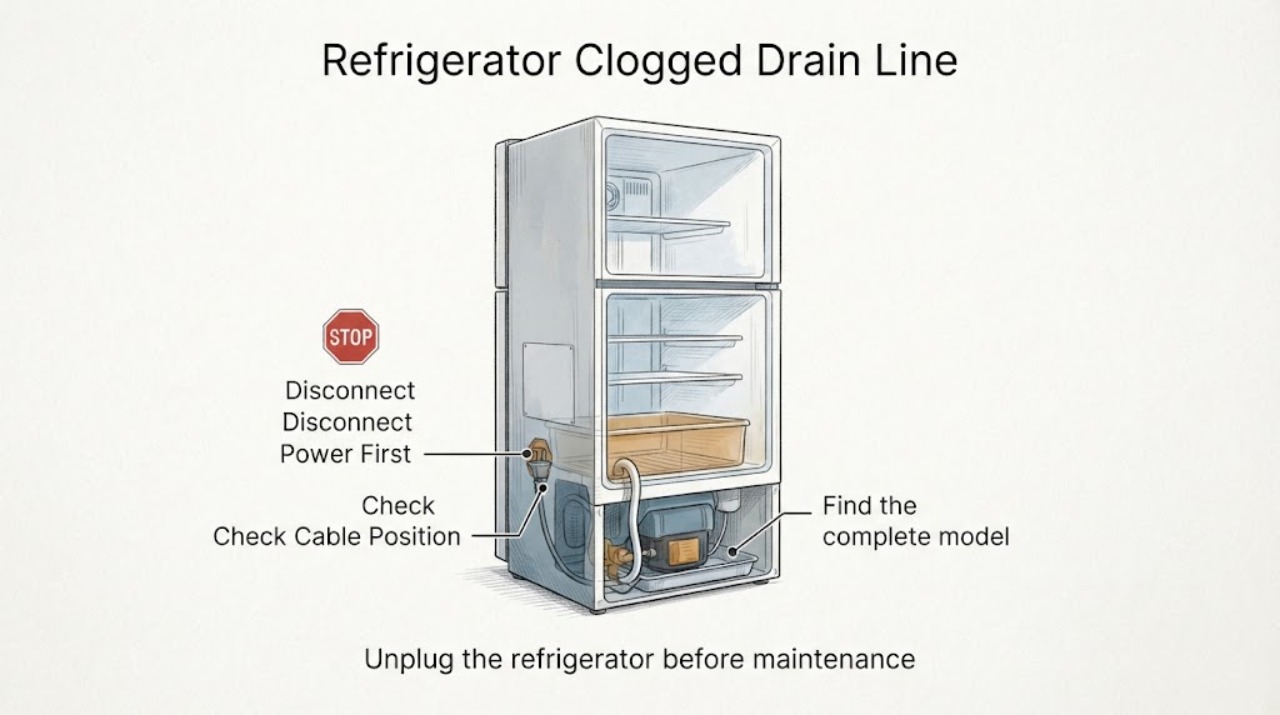
Work through in order
Diagnostic checks
Use only checks that match the exact appliance or system and its official guide.
-
Check 1
Unplug the refrigerator before maintenance or cleaning, dry standing water from the floor, and identify where ice or water is actually appearing: freezer floor, under fresh-food pans, inside the cabinet, or from a rear water connection. Do not touch wet electrical components.
Expected result: Ice or water is inside the freezer/under fresh-food pans, or the leak is at a water valve, copper/plastic supply line or icemaker fill line.
Next step: For a supply or fill-line leak, turn off the refrigerator water supply and arrange service or plumbing repair. For an internal ice/water pattern, continue only after the appliance is unplugged and the model layout is identified.
Why this matters
Why: GE Appliances associates the first pattern with a possible defrost drain issue but treats supply-valve and line leaks as separate causes. Water and electricity create a shock risk.
-
Check 2
Find the complete Hotpoint model number and read the matching Owner's Manual to confirm whether the appliance is self-defrost and whether it has a user-accessible drain. Identify side-by-side, bottom-freezer, top-freezer, compact or manual-defrost construction before removing anything.
Expected result: The manual confirms a visible drain access, directs the owner to service, or the appliance is compact/manual-defrost without the assumed drain system.
Next step: Follow only the matching manual. If it does not provide a user-clearing procedure or the configuration is uncertain, stop at external observation and arrange service.
Why this matters
Why: Official guidance says drain tubes depend on self-defrost design, compact refrigerators may have no drain tube, and access varies by layout. A generic Hotpoint instruction cannot cover all configurations.
-
Check 3
Only if the exact manual permits it and a side-by-side freezer has a visible drain hole or approved access panel, allow accessible ice to thaw and use a bulb baster to flush the hole with the documented baking-soda and hot-tap-water solution. Do not use boiling water, a knife, wire or compressed air.
Expected result: Water runs into the drain pan, the hole is not visible, the ice will not thaw safely, or water continues to return to the floor/freezer.
Next step: Stop if the manual does not authorize the procedure, access is hidden, or the leak persists; dry the area and schedule service. Do not dismantle the freezer or force the passage open.
Why this matters
Why: GE Appliances documents this limited flush for some side-by-side models and says a missing visible drain access or continued leak requires service. A successful flush does not establish that another layout can be treated the same way.
-
Check 4
For a bottom-freezer or top-freezer refrigerator, compare the water/ice location with the matching manual and official layout guidance without removing the freezer liner or rear panels. Do not attempt to reach a concealed drain with a sharp object or pour unapproved liquid into it.
Expected result: The appliance is bottom-freezer, top-freezer, built-in, compact or another layout for which the drain is concealed or the official page directs service.
Next step: Keep the refrigerator unplugged while water is present around electrical parts, protect food, and arrange qualified appliance service. Do not turn a concealed-drain problem into a cabinet disassembly project.
Why this matters
Why: GE Appliances says bottom-freezer drain tubes require disassembly and service, while most models with water on the floor require service; layout-specific instructions control any exception.
-
Check 5
Prepare the complete model, configuration, location of ice/water, photos of accessible conditions, whether the unit has an icemaker/water line, and whether a manual-authorized flush changed the symptom before contacting Hotpoint/GE service.
Expected result: The leak persists, the drain cannot be accessed as the manual permits, water returns after a flush, or the cause may be a valve, supply line, fill line or internal component.
Next step: Keep the appliance safe and dry, shut off the water supply for a water-line leak, and schedule qualified service. Do not open the sealed system, bypass a safety device or continue operating around wet electrical parts.
Why this matters
Why: A persistent leak or concealed drain requires model-specific diagnosis; the symptom alone does not identify a drain, valve, pan or defrost component.
Use your observations
Decision map
Find the observation that best matches what you see, then follow the next safe action.
-
PATH 01Next step
What you see
Ice is on the freezer floor or water is under the fresh-food pans, and the model is a self-defrost refrigerator.
Do this next
Identify the exact model and follow its Owner's Manual; use the limited side-by-side flush only when the manual and visible drain access authorize it, otherwise arrange service.
Why this path and its safety boundary
Why it matters: This pattern is consistent with a clogged defrost drain, but the freezer layout determines whether a user-accessible drain exists.
-
PATH 02Next step
What you see
The refrigerator is a side-by-side model with a visible drain hole or approved access panel, and the Owner's Manual permits cleaning.
Do this next
Let ice thaw and flush only as documented; stop if water does not reach the drain pan or the floor leak continues, then schedule service.
Why this path and its safety boundary
Why it matters: GE Appliances documents a bulb-baster flush with baking soda and hot tap water for this limited style of access.
-
PATH 03Next step
What you see
The unit is bottom-freezer, top-freezer, built-in, compact/manual-defrost, or the drain is hidden and the manual gives no user-clearing procedure.
Do this next
Do not remove panels or probe the drain; keep water away from electrical parts and arrange qualified service with the model and leak location.
Why this path and its safety boundary
Why it matters: Official guidance says some of these designs lack the assumed drain or require disassembly/service to reach it.
-
PATH 04Next step
What you see
Water is coming from the rear water valve, household supply line or icemaker fill line rather than from ice beneath the freezer or fresh-food pans.
Do this next
Turn off the refrigerator water supply and arrange appliance or plumbing service; do not keep operating the icemaker while the line leaks.
Why this path and its safety boundary
Why it matters: This is a water-supply/fill-line leak, not evidence of a clogged defrost drain.
Helpful context
Understand the symptom
Confirm that the symptom points to a defrost drain
A puddle is not proof of a clogged drain. GE Appliances says ice on the freezer floor or beneath fresh-food pans can indicate a clogged drain, while a leaking water valve or supply/fill line is a different problem. The official drain-tube guidance also says compact refrigerators may have no defrost drain at all. Record where the ice or water appears before choosing a procedure.
Match the action to the freezer layout
The opened support pages separate side-by-side, bottom-freezer and top-freezer models. Some side-by-side units expose a drain hole that can be flushed if the Owner's Manual permits it; bottom-freezer units require disassembly to reach the tube and are directed to service. Do not carry the side-by-side method into a different Hotpoint layout.
Keep water and electricity separated
GE Appliances instructs owners to unplug before maintenance or cleaning. A water-supply leak also requires shutting off the refrigerator water supply, and the exact icemaker shutoff method is model-specific. Do not pour boiling water into a drain, probe it with a sharp object or remove panels that the manual does not identify as user-accessible.
When checks do not resolve it
Need a professional?
Arrange qualified service when the model manual does not authorize drain access, the refrigerator is bottom-freezer or built-in with a concealed drain, water returns after a permitted side-by-side flush, or the leak is from a valve, supply line, fill line or electrical area. Keep the appliance unplugged during wet maintenance and shut off the refrigerator water supply for a water-line leak.
Safety scope: Unplug before maintenance or cleaning, keep water away from electrical components, do not use boiling water or sharp tools, do not remove concealed panels without model-specific instructions, and shut off the refrigerator water supply for a supply-line leak.
Have this ready
- Provide the complete model, freezer layout, self-defrost/manual-defrost status, exact ice/water location, photos of accessible drain access, icemaker/water-line status and whether any manual-authorized flush changed the symptom.
Common questions
FAQ
Can I flush any Hotpoint refrigerator drain with hot water?
No. GE Appliances documents a baking-soda and hot-tap-water flush only for some side-by-side models with visible drain access and a matching manual procedure. Do not use boiling water, sharp tools or the side-by-side method on a concealed or different layout.
Does water on the floor prove that the defrost drain is clogged?
No. Ice under the freezer basket or under fresh-food pans can point to a defrost drain, but GE Appliances also lists leaking valves, household water lines and icemaker fill lines. Locate the water source before choosing a drain procedure.
Can I clear a bottom-freezer Hotpoint drain myself?
The official bottom-freezer guidance says access requires disassembly and recommends service. Use the exact model manual and arrange qualified repair rather than removing freezer panels or probing a concealed drain.
Read the exact guide
Official sources
- Refrigerator & Freezer - Drain TubesGE Appliances / Hotpoint support · Opened official GE Appliances support content that explicitly includes GE and Hotpoint freezer distinctions. It says drain tubes depend on self-defrost design, full-size refrigerators generally have them, compact refrigerators do not, and older Hotpoint upright/freezer structures vary.
- Side-by-Side Refrigerator - Drain TubeGE Appliances / Hotpoint support · Opened official side-by-side drain-tube article. It describes the drain path, the usual ice/puddle evidence, visible access variations, manual-dependent flushing and service when the procedure fails.
- Refrigerator - Water on FloorGE Appliances / Hotpoint support · Opened official support content. It instructs unplugging before maintenance, distinguishes possible clogged defrost drains from water-valve/supply/fill-line leaks, and routes layouts or persistent leaks to model-specific service.
- Side-by-Side Refrigerator - Water on Floor, Repairing a Clogged Defrost DrainGE Appliances / Hotpoint support · Opened official side-by-side support content. It limits self-clearing to eligible visible drain access and the matching Owner's Manual, documents hot tap water with baking soda and a bulb baster, and sends inaccessible or persistent leaks to service.
- User Manual & Care for HTM18IBPSAGE Appliances / Hotpoint · Opened official GE Appliances Owner Center page for a Hotpoint top-freezer refrigerator. It demonstrates the official Hotpoint model/manual and service path, but its specific model is not asserted as the user's model and does not supply a universal drain procedure.
- Bottom Freezer Refrigerator - Clogged Drain Tube, Ice on Freezer FloorGE Appliances / Hotpoint support · Opened official bottom-freezer support content. It identifies ice/water locations and says bottom-freezer access requires disassembly, recommending service rather than a user drain-clearing procedure.
Community feedback
Share a repair observation
Share a plain-text repair observation. Accepted observations are published automatically; this page may take a moment to update.