
On this page
Start here
Quick answer
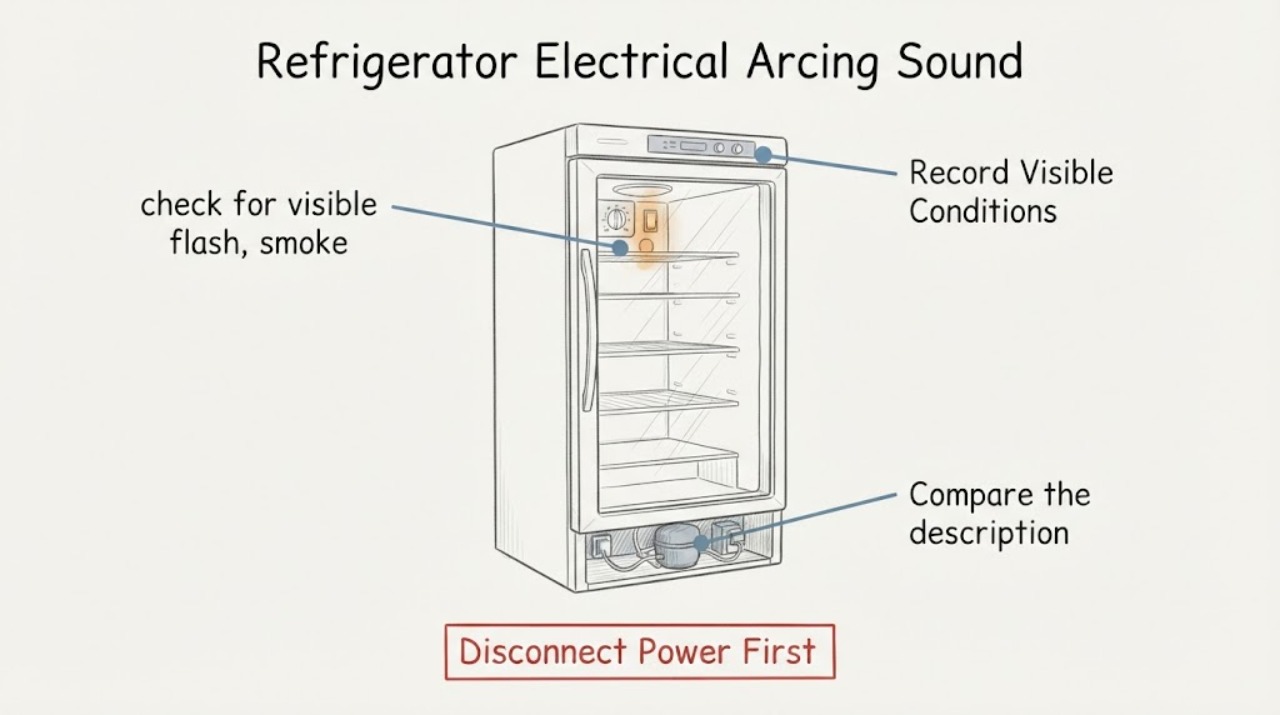
Treat a suspected electrical arc as a safety report, not a confirmed component diagnosis. If there is a visible flash, smoke, burning odor, hot or damaged wiring, repeated breaker action, or damage to the cabinet or cord, stop using the refrigerator, isolate power only from a safe position, and arrange qualified service without reproducing the sound. GE's official refrigerator guidance, which Hotpoint directs appliance questions to, also says some self-defrost refrigerators can make an arching-like sound when water drips on the defrost heater, while other new or unexplained sounds require service. Identify the exact Hotpoint model before applying model-specific guidance.
Work through in order
Diagnostic checks
Use only checks that match the exact appliance or system and its official guide.
-
Check 1
From a safe position, check for visible flash, smoke, burning or electrical odor, unusual heat, melted or damaged cord/wiring, water at an electrical area, or a tripped breaker associated with the refrigerator.
Expected result: Any danger sign is present, or the sound is only heard with no visible danger sign.
Next step: If any danger sign is present, stop using the refrigerator, keep clear of exposed electricity, isolate power only if it can be done without approaching the hazard, and arrange qualified service. Do not reset the breaker repeatedly or run the refrigerator to reproduce the sound.
Why this matters
Why: A danger sign makes this a safety event rather than a sound-identification exercise; an unconfirmed sound still cannot be diagnosed as a particular part.
-
Check 2
If there is no danger sign, record when the sound occurs: during or just after a defrost period, after a door is closed, during ice making or water dispensing, or continuously from the freezer or underneath.
Expected result: The sound matches a repeatable operating event, or it is newly occurring, continuous, or unrelated to a recognizable cycle.
Next step: Do not remove covers or use tools to locate the sound. Preserve the timing and location description for model-specific service.
Why this matters
Why: GE lists several normal event-linked sounds, including defrost-related hissing/sizzling/buzzing/arching, water or icemaker sounds, and post-outage compressor clicks; an unexplained or newly occurring sound is a different service branch.
-
Check 3
Compare the description with the official normal-sound boundary: a self-defrost refrigerator may make an arching-like sound when water drips on the defrost heater, while a fan-blade impact sound from the freezer is listed as abnormal.
Expected result: The sound occurs only around defrost and there are no visible electrical warning signs, or it sounds like repeated mechanical impact or a newly worsening electrical noise.
Next step: For a model-matched normal cycle with no warning signs, document it and monitor without opening the appliance. For a new, worsening, or unexplained sound, stop use and arrange service.
Why this matters
Why: The first pattern is consistent with the official normal-sound explanation but does not prove the Hotpoint model has that design; the second pattern is not a reason to keep testing.
-
Check 4
Locate the complete Hotpoint model information and give it, the sound location, timing, and any safety symptoms to the official Hotpoint/GE support route or qualified service.
Expected result: The model and a repeatable symptom description are available, or the model cannot be read.
Next step: Use the official support route with the model and symptom details. Do not infer a compressor, relay, defrost heater, fan, or wiring failure from the word arcing.
Why this matters
Why: The Hotpoint support page routes appliance questions through GE Appliances and service through Bodewell; the exact model is needed before model-specific sound or electrical guidance can be selected.
Use your observations
Decision map
Find the observation that best matches what you see, then follow the next safe action.
-
PATH 01Next step
What you see
There is a flash, smoke, burning odor, unusual heat, damaged cord/wiring, water near electrical parts, or repeated breaker action.
Do this next
Stop use, move away from the hazard, isolate power only from a safe position, and arrange qualified service. Do not reproduce the sound or open the cabinet.
Why this path and its safety boundary
Why it matters: The reported sound may involve an unsafe electrical condition; it cannot be safely classified by continued observation.
-
PATH 02Next step
What you see
The sound occurs only during or after a defrost event and there are no visible electrical warning signs.
Do this next
Record the model and timing, avoid internal inspection, and use the official model-specific support route if the sound changes, persists outside defrost, or causes concern.
Why this path and its safety boundary
Why it matters: GE documents an arching-like sound on some self-defrost refrigerators when water drips on defrost heaters, but this is family guidance and not proof for an unidentified Hotpoint model.
-
PATH 03Next step
What you see
The sound is new, continuous, worsening, comes from a fan or underside, or does not match a documented operating event.
Do this next
Stop testing and arrange qualified service with the exact model and symptom timing.
Why this path and its safety boundary
Why it matters: GE's unusual-noise guidance treats newly occurring or otherwise unexplained sounds as requiring diagnosis rather than a user part replacement.
Helpful context
Understand the symptom
Do not reproduce a suspected arc
A sound described as arcing can be a normal defrost-related sound on some refrigerators, but the description alone cannot prove that. Visible electrical evidence, smoke, odor, heat, damage, or repeated breaker action changes the response immediately: stop using the appliance and get qualified help.
When checks do not resolve it
Need a professional?
Stop using the refrigerator immediately for visible arcing, smoke, burning odor, unusual heat, damaged cord or wiring, water near electrical parts, repeated breaker trips, or a damaged cabinet. Do not reset a tripped breaker repeatedly, remove electrical covers, probe live wiring, or run the refrigerator to reproduce the sound. A new, worsening, continuous, or unexplained sound also warrants qualified service.
Common questions
FAQ
Is an arcing-like sound always an electrical failure in a Hotpoint refrigerator?
No. GE's official normal-sound guide says some self-defrost refrigerators can make an arching-like sound when water drips on the defrost heater. A visible flash, odor, smoke, heat, damage, repeated breaker action, or a new unexplained sound must be treated as a service and safety issue.
Should I open the back of the refrigerator to locate the arc?
No. Do not open electrical covers, perform live tests, or reproduce a suspected arc. Give the exact Hotpoint model and the sound timing/location to qualified service.
Read the exact guide
Official sources
- Appliance Support - HotpointHotpoint · Official Hotpoint support page; it states Hotpoint appliances are registered with GE Appliances, appliance questions are directed to GE Appliances, and Hotpoint appliances are serviced by Bodewell.
- Refrigerator - Normal Sounds and Noises MadeGE Appliances · Official GE refrigerator family sound guidance reached through Hotpoint's official GE support route; it lists defrost-related arching-like sound and other event-linked noises but is not a model-specific Hotpoint diagnosis.
- Refrigerator - Unusual NoisesGE Appliances · Official GE refrigerator external noise triage reached through Hotpoint's official support routing; supports service for new/unexplained sounds and no internal electrical diagnosis.
- Refrigerator and Freezer Troubleshooting and SupportGE Appliances · Official GE refrigerator support route; supports obtaining model-specific guidance and qualified service rather than inferring an internal part.
Community feedback
Share a repair observation
Share a plain-text repair observation. Accepted observations are published automatically; this page may take a moment to update.