
On this page
Start here
Quick answer
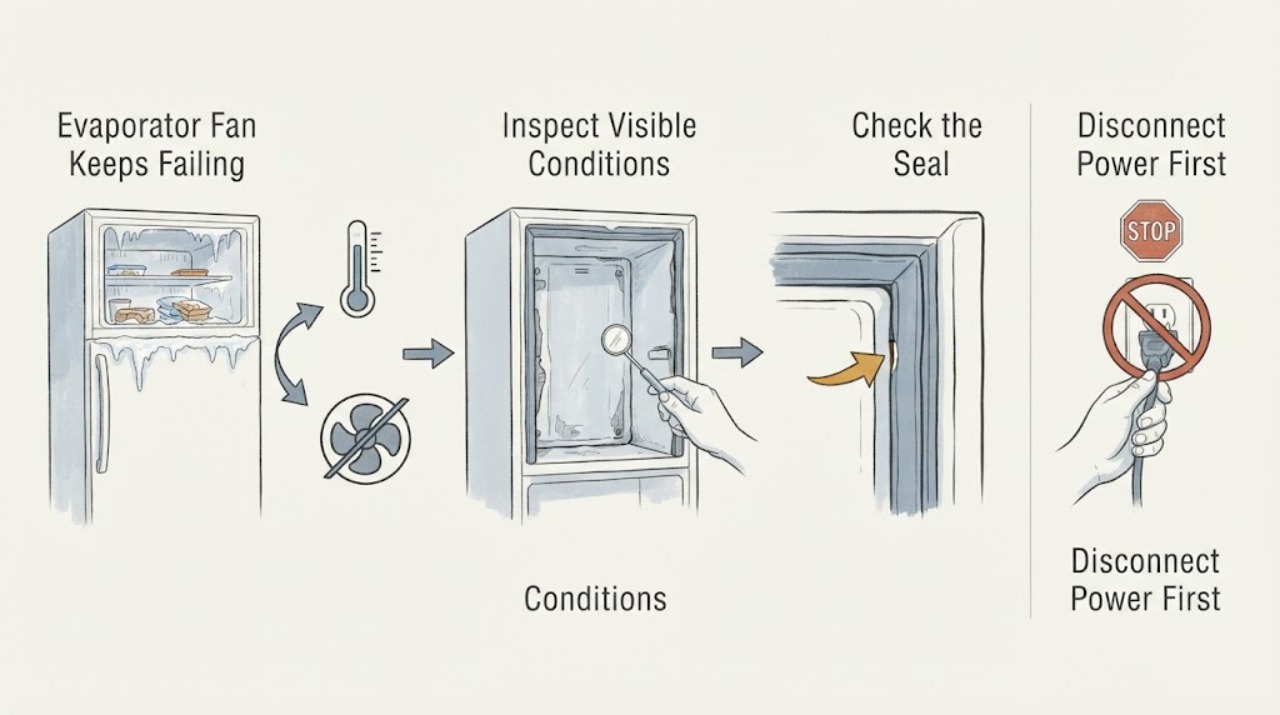
The Hotpoint HTS18GBSBRWW is an 18.2 cu. ft. frost-free top-freezer refrigerator, and its documented owner literature is a general Models 16, 17, 18 manual. A fan that is quiet during automatic defrost is not automatically failed: GE says the compressor and fans are normally off during defrost, usually for about 25–45 minutes, while the exact manual tells owners to allow about 30 minutes when the refrigerator appears not to operate. The useful distinction is what happens afterward. If cooling and normal airflow return after the defrost interval, record that pattern rather than replacing a fan. If frost builds on the freezer wall, packages block the rear air path, the door or gasket does not seal, or the fan remains absent after the interval, unplug before any cleaning and arrange qualified service. Do not hold a door switch, reach toward the evaporator fan, probe wiring, or perform a live voltage test; repeated prior fan replacement is only a clue that an underlying frost, defrost, wiring, or control condition still needs professional diagnosis.
Before you begin
Safety first
- Unplug the refrigerator before cleaning or repairs. Do not hold a door switch, reach toward the evaporator fan, remove the evaporator cover, probe live wiring, bypass a safety device, open the sealed system, or use a heat tool or sharp object to clear ice. The temperature control at 0 does not remove power from the light circuit.
Work through in order
Diagnostic checks
Use only checks that match the exact appliance or system and its official guide.
-
Check 1
Record the full label as Hotpoint HTS18GBSBRWW, the serial number, whether the fresh-food section is also warming, whether food is still hard-frozen or softening, and the exact time a fan or cooling sound seems to stop. Do not remove a cover to identify the fan.
Expected result: The model and serial are legible and the freezer remains partly cold, or the identity or temperature state is uncertain.
Next step: Use the model-linked manual and continue with timing, frost, door, and airflow observations. If the label is different, stop applying this page and locate the matching manual.
Stop if: Do not order an evaporator fan or open the freezer rear panel from the repair history alone.
Why this matters
Why: The exact model is supported, but a symptom described as “the evaporator fan failed” does not distinguish a normal defrost interval from a persistent airflow or cooling problem. Partly frozen food shows residual cooling, not a confirmed fan diagnosis.
-
Check 2
When the refrigerator appears quiet, note whether the quiet period ends within the manual's roughly 30-minute wait or the general automatic-defrost range of about 25–45 minutes. Observe only the outside: do not hold a door switch, reach toward a fan, or use a probe or meter on a live appliance.
Expected result: Cooling or normal operating sounds return after the interval, or the refrigerator remains quiet and temperatures continue to rise beyond it.
Next step: Record the start and recovery times and arrange service for a repeated or extended episode. Do not force a cycle or bypass a door safety switch to make the fan run.
Stop if: Stop immediately for smoke, burning odor, sparking, a hot or damaged cord, water near electrical parts, or a breaker that trips repeatedly.
Why this matters
Why: A quiet period followed by recovery is consistent with automatic defrost. Continued loss of cooling after the interval is not explained by the normal defrost window alone, but still does not identify the fan motor, defrost control, wiring, or compressor.
-
Check 3
With the refrigerator unplugged before cleaning or maintenance, inspect only visible frost, the door gasket, door closure, and package placement. Keep food and containers away from the visible freezer air duct and note whether the rear wall has a light, heavy, or rapidly returning frost pattern. Do not chip ice or remove the evaporator cover.
Expected result: There is heavy frost on the freezer wall, a torn or poor-sealing gasket, a package holding the door open, or a package against the rear wall; alternatively, the visible area is clear and the door seals normally.
Next step: Correct only the visible door, gasket, and package conditions, then monitor recovery. If frost returns, the freezer remains warm, or the fan is still absent after defrost, arrange qualified service rather than dismantling the freezer.
Stop if: Do not use a knife, heat gun, hair dryer, water spray, or live electrical test to clear or diagnose frost around the evaporator fan.
Why this matters
Why: GE associates frost with humidity, door openings, warm food loads, packages against the rear wall, and poor gasket sealing; packages can also block airflow. A clear exterior does not prove that the internal fan or defrost system is healthy.
-
Check 4
Check the external temperature-control position against the model manual, verify that it is not at 0, and make sure the refrigerator is plugged fully into its dedicated, properly grounded outlet. If a setting or power connection was corrected, record the change and allow the documented stabilization period instead of repeatedly changing the dial.
Expected result: The dial was at 0 or too warm, the plug or breaker was abnormal, or the setting and outlet are normal while the freezer remains underperforming.
Next step: After a safe correction, monitor the freezer without opening panels. If the symptom remains or recurs, provide the technician the setting, power observations, food condition, and defrost timing.
Stop if: Do not bypass grounding, use a damaged cord or unsafe extension arrangement, or treat a lit interior lamp as proof that the cooling circuit is operating.
Why this matters
Why: The Hotpoint manual says 0 stops cooling in both compartments without removing power from the light circuit, and lists unplugging or a tripped breaker as no-operation causes. A normal setting and outlet remove only those external explanations; they do not prove an evaporator-fan or sealed-system fault.
-
Check 5
If a fan has already been replaced and the symptom returned, list each replacement date, the exact symptom before and after it, the frost pattern, and whether cooling recovered after defrost. Leave internal diagnosis to a qualified technician; do not test fan voltage, jump the motor, or substitute a part based on appearance.
Expected result: The fan symptom returns with recurring frost, returns without visible frost, or the prior repair record is incomplete.
Next step: Arrange qualified Hotpoint/GE appliance service with the complete model, serial, prior work orders, temperature behavior, and defrost timing. Ask the technician to assess the whole cooling and defrost path before selecting a replacement part.
Stop if: Do not continue operating through a burning smell, smoke, sparking, repeated breaker trip, damaged wiring, or food-safety concern, and do not open the sealed system.
Why this matters
Why: A recurring symptom can involve ice interference, defrost control, wiring or connector integrity, or another cooling condition; the history alone cannot distinguish them. No visible frost also does not prove a motor or control failure.
Use your observations
Decision map
Find the observation that best matches what you see, then follow the next safe action.
-
PATH 01Next step
What you see
The refrigerator becomes quiet during a suspected defrost period and cooling or normal operating sounds return within about 25–45 minutes, with no heavy frost trend.
Do this next
Record the timing and monitor temperatures. If the same episode becomes longer, more frequent, or leaves the freezer warming, arrange service with the timing history.
Why this path and its safety boundary
Why it matters: The observation is consistent with normal automatic defrost and does not establish an evaporator-fan failure.
-
PATH 02Next step
What you see
Heavy frost returns on the freezer wall, the door gasket leaks air, a package holds the door open, or a package rests against the rear air path.
Do this next
Correct the visible obstruction or sealing issue with the appliance unplugged for maintenance. If frost returns or the freezer stays warm, arrange qualified service without removing the evaporator cover.
Why this path and its safety boundary
Why it matters: Door sealing, humidity, food loading, or blocked airflow is more likely than a proven fan-motor failure, although recurring frost can require service for the defrost system.
-
PATH 03Next step
What you see
The freezer remains warm or food continues softening after the documented defrost interval, the temperature setting and outlet are normal, and no visible door or package issue explains it.
Do this next
Arrange qualified Hotpoint/GE refrigerator service and provide the model, serial, temperature trend, defrost timing, frost pattern, and prior repair history. Do not buy a fan or control part solely from this branch.
Why this path and its safety boundary
Why it matters: The normal defrost and simple external branches do not explain the symptom. The remaining possibilities include airflow, defrost, control, wiring, or sealed-system conditions, but none is proven from an owner observation.
-
PATH 04Next step
What you see
There is smoke, burning odor, sparking, damaged wiring or cord, repeated breaker tripping, water near electrical parts, a sharp temperature rise, or food has thawed completely.
Do this next
Stop using the refrigerator, isolate power only from a safe position, do not refreeze food that has thawed completely, and arrange qualified appliance or electrical service. Do not touch internal wiring or the fan.
Why this path and its safety boundary
Why it matters: The situation has crossed the safe owner-check boundary and may involve electrical, fire, water, or food-safety risk.
Helpful context
Understand the symptom
What is confirmed about this Hotpoint
The exact HTS18GBSBRWW identity is supported by GE Appliances' Hotpoint parts/support page, which describes an 18.2 cu. ft. top-freezer refrigerator and links the owner literature. That literature is a shared Models 16, 17, 18 manual, so it supports the documented frost-free and safety boundaries but does not turn a repeated fan history into proof of a particular failed part. Keep the model and serial label available for service.
A quiet fan is not always a failed fan
Automatic defrost is the first timing distinction. GE says the defrost heater melts evaporator frost while the compressor and all fans are off, normally for roughly 25–45 minutes. The Hotpoint manual's troubleshooting table likewise says to wait about 30 minutes if the refrigerator appears not to operate. If the refrigerator resumes cooling afterward, that observation supports a defrost interval rather than proving an evaporator-fan failure.
Why food can still be frozen while the freezer is underperforming
Partly frozen food is not a component diagnosis. The manual lists a warm temperature setting, warm weather or frequent door openings, a door left open, and a package blocking the freezer air duct as possible explanations for a warm freezer compartment. GE's frost guidance also points to humidity, door sealing, packages against the rear wall, and a freezer fan that is not running. These observations should be recorded before anyone selects a fan, defrost, thermostat, or control part.
When checks do not resolve it
Need a professional?
Arrange qualified Hotpoint/GE appliance service when the fan remains absent after the normal defrost interval, frost returns, cooling stays inadequate after external corrections, a prior fan replacement did not hold, or diagnosis would require opening the freezer, testing wiring, or handling sealed-system components. Seek urgent service for smoke, burning odor, sparking, damaged wiring, repeated breaker trips, or water near electrical parts.
Safety scope: Unplug the refrigerator before cleaning or repairs. Do not hold a door switch, reach toward the evaporator fan, remove the evaporator cover, probe live wiring, bypass a safety device, open the sealed system, or use a heat tool or sharp object to clear ice. The temperature control at 0 does not remove power from the light circuit.
Have this ready
- Provide HTS18GBSBRWW, the serial number, food-temperature trend or whether food remains hard-frozen or softens, the exact quiet and recovery times, control setting, frost pattern, gasket and package observations, outlet/breaker observations, and every prior fan or cooling repair record.
Common questions
FAQ
Does a quiet evaporator fan prove that the Hotpoint HTS18GBSBRWW fan has failed?
No. GE says the compressor and fans are normally off during automatic defrost, which generally lasts about 25–45 minutes. Record whether cooling returns after that interval before treating the noise as a failed part.
Why can food still be frozen when the freezer is not freezing properly?
Residual cooling can leave some food frozen while airflow, frost, door sealing, temperature setting, or defrost behavior is abnormal. The food state narrows the observation but does not identify the fan motor, control, or sealed system.
Should I test the fan by holding the freezer door switch or measuring voltage?
No. Unplug before cleaning or repairs and leave internal fan, wiring, and control testing to a qualified technician. Do not bypass the door safety system or reach toward a moving or energized fan.
Read the exact guide
Official sources
- Refrigerator - Automatic Defrost SystemGE Appliances · Opened official GE guidance for the timing distinction only; it does not identify which internal part is defective on HTS18GBSBRWW.
- Refrigerator - Frost in FreezerGE Appliances · Opened official GE guidance for safe external checks before service; it does not support opening the evaporator cover or selecting a replacement part.
- Refrigerator & Freezer - Ice on Freezer WallGE Appliances · Opened official GE guidance for external frost and door/airflow observations; it directs service if the freezer fan is not running or the suggestions do not resolve the issue.
- Refrigerators Top-Freezer Models 16, 17, 18 Owner's Manual and Installation InstructionsGE Appliances / Hotpoint · Opened the owner PDF linked from the exact HTS18GBSBRWW support page; the manual states that model and serial numbers should be recorded and gives general Models 16, 17, 18 guidance, so it supports safety and broad symptom checks rather than a component diagnosis.
- Model Search | HTS18GBSBRWWGE Appliances / Hotpoint · Opened the official GE Appliances parts/support page for the exact assigned model; it identifies the product as an 18.2 cu. ft. Hotpoint top-freezer refrigerator and links owner literature without proving a particular fan failure.
Community feedback
Share a repair observation
Share a plain-text repair observation. Accepted observations are published automatically; this page may take a moment to update.