
On this page
Start here
Quick answer
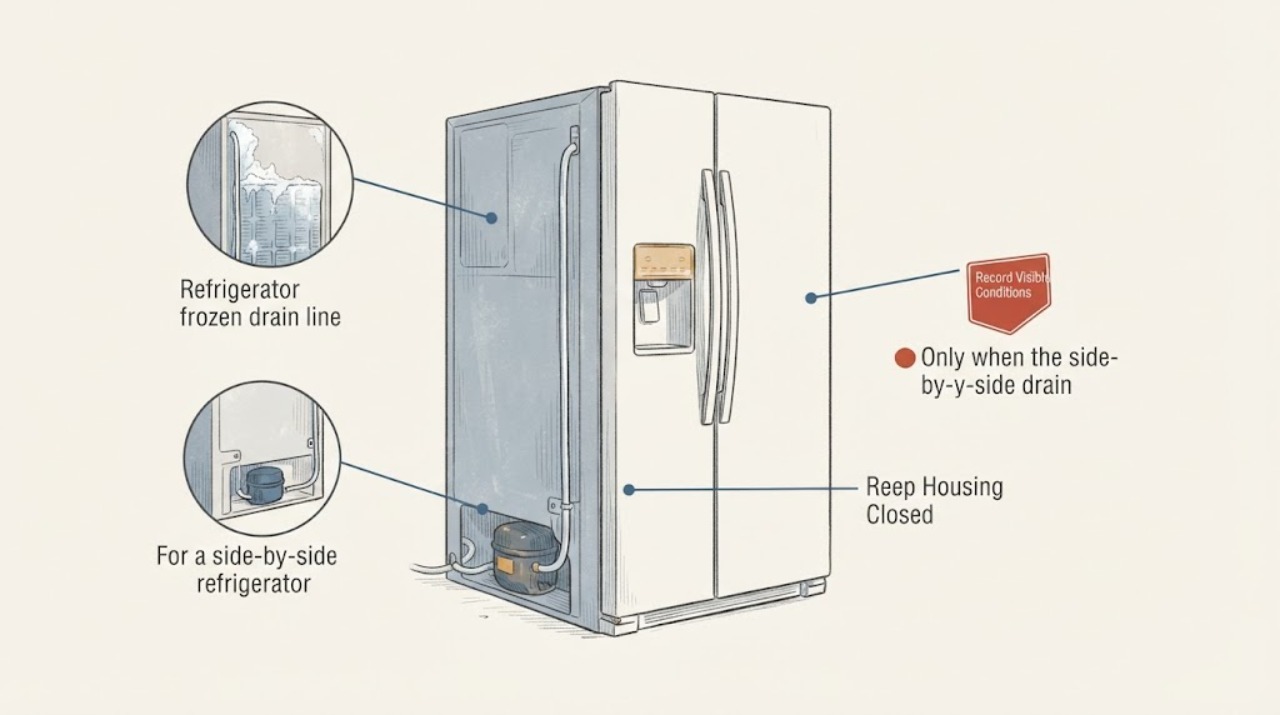
A Hotpoint refrigerator can have a defrost drain only if it is a self-defrost model, and a frozen or clogged drain is a symptom-level explanation rather than proof of a failed part. First identify the refrigerator layout and record where ice or water appears. GE Appliances' opened refrigerator guidance says that side-by-side models may have a visible drain opening that can be flushed only when the exact model manual allows it; top-freezer and bottom-freezer models generally require access that it recommends leaving to service. Because the task has no Hotpoint model number, use these layout branches only as a screening guide and match the Hotpoint manual before removing any panel. Stop for service if the drain opening is not visible, ice is on the rear wall, water continues onto the floor, or the refrigerator needs disassembly.
Before you begin
Safety first
- Limit owner checks to model identification, layout and symptom observation, safe thawing, spill control, and a visible side-by-side drain flush only when the exact Hotpoint manual permits it. Do not remove unknown panels, open the sealed system, perform live electrical tests, force a blocked drain, use boiling water or flame, or substitute a guessed part.
Work through in order
Diagnostic checks
Use only checks that match the exact appliance or system and its official guide.
-
Check 1
Confirm that the Hotpoint refrigerator is an automatic self-defrost model and record the exact model number, then identify its layout and the location of the ice or water.
Expected result: The model documentation confirms automatic defrost and the symptom is ice under a freezer basket, water under a fresh-food drawer, water on a rear wall, or water on the floor; or the appliance is compact or manual-defrost and has no documented drain.
Next step: Continue with the branch matching the confirmed refrigerator layout and keep the exact manual available.
Stop if: Do not force a drain diagnosis. Use the Hotpoint model manual or service route to identify the design before opening anything.
Why this matters
Why: GE Appliances says drain-tube presence depends on self-defrost, and its layout pages associate different water and ice locations with side-by-side, top-freezer, and bottom-freezer drain paths. A compact or manual-defrost refrigerator should not be treated as having a universal defrost drain.
-
Check 2
For a side-by-side refrigerator, with the appliance safely stopped, allow visible ice to thaw and inspect only the lower rear interior of the freezer for a drain opening or the model's documented access panel.
Expected result: A drain opening is visible in the documented location, or no opening is visible and reaching the drain would require removing an unconfirmed panel.
Next step: Use the exact Hotpoint manual to confirm that owner cleaning is allowed before flushing; if it is not allowed, stop and request service.
Stop if: Do not pry off covers or insert tools. Arrange service and report the ice location and model number.
Why this matters
Why: The official side-by-side guidance says some models expose a drain hole near the lower rear wall, while a missing visible opening means the model may require service; it does not authorize a universal panel-removal procedure for Hotpoint models.
-
Check 3
Only when the side-by-side drain opening is visible and the exact model manual permits owner cleaning, flush the opening with a bulb baster containing the manual-supported baking-soda and hot-tap-water solution; do not use boiling water or force the opening.
Expected result: The water runs into the drain pan below, or it backs up, cannot be seen entering the drain, or the floor leak returns.
Next step: Clean up the water, monitor the next defrost-related recurrence, and use service if the ice or leak returns.
Stop if: Stop the owner procedure and arrange qualified service; do not repeat forceful flushing or disassemble the cabinet.
Why this matters
Why: GE Appliances describes a bulb-baster flush for qualifying side-by-side designs and says hearing water run into the drain pan indicates an open path. A continued leak means the accessible check did not resolve the condition; it does not prove a particular Hotpoint part failed.
-
Check 4
For a top-freezer refrigerator, check only the visible symptom areas: around the temperature controls, down the rear fresh-food wall, under the vegetable pans, and on the floor, without removing the interior panels.
Expected result: Water is present in one of those areas, or the symptom is absent but the owner suspects a frozen drain line.
Next step: Keep the appliance closed and dry the accessible spill, then provide the model number and water location to service.
Stop if: Do not assume the drain is frozen from the title alone; use the exact manual or service diagnosis for other causes.
Why this matters
Why: GE Appliances identifies those locations as signs of a clogged top-freezer defrost drain and says access requires some disassembly, so a symptom match is a reason to arrange service rather than a license to open the refrigerator.
-
Check 5
For a bottom-freezer refrigerator, inspect the accessible freezer floor, the floor in front of the freezer, and beneath any full-width fresh-food drawer, without removing the evaporator cover or other cabinet parts.
Expected result: Ice or water is present in those locations, or the drain cannot be reached without disassembly.
Next step: Stop at the external observation, protect nearby flooring, and arrange service with the model number and symptom locations.
Stop if: Keep the diagnosis open and use the exact Hotpoint manual or service route instead of opening the rear or freezer panels.
Why this matters
Why: GE Appliances lists those locations as possible signs of a clogged bottom-freezer drain and recommends service because access requires disassembly; the observation does not identify a heater, sensor, valve, or drain-tube part.
Use your observations
Decision map
Find the observation that best matches what you see, then follow the next safe action.
-
PATH 01Next step
What you see
The refrigerator is a side-by-side, ice is under the lower freezer basket, and a puddle appears on the floor.
Do this next
Use the exact Hotpoint manual to decide whether the visible drain opening may be flushed; if the opening is absent or the leak continues, call service.
Why this path and its safety boundary
Why it matters: This combination matches the official symptom description for a clogged automatic-defrost drain, but it still does not establish a Hotpoint-specific part failure.
-
PATH 02Next step
What you see
The unit is a top-freezer refrigerator and water is under the vegetable pans, on the rear fresh-food wall, or around the controls.
Do this next
Do not remove panels on the unidentified Hotpoint model; arrange qualified service with the model number and observed location.
Why this path and its safety boundary
Why it matters: Those are the official top-freezer signs associated with a clogged defrost drain, and the access path requires disassembly.
-
PATH 03Next step
What you see
The unit is a bottom-freezer refrigerator and ice or water is on the freezer floor, in front of the freezer, or under the full-width fresh-food drawer.
Do this next
Stop at the external check, protect the floor and food, and arrange service instead of opening the evaporator area.
Why this path and its safety boundary
Why it matters: The official bottom-freezer page treats those observations as compatible with a clogged drain and says access requires disassembly.
-
PATH 04Next step
What you see
The refrigerator is compact, manual-defrost, has no model-confirmed drain, or the visible side-by-side flush does not restore drainage.
Do this next
Use the exact Hotpoint manual or a qualified technician; do not order or replace a drain part based only on the symptom name.
Why this path and its safety boundary
Why it matters: The opened evidence does not support assuming a universal drain location or a successful repair for this Hotpoint model.
-
PATH 05Next step
What you see
Water is near electrical parts, the refrigerator cannot hold a safe food temperature, the rear wall is heavily iced, or the proposed check requires cabinet disassembly.
Do this next
Stop using the affected function as needed, protect or discard food according to local food-safety guidance, and arrange qualified service.
Why this path and its safety boundary
Why it matters: The situation is outside the documented owner-level checks and may add electrical, food-safety, or concealed-component risk.
Helpful context
Understand the symptom
A frozen drain line usually means defrost water is not reaching the drain pan, but the phrase does not identify one Hotpoint component or one access method. The refrigerator must use automatic self-defrost to have a defrost drain at all. Start by finding the model number and noting whether the unit is side-by-side, top-freezer, or bottom-freezer; the opened official guidance separates the checks by that layout.
This task does not include a Hotpoint model number. The official pages used here are GE Appliances support articles that describe refrigerator drain layouts and explicitly send the owner to the exact manual where access differs. Use them to interpret visible ice and water, not to assume that an unidentified Hotpoint refrigerator has the same panel, tube, or part.
Keep the work external unless the exact Hotpoint manual explicitly permits the step. Do not pry off an evaporator cover, insert a sharp tool into a drain, apply a torch or heat gun, or perform live electrical checks. If water is near electrical parts, food temperatures are unsafe, the rear wall is heavily iced, or the procedure would require disassembly, stop using the appliance as appropriate and arrange qualified service.
When checks do not resolve it
Need a professional?
Use the exact Hotpoint support/manual path or a qualified refrigerator technician for concealed drain access, recurring ice or water, rear-wall icing, a floor leak, uncertain model applicability, or any internal electrical or refrigeration work.
Safety scope: Limit owner checks to model identification, layout and symptom observation, safe thawing, spill control, and a visible side-by-side drain flush only when the exact Hotpoint manual permits it. Do not remove unknown panels, open the sealed system, perform live electrical tests, force a blocked drain, use boiling water or flame, or substitute a guessed part.
Common questions
FAQ
Does every Hotpoint refrigerator have a defrost drain line?
No. The opened GE Appliances guidance says drain-tube presence depends on automatic self-defrost; full-size refrigerators generally have one, while compact or under-counter models do not, with older manual-defrost exceptions. Confirm the Hotpoint model manual before assuming a drain exists.
Can I flush a frozen drain on a Hotpoint refrigerator myself?
Only if the exact model manual permits it and a visible side-by-side drain opening is available. The official side-by-side guidance describes a bulb-baster flush with baking soda and hot tap water; its top-freezer and bottom-freezer guidance recommends service because access requires disassembly. Do not transfer the side-by-side step to another layout.
What does water under the vegetable drawer mean?
On an automatic-defrost top-freezer refrigerator, GE Appliances lists water under the vegetable pans as a common sign of a clogged defrost drain. The page recommends service because reaching the drain requires disassembly, so the symptom does not justify removing panels on an unidentified Hotpoint model.
Is ice on the freezer floor normal?
The opened GE Appliances side-by-side guidance says ice buildup on the freezer floor is not normal and may be associated with a clogged drain. If there is rear-wall ice, no visible model-approved drain access, or the issue persists after the documented check, arrange service.
Read the exact guide
Official sources
- Side-by-Side Refrigerator - Drain TubeGE Appliances · Opened the official GE Appliances side-by-side article directly. It is used only for layout-specific symptom interpretation and its model-manual limitation; it is not presented as a universal Hotpoint procedure.
- Top Freezer Refrigerator - Drain TubeGE Appliances · Opened the official GE Appliances top-freezer article directly. It is used for symptom location and the recommendation to leave access requiring disassembly to service, not for a Hotpoint part or internal layout.
- Bottom Freezer Refrigerator - Clogged Drain Tube, Ice on Freezer FloorGE Appliances · Opened the official GE Appliances bottom-freezer article directly. It is used for symptom location and its disassembly/service boundary, not for a Hotpoint part or exact-model procedure.
- Refrigerators, Freezers and Icemakers: Troubleshooting and SupportGE Appliances · Opened the official GE Appliances support page directly. It is a general support hub rather than a Hotpoint model manual; it supports the article's model-number and qualified-service boundary, not a claim that every Hotpoint refrigerator has GE's internal layout.
- Refrigerator & Freezer - Drain TubesGE Appliances · Opened the official GE Appliances article directly. It gives generic refrigerator drain-presence boundaries and names Hotpoint only in its separate upright-freezer discussion; no Hotpoint refrigerator part or model compatibility is inferred here.
- Side-by-Side Refrigerator - Water on Floor, Repairing a Clogged Defrost DrainGE Appliances · Opened the official GE Appliances article directly. It states that the owner manual controls whether a specific freestanding model can be cleared and sends built-in or other models to service; no Hotpoint-specific internal access is claimed.
- Side-by-Side Refrigerator - Ice on Freezer FloorGE Appliances · Opened the official GE Appliances article directly. It says the exact owner manual controls any owner-clearing method and recommends service for rear-wall ice or an unresolved condition; it does not establish a Hotpoint model procedure.
Community feedback
Share a repair observation
Share a plain-text repair observation. Accepted observations are published automatically; this page may take a moment to update.