
On this page
Start here
Quick answer
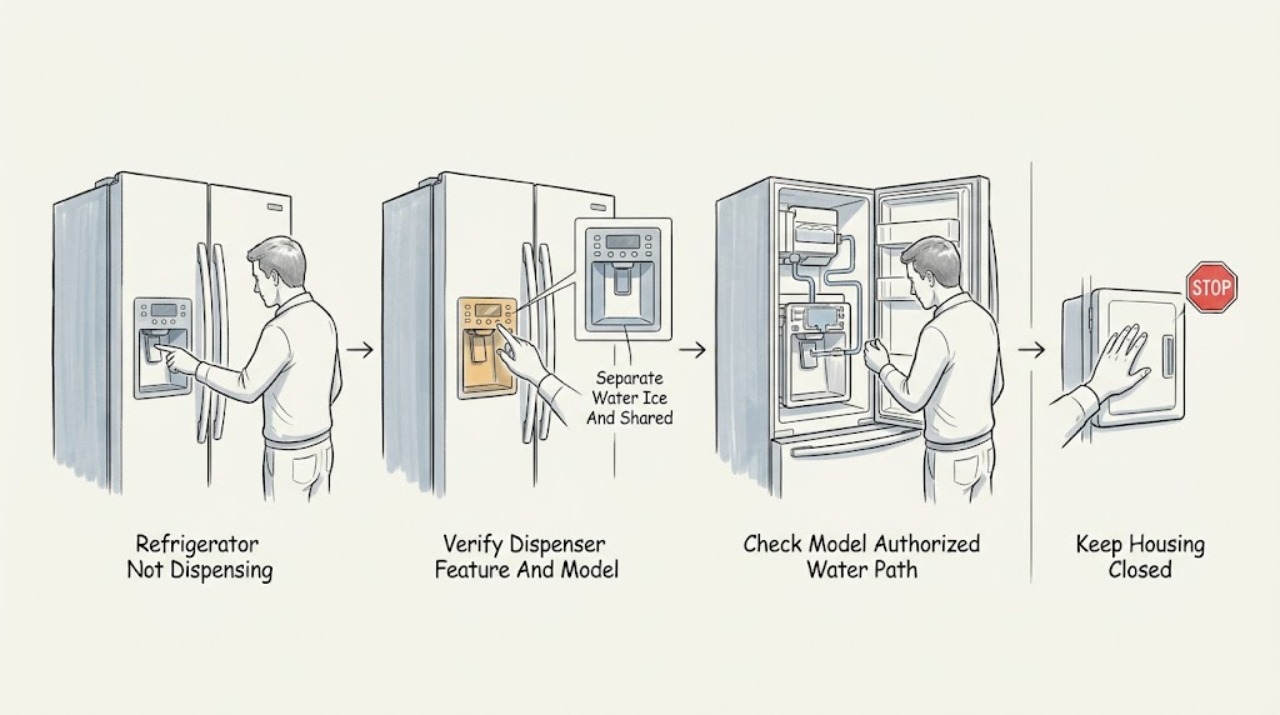
First verify that the exact Hotpoint refrigerator or fridge freezer actually has the built-in dispenser feature. Hotpoint's refrigeration catalogue describes water and ice dispensers on selected American-style models, so a standard Hotpoint refrigerator without that feature cannot be diagnosed as a dispenser failure. Record the full model/product code and separate the symptom: water only, ice only, or both fail. Check the exact manual for the dispenser's lock or mode, door-closed requirement, and any model-authorized filter, reservoir, or water-supply check; do not assume all Hotpoint models use the same arrangement. If the panel shows E0 or EE, Hotpoint identifies those as ice-maker and ice-maker-circuit faults when fitted; if a freezer high-temperature alarm or door problem is present, address that documented condition first. Stop for leaks near electrical parts, smoke, burning odor, damaged wiring, or a dispenser that requires internal disassembly, and arrange qualified Hotpoint refrigeration service.
Before you begin
Safety first
- The owner may identify the exact model and dispenser feature, separate water from ice symptoms, record codes, check visible door and mode conditions, and perform only external filter/reservoir/supply checks explicitly allowed by the exact manual. Qualified personnel must handle internal tubing, valves, ice-maker or auger assemblies, door switches, wiring, controls, refrigeration panels, plumbing disconnection, and live testing.
Work through in order
Diagnostic checks
Use only checks that match the exact appliance or system and its official guide.
-
Check 1
Read the Hotpoint refrigerator or fridge-freezer model/product code and confirm in the exact Hotpoint product record or manual that it has a built-in water dispenser, ice dispenser, or water-and-ice dispenser. Do not count an ice tray or an ordinary water shelf as a dispenser.
Expected result: The exact model documents a dispenser; the model has only an ice tray; it has a water-only feature; the feature is optional or absent; or the model code cannot be matched.
Next step: If a dispenser is confirmed, continue and keep the model manual open. If the feature is absent or the product is not a Hotpoint dispenser model, stop this workflow and use the correct appliance guidance.
Stop if: Do not add an aftermarket dispenser, water line, filter, or ice mechanism based only on the Hotpoint brand or cabinet appearance.
Why this matters
Why: Hotpoint's catalogue shows dispenser features on selected models, not across every refrigerator. Without a confirmed built-in dispenser and model identity, the no-output symptom may be normal or may belong to a different appliance architecture.
-
Check 2
With the appliance in its normal safe operating state, identify which selected dispenser function fails: chilled water, cubed/crushed or other ice option documented for the model, or both. Record whether the dispenser display, light, lock indicator, and refrigerator/freezer controls respond, without repeatedly holding the lever or paddle.
Expected result: Water works but ice does not; ice works but water does not; both fail; the display is locked or unresponsive; or the model does not offer the selected function.
Next step: Use the exact model manual for the selected function and follow the matching water, ice, or control branch. If the panel is unresponsive or the lock cannot be cleared as documented, arrange service rather than bypassing it.
Stop if: Do not reach into the dispenser chute, insert tools into an auger or actuator, bypass a door switch, or keep operating a dispenser that leaks or makes a grinding/electrical smell.
Why this matters
Why: One-function failure narrows the issue to that function's documented path. A simultaneous water-and-ice failure makes a shared lock, door condition, supply, or control state more plausible. Selecting an unsupported ice form or assuming a crushed-ice mode exists can mimic a fault.
-
Check 3
For a water-dispenser failure, use only the exact model manual to identify its arrangement, then inspect from outside for a closed documented shutoff, an incorrectly seated user-accessible filter or reservoir, a visible kink, or a dispenser lock/mode. Do not disconnect tubing or open a filter head unless the manual explicitly describes a safe owner procedure.
Expected result: The model-authorized lock is active; a visible filter/reservoir or shutoff condition is incorrect; a hose is visibly kinked or leaking; all permitted external conditions are normal; or the appliance uses an undocumented arrangement.
Next step: Correct only the visible condition permitted by the exact manual, dry and secure all user-accessible parts, and test once as the manual directs. Escalate persistent no-water output, a leak, or any internal water-path access.
Stop if: Do not disconnect a pressurized line, pull internal tubing, force a filter, use compressed air, test a valve live, or continue if water is near electrical parts.
Why this matters
Why: A documented setting or accessible supply condition can stop water without proving a failed valve. A normal external path or an arrangement that requires internal access makes a valve, filter head, tubing, door switch, sensor, or control fault possible, but not identifiable from the symptom alone.
-
Check 4
For an ice-dispenser failure, check the exact model's documented ice-bin, mode, and dispenser controls from outside. Record E0, EE, E9, another code, or a flashing pattern, and check that the freezer door closes and the freezer is not showing a high-temperature condition. Do not dismantle the ice maker or auger.
Expected result: Water dispenses but ice does not; the ice bin or mode is visibly incorrect; E0 or EE appears; E9 or a high-temperature alarm appears; the door is ajar; or no code appears but ice remains unavailable.
Next step: Correct only the model-documented external condition, then preserve the code and use the exact manual. Arrange qualified service for E0/EE, a persistent no-ice condition, an internal jam, or a freezer-temperature fault that does not clear safely.
Stop if: Do not force an ice ejector or auger, chip ice with sharp tools, bypass a sensor or door switch, open the freezer panel, or perform live tests.
Why this matters
Why: A bin/mode or freezer-door condition can inhibit delivery without identifying a failed ice-maker part. Hotpoint assigns E0 to an ice-maker fault and EE to an ice-maker circuit fault when fitted, while E9 concerns freezer temperature and door closure. No code does not justify a generic motor or auger replacement.
-
Check 5
After confirming the dispenser model, separating water versus ice, recording codes, and completing only the exact manual's external checks, keep the appliance isolated as needed and prepare a service report with the model, failed function, display response, leak status, and observations.
Expected result: Output returns after a documented setting or accessible condition is corrected; one function remains unavailable; both functions remain unavailable; E0/EE returns; or there is a leak, smoke, odor, electrical damage, or repeated trip.
Next step: Use the dispenser only when it operates normally without leaks or abnormal sounds. Otherwise arrange qualified Hotpoint refrigeration service and provide the full model/product code and recorded evidence; shut off a documented water supply only if it can be reached safely and the manual or installation instructions identify it.
Stop if: Stop immediately for smoke, sparks, burning odor, hot or damaged cord/plug, exposed wiring, water near electrical components, an uncontrolled leak, or any need to open internal dispenser, refrigeration, or control panels.
Why this matters
Why: A resolved documented condition supports a control, bin, door, or accessible supply explanation. Persistent failure points to a model-specific dispenser, valve, ice-maker, auger, sensor, wiring, or control diagnosis. Leak or electrical signs make continued dispensing unsafe.
Use your observations
Decision map
Find the observation that best matches what you see, then follow the next safe action.
-
PATH 01Safety boundary
What you see
The Hotpoint model is a standard refrigerator without a documented water or ice dispenser, has only an ice tray, or cannot be matched to a product record.
Do this next
Stop this workflow and identify the correct appliance feature or manual. Do not install a dispenser component or water line from the symptom alone.
Why this path and its safety boundary
Why it matters: Hotpoint's catalogue makes dispenser availability model-dependent. No output from a feature the appliance does not have is not a dispenser failure, and a generic retrofit assumption is unsafe.
Safety stop: Do not open the cabinet to search for hidden dispenser tubing or apply American-style dispenser instructions to a non-dispenser Hotpoint refrigerator.
-
PATH 02Safety boundary
What you see
The exact Hotpoint model has a dispenser, ice output works, but water does not dispense, or the model documents a water-only dispenser and its output has stopped.
Do this next
Follow only the exact model's external water-path procedure and arrange service for persistent no-water output or any leak.
Why this path and its safety boundary
Why it matters: The water side's model-specific lock, reservoir/filter, documented supply, tubing, valve, door switch, or control is more relevant than the ice maker. If all permitted external conditions are normal, an internal water-path fault is possible.
Safety stop: Do not disconnect water lines, force a filter housing, use compressed air, test a valve live, or continue with water near electrical parts.
-
PATH 03Safety boundary
What you see
Water dispenses but ice does not, the ice side is selected but silent or blocked, or E0/EE appears on a model with a fitted ice-maker/dispenser.
Do this next
Check the exact manual's external bin and mode conditions, preserve the code, and arrange qualified service when no ice persists or E0/EE returns.
Why this path and its safety boundary
Why it matters: The ice-maker, ice bin/auger, ice mode, sensor, or circuit may be involved. Hotpoint labels E0 and EE as fitted ice-maker conditions and recommends service, so the code does not identify a user-replaceable universal motor or assembly.
Safety stop: Do not force an ejector or auger, chip ice with sharp tools, bypass an ice-maker sensor or door switch, or open the assembly.
-
PATH 04Safety boundary
What you see
Both water and ice fail, the dispenser panel is locked or unresponsive, the door does not close, a freezer high-temperature alarm appears, or the failure follows a power/control event.
Do this next
Correct only a visible door obstruction or documented mode and record the display state. If both functions remain unavailable or the panel/control issue recurs, arrange qualified service.
Why this path and its safety boundary
Why it matters: A shared lock, door condition, supply, temperature condition, display/control, or wiring fault is more plausible than two unrelated output parts. Hotpoint identifies E9 as a freezer high-temperature alarm and directs a door-closure check; other control faults remain model-specific.
Safety stop: Stop for smoke, sparks, burning odor, damaged power hardware, repeated trips, leaks near electrical parts, or any attempt to bypass the door or control interlock.
Helpful context
Understand the symptom
Confirm the dispenser architecture before checking a fault
Hotpoint's current refrigeration catalogue contains American-style fridge-freezer models with water and ice dispensers, but the feature is selected-model rather than universal. A refrigerator with no dispenser, an ice tray without a dispenser, and a dispenser that provides only water are different products. Read the appliance label and the exact product documentation first. This guide applies only when the manual or product record confirms a built-in dispenser; it does not apply to a countertop dispenser, an aftermarket water line, or a standard Hotpoint refrigerator with no dispenser.
Separate water, ice, and both functions
Pressing the dispenser and getting no water is not the same observation as getting water but no ice. If water works while ice does not, the ice-making or ice-delivery side deserves the model-specific check. If both functions fail together, a lock, door-closed condition, supply, display/control state, or shared circuit is more relevant than immediately replacing an ice-maker motor. If the refrigerator has no dispenser feature, the absence of output is normal and needs no dispenser repair.
Use the exact manual for the dispenser's water arrangement
The safe owner checks depend on whether the model uses a plumbed dispenser, an internal reservoir, a replaceable filter, or another documented arrangement. Hotpoint's manual portal requires the appliance model number or 12NC to locate the correct documentation. Check only the external items that that manual names, such as a visible mode or lock, a correctly seated user-accessible filter or reservoir, or a visible water-supply shutoff. Do not disconnect tubing, force a filter housing, or infer a connection layout from a similar-looking Hotpoint appliance.
Treat ice-maker codes and temperature alarms as separate evidence
Hotpoint's official fridge-freezer page identifies E0 as an ice-maker fault and EE as an ice-maker circuit fault when the feature is fitted. The same guidance identifies E9 as a freezer high-temperature alarm and asks the user to check that the door is closed properly. A code is therefore more useful than the phrase 'not dispensing', but it still must be matched to the exact appliance family. Do not copy a code meaning or reset sequence from another Hotpoint model.
Internal dispenser repairs are a service boundary
A persistent failure after the exact model's external checks can involve the dispenser actuator, door switch, water valve, filter head, tubing, ice maker, auger, sensor, wiring, or control. The official Hotpoint material supports model identification and service escalation but does not support one generic repair procedure for these parts. Disconnect mains power before any model-authorized part replacement, and use qualified service for internal panels, water connections, electrical testing, sealed refrigeration work, or a recurring E0/EE condition.
Safety boundary
Stop conditions
- Stop using the dispenser for smoke, sparks, burning or electrical odor, a hot or damaged cord or plug, exposed wiring, repeated breaker trips, or water near electrical components.
- Do not disconnect a water line, remove internal dispenser panels, or reach into an ice auger or ejector while the appliance is energized. Disconnect mains power before any model-authorized part replacement.
- Do not bypass the dispenser lock, door switch, ice-maker sensor, water-level protection, or control circuit; do not perform live electrical tests.
- Do not force filters, reservoirs, ice bins, ejectors, or augers; do not chip hidden ice with sharp tools or use compressed air to clear internal tubing.
- If the exact Hotpoint model has a dispenser and the permitted external checks do not restore water or ice, or E0/EE returns, keep the appliance out of service as needed and arrange qualified refrigeration repair.
Only after diagnosis
Potential parts
- Hotpoint dispenser water filter or filter-head component
Consider only if the exact model documents a user-accessible filter and qualified diagnosis or the manual confirms the filter/head is expired, damaged, or obstructed after the permitted external checks. No-water output alone does not identify this part.
Filter format, head, connection, and replacement procedure vary by Hotpoint dispenser model and region. Verify the full product code and manual; do not force or bypass the filter assembly. - Hotpoint refrigerator dispenser valve or tubing assembly
Consider only after qualified diagnosis confirms an internal water-path fault on a model that uses the relevant valve or tubing arrangement. A visible kink or no-water symptom is not enough to choose a component.
Plumbing layout, connectors, pressure arrangement, and door routing are model-specific. Internal water work requires qualified installation and safe isolation. - Hotpoint fitted ice-maker or dispenser auger assembly
Consider only when the exact model has a fitted ice maker/dispenser and qualified diagnosis confirms an internal ice-making or delivery assembly fault after safe bin, mode, door, and freezer checks.
Ice-maker, bin, auger, motor, sensor, and circuit interfaces vary by Hotpoint model. E0, EE, or no ice alone does not establish part fit or failure; verify the full product code.
When checks do not resolve it
Need a professional?
Arrange qualified Hotpoint refrigeration service when a confirmed dispenser model still fails to dispense water or ice after its exact manual's lock, mode, door, bin, filter/reservoir, and external supply checks; when E0 or EE returns; when both functions fail; or when diagnosis could involve a valve, tubing, door switch, ice maker, auger, sensor, wiring, or control. Stop immediately for smoke, sparks, burning odor, damaged power hardware, repeated trips, uncontrolled leaks, or water near electrical parts. A Hotpoint refrigerator without a documented dispenser needs a different workflow.
Safety scope: The owner may identify the exact model and dispenser feature, separate water from ice symptoms, record codes, check visible door and mode conditions, and perform only external filter/reservoir/supply checks explicitly allowed by the exact manual. Qualified personnel must handle internal tubing, valves, ice-maker or auger assemblies, door switches, wiring, controls, refrigeration panels, plumbing disconnection, and live testing.
Common questions
FAQ
Does every Hotpoint refrigerator have a water or ice dispenser?
No. Hotpoint's official catalogue lists water-and-ice dispenser features on selected American-style fridge-freezer models. Confirm the exact model's product record or manual; a standard Hotpoint refrigerator without a documented dispenser has no dispenser fault to troubleshoot.
Why does my Hotpoint refrigerator dispense water but not ice?
First confirm that the exact model supports ice dispensing and record whether the ice mode, bin, door, and freezer conditions match the manual. Water working narrows the symptom to the ice-making or ice-delivery side, but it does not identify an auger, ice maker, sensor, or circuit. E0 and EE are fitted ice-maker conditions in Hotpoint's official error guidance and should be serviced rather than guessed at.
What should I check if both water and ice stop dispensing?
Check the exact model's visible dispenser lock or mode, door closure, freezer condition, and any user-accessible water or filter arrangement documented in its manual. Record display codes before resetting. If both remain unavailable, the shared control, supply, door switch, or internal circuit needs qualified diagnosis; do not disconnect tubing or bypass an interlock.
What do E0 and EE mean on a Hotpoint dispenser refrigerator?
Hotpoint labels E0 as an ice-maker fault and EE as an ice-maker circuit fault when the feature is fitted, and its guidance recommends service. Match the code to the exact model and do not use it to select a generic dispenser motor, valve, or control board.
When should I stop using a Hotpoint refrigerator dispenser?
Stop for an uncontrolled leak, water near electrical parts, smoke, sparks, burning odor, a hot or damaged cord or plug, repeated trips, exposed wiring, or any need to open the dispenser or control enclosure. Also stop when the exact model's external checks do not restore output; arrange qualified refrigeration service instead of forcing a valve, filter, auger, or ice-maker mechanism.
Read the exact guide
Official sources
- Fridge Freezers - HotpointHotpoint · Hotpoint UK fridge-freezer range; the catalogue lists water-and-ice dispenser features on selected American-style models, not all refrigerators.
- Hotpoint Fridge Freezer Error Codes - HotpointHotpoint · Hotpoint fridge-freezer support; E0 and EE apply when the appliance has the fitted ice-maker feature, while E9 is a freezer high-temperature alarm.
- Hotpoint Appliance ManualsHotpoint · Hotpoint product documentation lookup for refrigerators, freezers, and fridge freezers; exact manual is required for dispenser feature and control details.
- Hotpoint Service Fridge Freezer Repair - HotpointHotpoint · Hotpoint fridge-freezer family; directs owners to model manuals and qualified repair for unresolved or internal faults.
Community feedback
Share a repair observation
Share a plain-text repair observation. Accepted observations are published automatically; this page may take a moment to update.