
On this page
Start here
Quick answer
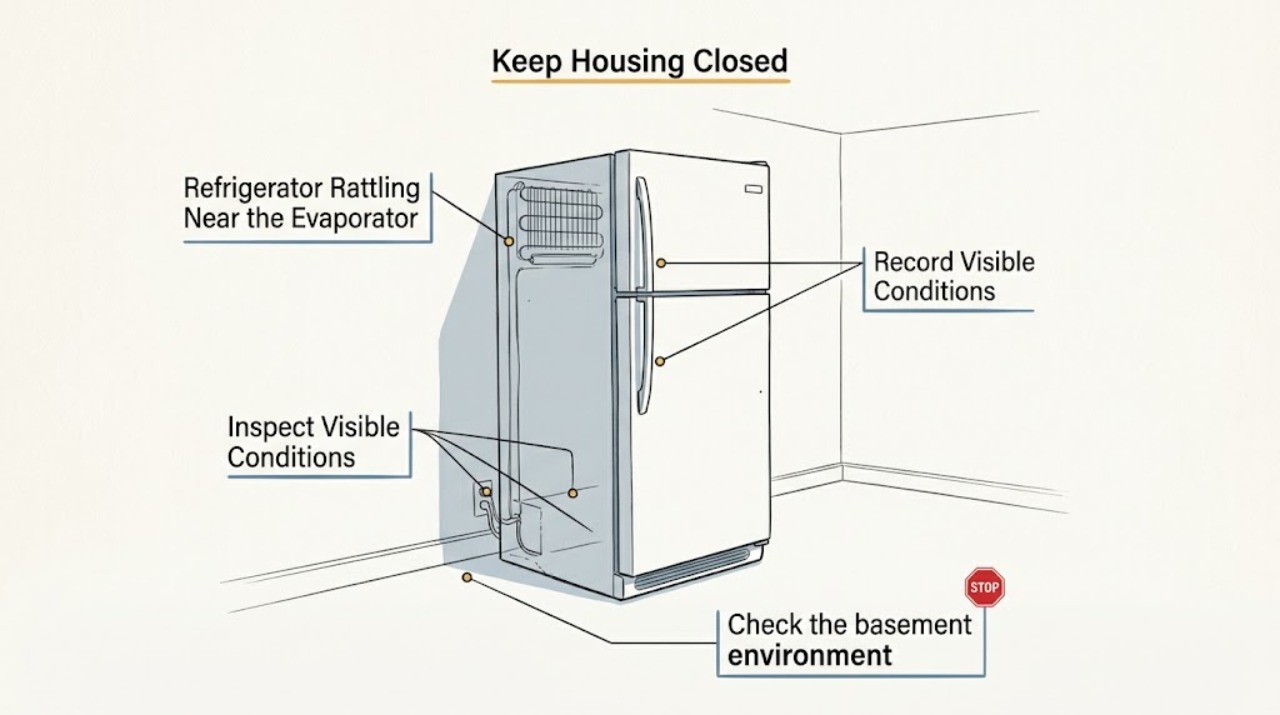
A rattle that seems to come from the freezer or evaporator-fan area is not enough to name a fan motor or blade. GE Appliances' official refrigerator-noise guidance says a sound like a fan blade hitting something in the freezer is not normal and needs service diagnosis; it does not authorize removing the fan cover or touching the fan. First record the sound with the door closed and open, note whether it follows a cooling or defrost interval, look through the opening for visible frost without scraping it, and check only accessible cabinet contact, floor stability, and room conditions. A basement that is below 60°F can affect refrigerator cooling, but a persistent scrape or rattle remains a service issue even if the temperature is normal. Keep the doors closed, protect food if cooling is weak, and arrange Hotpoint/qualified service if the sound persists, is worsening, or is accompanied by heavy frost, poor cooling, heat, odor, water, or electrical symptoms.
Before you begin
Safety first
- Do not remove the freezer evaporator cover or rear cabinet panels, touch the fan or wiring, perform live electrical tests, bypass controls, scrape frost with tools, move or tilt the refrigerator, or open the sealed refrigeration system.
Work through in order
Diagnostic checks
Use only checks that match the exact appliance or system and its official guide.
-
Check 1
From outside the refrigerator, record the rattle with the freezer and refrigerator doors closed, then compare it with a brief door-open observation without touching the interior fan or rear cover. Note whether the sound starts, stops, or changes when a door is opened, and whether it occurs during compressor cooling, after a door closes, or at apparently random times.
Expected result: The sound changes with a door event, follows a cooling interval, stays in the freezer area regardless of the door, or is a harsh scrape or grind that persists.
Next step: Save the recording and compare the timing with the exact HPS15BTHCRWW manual. If the sound is a persistent scrape, grind, or repeated fan-like impact, stop trying to reproduce it and arrange qualified Hotpoint service.
Stop if: Do not block the fan, insert a hand or tool through the grille, remove the freezer cover, or operate with a panel removed.
Why this matters
Why: GE Appliances documents fan-speed changes after door openings and several normal cycle sounds, but it separately says a freezer sound like a fan blade hitting something is not normal. A door-related change can help a technician localize the symptom; it does not prove that the evaporator fan is the failed part.
-
Check 2
With the doors open only as needed for a visual check, look for frost on the visible freezer wall, packages pressed against the rear wall or air openings, a door that does not close, or a gasket with a visible gap. Do not scrape frost, remove an air duct, or reach toward the evaporator fan.
Expected result: There is heavy frost, a package blocks an opening, the door or gasket does not seal, or the visible interior is clear but the rattle remains.
Next step: Move only a plainly obstructing package and close the door. If frost is heavy, the fan area scrapes, cooling is weak, or the sound continues with a clear interior, keep the refrigerator closed and arrange model-specific service.
Stop if: Do not chip ice, use heat, pull the evaporator cover, touch a rotating fan, or continue testing a refrigerator with exposed or damaged interior parts.
Why this matters
Why: GE Appliances identifies blocked airflow, door-closure problems, gasket gaps, and frost as possible contributors to cooling trouble; its ice-on-freezer-wall guidance also treats a fan that is not running as a service condition. These observations can explain a symptom combination but do not identify a fan blade or motor safely.
-
Check 3
Check the basement environment and exterior installation from a safe position: note the room temperature, visible clearance around the cabinet, whether the refrigerator rocks, and whether a wall, pipe, shelf, bottle, or other loose object touches the cabinet. Do not pull the refrigerator out, reach behind it, or adjust leveling hardware without the exact manual and safe access.
Expected result: The room is below 60°F or above 110°F, the cabinet rocks or leans, an accessible object vibrates against it, ventilation is visibly blocked, or the installation is stable and clear.
Next step: Remove only a loose accessible object and keep visible airflow clear. For an unstable appliance, a clearance issue, or a room outside the stated range, follow the exact manual or contact the installer/service provider; do not move the unit alone.
Stop if: Do not lift, tilt, unstack, pull a plumbed unit, loosen rear hardware, or work around a strained water line or exposed wiring.
Why this matters
Why: GE Appliances says installation-area temperature can affect cooling and that proper clearance varies by model. A loose accessible object can create a rattle, while an unstable cabinet or blocked clearance is an installation concern; neither observation proves an evaporator-fan failure.
-
Check 4
Check cooling behavior without creating a new test: record whether the freezer keeps food frozen, whether the fresh-food section is cooling evenly, whether the compressor and fans are silent only during an expected defrost interval, and whether the rattle appeared after delivery, a move, or a power event. Keep the doors closed between observations.
Expected result: Cooling is normal and the sound is brief and documented by the exact manual, cooling is weak or uneven, frost is increasing, the sound began after a move, or the refrigerator seems to stop for a defrost period.
Next step: Monitor only a brief manual-described sound when cooling remains normal. If cooling worsens, frost grows, or the rattle is persistent or unlisted, protect perishable food and arrange qualified refrigerator service rather than ordering a fan.
Stop if: Do not keep cycling power to reproduce the noise, scrape frost, open covers, or handle refrigerant or sealed-system components.
Why this matters
Why: GE Appliances says compressor and fans may be off during a defrost cycle and that several hums, clicks, refrigerant sounds, and defrost sounds can be normal. It also says poor cooling, frost, or an unlisted freezer fan-impact sound requires a different service decision than an isolated normal cycle sound.
-
Check 5
Use the complete rating label to search the official model-literature page and preserve the sound recording, location, door-open comparison, frost/cooling observations, room temperature, and installation history. If a service provider is needed, leave the appliance in the state that best preserves the symptom unless a safety hazard requires isolation.
Expected result: The official search returns a matching HPS15BTHCRWW manual, only a near-model result appears, the manual does not describe the rattle, or the refrigerator shows smoke, burning odor, water near electrical parts, a hot cord, arcing, or repeated breaker trips.
Next step: Use only a matching manual for external installation instructions. For a near-model or missing manual, persistent rattle, cooling/frost change, or any hazard, keep the refrigerator out of unsafe operation and arrange Hotpoint or qualified service with the evidence record.
Stop if: Do not substitute a similar model's fan diagnosis, remove panels, perform live electrical tests, bypass controls, or order a fan assembly by appearance.
Why this matters
Why: GE Appliances directs owners to search literature by the complete model number, and its noise guidance sends an unlisted or fan-impact sound to service. A near-model manual cannot establish the correct fan cover, frost path, clearance, or parts for HPS15BTHCRWW.
Use your observations
Decision map
Find the observation that best matches what you see, then follow the next safe action.
-
PATH 01Next step
What you see
The rattle is brief, follows a documented compressor, defrost, refrigerant, or fan-cycle sound, cooling remains normal, and no scraping or safety symptom is present.
Do this next
Monitor without opening the appliance. Escalate if the sound becomes harsh, persistent, louder, or associated with cooling loss, frost, heat, odor, water, or an electrical warning.
Why this path and its safety boundary
Why it matters: A normal operating sound is more likely than a failed evaporator-fan part, although the exact HPS15BTHCRWW manual still controls the interpretation.
-
PATH 02Next step
What you see
The sound is a repeated freezer-area scrape or impact, changes little with safe door observations, or continues while cooling or frost becomes abnormal.
Do this next
Keep the doors closed, protect food if temperatures are rising, and arrange qualified Hotpoint service. Do not remove the evaporator cover or attempt a fan test.
Why this path and its safety boundary
Why it matters: This matches GE Appliances' warning that a freezer sound like a fan blade hitting something is not normal. Frost, airflow, fan mounting, wiring, control, or another internal cause may be involved, but the observation does not select a fan or motor.
-
PATH 03Next step
What you see
The rattle changes or stops after a loose accessible object is removed, the cabinet is stable, and cooling and frost remain normal.
Do this next
Leave the object clear and monitor one normal cooling period. If the rattle returns or its location changes, stop guessing and give the recording to service.
Why this path and its safety boundary
Why it matters: External contact or vibration is more likely than an evaporator-fan diagnosis. The change does not prove that an internal component was repaired.
-
PATH 04Next step
What you see
The basement is below 60°F, the refrigerator is not cooling correctly, the unit rocks or shifted, or there is smoke, burning odor, water near electrics, a hot or damaged cord, arcing, or a repeated breaker trip.
Do this next
For a temperature or stability issue, follow the exact model's installation guidance or call the installer; do not move the refrigerator alone. For any electrical, water, smoke, or odor hazard, stop using it, isolate power only from a safe dry position, and obtain qualified or emergency help.
Why this path and its safety boundary
Why it matters: The environment or installation may be affecting operation, and the electrical or water signs are an immediate safety boundary. Neither the room temperature nor the sound proves a specific fan part.
Helpful context
Understand the symptom
Localizing a rattle to the evaporator-fan area is useful, but it is still a location report rather than a component diagnosis. A fan blade contacting frost or another object, a loose cover, a cabinet vibration, or a different sound traveling through the liner can be heard in the same area. GE Appliances' official guidance is more specific about the decision than the part: a freezer sound like a fan blade hitting something is not normal and should be sent for service diagnosis. Do not remove the freezer rear cover or put fingers near a fan to confirm it.
A basement adds an environmental check. GE Appliances says a refrigerator may not cool properly when the installation area is below 60°F or above 110°F, and it gives model-specific clearance and manual guidance. That does not make a persistent mechanical rattle normal, and it does not prove that the room caused the sound. Confirm the complete HPS15BTHCRWW label and use its own manual before any installation adjustment or parts decision; the official model-literature page explains how to search by the complete model number.
Only after diagnosis
Potential parts
- evaporator fan assembly or fan mount
Consider this class only if a qualified technician confirms that the exact model's fan or mounting is the cause after ruling out frost, external vibration, installation, wiring, control, and other cooling causes; a rattle alone is not sufficient.
Confirm the complete HPS15BTHCRWW model and manufacturer fitment. Do not buy or install a fan based on a near-model diagram or sound location. - model-matched leveling or vibration-support component
Consider this class only if the exact installation inspection finds a damaged or missing support and the provider confirms it is the source of the vibration.
Verify the exact model, installation configuration, and support geometry before ordering; do not improvise shims or brackets under a heavy refrigerator.
When checks do not resolve it
Need a professional?
Request qualified Hotpoint/GE refrigerator service for a persistent or fan-impact rattle, rattle with frost or cooling loss, an unlisted sound, a shifted installation, or an unresolved sound after safe external checks. Use qualified electrical or emergency help for smoke, arcing, shock, water near electrics, burning odor, or repeated breaker trips.
Safety scope: Do not remove the freezer evaporator cover or rear cabinet panels, touch the fan or wiring, perform live electrical tests, bypass controls, scrape frost with tools, move or tilt the refrigerator, or open the sealed refrigeration system.
Have this ready
- Provide the complete HPS15BTHCRWW model and serial label, market if known, sound recording, whether the sound changes with the freezer door open or closed, location and timing, cooling and frost observations, basement room temperature, visible clearances, whether the unit was moved, and any hazard signs.
Common questions
FAQ
Does a rattle near the evaporator fan mean the fan motor is bad?
No. GE Appliances says a freezer sound like a fan blade hitting something is not normal and needs service diagnosis, but the sound does not identify a fan motor, blade, mount, frost, control, or another cause. Do not remove the cover or touch the fan to test it.
Can opening the freezer door confirm the evaporator fan problem?
A safe door-open comparison can document whether the sound changes, but it cannot prove a fan fault because cycle timing, airflow, and vibration can also change. Record the result and use the exact HPS15BTHCRWW manual or qualified service for diagnosis.
Can a cold basement cause this refrigerator rattle?
GE Appliances says a refrigerator may not cool properly when the installation area is below 60°F or above 110°F. That is an environmental cooling boundary, not proof that a cold room causes a mechanical rattle. Record the room temperature and have the appliance assessed if cooling or noise is abnormal.
Should I remove the freezer panel to look at the evaporator fan?
No. The safe user boundary is an external recording and visual check for frost, door closure, airflow obstruction, and installation contact. A repeated scrape or fan-impact sound should be diagnosed by qualified service without the owner reaching the rotating fan or wiring.
Read the exact guide
Official sources
- GE Appliance - Model and Serial Number LocationGE Appliances · Official identity guidance for confirming the assigned Hotpoint HPS15BTHCRWW label before using a manual or requesting service.
- Refrigerator - Not Cooling EnoughGE Appliances · Official family-level cooling and basement-environment guidance for Hotpoint HPS15BTHCRWW; exact clearance and operating limits remain model-specific.
- Refrigerator - Normal Sounds and Noises MadeGE Appliances · Official family-level sound context for Hotpoint HPS15BTHCRWW; it does not override the exact model manual or turn a persistent fan-area rattle into a normal sound.
- Refrigerator & Freezer - Ice on Freezer WallGE Appliances · Official family-level frost and fan observation guidance for Hotpoint HPS15BTHCRWW; it does not support removing the evaporator cover as a consumer check.
- Refrigerator - How to LevelGE Appliances · Official family-level stability context for Hotpoint HPS15BTHCRWW; do not apply adjustment steps without the exact model and safe access.
- GE Appliance - Download a Copy of Your Owner's Manual or Installation InstructionsGE Appliances · Official lookup instruction used to search the complete Hotpoint HPS15BTHCRWW model; it is not an exact-model repair manual and does not prove any fan or clearance specification.
- Refrigerator - Does Not Run or CoolGE Appliances · Official family-level cycle and power context for Hotpoint HPS15BTHCRWW; it does not identify a rattle source or authorize internal testing.
- Refrigerator - Unusual NoisesGE Appliances · Official GE Appliances family guidance used for the assigned Hotpoint HPS15BTHCRWW refrigerator's safe external noise triage; it does not authorize opening the evaporator cover or identify a specific part.
Community feedback
Share a repair observation
Share a plain-text repair observation. Accepted observations are published automatically; this page may take a moment to update.