
On this page
Start here
Quick answer
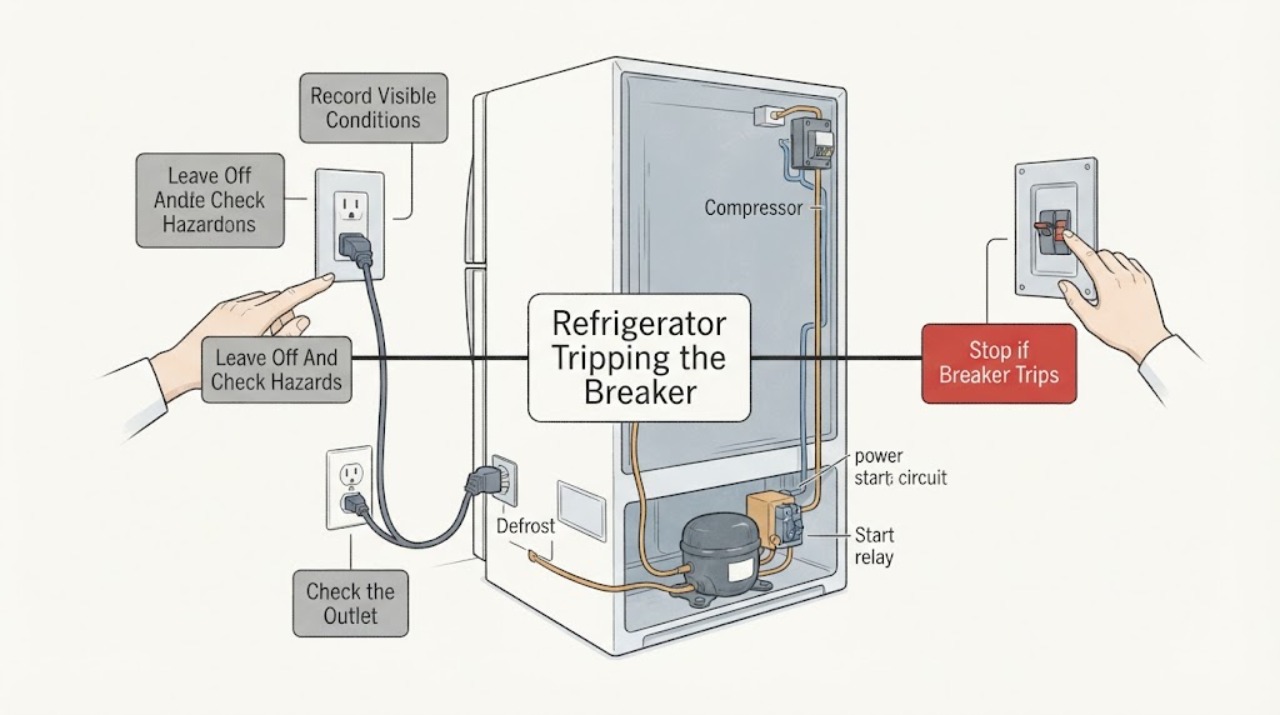
Treat a breaker trip as a safety event, not a reset prompt. Leave the Hotpoint refrigerator off and do not repeatedly reset the breaker or install a larger one. From a dry, safe position, record whether the trip was immediate, occurred when cooling started, followed a long run or defrost period, followed a leak or condensation event, or affected other household loads. Inspect only the accessible plug and cord for heat, damage, looseness, or discoloration; do not open an outlet, remove refrigerator panels, or perform a live test. Hotpoint’s official service guidance says to disconnect the appliance from the mains before replacing a part and provides model-specific manual and service routes. If smoke, burning or electrical odor, sparks, melting, shock, water near electricity, a hot or damaged plug or outlet, repeated tripping, or warming food is involved, keep the appliance isolated and arrange qualified electrical or Hotpoint service. A repeatable trip at compressor start, defrost, or another operating stage can involve the appliance or the circuit, but timing cannot identify a safe replacement part.
Before you begin
Safety first
- This article covers power-off observation of trip timing, hazards, model information, and accessible cord, plug, outlet, and moisture conditions. Circuit measurements, outlet work, refrigerator panels, compressor or start components, defrost parts, controls, wiring, and all live tests require qualified service.
Work through in order
Diagnostic checks
Use only checks that match the exact appliance or system and its official guide.
-
Check 1
Leave the refrigerator off after the trip. From a dry, safe position, note smoke, burning or electrical odor, sparks, melting, water near the plug or outlet, a hot or discolored plug, cord, or outlet, or any shock. Do not touch wet electrical equipment.
Expected result: A fire, shock, water, heat, odor, spark, or melting sign is present, or none of those hazards is visible.
Next step: For any hazard, keep clear, isolate power only from a dry safe position if it is safely accessible, and contact emergency or qualified electrical help as appropriate. If no hazard is visible, continue only with power-off observations and do not reset repeatedly.
Stop if: Do not reset the breaker again, install a larger breaker, touch a wet or hot electrical area, or use the refrigerator after smoke, burning smell, sparks, melting, shock, or water near electricity.
Why this matters
Why: Any hazard overrides troubleshooting and may indicate shock or fire risk. No visible hazard does not prove that the refrigerator or circuit is safe to re-energize.
-
Check 2
Without reconnecting the appliance, record when the trip occurred: immediately on connection, when cooling started, after a long run or possible defrost period, after a leak or condensation event, or during an unrelated household event. Note whether lights or other appliances on the circuit also lost power.
Expected result: The event was immediate, tied to a refrigerator operating stage, followed water or condensation, affected other loads, or has no reliable timing.
Next step: Give the timing and affected loads to a qualified electrician or Hotpoint technician. Do not perform a powered retest to obtain a cleaner pattern.
Stop if: Do not cycle power, force a defrost, bypass protection, or treat one successful restart as proof that the fault is resolved.
Why this matters
Why: Immediate timing raises a power-path or input fault; a repeatable operating-stage pattern makes an internal start, compressor, defrost, control, or wiring circuit more relevant; a wider event may be circuit-side. Timing alone cannot identify a failed part.
-
Check 3
With the refrigerator disconnected only if the plug can be handled safely, inspect the accessible cord and plug for cuts, crushed insulation, heat, or discoloration. Observe whether the outlet is loose, cracked, wet, or scorched without removing its cover or measuring it live.
Expected result: The cord, plug, or outlet is damaged, hot, wet, loose, or discolored, or the accessible power path looks intact.
Next step: Keep the appliance disconnected and arrange a qualified electrician for a damaged or overheated outlet, cord, or plug. If the path looks intact, leave the breaker and refrigerator off until the timing and model information are reviewed by service.
Stop if: Do not open the outlet, repair the cord with tape, probe contacts, use a larger breaker, or reconnect a plug or cord that is wet, hot, damaged, or discolored.
Why this matters
Why: A visible power-path defect can itself trip household protection and requires electrical assessment. An intact-looking path does not clear the refrigerator’s internal circuits or the household circuit.
-
Check 4
From outside and without removing panels, look for a recent spill, condensation trail, leak, or water pooled near the refrigerator base, cord, or outlet. Record whether the cabinet, display, alarm, and cooling state changed before the trip; do not move a wet appliance or reach behind it.
Expected result: Water or moisture is near electrical equipment, the appliance is warming or alarming, or the refrigerator appears dry with no visible change before the trip.
Next step: For water near electrical equipment or a warming appliance, keep power isolated, protect food when safe, and obtain qualified service. For a dry appliance, preserve the observation and do not use a live test to continue diagnosis.
Stop if: Do not touch wet electrical parts, remove a rear or bottom cover, tip the refrigerator, or reconnect it while moisture, a leak, or a food-safety concern remains.
Why this matters
Why: Moisture near electricity increases shock and short-circuit risk, while warming or an alarm affects food safety as well as diagnosis. A dry exterior does not rule out an internal fault.
-
Check 5
Record the complete Hotpoint model and serial information and any exact display code, alarm, temperature warning, or door indication that was visible before power was removed. Compare a code only with the exact model manual or Hotpoint’s model-specific code guide.
Expected result: There is an exact code or persistent alarm, a temperature warning, no code, or the model cannot be identified.
Next step: Give the exact model, code, alarm, and trip timing to Hotpoint service. If the model cannot be identified, photograph the rating label from a dry, safe position rather than removing panels.
Stop if: Do not apply another model’s code table, reset a control repeatedly, disconnect internal connectors, or test sensors, heaters, compressors, or wiring while energized.
Why this matters
Why: Hotpoint assigns refrigerator codes to model-specific sensors, defrost, control, environmental, or temperature conditions; a code from another family can mislead. No code does not exclude a power or internal fault.
-
Check 6
Prepare the service report with the model, power-path observations, trip timing, affected household loads, moisture or hazard signs, cooling status, and any code. Keep the refrigerator isolated unless a qualified professional and the exact manual determine that restoring power is safe.
Expected result: The breaker trips again, the refrigerator trips at a repeatable stage, the display or cooling is abnormal, an internal fault is suspected, or the refrigerator remains stable only while disconnected.
Next step: Arrange a qualified electrician for the household circuit, cord, plug, or outlet and Hotpoint service for the appliance. Tell the technician that the protection device tripped and do not authorize a larger breaker as a workaround.
Stop if: Do not remove panels, perform live electrical tests, replace internal parts, bypass protection, or continue operating after a repeated trip or any smoke, burning, spark, heat, water, or food-safety symptom.
Why this matters
Why: These patterns require qualified diagnosis of the supply, start circuit, compressor, defrost, control, or wiring; a user cannot safely identify the failed internal part from the breaker symptom alone.
Use your observations
Decision map
Find the observation that best matches what you see, then follow the next safe action.
-
PATH 01Safety boundary
What you see
There is smoke, burning smell, a spark, melting, shock, water near electricity, or a hot, damaged, loose, or discolored plug, cord, or outlet.
Do this next
Keep the refrigerator and affected circuit isolated from a dry, safe position and contact qualified electrical help; use emergency services for an active fire or immediate danger.
Why this path and its safety boundary
Why it matters: The immediate issue is an electrical or fire safety hazard, not a refrigerator part-selection problem.
Safety stop: Do not touch wet or live parts, reset the breaker, fit a larger breaker, or reconnect the refrigerator.
-
PATH 02Safety boundary
What you see
The protection device trips as soon as the refrigerator is connected, or multiple household loads lose power, while no user-safe inspection identifies a damaged cord or outlet.
Do this next
Have a qualified electrician assess the circuit, outlet, and protective device, and provide the Hotpoint model and trip history for appliance service if the circuit is cleared.
Why this path and its safety boundary
Why it matters: A supply-side fault, circuit issue, protective-device issue, or appliance input fault is possible; the refrigerator should not be used to distinguish them by repeated testing.
Safety stop: Do not repeatedly reconnect the refrigerator, substitute a higher-rated breaker, or use a power strip or extension as a workaround.
-
PATH 03Safety boundary
What you see
The breaker trips at a repeatable cooling start, long run, or possible defrost stage, with no external cord or outlet defect visible.
Do this next
Keep the refrigerator off and arrange Hotpoint service with the exact model and timing. A qualified technician can separate appliance and circuit faults using safe procedures.
Why this path and its safety boundary
Why it matters: An internal start, compressor, defrost, control, or wiring circuit becomes more relevant, but the timing does not identify a replaceable part.
Safety stop: Do not force a defrost, open panels, test a capacitor or heater, bypass a protector, or perform live voltage or continuity tests.
-
PATH 04Safety boundary
What you see
The trip followed a leak or visible condensation near electrical equipment, or the refrigerator is now warming or showing a persistent temperature alarm.
Do this next
Keep power isolated, avoid wet parts, protect perishable food when safe, and arrange qualified service. Supply the model, alarm, and location of the moisture.
Why this path and its safety boundary
Why it matters: Moisture can create an electrical hazard, and cooling loss creates a food-safety concern that takes priority over restart attempts.
Safety stop: Do not tip or move a wet appliance, remove the rear cover, wipe inside energized compartments, or reconnect to see whether cooling returns.
-
PATH 05Safety boundary
What you see
There was one trip, no hazard is visible, the accessible cord and outlet appear normal, and the refrigerator’s exact timing or model-specific indication is unknown.
Do this next
Leave the appliance off, identify the model, preserve the trip details, and obtain qualified advice before restoring power. If the breaker or refrigerator trips again, escalate without another reset cycle.
Why this path and its safety boundary
Why it matters: The cause remains unresolved; a single uneventful event is not evidence that repeated operation is safe.
Safety stop: Do not treat a successful restart as a repair, repeatedly reset the household protection device, or increase its rating.
Helpful context
Understand the symptom
A tripped breaker is a protection event
Do not turn the refrigerator back on just to see whether the trip was a one-time event. A breaker can be responding to the household circuit, the plug or cord, or an internal refrigerator fault. Hotpoint’s official service material separates easy model-specific guidance from qualified repair and says the appliance must be disconnected before part replacement. The first useful information is hazard signs, timing, and whether other loads were affected.
Timing changes the diagnostic branch
Write down whether the trip happened as soon as the plug was connected, when the compressor or cooling system started, after a long run or possible defrost event, after water or condensation appeared, or during a wider household power event. A repeatable stage is useful to a technician but does not prove a failed compressor, start component, heater, sensor, or control. Do not create a cleaner pattern with a powered retest.
Protect food and keep moisture away from electricity
If the refrigerator is warming, keep the doors closed as much as practical and move perishable food only when it is safe. Hotpoint’s troubleshooting describes moisture and defrost water as model- and location-dependent; water near the plug, outlet, cord, or electrical compartment is a safety boundary, not a cleaning task. Do not tip or move a wet appliance to find its source.
Use the exact model for codes and service
Record the complete model and serial information and any visible code or alarm. Hotpoint’s official error-code page covers specific integrated fridge-freezer codes for sensors, defrost, controls, environmental conditions, and high temperature, and recommends service for unresolved faults. A code or manual from a different Hotpoint family can send the diagnosis in the wrong direction.
Safety boundary
Stop conditions
- Do not repeatedly reset the breaker and never install a larger-rated breaker to keep the refrigerator running.
- Stop immediately for smoke, burning or electrical smell, sparks, melting, shock, a hot or damaged cord or plug, water near electrical equipment, or a repeated trip.
- Do not perform live voltage or continuity tests, open outlets, remove refrigerator panels, bypass protective devices, or test internal components.
- Keep the refrigerator isolated after a trip until a qualified electrician or Hotpoint technician determines that restoring power is safe.
- Protect perishable food and obtain service if the refrigerator is warming, alarming, or unable to maintain its normal temperature.
Only after diagnosis
Potential parts
- exact-model power cord, plug, or inlet assembly
Consider only if qualified service confirms an accessible power-path defect and the exact model documentation identifies a replaceable assembly.
Cord, plug, inlet, and regional electrical requirements vary by model; do not splice or substitute a part from a different Hotpoint family. - exact-model compressor start, defrost, control, or wiring component
Consider only after qualified diagnosis confirms an internal fault at the repeatable trip stage.
A breaker symptom does not identify a capacitor, relay, heater, sensor, board, compressor, or wire; internal replacement is not an owner task.
When checks do not resolve it
Need a professional?
Call a qualified electrician for a hot, damaged, loose, wet, or discolored outlet, plug, or cord, a wider circuit trip, or any shock, smoke, burning smell, spark, or melting. Call Hotpoint service for a refrigerator that trips at a repeatable operating stage, trips again after the circuit is assessed, shows a model-specific code or temperature alarm, has suspected internal moisture, or cannot cool. Do not keep resetting the breaker or install a larger breaker as a workaround.
Safety scope: This article covers power-off observation of trip timing, hazards, model information, and accessible cord, plug, outlet, and moisture conditions. Circuit measurements, outlet work, refrigerator panels, compressor or start components, defrost parts, controls, wiring, and all live tests require qualified service.
Common questions
FAQ
Should I reset the breaker if my Hotpoint refrigerator trips it once?
Leave the refrigerator off and do not keep resetting the breaker. Record the timing and inspect only the accessible, dry power context for visible damage; obtain qualified advice before restoring power. Never install a larger-rated breaker to make the appliance run.
What can I check without opening a Hotpoint refrigerator?
From a safe, dry position, note the trip timing, model, display or alarm, cooling status, and any visible damage, heat, discoloration, looseness, or moisture at the cord, plug, and outlet. Do not open outlets or refrigerator panels or perform live tests.
What does it mean if the breaker trips when the refrigerator starts cooling?
A repeatable cooling-start trip makes an appliance start or compressor circuit, the supply, or the protective device relevant, but timing cannot identify a failed part. Keep the refrigerator off and have the circuit and appliance assessed by qualified professionals.
Can a leak or condensation make a Hotpoint refrigerator trip a breaker?
Water or condensation near a plug, outlet, cord, or appliance electrical area makes the situation hazardous. Do not move a wet appliance, remove panels, or reconnect it to test cooling; isolate it safely and arrange qualified service.
Can I use a different or larger breaker for the refrigerator?
No. Do not change the protection rating or bypass the protection device to keep a tripping refrigerator operating. A qualified electrician must assess the circuit, and Hotpoint service must assess the appliance when an internal fault is possible.
Do Hotpoint refrigerator error codes identify the part that caused the trip?
Not generically. Hotpoint’s official error-code guidance is model-specific and covers sensor, defrost, control, environmental, and temperature conditions. Record the exact code and model and give them to service rather than applying another model’s table.
Read the exact guide
Official sources
- Hotpoint Service Fridge Freezer Repair - HotpointHotpoint · Official Hotpoint service page that routes owners to manuals and qualified repair; service availability and instructions are region dependent.
- Hotpoint Freezer Troubleshooting & Repair - HotpointHotpoint · Official Hotpoint freezer troubleshooting page used for the general refrigeration safety boundary; exact refrigerator model instructions take precedence.
- Hotpoint Integrated Fridge Freezer Error CodesHotpoint · Official Hotpoint page for integrated fridge-freezer code families; codes and advice must be matched to the exact model and region.
- Hotpoint Fridge Freezer Troubleshooting & FAQ - HotpointHotpoint · Official Hotpoint UK service guidance; specific behavior and advice vary by model and region.
Community feedback
Share a repair observation
Share a plain-text repair observation. Accepted observations are published automatically; this page may take a moment to update.