
On this page
Start here
Quick answer
A Hotpoint BHWD129 that bangs rapidly during spin in a new flat should be treated as an installation and stability problem first, not as proof that a bearing, motor, or shock absorber needs replacement. Stop the cycle if the cabinet walks, strikes the kitchen unit, leaks, smells hot or burnt, smokes, sparks, or trips the supply. Do not pull an integrated or tightly fitted machine forward yourself. Have the installer or a qualified appliance technician verify that the transport brackets or bolts were removed, the feet and floor are stable, and the cabinet is not being forced by the surrounding units. If the machine is safe to inspect from the front, record whether the noise follows one uneven load or remains with an empty drum; a persistent empty-drum knock, scrape, or growl needs service rather than more spin tests.
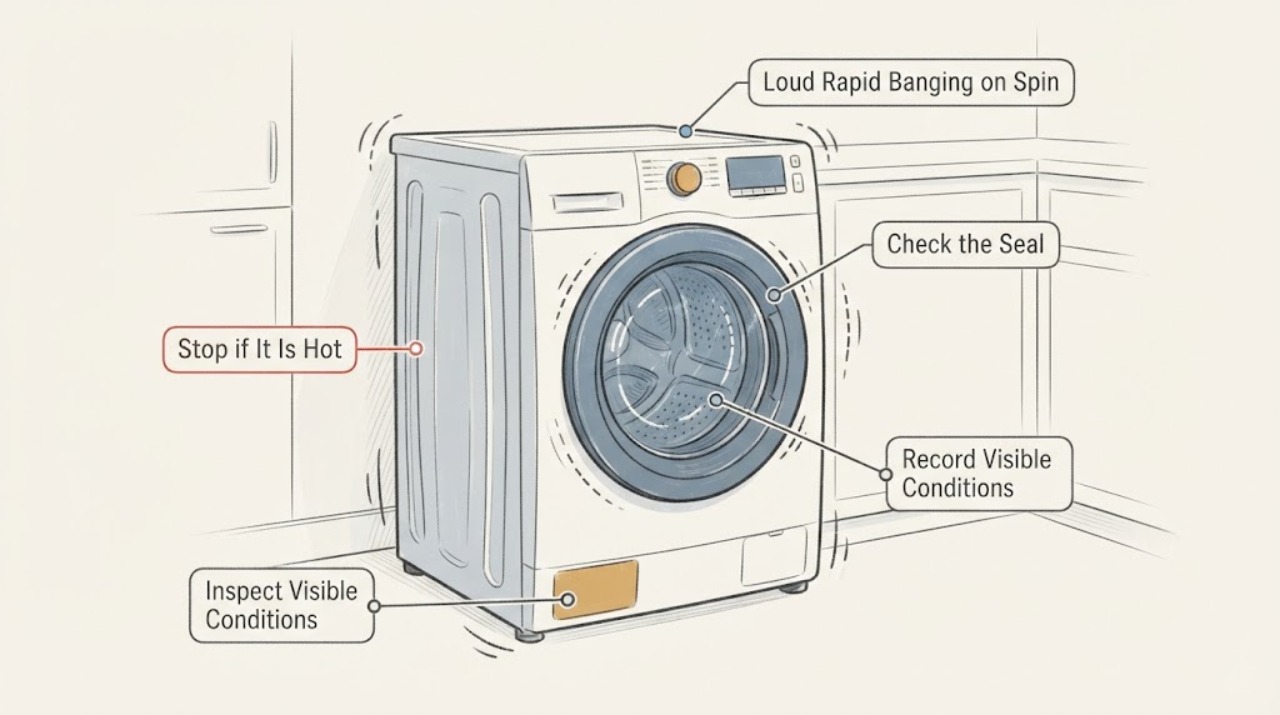
Work through in order
Diagnostic checks
Use only checks that match the exact appliance or system and its official guide.
-
Check 1
Stop the programme and observe the appliance from a safe position. Record whether the cabinet walks, hits the cabinet door or worktop, rocks in its opening, leaks, or shows smoke, a burning smell, unusual heat, sparks, a damaged cord, or a repeated supply trip. Do not put hands under it or reach into a moving drum.
Expected result: There is violent movement or any electrical, water, heat, or burning warning, or the machine is stable and only the rapid spin bang is present.
Next step: For any warning, stop using the washer-dryer and isolate power only if it is safe from a dry position; arrange qualified appliance, electrical, or plumbing service. Otherwise continue without pulling the machine out.
Stop if: Do not run another cycle after violent movement, smoke, burning smell, sparks, water near electrical parts, a hot or damaged cord, or a repeated trip.
Why this matters
Why: A safety warning or violent movement takes priority over identifying the sound. A stable machine without a warning can be assessed with limited, supervised observations, but stability does not rule out an internal fault.
-
Check 2
Ask the installer or landlord whether the BHWD129 was transported or newly installed, and have that person consult the exact handbook and verify from the accessible rear or installation records whether all specified transport brackets or bolts were removed. Do not pull an integrated or tightly fitted unit forward yourself to search for them.
Expected result: The noise began on the first use or after a move, transport hardware cannot be confirmed removed, or the installer confirms it was removed and the unit was secured and leveled.
Next step: If hardware status is unknown or pieces remain, keep the machine off and have the installer complete the model-specific installation before use. If installation is confirmed, continue with the front-accessible load and sound observations.
Stop if: Do not operate with transport hardware still fitted and do not improvise a removal method behind cabinetry.
Why this matters
Why: Hotpoint specifically identifies incomplete transport-hardware removal as a cause of first-use noise or instability. If that hardware is confirmed removed, the next likely decision is level, load, clearance, or an internal fault rather than repeating the same check.
-
Check 3
With the drum stopped and the door open, note the load that produced the bang. Remove only a visibly overpacked or single heavy item, separate tangled items, and redistribute the remaining laundry evenly. Inspect the visible door-seal fold and drum opening for a coin, button, or other loose object without prying behind the seal or drum.
Expected result: A single bulky item or tightly clustered load is present, a loose object is visible, or the drum opening and seal are clear.
Next step: Only if the cabinet is stable and there is no safety warning, run one supervised low-load spin permitted by the handbook. If the same rapid banging remains, stop rather than adding clothes to mask it.
Stop if: Do not pry at a trapped object, reach through a locked door, or continue a test while the cabinet is unstable.
Why this matters
Why: A clustered or uneven load can produce a repeated thump specifically at spin; a small hard object can make a sharper rattle. A clear opening does not rule out an object trapped out of reach or an internal rotating fault.
-
Check 4
Without moving the appliance, inspect the visible front and side gaps, plinth, cupboard door, and floor line for contact or rocking. If the installation exposes the adjustable feet and the handbook or installer permits it, ask the installer to verify level and firm support; do not adjust concealed feet or lift the machine yourself.
Expected result: The cabinet rocks, a foot or support is visibly not seated, a cupboard or plinth is being struck, or the cabinet is firm with no visible contact.
Next step: Have the installer correct only the model-approved support, clearance, or leveling condition and then perform one supervised comparison. If the machine cannot be accessed safely without moving it, arrange a qualified visit.
Why this matters
Why: A new-flat floor, cabinet, or leveling problem can amplify normal spin forces into a rapid bang. A firm, clear installation with the same noise on an empty drum shifts concern toward a rotating, suspension, drive, or other internal fault.
-
Check 5
While the appliance remains in place and off, look at the visible fill and drain hose runs, nearby plumbing, and cabinet edges. Note a hose tapping the cabinet, a drain hose pulled tight, a loose external object, water, or a kink. Do not loosen a connection or pull the washer-dryer out to reach the rear.
Expected result: The sound or contact appears to come from an external hose or cabinet edge, the hose is under tension or kinked, a leak is present, or the visible plumbing is clear.
Next step: Clear only a harmless visible contact without disturbing a connection and ask the installer to correct any hose routing. For a leak, strained connection, or inaccessible contact, leave the machine off and arrange qualified service.
Stop if: Do not loosen pressurized connections, work behind the machine, or allow water to approach electrical parts.
Why this matters
Why: A hollow tap synchronized with pump or spin activity may be transmitted by an external hose or cabinet contact, while a leak or strained hose is an installation repair and safety issue. Clear plumbing does not explain persistent empty-drum scraping or growling.
-
Check 6
If the unit is stable, dry, and safe, compare the original symptom with one empty or very low-load spin allowed by the exact handbook, preferably with the installer present. Record whether the sound occurs only as speed rises, during wash tumble, while draining, or through the entire drum rotation; stop immediately if the cabinet begins to walk.
Expected result: The bang disappears with a balanced low load, continues with an empty drum, changes to scraping or growling, or the drum hesitates or fails to spin normally.
Next step: Stop using the appliance for persistent empty-drum noise, abnormal movement, or a failed spin. Give the technician the cycle stage, sound recording, load, installation status, and visible observations; do not order a guessed part.
Why this matters
Why: A load-dependent bang supports balance or installation as the next service conversation. A machine-dependent scrape, growl, repeated knock, or failed spin is not explained by laundry distribution and may involve an internal rotating or support system that the code and symptom cannot identify precisely.
Use your observations
Decision map
Find the observation that best matches what you see, then follow the next safe action.
-
PATH 01Next step
What you see
The rapid banging began on the first use or immediately after the machine was installed or moved, and the transport brackets or bolts cannot be confirmed removed.
Do this next
Keep the appliance off and have the installer or qualified technician follow the BHWD129 handbook, confirm the hardware removal and support, and then perform one low-load observation. Do not pull the fitted machine out yourself.
Why this path and its safety boundary
Why it matters: Incomplete installation is the leading actionable branch for a first-use Hotpoint washer-dryer noise; the model-specific transport hardware and leveling must be verified before further operation.
-
PATH 02Next step
What you see
The cabinet is stable, the installation is confirmed, and the noise occurs only with one clustered, bulky, or uneven load and disappears after safe redistribution.
Do this next
Use evenly mixed loads within the exact handbook limits and monitor. Arrange service if the bang returns with normal loads or the cabinet begins to move.
Why this path and its safety boundary
Why it matters: The observation is consistent with load balance rather than proof of a failed part. Hotpoint says an excessive or unbalanced load can affect the spin indication and recommends redistributing the load.
-
PATH 03Next step
What you see
The same knock, scrape, growl, or rapid banging continues with an empty drum, or the drum hesitates, fails to spin, or the machine keeps walking after installation checks.
Do this next
Stop using the washer-dryer and arrange qualified appliance service. Supply the exact BHWD129 identity, cycle stage, sound recording, empty-load result, and installation observations; do not dismantle the cabinet or replace a guessed component.
Why this path and its safety boundary
Why it matters: The symptom is machine-dependent and may involve an internal rotating, suspension, drive, pump, or support system, but the sound alone cannot identify a specific part.
-
PATH 04Next step
What you see
A hose or cabinet edge taps in time with the vibration, or a visible hose is kinked, under tension, or leaking, while the drum itself is otherwise quiet.
Do this next
Leave connections undisturbed, clear only a harmless visible contact, and have the installer or a qualified plumber/appliance technician correct the routing. Stop if water reaches electrical parts.
Why this path and its safety boundary
Why it matters: The sound may be transmitted by the installation rather than generated by the drum. A leak or strained connection makes it an installation and water-safety issue.
-
PATH 05Next step
What you see
The appliance moves violently, strikes surrounding units, produces smoke or a burning smell, has a hot or damaged cord, sparks, leaks near electrical parts, or trips the supply repeatedly.
Do this next
Stop the programme, keep clear, isolate power only if safe from a dry position, and arrange qualified appliance, electrical, or plumbing service. Do not pull a fitted heavy appliance out as a first response.
Why this path and its safety boundary
Why it matters: This is a safety stop, not a normal unbalanced-load branch. Continued spinning can worsen damage or create an injury, fire, or electrical risk.
Helpful context
Understand the symptom
The model identity is Hotpoint BHWD 129 (UK)/1, a washer-dryer listed in Hotpoint product information with a maximum spin speed of 1200 rpm. The useful first split is not the noise's imagined part: it is whether the violent banging began on first use or after the appliance was moved, whether the cabinet is unstable, and whether the sound remains with no laundry.
Because the machine is in a new flat and may be behind a kitchen door or plinth, treat access as part of the diagnosis. Hotpoint directs owners to the handbook for transport-hardware removal and recommends unplugging before part replacement; a resident should not dismantle cabinetry, strain hoses, or move a heavy fitted appliance just to investigate a bang.
When checks do not resolve it
Need a professional?
Have the installer or a qualified appliance technician inspect the BHWD129 when transport hardware, leveling, cabinet clearance, or support cannot be confirmed without moving the fitted machine; when banging persists with an empty drum; when the machine walks or spin aborts; or when a hose or plumbing contact cannot be corrected safely. Stop immediately for violent movement, smoke, burning smell, sparks, abnormal heat, a damaged cord, water near electrical parts, or a repeated supply trip. Do not dismantle cabinetry, reach behind a heavy integrated unit, or diagnose a bearing, motor, suspension, pump, or belt from sound alone.
Common questions
FAQ
Could transport bolts still cause loud banging on a Hotpoint BHWD129 in a new flat?
Yes, if the noise began on first use or immediately after installation and the transport brackets or bolts were not removed. Hotpoint specifically tells owners to confirm their removal according to the handbook. Do not pull an integrated or tightly fitted unit forward yourself; have the installer verify the installation.
How can I tell an unbalanced load from an internal fault?
A clustered or bulky load that causes banging only as spin speed rises, then becomes quiet after safe redistribution, supports a load or installation explanation. The same knock, scrape, or growl with an empty drum, failed spin, or continued walking needs service and does not identify a specific part by sound alone.
Should I pull the built-in washer-dryer out to level it or inspect the rear?
Not as a first response. In a new flat, moving a heavy fitted machine can strain the water, drain, power, cabinet, or door installation. Ask the installer or a qualified technician to verify the model-specific feet, supports, clearance, and transport hardware; do not reach behind or loosen connections yourself.
Does the BHWD129 noise prove that the bearings or shock absorbers have failed?
No. A noise description cannot distinguish a load imbalance, transport or leveling problem, cabinet contact, trapped object, suspension or drive issue, pump noise, or another internal fault. Persistent empty-drum noise or unstable spinning should be diagnosed by a qualified technician rather than by ordering a guessed part.
Read the exact guide
Official sources
- Hotpoint Service Washer Dryer RepairHotpoint UK Appliances Limited · Hotpoint says a washer-dryer that is noisy or unstable on first use may still have protective transport brackets or bolts, directs the owner to the handbook for removal, and advises unplugging before part replacement. It also links an unbalanced spin indication to an excessive or unbalanced load.
- WASHER-DRYERS PRODUCT FICHEHOTPOINT · The opened product fiche identifies the commercial code BHWD 129 (UK)/1, also written here as BHWD129 for exact-model matching, maximum 1200 rpm spin, 6.5 kg wash capacity, 5 kg drying capacity, and washer-dryer noise ratings. It is used only to anchor the exact product identity and not to infer a failed part.
- Washer Dryer Troubleshooting & Repair ServiceHotpoint UK Appliances Limited · Hotpoint's UK troubleshooting page repeats the transport-hardware and first-use noise warning, identifies excessive or unbalanced loads as a spin issue, discusses leveling and hose/plumbing checks for installation problems, and states that model handbooks vary.
Community feedback
Share a repair observation
Share a plain-text repair observation. Accepted observations are published automatically; this page may take a moment to update.