
On this page
Start here
Quick answer
If your Hotpoint washer dryer will not drain, stop the programme and do not keep restarting it. Keep children and pets away, close the water-supply tap, and disconnect power only when your hands, the plug, floor, and route are dry and safe; if water is near electrical equipment, do not touch the plug or water and isolate power from a dry location or call a qualified professional. Check the display for a fault and inspect the visible drain hose, standpipe or sink connection for kinks, a loose end, a blocked waste path, or an incorrect installation. Do not open or remove the pump filter while water remains in the drum or cabinet, and do not tip or pull a heavy, water-filled appliance forward. If the drum is full, the filter cover is wet, the hose is inaccessible, the pump only hums, the appliance leaks, a protective device has tripped, or the external route is clear but draining still fails, leave the machine isolated and arrange qualified appliance or plumbing service.
Before you begin
Safety first
- This article is limited to safe triage and visible external checks. A qualified professional determines whether residual water can be removed safely and whether a filter, pump, hose, control, door lock, or household waste connection needs model-specific work.
Work through in order
Diagnostic checks
Use only checks that match the exact appliance or system and its official guide.
-
Check 1
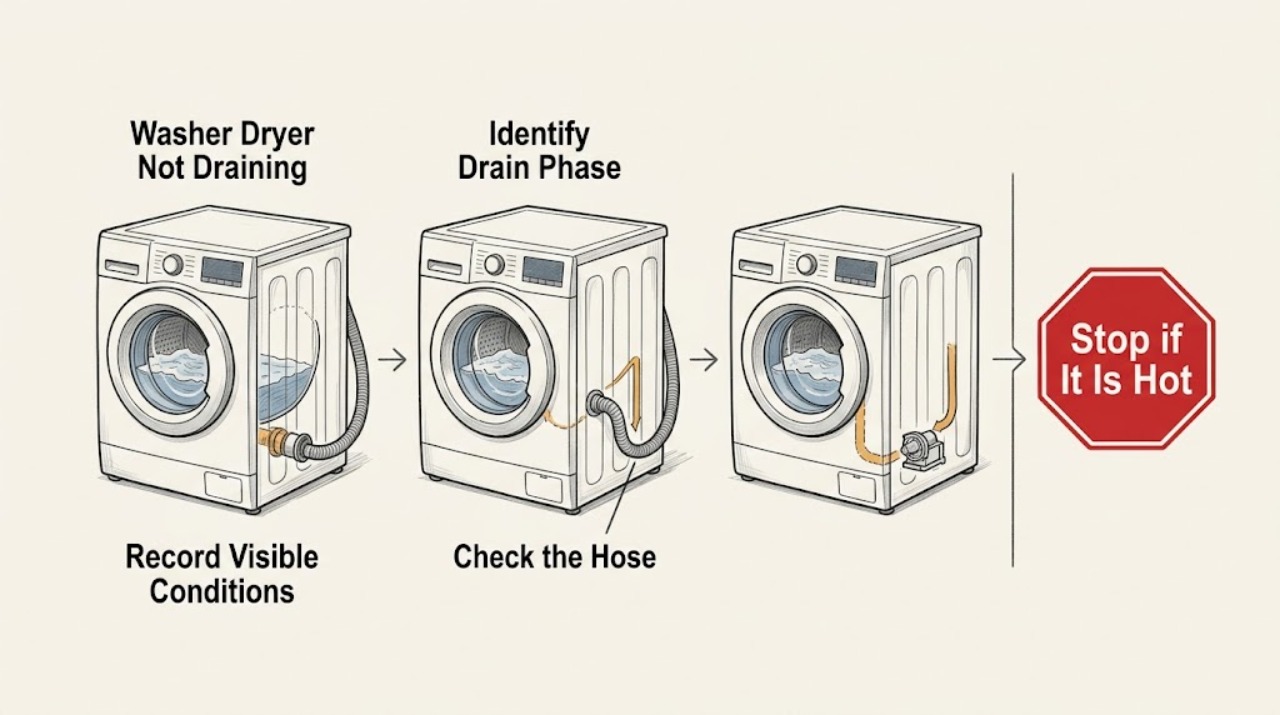
Stop the programme and keep people and pets away. From a dry, stable position, close the water-supply tap; disconnect the appliance only if the plug, hands, floor, and route are dry and accessible, otherwise isolate power from a dry location or call a qualified professional.
Expected result: Record whether water is visible in the drum, whether it is hot or unknown, whether water is near the socket or cable, whether a protective device has tripped, and whether the appliance is still trying to pump.
Next step: Photograph the display, drum level, lower front, floor, and visible hose route without opening covers or moving the machine.
Stop if: Do not touch wet electrics, the plug, hot or contaminated water, a wet filter cover, or a heavy appliance that would need to be pulled forward.
Why this matters
Why: A full or hot drum and any wet electrical area change this from a routine hose check to a safety and service handoff. A dry, powered-down appliance permits only the external observations below; it does not justify opening a filter with water inside.
-
Check 2
Use the last safe observation and the display to identify when draining stopped: before any pump sound, after washing, during the drain or spin transition, or after the machine reported a fault; do not restart a cycle to reproduce the symptom.
Expected result: The drum never emptied, water drained slowly, the pump hummed without visible discharge, the machine stopped with water and an error, or the timing is unknown.
Next step: Write the exact display or flashing-light pattern and provide it with the water level and timing to the service professional; keep the water supply closed.
Stop if: Do not repeatedly select drain or spin, reach into a running drum, bypass a door lock, or make live electrical measurements.
Why this matters
Why: No pump sound can point toward a control, door-lock, or electrical issue; humming with no discharge supports checking the visible drain route and then professional pump or filter assessment. Slow or partial drainage can leave a restriction even when some water exits. Timing alone cannot identify an internal part.
-
Check 3
From a dry position, follow the visible drain hose from the rear of the washer dryer to the standpipe, sink trap, or waste connection; inspect for a sharp kink, crushing, a loose end, a hose pulled out, or a connection that is visibly blocked, without pulling the appliance forward.
Expected result: The hose is kinked, pinched, loose, submerged, pushed too far into the standpipe, or attached to a sink spigot with an unresolved blanking cap; or the visible route is dry and open.
Next step: Photograph the route and keep the appliance isolated; correct only an obvious, dry, user-accessible hose position when the exact manual permits it, then have a professional confirm the waste arrangement before reuse.
Stop if: Do not pull the machine across a wet floor, insert tools into the drain hose, disconnect a water-filled hose, or operate the appliance to pressure-test it.
Why this matters
Why: A kink, displaced hose, incorrect standpipe insertion, or blocked sink connection can stop pump-out or make water back up. A dry, open route does not rule out a blocked filter, pump, or internal hose, and it is not a reason to open the lower panel while the drum is full.
-
Check 4
If the drain hose enters an under-sink trap or standpipe that can be viewed without moving the appliance, inspect the household waste opening and surrounding joints for visible backup, food or grease blockage, a loose clamp, or water escaping during another fixture's use; do not open the washer dryer's pump or lower filter.
Expected result: The sink or waste system drains poorly for other fixtures, water backs up at the connection, the hose joint leaks, or the household waste appears clear and dry.
Next step: Keep the washer dryer unused and ask a plumber to clear or repair a shared waste obstruction; give an appliance professional the same observation if the household drain is clear.
Stop if: Do not pour chemicals into a connected washer-dryer waste path, disconnect a joint with trapped water, or open the machine's filter while water remains.
Why this matters
Why: Poor drainage in other fixtures or backup at the shared waste points toward household plumbing. A clear household waste path shifts attention to the appliance drain hose, filter, pump, or control, which needs model-specific service when water remains inside.
-
Check 5
From the front, inspect only the visible door seal, dispenser area, lower cover, and floor for a leak or obstruction, using ordinary dry access; do not open the lower filter or remove any cover when the drum or cabinet may contain water.
Expected result: A torn seal, blocked dispenser, wet lower cover, water trail, or foreign object is visible; or there is no external front evidence.
Next step: Document the area, leave water and power isolated, and arrange service for any damaged seal, lower cover, pump, filter, or internal blockage.
Stop if: Do not force the door, use sharp tools, remove a wet filter, drain onto the floor, or reach into the pump chamber with water present.
Why this matters
Why: A front leak or obstruction can accompany a drainage fault, while a wet lower cover can make filter access hazardous. No visible evidence leaves the internal drain path unresolved and does not support further user disassembly.
-
Check 6
Review the water level, electrical condition, display pattern, pump sound, hose route, household waste condition, and visible damage, then choose qualified appliance or plumbing service without attempting an internal repair.
Expected result: Choose urgent help for flooding, water near electrics, hot or contaminated water, a tripped protective device, a burst hose, unsafe access, or a machine that cannot be isolated. Choose prompt appliance service when the external route is clear but water remains, the pump hums or is silent, the filter area is wet, or the fault returns.
Next step: Provide the model identification, dated photographs, water level, cycle phase, error or light pattern, hose and waste arrangement, and every safe observation to the service provider.
Stop if: Do not bypass a door lock or protective device, make live electrical checks, tip the appliance, open the filter with water inside, or return it to service while the drain fault remains.
Why this matters
Why: The route distinguishes an immediate hazard from a contained drain fault; it does not prove that the pump, filter, valve, hose, control, or door lock has failed. A replacement part must be matched to the exact model after inspection.
Use your observations
Decision map
Find the observation that best matches what you see, then follow the next safe action.
-
PATH 01Safety boundary
What you see
Water is near a socket, plug, cable, control, or protective device, or water is spreading beyond the appliance.
Do this next
Keep clear, do not touch water or electrics, isolate power only from a dry safe location if possible, close the supply tap if it can be reached without contact, and arrange urgent qualified help.
Why this path and its safety boundary
Safety stop: No wet-area plug handling, floor entry, appliance movement, or cycle reproduction.
-
PATH 02Safety boundary
What you see
Water remains above the door threshold or the drum level is unknown and the lower filter or drain hose would need to be opened.
Do this next
Do not remove the filter or disconnect a hose; keep the appliance isolated and arrange qualified service that can control the remaining water safely.
Why this path and its safety boundary
Safety stop: Never open a pump filter with water in the drum, and do not drain onto the floor.
-
PATH 03Safety boundary
What you see
The sink trap, standpipe, or shared waste backs up or drains poorly for other fixtures.
Do this next
Keep the appliance unused and arrange plumbing service for the accessible household waste obstruction or connection.
Why this path and its safety boundary
Safety stop: Do not add chemical drain cleaner to a connected appliance line or disconnect a water-filled joint.
-
PATH 04Safety boundary
What you see
The visible drain hose is kinked, crushed, loose, pulled out, or routed contrary to the exact installation instructions.
Do this next
Photograph the condition, correct only a dry and plainly accessible position permitted by the manual, and have the installation confirmed before reuse.
Why this path and its safety boundary
Safety stop: Do not pull the machine, cut or extend the hose, or run a cycle as a pressure test.
-
PATH 05Safety boundary
What you see
The external route is clear, but the pump is silent or only humming, the drum remains full, the filter cover is wet, or the drain error returns.
Do this next
Leave water and power isolated and arrange qualified appliance service for model-specific filter, pump, internal hose, control, or door-lock diagnosis.
Why this path and its safety boundary
Safety stop: No filter removal with water present, cabinet disassembly, bypassing, live testing, or repeated restart.
Helpful context
Understand the symptom
Start with water and electrical safety, not a filter cap
A non-draining washer dryer can leave hot, detergent-containing water behind the door. A full drum also makes the appliance heavy and can release water unexpectedly if a cover or hose is opened. Stop the programme, keep the area clear, and isolate water and power only from a dry, safe position. If you cannot make the area safe, stop at the doorway and arrange service. The user-visible checks below are intended to identify an external route problem without opening the pump or cabinet.
The drain route is a separate question from the pump
Hotpoint's washer-dryer guidance recommends checking the drain hose during pump-out, and its installation manual describes a hose that must not be kinked and a waste connection that must be prepared correctly. A hose pushed too far into a standpipe, a loose connection, a blocked sink trap, or a kink can prevent water leaving even when the pump itself is not the first thing to replace. Do not infer a pump failure until the safe, visible route and the cycle timing have been documented.
A clear hose does not make internal access safe
If the visible route is clear but the drum remains full, the cause may be a pump filter, pump, internal hose, control or another model-specific component. The exact manual may describe a drain procedure, but it does not make a wet-area repair suitable for everyone. Do not remove the filter with water in the drum, do not open a wet lower cover, and do not run repeated programmes to force a blockage through. Give the professional the display code, water level, timing, hose arrangement, and any sound from the pump.
Only after diagnosis
Potential parts
- washer-dryer drain hose
Consider this only when inspection confirms the hose is cracked, crushed, or otherwise damaged and the exact model identifies it as the cause.
Match the exact Hotpoint model and installation arrangement; do not cut, extend, or force a replacement hose and keep the machine isolated during work. - washer-dryer pump filter or filter seal
Consider this only after qualified assessment or a model-specific manual confirms that a filter or seal is serviceable and is implicated; a full drum is not a safe invitation to remove it.
Never open the filter with water remaining, and do not substitute a generic filter, cap, or seal without exact model confirmation. - washer-dryer drain pump
Consider this only when a qualified technician confirms a pump fault after safe external checks; no-drain symptoms can also be caused by routing, filter, wiring, control, or household waste.
Confirm exact model and electrical/mechanical fit through the service provider; pump replacement is not a user procedure in this article.
When checks do not resolve it
Need a professional?
Arrange qualified appliance service when the drum remains full, the filter area is wet, the pump is silent or only humming, the drain error returns, the visible route is clear, the appliance leaks, or any internal access would be required. Treat flooding, hot or contaminated water, water near electrical equipment, a tripped protective device, a burst hose, or unsafe movement as urgent. Arrange plumbing service when the sink trap, standpipe, or shared household waste backs up.
Safety scope: This article is limited to safe triage and visible external checks. A qualified professional determines whether residual water can be removed safely and whether a filter, pump, hose, control, door lock, or household waste connection needs model-specific work.
Have this ready
- Exact model identification and installation location
- Dated photographs of the display, drum water level, lower front, hose route, standpipe or sink connection, and floor
- The cycle phase when draining stopped and whether the pump was silent, humming, or discharging slowly
- Any error code or flashing-light pattern, recent relocation, installation work, overflow, or household plumbing symptom
- Whether water and power were isolated and whether any protective device operated
Common questions
FAQ
What should I do first if my Hotpoint washer dryer will not drain?
Stop the programme, keep people away, close the water tap, and isolate power only from a dry safe position. Record the drum level and display, then inspect the visible drain route without opening the pump filter.
Can I open the pump filter when water is still in the drum?
No. Do not open or remove the filter while water remains in the drum or cabinet. Water may be hot, the flow can be uncontrolled, and the wet-area electrical risk is not suitable for an improvised repair. Arrange qualified service for safe residual-water handling.
Why does my washer dryer hum but not drain?
Humming with no discharge can involve a blocked or kinked drain route, a filter or pump restriction, or a pump or control fault. Document the sound and check only the visible, dry hose and household waste path; leave internal diagnosis to service.
When is a no-drain fault urgent?
Seek urgent help for flooding, hot or contaminated water, water near electrical equipment, a tripped protective device, a burst hose, unsafe access, or an appliance that cannot be isolated. A contained full drum still needs prompt service and should not be repeatedly restarted.
Read the exact guide
Official sources
- Washer Dryer Troubleshooting & Repair ServiceHotpoint · Supports checking the drain hose, pump-out path, plumbing, and common washer-dryer symptoms, and unplugging before spare-part work.
- Washing Machine Troubleshooting: Quick Fixes for Common ProblemsHotpoint · Corroborates drain-hose, pump, filter, shared-waste, and power-safety checks; the exact washer-dryer manual still controls model-specific access.
- Hotpoint Service Washer Dryer RepairHotpoint · Supports drain-hose, pump-filter, waste-pipe, plumbing, error-code, and service escalation decisions.
- Hotpoint Instructions for Use: RPD 10457 JHotpoint · Used for general safety principles only; this is one model manual, so dimensions and access steps must not be generalized to an unconfirmed washer dryer.
Community feedback
Share a repair observation
Share a plain-text repair observation. Accepted observations are published automatically; this page may take a moment to update.