
On this page
Start here
Quick answer
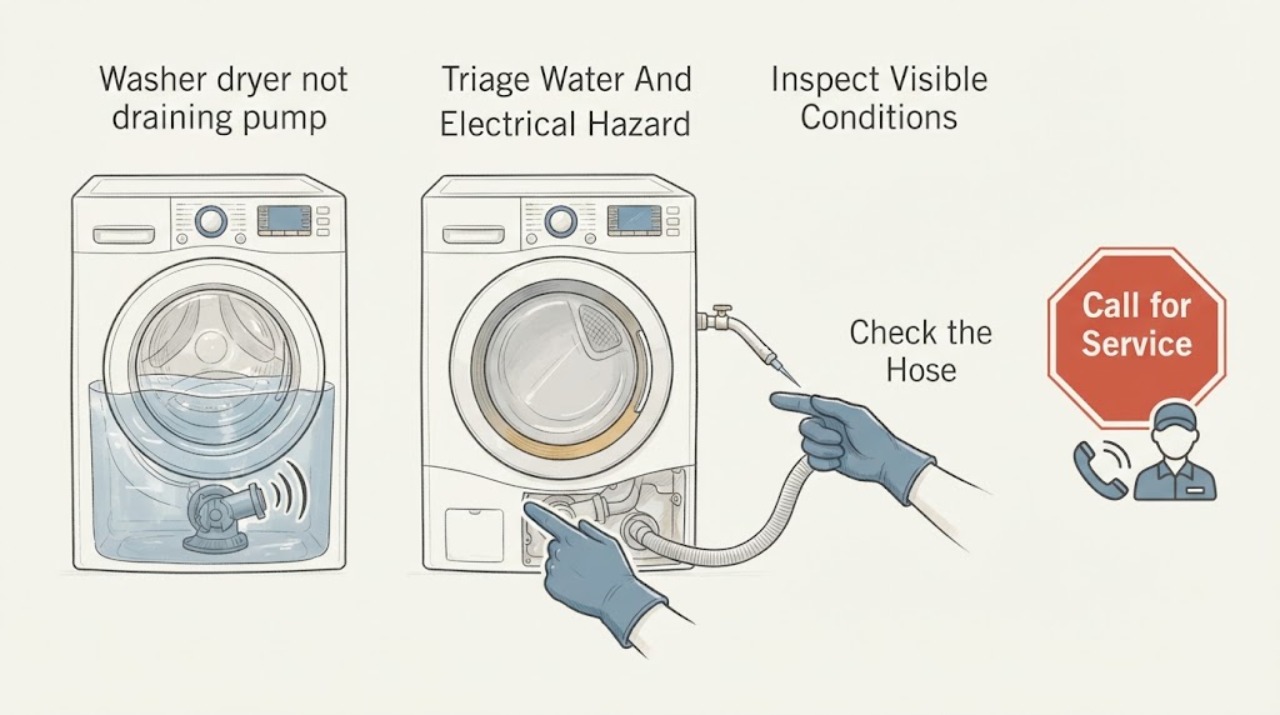
A washer dryer that will not drain can make a low hum while the pump is moving water, but a hum with no flow often points to a blocked filter, hose, or pump path; a silent pump can mean the drain step was not enabled, an interlock or control condition is holding the cycle, or the pump or wiring needs service. Stop for flooding, water near electrical connections, burning odor, smoke, or a drum that may contain hot water. If the exact manual allows it, unplug the appliance, catch residual water, inspect the external drain hose, and clean an accessible pump filter. Do not run a pump dry, open the pump, or reach into an energized appliance.
Before you begin
Safety first
- Owner checks are limited to safe observation, external hose and household-drain inspection, and—only when the exact manual permits it—an accessible residual-drain or filter cleaning procedure after power is disconnected and water can be contained. A qualified professional must handle pump, wiring, control, interlock, cabinet, energized testing, and internal obstruction work.
Work through in order
Diagnostic checks
Use only checks that match the exact appliance or system and its official guide.
-
Check 1
From a safe position, look for water on the floor, water near the plug or outlet, smoke, a burning smell, sparking, a hot cabinet, or a drum that may contain hot water. Do not touch pooled water or reach behind the appliance while it is powered.
Expected result: There is no immediate hazard; or water is near electrical parts, the appliance is smoking or hot, a burning odor or sparks are present, or hot residual water is suspected.
Next step: If there is smoke, fire, active sparking, or a strong burning smell, leave the area and contact emergency help from a safe location. Otherwise stop the appliance using its normal control if safe, keep clear, and arrange qualified appliance or electrical service; do not start another cycle.
Stop if: Stop immediately for smoke, fire, sparking, crackling, burning odor, water near energized connections, a hot cabinet, or any need to touch hot water or an energized part.
Why this matters
Why: A simple drain restriction can be checked only when the appliance and floor are safe. Water near electrical connections, overheating, or smoke changes the problem to an electrical, fire, or burn hazard.
-
Check 2
If the appliance is safe and the manual permits a drain or spin test, select the normal drain-related cycle and listen from the front without opening anything. Observe whether water exits, the pump hums, the pump is silent, the drum spins, or an error message appears; do not repeat the cycle if the drum remains full or the sound worsens.
Expected result: Water flows with a steady or brief hum; the pump hums but little or no water flows; the pump is silent; or an error, door, or cycle message appears.
Next step: Record the exact pattern and error text. Use the matching branch below; do not bypass a door lock, open the pump while powered, or keep commanding a stalled pump.
Stop if: Stop if the appliance leaks, the door cannot be safely opened after the manual's procedure, the pump makes grinding or burning sounds, the drum is full of hot water, or repeated tests could overflow the room.
Why this matters
Why: Flow with a modest hum is consistent with normal pump operation. A hum with no flow makes a restriction or jam more likely. Silence can mean the drain command is not being reached, an interlock or control condition is active, or the pump, wiring, or control needs diagnosis.
-
Check 3
With the appliance off, inspect the visible drain hose and its connection without pulling the washer dryer away if doing so would strain hoses or power. Look for a kink, compression behind the unit, a blocked sink or standpipe, a sealed connection, or a hose position that does not match the installation manual.
Expected result: The hose is kinked or pinched; the standpipe or sink backs up; the hose is taped or sealed into the drain; the hose position is outside the manual's limits; or the external path looks clear.
Next step: Correct only an obvious external hose position or blockage according to the exact installation instructions, and have a plumber inspect a backing-up household drain. Do not cut, extend, seal, or reroute the hose by guesswork; if the path is clear, continue to the model-approved filter check.
Stop if: Stop if the hose or plumbing is cracked, water is spraying, the unit must be moved to inspect it, the drain is overflowing, or correction requires disconnecting pressurized or electrical connections.
Why this matters
Why: A restricted or incorrectly installed hose or household drain can prevent the pump from moving water and can create siphoning or backflow. A clear external path shifts suspicion toward the filter, internal hose, pump, control, or interlock.
-
Check 4
Only if the exact model manual provides an accessible pump-filter or residual-drain procedure, turn the appliance off and disconnect power before opening that access point. Place a shallow container and towels below it, drain slowly, check for lint or foreign objects, clean the filter as directed, and reseat the cap or filter fully.
Expected result: The filter is clogged; a coin, lint, or other object is present; water is hot or spills unexpectedly; the filter is clear; or the cap will not turn or reseat normally.
Next step: Let hot water cool and stop if water cannot be contained. Remove only accessible debris the manual permits, never reach into a moving pump, and reseat the filter exactly as instructed. If the filter is clear or the pump remains silent or ineffective, arrange service rather than opening the pump.
Stop if: Stop for hot water, an uncontrolled spill, a stuck filter, damaged threads or seal, visible wiring, a broken impeller, or any need to disassemble the pump or cabinet.
Why this matters
Why: A clogged filter or foreign object can restrict flow and make a pump hum without moving water. Hot water, uncontrolled spilling, a stuck cap, or a filter that cannot seal safely means the procedure has exceeded a safe owner check.
-
Check 5
After the water hazard is controlled, inspect the accessible door-seal drain holes for lint and check whether the load is tightly packed, badly unbalanced, or producing excessive suds. Do not pull the seal out, reach beneath the drum, or add chemicals to force a drain.
Expected result: Lint blocks seal holes; the load is tightly packed or unbalanced; excessive suds are visible; the door remains locked; or these conditions are not present.
Next step: Clean only accessible lint as the manual directs, reduce or rebalance the load for a later approved cycle, and use the correct detergent amount. If the door remains locked, the drum stays full, or draining still fails, request service; never force the door.
Stop if: Stop if the door is locked with water inside, the seal is torn, the drum is hot, suds are overflowing, or clearing the path requires tools, cabinet access, or reaching into the appliance.
Why this matters
Why: Blocked seal holes, a dense or unbalanced load, and excessive suds can leave water or prevent a proper spin, but they do not prove that the pump is defective. A door that remains locked may be protecting against residual water or may indicate an interlock fault.
-
Check 6
Record the model and serial information from a safely visible label, the cycle and error text, water level and temperature if known, whether the pump hums or is silent, whether water exits the hose, filter findings, and any recent move, repair, freezing weather, or plumbing work. Give the record to qualified appliance service or a plumber as appropriate.
Expected result: The machine drains after an external correction or filter cleaning; it hums without flow; it stays silent; the household drain backs up; or the cause remains uncertain.
Next step: Keep the appliance off when water remains or the pump behavior is unsafe or persistent. A technician can test the pump, internal hose, wiring, control, door interlock, and drain path without guessing at a part.
Stop if: End owner troubleshooting when diagnosis requires energized measurements, cabinet panels, pump disassembly, wiring, interlock bypass, or a replacement part.
Why this matters
Why: A restored drain after a clear filter or hose restriction supports a blockage or installation cause. Hum without flow can still reflect an internal obstruction or failing pump. Silence, recurring failure, a blocked home drain, or an unknown result needs model-specific diagnosis.
Use your observations
Decision map
Find the observation that best matches what you see, then follow the next safe action.
-
PATH 01Next step
What you see
The pump makes a modest hum during the drain or final-spin portion and water visibly leaves the appliance without leaks or abnormal noise.
Do this next
Allow the model-approved cycle to finish. If draining becomes slow, the hum changes to grinding, or water remains after the cycle, stop and inspect only the external hose and accessible filter as the manual permits.
Why this path and its safety boundary
Why it matters: The hum is more likely normal pump operation than a failure; residual gurgling can occur as the last water is removed.
-
PATH 02Next step
What you see
The pump hums during a drain command but little or no water leaves, especially when the external hose is clear.
Do this next
Disconnect power and follow the exact manual's accessible filter procedure if safe. If the filter is clear, the pump remains ineffective, or the obstruction is inside the cabinet, arrange appliance service; do not open or force the pump.
Why this path and its safety boundary
Why it matters: A clogged filter, internal hose, pump inlet, jammed impeller, or pump that cannot develop flow is more likely than a simple cycle delay.
-
PATH 03Next step
What you see
The drain command is selected but the pump is silent and no water exits, with no obvious kink or filter blockage.
Do this next
Record the error and cycle state, keep the door closed if water is inside, and request qualified appliance service. Do not bypass the door lock, probe the pump, or repeatedly restart a full drum.
Why this path and its safety boundary
Why it matters: The appliance may not be reaching the drain step, a door or cycle interlock may be active, or the pump, control, or wiring may not be operating.
-
PATH 04Next step
What you see
The appliance's hose is kinked or compressed, the standpipe or sink backs up, or the machine drains only when a model-approved test discharges into a clear container.
Do this next
Correct the hose position only per the installation manual and have a plumber clear a backing-up home drain. Do not seal the hose, alter its length, or create a spill-prone test setup.
Why this path and its safety boundary
Why it matters: The restriction is more likely in hose installation or household plumbing than in the pump itself.
-
PATH 05Next step
What you see
The accessible pump filter contains lint or an object, or drain holes in the door seal are visibly blocked, and the appliance is safely disconnected before cleaning.
Do this next
Clean only the accessible area using the model manual, contain residual water, reseat the filter or cap, and test once if safe. If the pump remains silent, hums without flow, or the filter cannot seal, call service.
Why this path and its safety boundary
Why it matters: A local lint or foreign-object restriction is more likely and can explain a humming pump with weak or absent flow.
-
PATH 06Next step
What you see
Water is hot or uncontrolled, there is a leak near electrical parts, smoke or burning odor, a locked full drum, repeated drain failure, or a pump that grinds or overheats.
Do this next
Stop the appliance and keep people away. Leave for smoke, fire, or active arcing and contact emergency help; otherwise arrange prompt qualified appliance service and do not re-energize the unit to reproduce the symptom.
Why this path and its safety boundary
Why it matters: The immediate risk is burn, flood, electrical, or equipment damage; owner troubleshooting cannot safely separate a pump, control, wiring, interlock, or plumbing fault.
Helpful context
Understand the symptom
A hum is a clue, not proof that the pump is clear
A quiet hum while water is visibly leaving can be a normal drain-pump sound, and final spin may include humming or brief gurgling as the last water is removed. A hum with no flow can mean the filter, hose, pump inlet, or household drain is restricted. A silent pump may mean the appliance has not reached the drain step, a door or cycle condition is preventing it, power is not reaching the pump, or the pump has failed. The exact model manual decides which owner checks are permitted.
Treat residual water as a burn and spill hazard
Before opening a filter or residual-drain access point, the appliance must be off and disconnected as the model manual directs. Water can spill suddenly, and it may still be hot. Use a shallow container and towels only where the manual provides an access procedure and the floor can safely handle the water. Do not force a filter cap, tip the appliance, or pull hoses from behind the unit to make water drain faster.
The household drain can mimic a washer dryer failure
If the machine's hose can discharge into an appropriate open container during a model-approved test and water flows there, the restriction may be in the standpipe, sink, or household drain rather than inside the appliance. Do not seal the hose into the standpipe or use a test that could spill water or defeat the appliance's installation requirements. A plumber may be needed when the home drain backs up or the machine drains only after the hose is disconnected.
Safety boundary
Stop conditions
- Stop and leave the area for smoke, fire, active sparking, crackling, or a strong burning smell; contact emergency help from a safe location.
- Do not touch pooled water near an outlet, plug, cord, or energized appliance. Keep the appliance disconnected and arrange qualified electrical or appliance service.
- Before opening a residual-drain hose or pump filter, use the exact model procedure, disconnect power, contain the water, and account for possible hot water. Stop for an uncontrolled spill or hot water you cannot safely manage.
- Do not force a locked door, run a pump dry, reach into a pump, tip or move the washer dryer to expose hoses, bypass an interlock, or open cabinet panels and wiring.
- Call qualified appliance service for a silent pump with a full drum, a hum with no flow after a safe filter and hose check, repeated failure, grinding or overheating, or any diagnosis requiring electrical testing or pump replacement. Call a plumber when the household drain backs up.
Only after diagnosis
Potential parts
- washer dryer drain pump
Consider this only when a qualified technician confirms that the pump is receiving the required command and cannot move water after the filter, hose, and household drain are clear.
Verify the exact model, pump design, connector, seal, and manufacturer fit information; a pump that looks similar may not be safe or compatible. - washer dryer drain pump filter or filter seal
Consider this only if the filter is cracked, the threads or seal are damaged, or it cannot reseat without leaking after debris is removed.
Confirm exact model, filter style, cap, seal, and access design; do not leave out the filter or substitute a generic cap to stop a leak. - washer dryer drain hose
Consider this only when a technician confirms the hose is split, collapsed, permanently obstructed, or otherwise unable to meet the model's installation requirements.
Verify the exact model connection, routing, length, clamps, and installation limits; do not extend or seal the hose by guesswork. - washer dryer door interlock or drain-control component
Consider this only after qualified diagnosis finds that the door interlock, control, wiring, or related component is preventing the drain command or pump operation.
Confirm exact model, control revision, connector, safety interlock requirements, and manufacturer service guidance; never bypass an interlock to test a drain fault.
When checks do not resolve it
Need a professional?
Call qualified appliance service when the pump is silent during a drain command, hums without flow after the model-approved hose and filter checks, the door remains locked with water inside, the pump grinds or overheats, or draining fails repeatedly. Call a plumber when the standpipe, sink, or household drain backs up. Treat smoke, fire, sparks, burning odor, hot water near electrical parts, and uncontrolled flooding as urgent hazards; do not open panels, bypass the door lock, or disassemble the pump.
Safety scope: Owner checks are limited to safe observation, external hose and household-drain inspection, and—only when the exact manual permits it—an accessible residual-drain or filter cleaning procedure after power is disconnected and water can be contained. A qualified professional must handle pump, wiring, control, interlock, cabinet, energized testing, and internal obstruction work.
Common questions
FAQ
Is a humming drain pump normal in a washer dryer?
A slight hum during draining or final spin can be normal, especially when water is visibly leaving. A hum with little or no flow, grinding, heat, odor, or repeated failure is not cleared by the sound alone and needs a safe filter, hose, and service decision.
What does it mean if the drain pump is silent?
The appliance may not be reaching the drain step, a door or cycle interlock may be active, or the pump, control, or wiring may not be operating. Record the cycle and error text, keep a full drum closed, and call qualified service rather than bypassing the lock.
Can a clogged filter make the pump hum but not drain?
Yes. Manufacturers identify lint and foreign objects in the pump filter as causes of poor or absent draining. Disconnect power and use the exact model's filter procedure only if water can be contained and is not dangerously hot.
How do I know whether the household drain is blocked?
If the standpipe or sink backs up, or a model-approved hose test drains into a suitable open container while the household drain does not, plumbing is more likely involved. Do not seal the hose, create a spill-prone test, or alter the installation by guesswork.
What should I do if water is still in the drum?
Keep the door closed if it is locked, stop the cycle, and follow only the exact manual's residual-drain procedure after disconnecting power. Account for hot water and spills. Do not force the door, tip the appliance, or reach into the pump.
Can a kinked drain hose stop a washer dryer from draining?
Yes. A pinched or compressed hose can restrict flow. Inspect the visible hose without moving the appliance unsafely and correct only the routing shown in the installation manual; replace or service a damaged hose.
Can excessive suds cause a drain or spin problem?
Excessive suds can interfere with rinsing, spinning, and draining. Use the detergent type and amount specified for the exact appliance, but do not add chemicals or repeatedly restart a full drum to force it to drain.
Should I replace the drain pump because it hums?
Not from sound alone. Clear external restrictions and the accessible filter only as the manual permits. A technician should confirm pump command, flow, internal blockage, wiring, and control behavior before a pump is selected.
When is a silent pump an emergency?
Silence itself is usually a service symptom, but treat smoke, burning odor, sparks, water near electrical parts, uncontrolled flooding, or a hot cabinet as an immediate hazard. Leave for fire or active arcing and contact emergency help; otherwise disconnect and arrange prompt service.
Why does the washer dryer drain after I disconnect the hose?
That pattern can indicate a blocked standpipe, sink, or household drain rather than a failed pump. Have the home drain inspected and restore the hose exactly as the installation manual requires; do not keep using a setup that can spill or siphon.
Read the exact guide
Official sources
- [LG Washing Machine] Water Not Draining (OE Error)LG USA Support · Manufacturer guidance covering washer dryer combos and washers; service-cover, residual-water, and hose procedures vary by model.
- Humming Noise - All-In-One Washer Dryer - Product HelpWhirlpool Product Help · Manufacturer guidance that slight humming during fill, drain, and final spin can be normal when the pump is moving water.
- LG Washer - Troubleshooting Washer Does Not Drain or Spin (Clothes Too Wet)LG USA Support · Manufacturer troubleshooting flow for washer and washer dryer combo models; the exact model manual controls test-cycle availability.
- Not Draining - All-In-One Washer Dryer - Product HelpWhirlpool Product Help · Manufacturer guidance for model-specific all-in-one washer dryer drain-path checks; installation limits must be confirmed for the exact appliance.
- [LG Washer] Why Isn't My Washer DrainingLG USA Support · Manufacturer warning that residual water can spill and may be hot before pump-filter access; exact access location varies by model.
- Whirlpool Janus Combo Use and Care GuideWhirlpool · Official combo manual example supporting power disconnection, contained residual water, filter seating, foreign-object checks, and service escalation; exact model manual controls applicability.
Community feedback
Share a repair observation
Share a plain-text repair observation. Accepted observations are published automatically; this page may take a moment to update.