
On this page
Start here
Quick answer
Water left in an Electrolux washer dryer does not prove that the drain pump itself has failed. First stop safely, let hot water cool, and record whether the drum is full, whether the pump hums or is silent, and whether a code such as E20, E21, or C2 appears. Check the visible drain hose and household drain for kinks, a blockage, or incorrect installation. If the exact model has a user-accessible pump filter, clean it only with the appliance off and unplugged, the water cool, and a container ready for the spill. If the filter and visible hose are clear but the washer dryer still will not drain, or the pump is noisy, silent, leaking, or inaccessible, leave it off and arrange qualified service; internal pump removal and electrical diagnosis are not routine user checks.
Before you begin
Safety first
- Keep the washer dryer off for a hot or uncontainable full tub, a leak near electrics, smoke, burning odor, repeated power trips, a pump that remains inaccessible, or a door or drum that cannot be safely controlled. Do not dismantle the pump or cabinet.
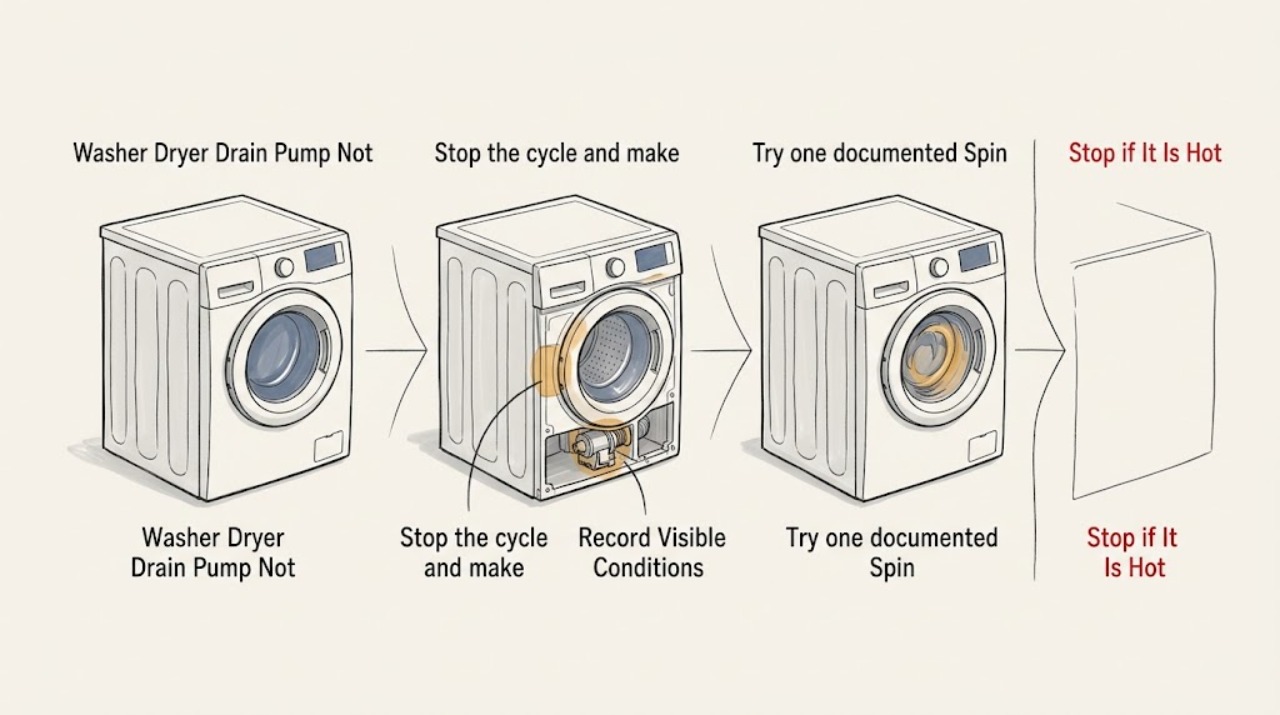
Work through in order
Diagnostic checks
Use only checks that match the exact appliance or system and its official guide.
-
Stop the cycle and make the appliance safe
Press Stop or Pause if the controls respond, wait for the drum to become completely still, and look for water on the floor, smoke, a burning or electrical odor, a hot plug, or water near electrical equipment. If the washer dryer is safe to approach and the floor is dry, switch it off and unplug it before any filter or hose inspection. Allow hot water to cool before handling.
Expected result: The drum is still moving, water is hot, the floor or plug is wet, a significant leak is present, or smoke, heat, or an electrical odor appears.
Next step: Stop. Keep clear, isolate power only from a safe, dry location, close the water supply only if safely reachable, and arrange qualified appliance or electrical help. Use emergency help for smoke or fire.
Stop if: Do not reach into a moving drum, touch wet electrical equipment, tip the appliance, or remove a filter while it is operating.
Why this matters
Why: The immediate risk is injury, scalding, shock, fire, or water damage, not an ordinary drain blockage.
-
Record the draining symptom and exact code
With the appliance stopped, record the Electrolux model or product number, washer-dryer configuration, selected programme, whether water remains in the drum, whether the drum turns, whether the pump hums or is silent, and every displayed code or flashing pattern. Do not replace a complete code with a remembered description.
Expected result: A code such as E20, E21, or C2 appears, the drum is full, the drum does not turn, an unusual pump noise is present, or no code appears.
Next step: Use the exact model manual and the matching checks below. Keep the exact display evidence for service if the symptom persists.
Stop if: Do not apply a code procedure from a different model or appliance type.
Why this matters
Why: Electrolux associates these code and symptom patterns with the drainage system, but the code does not by itself distinguish a filter, hose, household drain, pump, or electrical fault.
-
Try one documented Spin or Drain programme
If there is no leak, hot water, electrical hazard, or moving-drum risk, select the exact model's Spin/Drain, Drain, or equivalent programme once. Stay nearby and watch whether the machine pumps water out and whether the drum remains stable. If the programme cannot start because water is trapped or a door lock remains active, do not force the door.
Expected result: The washer dryer drains normally, drains only partly, hums without draining, remains silent, or refuses to start the drain programme.
Next step: If it drains, monitor one ordinary cycle. If not, switch it off and unplug it from a safe, dry position before checking only the visible hose and any approved filter.
Stop if: Do not run repeated drain programmes to force a blocked or noisy pump to work.
Why this matters
Why: A successful one-time drain points toward a temporary setting or restriction; partial, noisy, silent, or door-locked failures require checks of the visible path and the model-specific service boundary.
-
Inspect the visible drain hose and connection
From behind the appliance without dragging it, inspect the visible drain hose for a kink, twist, crushing, damage, or a low or incorrect routing. Check the sink trap or drain connection for an obvious blockage. Compare hose insertion and drain height with the exact installation instructions; Electrolux support gives a 60 to 100 cm range and no more than 10 cm insertion for the applicable guidance, but the model manual controls.
Expected result: The hose is kinked, crushed, damaged, inserted too far, routed outside the model range, connected to a blocked sink trap, or visibly clear and correctly installed.
Next step: Correct only a visible routing issue that can be done without moving a heavy, full appliance or disconnecting a wet hose. Use plumbing help for a blocked household drain; leave the washer dryer off for damage or an unresolved restriction.
Stop if: Do not pull the appliance across connected hoses, disconnect a pressurized or wet connection, probe a hidden blockage, or use chemical drain cleaner in the washer dryer.
Why this matters
Why: A restricted or incorrectly installed outlet can prevent the drain pump from moving water even when the pump motor is sound. A clear external path makes a filter, internal blockage, pump, control, or electrical issue more likely.
-
Separate a household drain blockage from an appliance blockage
If the installation allows a safe comparison without moving a full appliance, observe whether the sink or standpipe drains normally and whether water backs up at the household connection. Use only the model-documented test arrangement; do not hold a heavy, pressurized discharge hose loosely over an unstable container.
Expected result: The sink or standpipe backs up, the outlet is slow, the washer dryer drains when the household connection is cleared, or the household drain is normal but the appliance still retains water.
Next step: Have a plumber clear an external household blockage. If the household drain is normal and the appliance still will not drain, continue only with the exact model's accessible filter procedure or call appliance service.
Stop if: Do not create an improvised discharge setup, flood the room, or disconnect hoses around pooled water or electrical equipment.
Why this matters
Why: A household siphon or outlet restriction is more likely when other drainage is poor or the appliance works through a correctly arranged alternate outlet. Normal household drainage shifts suspicion back to the appliance's filter, pump path, pump, or controls.
-
Clean an accessible pump filter only under the model procedure
If the exact Electrolux model has a user-accessible pump filter and the appliance is off, unplugged, cool, and on a dry stable floor, place a shallow container and towels at the access point. Open the pump cover as the manual shows, release water gradually, remove the filter only after flow stops, and clear lint or visible objects. Rinse the filter, refit it fully, and close the cover to prevent leakage.
Expected result: The filter is blocked with lint or objects, the water is too hot or excessive to contain safely, the filter will not release, the filter is inaccessible, or the filter and recess are clear.
Next step: If the filter was safely cleared and the manual permits it, restore the cover and run one documented drain or rinse test only after checking for leaks. If the filter cannot be safely serviced or the symptom remains, call qualified appliance service.
Stop if: Never remove the filter while operating, clean it with hot water in the appliance, reach into the internal pump, or force a stuck cover.
Why this matters
Why: A blocked filter can restrict the pump and cause retained water or unusual noise. A hot, inaccessible, damaged, or stubborn filter is outside a safe general check; a clear filter does not prove the pump is healthy.
-
Use detergent and programme clues without adding chemicals
Note whether the drum contains excessive foam, whether too much or unsuitable detergent was used, and whether the selected programme intentionally ends with water in the tub. Follow the exact model and detergent instructions; do not add drain cleaner or more detergent. Use a model-documented drain or rinse programme only when the appliance is stable, cool, and leak-free.
Expected result: Heavy foam is present, the programme ends with water by design, or there is no excess foam and the programme should have drained.
Next step: Correct only the detergent type or programme selection described by the manual and monitor one cycle. For persistent retained water, do not keep operating while hoping foam clears; arrange service.
Stop if: Do not mix cleaning products, pour chemical drain opener into the appliance, or override a programme's safety state.
Why this matters
Why: Electrolux says excess foam can interfere with the level system and that some options finish with water in the tub. A normal programme with no foam and retained water points more strongly to a drain path or pump fault.
-
Stop at the internal pump and electrical diagnosis boundary
After the visible hose, household outlet, programme, and permitted filter checks, classify the pump response during the single test: hums but does not move water, runs with an empty path but the drum remains full, stays silent, leaks, or triggers a returning code. Keep the washer dryer off and do not remove the pump, impeller, wiring, cabinet panels, or control parts.
Expected result: The pump hums without draining, is silent when commanded, makes repeated unusual noise, leaks after filter refitting, or the same code returns after a clear path.
Next step: Arrange qualified appliance service and provide the model, code, water level, hose and filter findings, and pump sound. Use plumbing service as well if the external household drain is restricted.
Stop if: Do not dismantle the pump, test live terminals, bypass the door lock, or order a pump based only on a hum or a generic washer-dryer description.
Why this matters
Why: Electrolux lists a defective pump, internal blockage, and electrical malfunction as reasons to call a technician. These possibilities cannot be separated safely by an ordinary external inspection.
Use your observations
Decision map
Find the observation that best matches what you see, then follow the next safe action.
-
PATH 01Next step
What you see
The hose or sink connection was visibly restricted, and the washer dryer drains normally after a safe routing or household-drain correction.
Do this next
Monitor one ordinary programme. If the failure returns with a clear outlet, stop using the appliance and arrange service.
Why this path and its safety boundary
Why it matters: An external outlet restriction is more likely than a failed drain pump.
-
PATH 02Next step
What you see
The exact model has an accessible filter, it contains lint or an object, and one safe drain test succeeds after cool, unplugged cleaning.
Do this next
Refit the filter securely, check for leaks, and monitor one cycle. Persistent or returning failure needs appliance service.
Why this path and its safety boundary
Why it matters: A blocked filter or pump inlet is the likely immediate cause; this result does not establish that the pump itself is undamaged.
-
PATH 03Next step
What you see
The hose, household outlet, and permitted filter are clear, but the drum remains full and the pump hums or makes unusual noise.
Do this next
Leave the washer dryer off and arrange qualified service. Do not reach into or dismantle the pump.
Why this path and its safety boundary
Why it matters: An internal blockage or defective drain pump is more likely than a simple installation issue.
-
PATH 04Next step
What you see
The drain command is selected but the pump is silent, the display or controls are abnormal, or a code returns after a clear drain path.
Do this next
Record the exact code and response and request appliance service; do not test live wiring or repeatedly reset the machine.
Why this path and its safety boundary
Why it matters: An electrical, control, wiring, or pump fault is possible and cannot be confirmed safely from outside.
-
PATH 05Next step
What you see
A code such as E20, E21, or C2 appears together with retained water, a non-turning drum, or pump noise.
Do this next
Follow only the model-specific visible checks, then call service if the code returns or draining remains incomplete.
Why this path and its safety boundary
Why it matters: Electrolux uses these code patterns for a drainage-related fault, but the code still requires the exact model procedure to distinguish hose, filter, pump, and external drain causes.
-
PATH 06Next step
What you see
The filter is not accessible, the water is hot or too large to contain, the cover will not release, or a leak appears around the filter after refitting.
Do this next
Keep the appliance off, contain water only if safe, and arrange qualified appliance service.
Why this path and its safety boundary
Why it matters: The condition has crossed the safe user-maintenance boundary and forcing access could cause scalding, flooding, or damage.
-
PATH 07Next step
What you see
Water reaches electrical equipment, smoke or burning odor appears, the floor floods, the door cannot safely be released, or the machine repeatedly trips power.
Do this next
Keep clear, isolate power only from a safe dry location, close the water supply if safely reachable, and obtain qualified emergency, appliance, or electrical help.
Why this path and its safety boundary
Why it matters: Shock, fire, flooding, or injury risk overrides drain troubleshooting.
Helpful context
Understand the symptom
Drain-pump symptoms are not the same as a confirmed pump failure
A washer dryer may retain water because a hose or sink connection is restricted, the filter is blocked, the selected programme ends with water in the tub, or foam interferes with the level or drain system. A pump that hums without moving water, remains silent when a drain command is selected, or continues to fail after the visible path is clear needs diagnosis rather than a guessed replacement.
The filter is a model-dependent user check
Some Electrolux washer dryers provide a lower pump-filter access point; others require a different procedure. Use the exact E-Nr. manual. Never remove a filter while the appliance is operating, and do not clean the pump while the water is hot. Unplugging, containing the water, and avoiding wet electrical equipment are prerequisites for any permitted filter check.
A full tub changes the safety boundary
Standing water can be heavy and may be hot or contaminated with detergent. Do not tip or move a full appliance, reach into a pump, or disconnect a wet hose just to test a theory. If the water cannot be safely contained, the filter is inaccessible, or there is a leak near electrical equipment, stop and call service.
Safety boundary
Stop conditions
- Stop immediately for smoke, burning or electrical odor, a hot plug, repeated breaker trips, water near electrical equipment, a significant leak, flooding, or a door or drum that cannot be safely controlled. Keep clear and isolate power only from a safe, dry location.
- Do not remove a filter while the washer dryer is operating, handle hot water, tip or drag a full appliance, or create an improvised discharge arrangement.
- Do not open the cabinet, remove the internal drain pump, reach into the impeller or wiring, test live terminals, bypass the door lock, or force a stuck filter or cover.
- Use the exact Electrolux model manual for filter access, drain-hose routing, programme behavior, error-code meaning, and any reset. A pump replacement is conditional on diagnosis, not on a hum or retained water alone.
Only after diagnosis
Potential parts
- drain pump
Consider this only when the hose, household drain, programme, and accessible filter are clear and qualified diagnosis confirms that the drain pump is defective or cannot move water.
Electrolux pumps vary by model, product number, configuration, and revision. Confirm the exact model and diagnosis before selecting a part; internal replacement requires qualified service. - drain pump filter or filter housing
Consider this only when inspection confirms a damaged filter, seal, or housing that leaks or restricts drainage after correct cleaning and refitting.
Filter access and fit vary by Electrolux washer-dryer model. Do not substitute a generic filter or keep operating with a leaking housing. - internal drain hose
Consider this only when qualified service finds an internal hose blockage, split, collapse, or failed connection after the external hose and outlet are ruled out.
Internal hoses are model-specific and may require cabinet access. Confirm the exact product number and diagnosis before ordering or fitting.
When checks do not resolve it
Need a professional?
Request service for a persistent no-drain condition, a returning E20, E21, C2, or other exact model code, a pump that hums or is silent, a leaking or inaccessible filter, an internal blockage, or any electrical or water-safety symptom.
Safety scope: Keep the washer dryer off for a hot or uncontainable full tub, a leak near electrics, smoke, burning odor, repeated power trips, a pump that remains inaccessible, or a door or drum that cannot be safely controlled. Do not dismantle the pump or cabinet.
Common questions
FAQ
Does water left in an Electrolux washer dryer mean the drain pump must be replaced?
No. Electrolux also identifies a blocked filter, kinked or incorrectly installed hose, household drain blockage, excessive foam, programme selection, internal blockage, and electrical malfunction. Check only the model-specific visible path and accessible filter before service diagnoses a pump.
Can I clean the Electrolux washer dryer pump filter myself?
Only if the exact model provides user-accessible filter instructions and the appliance is off, unplugged, cool, stable, and safe to drain into a container. Electrolux says never to remove a filter while the machine is in use or clean the pump while water is hot. Internal pump work belongs to qualified service.
What do Electrolux E20, E21, or C2 drainage codes mean?
They indicate a drainage-related problem in the applicable Electrolux guidance, but do not identify one failed part by themselves. Check the exact model's hose position, household outlet, filter, and other permitted steps, then provide the complete code to service if it returns.
When should I stop using the washer dryer?
Stop for hot or uncontainable water, a leak near electrical equipment, smoke, a burning or electrical odor, repeated power trips, flooding, a pump or filter that cannot be safely accessed, or a door or drum that cannot be controlled. Keep clear and arrange qualified appliance, electrical, plumbing, or emergency help as appropriate.
Read the exact guide
Official sources
- How to clean and maintain your Electrolux washer dryerElectrolux · Electrolux washer dryers; the filter location and procedure may differ by model
- Washing machine does not drain, displays error code E20, E21 or C2, emits 2 beeps / 2 flashesElectrolux · Electrolux front-load, top-load, and washer-dryer models; exact installation instructions and model manual control
- Use and Care ManualElectrolux · The specific Electrolux washer model identified in the manual; use only as an example of model-specific instructions, not as universal fitment
- How to Drain a Washing Machine or Washer Dryer (Step-by-Step Guide)Electrolux · Electrolux washing machines and washer dryers; use the exact model manual for access and installation details
Community feedback
Share a repair observation
Share a plain-text repair observation. Accepted observations are published automatically; this page may take a moment to update.