
On this page
Start here
Quick answer
If an Electrolux washer dryer leaves water in the drum, stop the cycle and let hot water cool. Try the model's Spin/Drain program once, then disconnect the appliance from mains power before any filter or drain access. From the outside, check the visible drain hose for a kink or twist and check that the sink trap or outlet drains normally. If the exact model instructions permit it, drain into a shallow container, clean the user-accessible filter, and refit it firmly to prevent leaks. If the appliance still will not drain, makes unusual pump noise, shows a recurring code, leaks, or would require cabinet or pump disassembly, stop and arrange qualified appliance service; a blocked internal path, faulty pump, or electrical fault cannot be safely confirmed by repeated user tests.
Before you begin
Safety first
- This article covers ordinary visual checks, model-directed program selection, and a user-accessible filter procedure only when the exact manual permits it. Cabinet removal, pump disassembly, live electrical testing, and improvised plumbing work require qualified service.
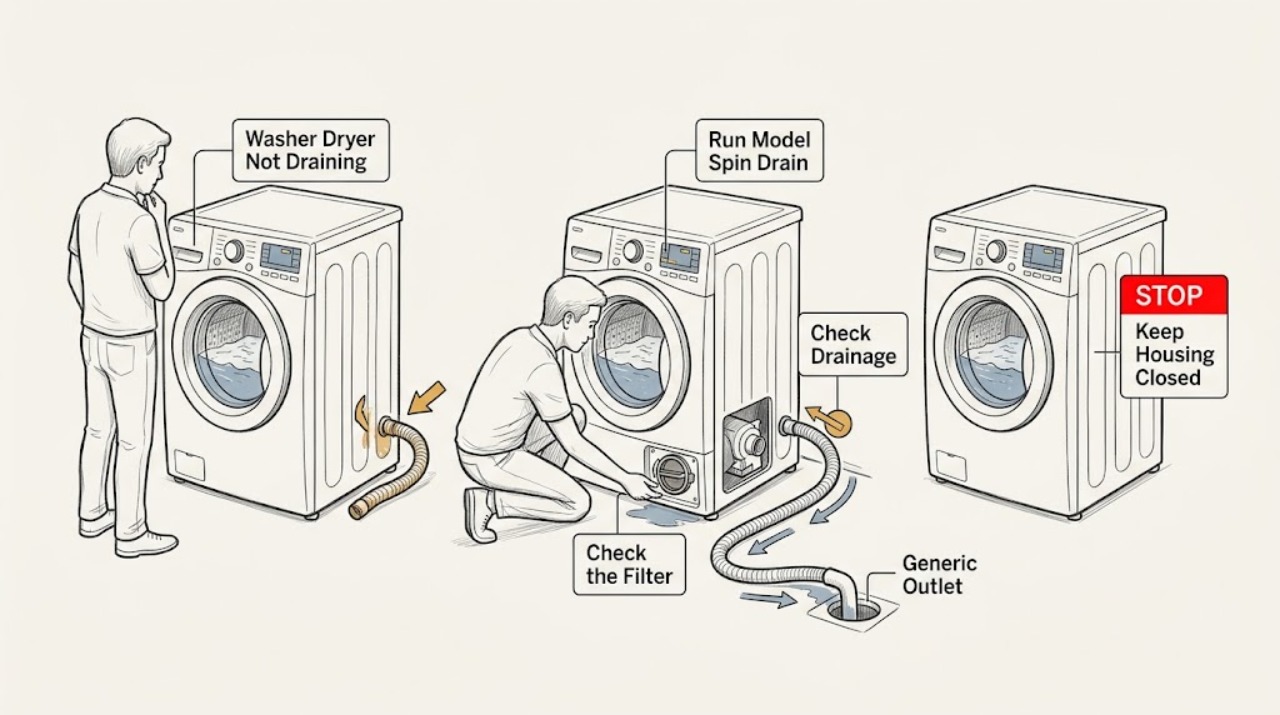
Work through in order
Diagnostic checks
Use only checks that match the exact appliance or system and its official guide.
-
Check 1
With the washer dryer closed and controls operated normally, select the model-directed Spin/Drain program once; do not start another wash with detergent or force the door.
Expected result: Note whether water leaves the drum, the drum spins, the pump is silent or unusually noisy, a code or flashing pattern appears, or the program stops with water still present.
Next step: If water remains or the program fails, stop the cycle, let hot water cool, and continue only with the external hose and outlet check; preserve the displayed code for service.
Stop if: Stop immediately for smoke, burning odor, a new leak, repeated electrical tripping, violent noise, or a door that will not safely release.
Why this matters
Why: A successful drain points toward a transient load, foam, or route condition, while failure with a code or unusual pump sound keeps a blockage or pump fault possible. This test does not prove that the pump is healthy.
-
Check 2
From a stable position, inspect the visible drain hose behind or beside the washer dryer for a kink, twist, crushing, or an improvised extension, and confirm that the sink trap or outlet is draining normally without pulling the appliance out or disconnecting a hose.
Expected result: The hose is visibly kinked or twisted; the sink or trap drains slowly; an extension join is suspect; or the visible route appears clear and the outlet drains normally.
Next step: Correct only an obvious external kink without moving the machine into an unsafe position, clear the sink outlet using its ordinary household access, and then run the model-directed drain test once; if the route is clear or the failure returns, stop for the filter decision or service.
Stop if: Do not unscrew inlet or drain connections, change hose height or insertion by guesswork, move a stacked or built-in appliance, or enter pooled water near electrical equipment.
Why this matters
Why: A restricted hose or blocked outlet can prevent flow even when the appliance is otherwise working. A clear external route shifts concern toward the filter, pump, internal path, or a control fault.
-
Check 3
Only if the exact Electrolux manual identifies a user-accessible pump filter, disconnect mains power, let the water cool, place a shallow tray and towels under the access point, and drain and clean the filter exactly as the instructions describe; do not remove a panel or disassemble the pump.
Expected result: The filter contains lint or an object; the recess is clear; the filter will not release; the filter cannot be identified safely; or water leaks after the filter is refitted.
Next step: Remove only loose debris the manual permits, rinse the filter, refit it fully in its guides, and run the model-directed Spin/Drain program once; if it will not release, leaks, or the problem remains, arrange qualified service.
Stop if: Do not reach into an unisolated appliance, force the filter, probe deep into the pump, bypass a cover, or continue if water cannot be contained safely.
Why this matters
Why: Lint or an object can restrict drainage, while a clear filter does not rule out a deeper blockage or pump issue. A seized access point or leak means the user-accessible procedure has reached its limit.
-
Check 4
Look through the door for unusually heavy foam and review whether excess detergent was used; after the appliance is safe and the filter check is complete, use only the model-directed rinse or hot cleaning cycle without adding detergent.
Expected result: Foam is heavy, the drum is clear but the drain works after a no-detergent cycle, or there is no foam and the drain failure persists.
Next step: Use the detergent amount and product specified for the exact model, record the before-and-after result, and do not repeat cycles indefinitely if water remains or the code returns.
Stop if: Do not add chemicals to force a drain, mix cleaning products, run repeated hot cycles with standing water, or continue when foam reaches the door seal or a leak appears.
Why this matters
Why: Electrolux notes that excess powder or foam can obstruct the level system and drain path. Improvement after a no-detergent cycle supports a foam or detergent contribution, but persistent failure points back to the route, filter, pump, or service diagnosis.
-
Check 5
Record the exact display code or flashes, the water level, the pump sound, the hose and filter findings, and whether switching the appliance off for the model-approved cool-down period changes the next drain attempt; do not reset repeatedly to hide the symptom.
Expected result: The code or failure clears once and stays cleared; the same code or no-drain condition returns; the pump remains silent or grinds; or the appliance trips power or leaks.
Next step: Provide the code, timeline, model details, photos of the external route and filter area, and the test results to qualified appliance service; leave the appliance disconnected if an electrical or leak symptom remains.
Stop if: Stop all troubleshooting for a recurring code, grinding or burning sound, exposed wiring, repeated trip, leak, or any request to open the cabinet or test live voltage.
Why this matters
Why: Electrolux associates E20, E21, and C2 with a drain problem and notes that a blocked pump may temporarily stop until it cools. A recurring code or abnormal sound is not a confirmed user-repair diagnosis and may indicate a defective pump, internal blockage, or electrical fault.
Use your observations
Decision map
Find the observation that best matches what you see, then follow the next safe action.
-
PATH 01Safety boundary
What you see
The model-directed Spin/Drain program removes the water and no code, leak, or unusual noise returns.
Do this next
Monitor the next normal load with the correct detergent amount and keep the hose, outlet, and filter observations in the appliance record.
Why this path and its safety boundary
Why it matters: The failure may have been transient or related to the load, foam, or drain route, but one successful cycle does not establish that the pump and internal path are fault-free.
Safety stop: Arrange service if the no-drain symptom, code, leak, or unusual pump sound returns.
-
PATH 02Safety boundary
What you see
A visible hose kink, blocked sink trap, or slow outlet is found.
Do this next
Restore only the obvious external condition within ordinary safe access, then run Spin/Drain once and compare the result.
Why this path and its safety boundary
Why it matters: The external drain route can explain the symptom without proving an appliance fault.
Safety stop: Stop if correcting the route requires moving a built-in or stacked appliance, disconnecting plumbing, or exposing water near electrical equipment.
-
PATH 03Safety boundary
What you see
The exact manual permits filter access and loose debris or lint is found in the user-accessible filter.
Do this next
Clean and refit the filter as directed, contain water, and run Spin/Drain once. Escalate if the filter leaks or drainage remains poor.
Why this path and its safety boundary
Why it matters: The debris is a plausible restriction, but correct refitting and a drain test are needed; it does not rule out a pump or internal blockage.
Safety stop: Do not force the filter, probe the pump, or run the appliance with a loose cover or leaking seal.
-
PATH 04Safety boundary
What you see
Heavy foam is visible or the problem follows a high-detergent load.
Do this next
Use the model-directed no-detergent cleaning or rinse procedure once, reduce detergent to the exact manual guidance, and observe the next drain result.
Why this path and its safety boundary
Why it matters: Excess foam may obstruct the level system or drainage, but persistent standing water still needs the same mechanical and service boundary checks.
Safety stop: Stop for a leak, recurring code, or water that remains after the permitted test; do not add improvised chemicals.
-
PATH 05Safety boundary
What you see
The route and permitted filter checks are clear, but water remains, a code returns, the pump is abnormal, or a leak appears.
Do this next
Disconnect the appliance if a leak or electrical symptom is present and arrange qualified appliance service with the recorded code, sound, water level, and checks.
Why this path and its safety boundary
Why it matters: Electrolux lists a faulty pump, internal blockage, and electrical malfunction among possible causes; the evidence is sufficient for service escalation but not for naming a replacement part.
Safety stop: Do not open the cabinet, remove the pump, test live circuits, or keep repeating cycles.
Helpful context
Understand the symptom
Start with water and power safety
Water left in the drum may be hot and the door may remain locked. Do not force the door or reach into a moving drum. Let hot water cool, keep towels and a shallow container ready, and disconnect the washer dryer from mains power before filter or drain access. The model manual controls the location and method of any user-accessible drain point.
Separate a blocked route from a machine fault
A visible hose kink, blocked sink trap, dirty filter, excess foam, internal blockage, or pump problem can all leave water behind. Work from the least invasive observation to the model-approved filter check. A single successful drain after clearing an obvious external obstruction is useful evidence; repeated failure, unusual pump noise, a leak, or a recurring code is a service boundary rather than a reason to open the cabinet.
Use the exact installation and care instructions
Electrolux specifies that drain-hose position and height follow the user manual or installation instructions. Do not guess at hose routing, disconnect pressurized connections, or substitute a pump or filter based only on appearance. Record the model identity, displayed code, water level, hose and filter observations, and the result of the one permitted test for the technician.
Safety boundary
Stop conditions
- Disconnect mains power before any filter or drain access, and let hot water cool before handling it.
- Do not force the door, reach into a moving drum, or enter pooled water near electrical equipment.
- Do not open the cabinet, remove or disassemble the pump, test live voltage, or disconnect plumbing by guesswork.
- Stop for smoke, burning odor, repeated electrical tripping, exposed wiring, a leak, grinding pump noise, or a recurring error code.
- Do not run repeated cycles with standing water or add improvised chemicals to force drainage.
When checks do not resolve it
Need a professional?
Arrange qualified appliance service when the washer dryer still will not drain after the model-directed Spin/Drain attempt and permitted external or filter checks, when the filter cannot be accessed safely, when the pump is unusually noisy or silent, when E20, E21, C2, or another code returns, or when there is a leak or electrical symptom. Keep the appliance disconnected when a leak, burning odor, or repeated power trip is present.
Safety scope: This article covers ordinary visual checks, model-directed program selection, and a user-accessible filter procedure only when the exact manual permits it. Cabinet removal, pump disassembly, live electrical testing, and improvised plumbing work require qualified service.
Common questions
FAQ
What should I check first when my Electrolux washer dryer will not drain?
Let hot water cool, try the model-directed Spin/Drain program once, and then disconnect mains power before filter access. Check the visible drain hose and sink outlet for an obvious restriction without moving the appliance unsafely.
Can I clean the drain filter myself?
Only when the exact model manual identifies a user-accessible filter. Disconnect power, cool the water, use a shallow container, clean only the parts the instructions identify, and refit the filter fully. Stop if access is seized, water cannot be contained, or a leak appears.
What do E20, E21, or C2 mean on an Electrolux washer dryer?
Electrolux uses these codes for a drain problem. Check the hose, outlet, and permitted filter procedure, record the code, and arrange service if it returns or the appliance still leaves water behind.
Can too much detergent stop the washer dryer from draining?
Yes. Electrolux notes that excess powder or foam can block the level system. Do not add more chemicals; use the model-directed no-detergent cleaning or rinse procedure once and escalate if standing water or the code persists.
When should I stop troubleshooting and call for appliance service?
Stop when the route and permitted filter checks do not restore drainage, the pump is unusually noisy or silent, a code returns, the filter leaks or cannot be accessed safely, or there is smoke, burning odor, repeated power tripping, or a leak. These symptoms can require diagnosis of an internal blockage, pump, or electrical fault.
Read the exact guide
Official sources
- Washing machine does not drain, displays error code E20, E21 or C2, emits 2 beeps / 2 flashesElectrolux UK · The opened article explicitly includes washer dryers and addresses no-drain symptoms with or without E20, E21, or C2.
- How to Drain a Washing Machine or Washer Dryer (Step-by-Step Guide)Electrolux UK · Applies explicitly to washing machines and washer dryers; the exact model manual controls the access method and any differences.
Community feedback
Share a repair observation
Share a plain-text repair observation. Accepted observations are published automatically; this page may take a moment to update.