
On this page
Start here
Quick answer
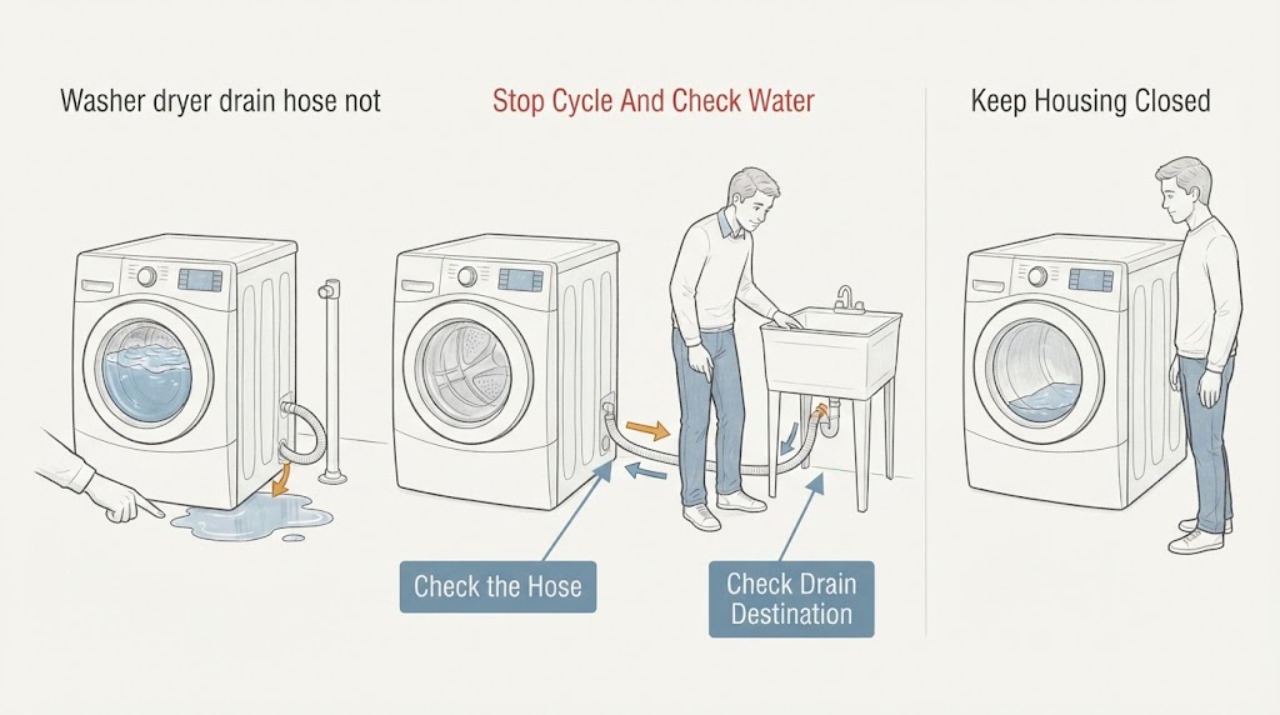
When a washer-dryer combo will not drain, start with the drain hose and its destination, not a guessed pump replacement. Stop the cycle, keep hands out of standing water, and follow the model manual before moving or disconnecting anything. With the appliance off, inspect the visible hose for a sharp bend, crushing behind the unit, sagging, blockage, or an end pushed too far into the standpipe; also check whether the standpipe or laundry sink itself is blocked. A hose that is straight and correctly routed but still leaves water in the tub shifts suspicion toward a pump filter, drain pump, internal hose, excessive suds, or control fault. Do not force the machine, reach into a wet pump area, open a filter without a drain plan, or run repeated cycles. If water is leaking onto the floor, the hose is damaged, the drum is full, the unit is hot or smoking, or a breaker trips, stop and arrange qualified appliance service.
Work through in order
Diagnostic checks
Use only checks that match the exact appliance or system and its official guide.
-
Check 1
Stop the cycle using the normal control, keep the appliance upright, and observe the floor, door or lid, hose connections, and remaining water without reaching into the tub or pump area; follow the manual's power-off instruction before any physical inspection.
Expected result: Record a full tub with no floor water, water leaking at a connection, water spreading on the floor, a hot or smoking appliance, or a breaker/power interruption.
Next step: Keep the appliance off and use the safety branch for any hazard. If water is contained, continue only with the visible hose and drain-destination checks in the manual.
Stop if: Do not touch electrical parts in water, open the pump filter, pull the appliance by its hose or door, or restart a machine that is hot, smoking, leaking heavily, or tripping protection.
Why this matters
Why: A full but contained tub permits a planned external hose check. Floor water, heat, smoke, electrical symptoms, or a damaged hose creates a safety and property-damage boundary rather than a routine unclogging task.
-
Check 2
With the unit off and only from a stable position, inspect the accessible drain hose behind or beside the washer-dryer for a sharp kink, crushing against the wall, sagging, visible blockage, a split, or an end pushed too deeply into the standpipe or sink.
Expected result: Record a straight undamaged hose, a kink or pinch that can be relieved without forcing the appliance, visible damage, a blocked hose end, or an inaccessible route.
Next step: Correct only a clearly accessible routing problem using the exact installation guide, leaving the prescribed air gap and support. Do not pull the combo unit across the floor or disconnect a hose full of water.
Stop if: Do not bend the hose sharply, force the appliance away from cabinetry, remove clamps, or continue if the hose is leaking, brittle, split, or under tension.
Why this matters
Why: A kink, pinch, sag, or blockage can restrict the pump's flow; a split or inaccessible hose needs service. A straight hose does not rule out a blocked standpipe, pump filter, internal hose, or pump.
-
Check 3
Inspect the visible standpipe, laundry sink, or approved drain opening without putting hands into it; check for standing water, overflow, a blocked opening, a hose sealed into the pipe, or a route that differs from the appliance installation instructions.
Expected result: Record a clear destination, a slow or blocked standpipe/sink, water backing up at the destination, an end submerged or sealed, or no safe access to the drain connection.
Next step: Clear only an obvious, reachable obstruction in the drain destination using normal household practice and the appliance manual. If the destination backs up or the hose connection must be detached, stop and arrange appliance or plumbing service.
Stop if: Do not pour drain chemicals into the washer hose, insert tools into the appliance, detach a water-filled hose, or work on a concealed drain without a safe isolation and spill plan.
Why this matters
Why: Good flow through the hose with backup at the standpipe or sink points to a household drain restriction. An improperly inserted or sealed hose can cause siphoning, backflow, or incomplete draining. An inaccessible destination needs service rather than blind hose removal.
-
Check 4
Use the exact washer-dryer model manual to compare the visible drain-hose height, insertion depth, U-shaped support, standpipe or sink connection, and any anti-siphon requirement; note whether the routing changed after installation, moving, or a recent plumbing change.
Expected result: Record routing that matches the manual, hose too high or too low, excessive insertion, missing support, a sealed connection, or a recent change followed by the drainage failure.
Next step: Restore only a clearly documented external route without pulling or tipping the appliance. If the required route cannot be achieved safely, request installation or appliance service.
Stop if: Do not drill, reroute concealed plumbing, seal the hose airtight, or dismantle the rear panel to reach the drain connection.
Why this matters
Why: A change that coincides with the failure makes installation or routing more likely. Whirlpool and LG both caution that hose height and routing affect drainage, but the exact limits differ by model; an internet measurement from another washer is not a fitment rule.
-
Check 5
Only if the owner's manual explicitly identifies a user-accessible pump filter or emergency drain, power the appliance off as directed, prepare a shallow container and towels, and inspect that access without opening an unlisted panel or tipping the machine.
Expected result: Record no filter access for the model, a filter with lint/coins or other debris, water that cannot be contained, a damaged filter cap, or a clear filter with the tub still not draining.
Next step: Follow the model manual for cleaning and reseating an accessible filter only. If the procedure is unclear, water remains trapped, or the issue persists, leave the appliance off and arrange qualified service.
Stop if: Do not open a filter under pressure, reach into moving or energized parts, remove an internal hose, use a sharp tool to clear a pump, or continue when water cannot be contained.
Why this matters
Why: A blocked accessible filter can restrict the pump path. No filter, uncontrolled water, damaged access, or a clear filter with continued failure shifts the issue toward the internal hose, pump, control, or another model-specific fault.
-
Check 6
Prepare a service request with the washer-dryer model, cycle and error indication if any, water level, hose route and destination, blockage or kink observations, recent installation/moving, detergent or suds history, filter access/result, and any leak or power symptom.
Expected result: Confirm that the record contains external observations and only model-documented user access, with no rear panel, pump, internal hose, wiring, or pressurized connection disturbed.
Next step: Keep the machine off when water remains or the fault repeats, and arrange qualified appliance service; request plumbing assistance when the household drain backs up independently of the appliance.
Stop if: Stop all homeowner troubleshooting when diagnosis requires tipping the unit, opening panels, disconnecting hoses, testing the pump, or working on wiring or concealed plumbing.
Why this matters
Why: This lets the technician separate an external hose or household drain restriction from a pump filter, internal hose, drain pump, suds, control, or installation problem and prevents a guessed part from replacing a routing fix.
Use your observations
Decision map
Find the observation that best matches what you see, then follow the next safe action.
-
PATH 01Next step
What you see
The visible hose is sharply bent, crushed behind the unit, sagging, or blocked, and the issue began after the appliance was moved or installed.
Do this next
Restore the model-documented route only if it can be done without moving or stressing the appliance. Run one approved test; if water remains or the hose is damaged, request service.
-
PATH 02Next step
What you see
The hose appears to discharge but the standpipe or laundry sink backs up, overflows, or drains slowly, or another fixture shows the same restriction.
Do this next
Stop the cycle and arrange plumbing service if the destination is not cleared by a safe, obvious household check. Do not detach a water-filled hose or use chemical drain cleaner through the appliance.
-
PATH 03Next step
What you see
The hose is intact but is too high/low for the model, inserted too far, sealed into the standpipe, missing its support, or routed differently from the installation guide.
Do this next
Follow the exact manual to correct only accessible external routing. Arrange appliance or plumbing service when the required route cannot be achieved without disassembly.
-
PATH 04Next step
What you see
The hose and destination are clear and correctly routed, but the tub remains full; the model has an accessible filter that is blocked, or the filter is clear and draining still fails.
Do this next
Use the model manual only for an accessible filter procedure with power off and water containment. If access is unclear or the problem persists, request qualified appliance diagnosis.
-
PATH 05Next step
What you see
The hose is clear, the machine drains partially, the load is unusually wet, or there was excessive detergent/suds or a low-spin/incorrect cycle.
Do this next
Follow the detergent and cycle guidance for the exact model and avoid repeated full cycles while water remains. Request service if the drain failure recurs with a normal empty test.
-
PATH 06Next step
What you see
The hose is split, water is spreading on the floor, the appliance is hot or smoking, a breaker trips, or water is near an electrical connection.
Do this next
Stop the appliance, keep clear, and arrange qualified appliance/electrical service. Use appropriate emergency help for smoke, fire, shock, or immediate flooding.
Helpful context
Understand the symptom
The hose is only one part of the drain path
A washer-dryer drains by moving water from the tub through an internal pump path, the external drain hose, and a standpipe, laundry tub, or other approved drain. Whirlpool notes that a wrong hose length or height, a kink, a clogged drainpipe, or a clogged filter can all leave water behind. This is why the most useful first check is where the hose exits and where the water is supposed to go, followed by a model-specific decision about the pump filter.
Routing can cause backflow or prevent pumping
The hose needs a supported route and the manufacturer's specified insertion and height. Whirlpool warns against excessive insertion into the standpipe, sealing the hose into the drain, and kinks or clogs; LG similarly lists a hose that is bent, pinched, blocked, or too high as a reason water may not drain smoothly. Compare the visible route with the exact installation instructions rather than applying a universal measurement to every combo unit.
When a clear hose points inside the machine
If the external hose is open, supported, and routed correctly but the tub remains full, the restriction may be in the pump filter, internal hose, drain pump, or control sequence. Whirlpool says some front-load models have an accessible drain-pump filter while others do not, and recommends the owner's manual for the model-specific location and procedure. Do not open a filter or tip the appliance without a controlled way to catch water and the required power-off instructions; a technician is the safe boundary when access is unclear.
Safety boundary
Stop conditions
- Do not reach into standing water or an energized machine, tip or drag the washer-dryer, open rear panels, remove internal hoses, or test the pump or wiring as a homeowner.
- Do not detach a water-filled hose without the model's power-off, isolation, and spill instructions; do not use chemical drain cleaner through the appliance, seal the hose into a standpipe, or force a kinked/damaged hose.
- Stop immediately for uncontrolled water, a split hose, floor or wall damage, smoke, burning odor, heat, shock, water near electrical connections, or a tripped breaker; keep the appliance off and arrange qualified help.
Only after diagnosis
Potential parts
- washer-dryer drain hose
Consider this only when the visible hose is split, crushed, permanently deformed, or a technician confirms it is the restriction and identifies the correct replacement route.
Confirm the exact model, hose ends, routing, support, insertion requirements, and manufacturer-approved fit before replacement. - drain pump filter
Consider this only when the exact model includes an accessible or replaceable filter and inspection or qualified diagnosis confirms damage or blockage that cleaning cannot resolve.
Filter access, presence, cap design, and fit vary by model; verify against the owner's manual and manufacturer information. - washer-dryer drain pump
Consider this only after the hose, drain destination, installation route, and accessible filter are clear and qualified diagnosis confirms the pump is not moving water.
Confirm the exact model, pump configuration, electrical connector, mounting, and manufacturer-approved compatibility before selecting a part.
When checks do not resolve it
Need a professional?
Arrange qualified appliance service when the drain hose is damaged or inaccessible, the external route and drain destination are clear but the tub remains full, the model's pump filter is absent or inaccessible, a filter check does not restore draining, or diagnosis requires tipping the combo unit, opening panels, disconnecting internal hoses, or testing the drain pump. Arrange plumbing service when the standpipe or laundry sink backs up independently. Stop immediately for floor flooding, water near electrical parts, smoke, burning odor, heat, shock, or repeated breaker trips.
Have this ready
- Provide the exact model, cycle/error indication, remaining water, hose route and destination, recent installation or moving, visible kink/blockage/damage, filter access/result, detergent/suds history, and any leak, heat, smoke, odor, or breaker symptoms.
Common questions
FAQ
Why is my washer-dryer drain hose not draining?
The hose may be kinked, crushed, blocked, too high, inserted incorrectly, or routed into a blocked standpipe or sink. If the external path is clear, the pump filter, internal hose, pump, suds, cycle, or control may be involved.
How do I check the drain hose safely?
Stop the cycle, follow the model's power-off instructions, and inspect the visible hose for bends, crushing, damage, blockage, and incorrect routing. Do not drag or tip the machine or disconnect a water-filled hose without the manual's procedure and a spill plan.
Can the standpipe be the reason the washer will not drain?
Yes. A blocked or slow standpipe can back water up even when the washer hose is clear. Check the visible destination without reaching into it; if it backs up or another fixture has the same restriction, arrange plumbing service.
Should I clean the washer pump filter?
Only if the exact model manual says the filter is user-accessible and gives a power-off, water-containment procedure. Some models have no accessible filter. Stop if water cannot be contained or the access is unclear and request service.
When should I call for washer-dryer service?
Call when the hose and drain destination are clear but water remains, the hose is damaged or inaccessible, the filter procedure is unavailable or does not help, or diagnosis requires opening panels, tipping the unit, disconnecting internal hoses, or testing the pump. Stop immediately for flooding, smoke, heat, shock, or a tripped breaker.
Read the exact guide
Official sources
- LG washing machine - Whys is water not draining from my washer?LG USA Support · LG washer guidance used for general external hose diagnosis; the exact washer-dryer model manual controls any removal or internal procedure.
- Washer Not Draining or Spinning? Troubleshooting GuideWhirlpool Product Help · Whirlpool troubleshooting guidance used for general washer-dryer drainage triage; filter access and limits vary by exact model.
- Why is My Washing Machine Not Draining?Whirlpool · Whirlpool consumer explanation used for general mechanism and escalation; exact washer-dryer configuration governs accessible parts.
- Not Draining - WasherWhirlpool Product Help · Whirlpool washer guidance used for general drain-hose reasoning; exact washer-dryer combo instructions govern model-specific dimensions and procedures.
Community feedback
Share a repair observation
Share a plain-text repair observation. Accepted observations are published automatically; this page may take a moment to update.