
On this page
Start here
Quick answer
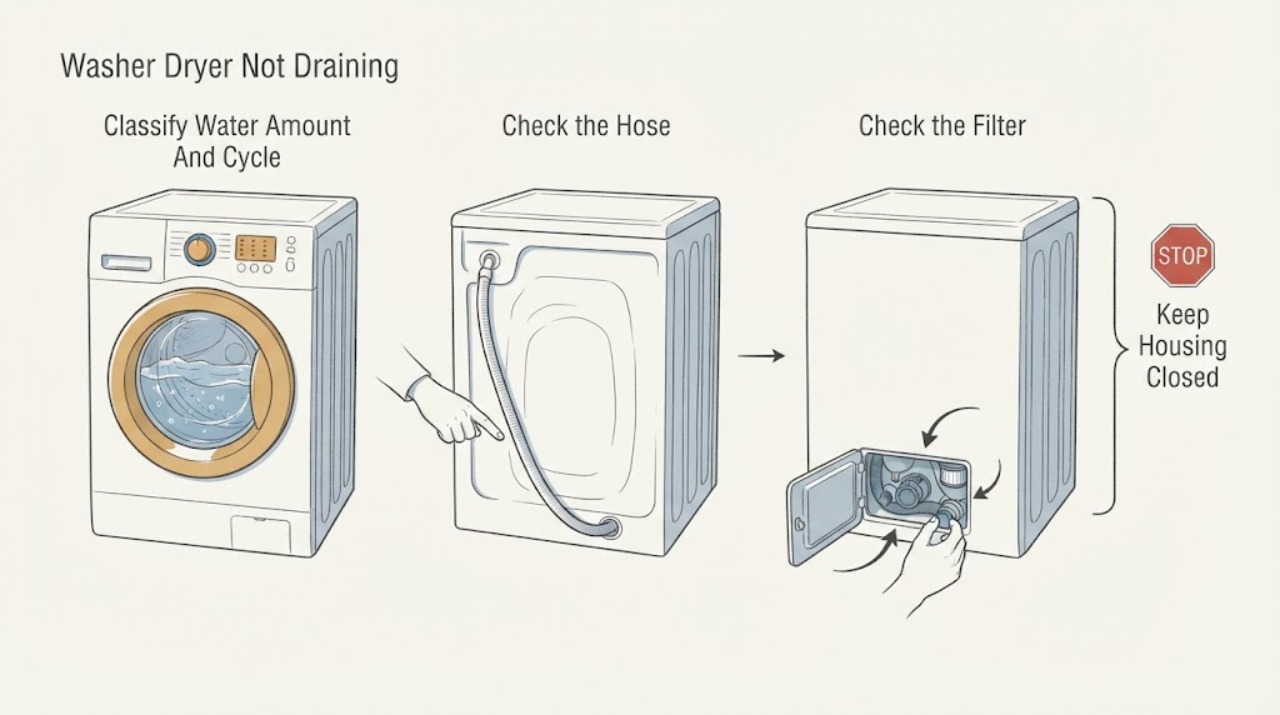
If substantial water remains in a washer-dryer after the wash, stop the appliance and keep it away from standing water until the cause is known. A small amount of moisture or condensation can be normal on some all-in-one models, but a full drum, slow drain, wet laundry, or water present before the next cycle points to a drainage problem. From a dry, safe position, check whether the selected cycle includes a drain or spin step, then inspect the visible drain hose for a kink, compression, or backflow and the home drain for overflow. If the exact manual identifies an accessible pump filter or residual-water hose, drain the tub into a suitable container and clean or reseat that part only as instructed; the water may be hot. Do not force the door, reach into standing water, remove a hidden panel, or repeatedly run cycles. If the filter and hose are clear but water remains, the pump, internal hose, control, or household drain needs qualified diagnosis.
Before you begin
Safety first
- This article supports only ordinary-access observation and exact-manual maintenance with contained water. Do not force a locked door, move the combo, open cabinets, reach into the pump, loosen pressurized connections, bypass a lock, or operate a leaking unit near electricity.
Work through in order
Diagnostic checks
Use only checks that match the exact appliance or system and its official guide.
-
Check 1
With the washer-dryer off and the area dry, observe the remaining water from outside the drum and record the completed or selected cycle; do not force the door or place hands into standing water.
Expected result: Record whether there is only a few droplets after drying, a shallow pool after a completed cycle, a substantial amount covering the drum bottom, water before starting a cycle, or saturated clothes with an otherwise empty drum.
Next step: Use the exact manual to confirm whether the selected program includes drain and spin, then continue with safe external checks. Keep the appliance off if water is substantial, the door is locked, or the cause is uncertain.
Stop if: Do not pry open a locked door, scoop water while the unit is energized, or run repeated cycles to see whether the level changes.
Why this matters
Why: A small amount after drying may be condensation or model-specific moisture, while a substantial pool after washing indicates incomplete drainage. Water present before starting can indicate drain backflow or, if it keeps entering while idle, an inlet-side fault; wet clothes with no pool can reflect incomplete spin or an unbalanced load.
-
Check 2
From ordinary safe access, inspect the visible drain hose and its connection to the household standpipe, sink, or drain for kinks, compression, a split, a hose that has slipped, an airtight fit, or water backing up; do not pull the combo forward.
Expected result: Record whether the hose is bent or pinched behind the unit, whether the household drain overflows when draining, whether water returns to the drum while idle, or whether the visible route is clear and dry.
Next step: If the hose can be straightened without moving or disconnecting the appliance, restore only the manual-approved routing; request appliance or plumbing service for a damaged hose, blocked drain, or any leak that persists.
Stop if: Do not move a stacked or tight-fitting combo, disconnect a hose with water in the tub, use drain chemicals, or reach behind the appliance.
Why this matters
Why: A kink or compression can restrict pump flow. Overflow or backflow at the home drain points toward a plumbing blockage or drain-hose routing issue rather than a failed pump; a clear external route with water remaining shifts attention to the filter, pump, internal hose, or controls.
-
Check 3
Check the exact owner's manual for a user-accessible drain-pump filter or residual-water hose; open the service cover only when the machine is off, the floor can safely receive water, and the manual describes the procedure for this model.
Expected result: Record whether the model has a visible filter and residual hose, whether the tub water is safely drained into a stable container, and whether lint, coins, fabric, or other debris is present at the filter or filter opening.
Next step: If the manual permits it, drain residual water first, clean only visible filter debris with the specified method, and fully reseat the cap, hose, filter, and cover. If any step differs from the manual or the filter is damaged, stop and arrange service.
Stop if: Do not open a pump cap with uncontained or potentially hot water, use tools to force it, reach into a running pump, or leave a cap, hose, or filter partly seated.
Why this matters
Why: Foreign objects or a clogged filter can prevent draining. Hot water, a large remaining volume, a missing cap, a damaged filter, or a service cover that is not clearly user-accessible creates a burn, flood, or damage risk and is not a routine cleaning decision.
-
Check 4
After any permitted filter or hose maintenance is complete and the floor is dry, use only the exact manual's empty drain, rinse-and-spin, or spin-only check; stay outside the splash zone and stop at the first leak or unsafe symptom.
Expected result: Record whether the pump hums and water exits normally, the pump is silent, water drains slowly, the drum spins without draining, or the leak returns at the filter, hose, door, or underneath.
Next step: Stop the check when the observed result is not normal, document the sound and leak location, and request qualified appliance service; do not interpret one successful drain as proof that the unit is safe under a full load.
Stop if: Do not repeat the test unattended, bypass a door lock, put hands near the pump or drum, or continue if water reaches electrical parts or the floor.
Why this matters
Why: Normal pumping after clearing debris supports a restriction or reseating issue. A hum without flow can indicate a remaining blockage or pump problem; silence, a recurring leak, no drain with a clear filter, or water from underneath requires service rather than more cycles. A spin-only result also depends on model controls and load balance.
-
Check 5
After the tub is safely empty, leave the appliance off long enough to observe whether water returns to the drum, and inspect the visible drain path without starting another wash; close the inlet valve only if water enters while idle and the exact manual or service guidance supports that safe action.
Expected result: Record whether the drum stays empty, water slowly returns from the drain, water enters from the supply while the unit is off, or the source cannot be distinguished.
Next step: For drain backflow, arrange plumbing or appliance diagnosis; for water entering while idle, stop use and have the inlet side inspected. Keep the unit off when the source is uncertain.
Stop if: Do not disconnect supply hoses, open the inlet valve housing, or leave an unattended appliance connected when water continues entering the drum.
Why this matters
Why: Water returning from a drain points toward backflow, an obstruction, or hose routing. Water entering while powered off can indicate an inlet valve or supply issue rather than a drain pump, and continuing water can create a flood risk even after the original drain problem is cleared.
-
Check 6
Record the exact model and serial from an ordinary-access label, any displayed drain error, the cycle selected, water level, pump sound, filter contents, drain-hose condition, and the result of any manual-approved check; do not open panels to find the label.
Expected result: Classify the outcome as cleared after approved filter or hose maintenance, drains but does not spin, spins but does not drain, returns water while idle, remains blocked with a clear external path, or leaks from underneath.
Next step: Provide the record and photos to qualified appliance service; involve a plumber when the household drain or supply is implicated, and keep the combo out of service until the water path is confirmed clear and safe.
Stop if: Do not order a drain pump, filter, hose, control, or seal from a generic symptom, and do not resume normal loads while substantial water remains.
Why this matters
Why: These patterns separate a simple restriction or load-cycle issue from a pump, control, internal hose, inlet, or household drain fault. An error code is a symptom and model-specific clue, not permission to replace the pump or bypass a safety control.
Use your observations
Decision map
Find the observation that best matches what you see, then follow the next safe action.
-
PATH 01Safety boundary
What you see
Only a small amount of moisture is seen after a drying phase, the drum is not substantially filled, and there is no floor water or slow-drain symptom.
Do this next
Check the exact combo manual for normal moisture guidance and monitor for water remaining after a wash or returning while idle; arrange service if the amount increases or escapes the cabinet.
Why this path and its safety boundary
Why it matters: Some all-in-one washer-dryers retain moisture or condensation after drying; this is different from a wash-cycle drain failure.
Safety stop: Do not dismiss a significant pool, water on the floor, or repeated slow draining as normal condensation.
-
PATH 02Safety boundary
What you see
Water remains after washing, the accessible pump filter contains lint or objects, or a residual-drain hose or pump cap was recently serviced and may not be fully closed.
Do this next
Follow the exact manual to drain into a container, clear only the user-accessible filter, and reseat every cap and cover; request service if the filter is damaged or the problem returns.
Why this path and its safety boundary
Why it matters: A drain restriction or incomplete filter reassembly is more likely than a door or inlet fault, but the remaining water may be hot and the cap must seal correctly.
Safety stop: Do not force the cap, open it without containing water, or run the machine with a missing or loose filter seal.
-
PATH 03Safety boundary
What you see
The filter is clear, the pump appears to run, but water drains slowly, backs up, or overflows at the standpipe, sink, or household drain.
Do this next
Restore only visible routing that can be corrected safely without moving the appliance and arrange plumbing or appliance service to clear or inspect the drain path.
Why this path and its safety boundary
Why it matters: A kinked or compressed hose, incorrect routing, or a blocked home drain is more likely than a failed pump; water can return to the drum when the drain path cannot accept discharge.
Safety stop: Do not push the hose deeper, make an airtight drain connection, use chemicals, or pull a stacked combo forward.
-
PATH 04Safety boundary
What you see
The accessible filter and visible hose are clear, but the pump is silent, hums without moving water, the drum remains full, or the unit repeatedly shows a drain error.
Do this next
Keep the combo off, drain residual water only by the exact safe manual procedure, and request qualified appliance diagnosis rather than replacing a pump by guesswork.
Why this path and its safety boundary
Why it matters: A drain pump, internal hose, wiring, sensor, door-lock state, or control problem remains possible; the visible checks cannot identify which component has failed.
Safety stop: Do not open the cabinet, probe wiring, reach into the pump, bypass a lock, or apply power to a removed component.
-
PATH 05Safety boundary
What you see
The drum is emptied but water returns from the drain or enters while the combo is off before the next cycle.
Do this next
Keep the appliance out of service, arrange plumbing or appliance inspection, and close the inlet supply only when the exact manual and conditions make that safe.
Why this path and its safety boundary
Why it matters: Drain backflow or a water-inlet valve or supply issue is more likely than an ordinary completed-cycle residual; continued filling can create a flood even when the pump is repaired.
Safety stop: Do not leave the unit unattended while it continues filling, disconnect hoses, or open the inlet assembly.
Helpful context
Understand the symptom
First separate normal moisture from a blocked drain
Some combo designs use water during drying, and LG notes that vapor can condense in the drum after drying. A small amount of moisture on the inner drum is not the same as a significant pool that remains after a wash, water that returns before the next cycle, or clothes that are saturated because the unit never completed draining. Record how much water remains, whether it is in the drum or only on the door, and which cycle was selected before opening any service access.
Use cycle timing to narrow the path
A cycle that was wash-only may not include the same drain or spin sequence as a rinse-and-spin or spin-only program on every model. If the machine filled normally but stopped with water, a clogged filter, pump, compressed hose, blocked household drain, or control interruption is more plausible than an inlet problem. If water flows back into an idle drum, an improperly routed or obstructed drain can be involved; if the drum is empty but clothes are very wet, an unbalanced load or incomplete spin can leave water in fabric without a full-drain failure.
Drain residual water before opening a filter
An accessible pump filter can contain the remaining tub water, and manufacturer instructions warn that water may be hot and can spill onto the floor. Use the exact model manual to locate any service cover, residual-water hose, cap, and filter. Prepare a stable container and protect the floor before opening anything; if the machine is hard-wired, wet, damaged, packed into a stack, or lacks a clearly described user-accessible procedure, stop and arrange service instead.
Safety boundary
Stop conditions
- Do not force the door or reach into standing water; do not touch a plug, breaker, wiring, or the appliance while water is near electrical connections.
- Do not open a pump filter, residual-water hose, or service cover unless the exact manual identifies it as accessible, the machine is off and cool, and water can be contained safely.
- Do not move, tilt, stack-adjust, or pull the washer-dryer forward, and do not open rear or cabinet panels to chase a hidden drain fault.
- Do not run repeated, unattended, or full-load tests for an unexplained drain problem, bypass a door lock, or apply power to exposed components.
- Do not use drain chemicals or force a hose, cap, filter, pump, or control; seek urgent help for flooding, smoke, arcing, burning odor, or electrical contact with water.
Only after diagnosis
Potential parts
- drain pump filter, cap, or residual-water hose
Consider this category only when the exact model has the part, inspection finds damage or a failed seal, and the leak or restriction remains after correct cleaning and reassembly.
Confirm the exact model, filter design, cap, hose, and seal through the manual or qualified service; do not use a loose universal cap or operate with an incomplete seal. - drain pump or internal drain hose
Consider only after the filter, visible drain hose, household drain, and safe cycle behavior point to a pump or internal hose fault and qualified diagnosis confirms it.
Match the exact model and combo layout; do not infer pump fit from a sound, error message, or exterior appearance alone. - door lock, control, sensor, or inlet valve
These are conditional diagnostic categories only when the unit's water level, door state, idle filling, or repeated drain behavior indicates a control, sensor, lock, or inlet-side issue after the drain path is checked.
A qualified technician must test the exact model and wiring before ordering or replacing any electrical or valve component.
When checks do not resolve it
Need a professional?
Arrange qualified appliance service when a substantial amount of water remains after washing, the pump filter and visible hose are clear but the machine will not drain, the pump is silent or only hums, water comes from underneath, the door remains locked with water inside, a drain error repeats, or water returns or enters while idle. A plumber may be needed when the standpipe, sink, or household drain backs up. Provide the exact model and serial if safely visible, combo configuration, cycle and timing, water level, filter and hose observations, error display, pump sound, photos, and any recent maintenance.
Safety scope: This article supports only ordinary-access observation and exact-manual maintenance with contained water. Do not force a locked door, move the combo, open cabinets, reach into the pump, loosen pressurized connections, bypass a lock, or operate a leaking unit near electricity.
Common questions
FAQ
Is a little water in a washer-dryer drum always a drain failure?
Not always. Some all-in-one models can retain a small amount of moisture or condensation after drying, but a substantial pool after washing, slow drainage, saturated laundry, water before the next cycle, or water on the floor is a different problem. Check the exact model manual and the amount and timing.
Can I open the drain-pump filter when water remains?
Only if the exact manual identifies the filter and residual-water hose as user-accessible, the appliance is off and cool, and you can safely contain the water. Remaining water may be hot and may spill quickly. If the combo is wet, stacked, hard-wired, or the procedure is unclear, request service.
Why does water return to the washer after it drains?
A blocked household drain, incorrect drain-hose routing, or drain backflow can return water to the drum. Water that enters while the machine is off can instead indicate an inlet-side fault. Keep the unit off and have the drain or inlet path inspected rather than repeatedly draining it.
What if the drain pump hums but water stays in the drum?
A humming pump does not prove that water is moving. A remaining filter or hose restriction, pump fault, or blocked household drain is possible. Check only the visible path and exact-manual filter procedure; stop and request qualified diagnosis if the drum remains full or water reaches the floor.
Can an unbalanced load leave clothes wet even when the washer drains?
Yes. If the drum is empty but clothes are very wet, an unbalanced or unsuitable load can prevent a full spin, while excessive suds can also interfere with rinsing and draining. This does not explain a substantial pool of water; use the model's approved spin or cycle guidance and request service if draining itself fails.
Read the exact guide
Official sources
- [LG Front Load Washer] Water remains in the drumLG Electronics · LG support guidance covering front-load washers and washer-dryer combos; exact model instructions control a particular appliance.
- LG Washer Dryer Combo - Troubleshooting Poor Drying PerformanceLG Electronics · LG guidance for washer-dryer combo drying systems; it supports the distinction between combo moisture and a wash-cycle drain failure.
- LG Washer - Troubleshooting Washer Does Not Drain or Spin (Clothes Too Wet)LG Electronics · LG support decision flow listed for washers and washer-dryer combos; cycle controls and hose requirements vary by model.
- [LG Washing Machine] Water Not Draining (OE Error)LG Electronics · LG support guidance for washer models and related washer-dryer combos; use the exact manual before opening a service cover or filter.
- LG Washer - Why Isn't My Washer DrainingLG Electronics · LG washer support guidance also categorized for washer-dryer combos; the exact model manual controls whether a filter and residual hose are user-accessible.
Community feedback
Share a repair observation
Share a plain-text repair observation. Accepted observations are published automatically; this page may take a moment to update.