
On this page
Start here
Quick answer
A washer or washer-dryer that will not drain may have a blocked pump filter, an object in the pump or hose, a kinked or frozen drain hose, a blocked household drain, excess suds, or a pump that is not receiving power or cannot move water. Stop the cycle and disconnect power before opening an access cover. Drain residual water into a shallow container using the appliance's documented emergency hose if fitted, clean the accessible pump filter, check the external hose and standpipe, then run one attended drain or spin test. If the pump only hums without moving water, makes a harsh noise, does not run, water remains after the filter and hose checks, or the machine leaks, leave it out of service and arrange qualified appliance repair.
Before you begin
Safety first
- A technician can safely inspect the pump, impeller, internal hoses, wiring, controls, door or water-level interlocks, and drain system. Keep homeowner work to power isolation, controlled residual-water draining, accessible filter cleaning, visible hose checks, and one documented test.
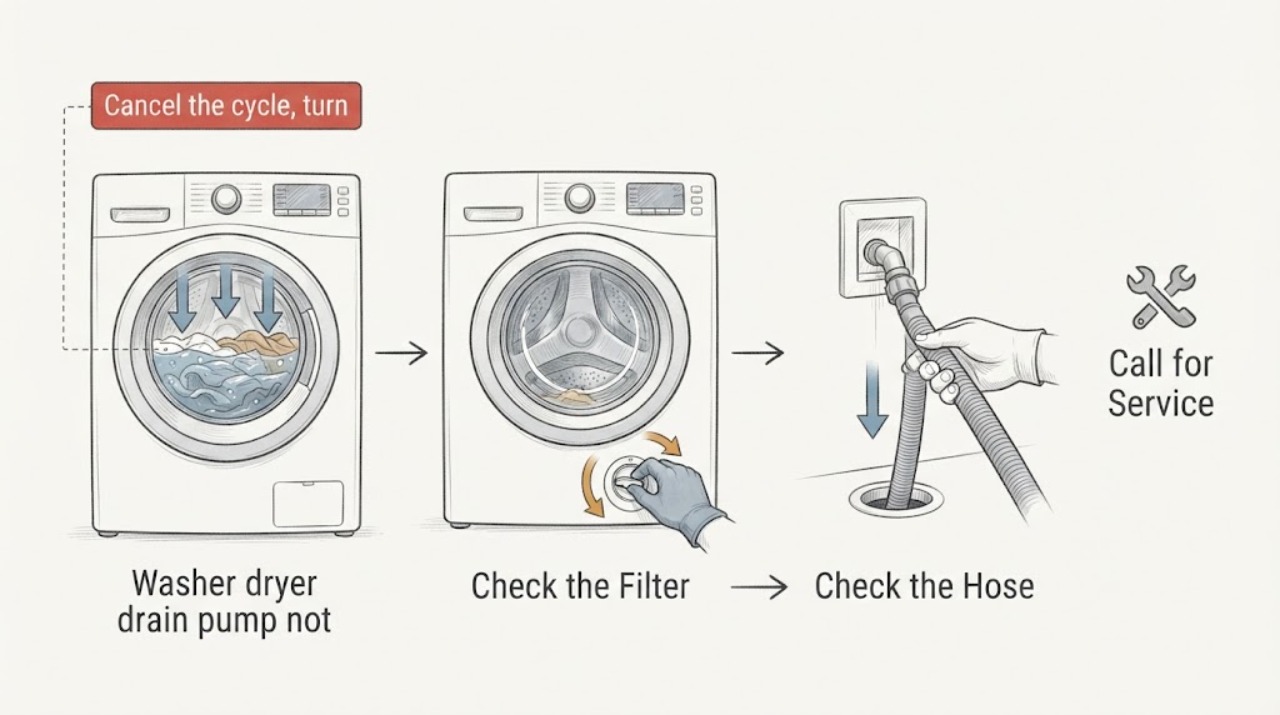
Work through in order
Diagnostic checks
Use only checks that match the exact appliance or system and its official guide.
-
Check 1
Cancel the cycle, turn the washer or combo off, and disconnect power before opening any lower access cover; close water supplies if the appliance or its manual calls for that during service.
Expected result: The drum contains visible water, the water may be hot, the floor is wet, the machine is still running, or the appliance is safely stopped and dry.
Next step: If water is hot, spreading, near electrical equipment, or cannot be contained, leave the machine off and arrange service. Otherwise prepare a shallow pan and towels before opening the service cover.
Why this matters
Why: Standing or hot water can spill or burn, and moving parts or energized components are not safe for a filter check. A stopped dry appliance permits only the model-documented residual-water procedure.
-
Check 2
Use the appliance's documented residual-water hose, if fitted, to drain into a shallow container, then remove and inspect the accessible pump filter only after flow is controlled.
Expected result: The residual hose releases substantial water, the filter contains lint or objects, the filter is clear, or no water comes out through the documented drain path.
Next step: Clean the filter and its opening with a soft brush or sponge, then reinstall the filter and hose cap securely. If the filter cannot be removed, is damaged, or water remains uncontrolled, stop and call appliance service.
Why this matters
Why: Water at the filter confirms that the tub was not empty and that opening the cap without preparation could have flooded the floor. Debris supports a filter restriction; a clear or dry filter shifts attention to the hose, pump, control, or a frozen path.
-
Check 3
With power still off, inspect the external drain hose from the rear and its connection to the standpipe or laundry sink for kinks, compression against the wall, cracks, a submerged end, or a loose connection.
Expected result: The hose is bent or compressed, visibly cracked, displaced from the drain, frozen, or routed freely without visible damage.
Next step: Restore only a safe, visible hose route as the manual permits; do not pull the appliance over a wet floor or replace a damaged hose without matching the model. If freezing is suspected, follow the manual's thawing guidance and do not use boiling water.
Why this matters
Why: A kink, compression, frozen section, or loose drain connection can prevent or spill drainage without a pump failure. A free external hose makes a filter, internal hose, pump, control, or household drain problem more likely.
-
Check 4
After the filter and hose are reassembled, separate the drain hose from the household drain only as the model instructions allow, secure it over a suitable container or laundry sink, and run one attended drain or spin test.
Expected result: Water flows strongly from the hose, water only backs up at the standpipe or sink, water trickles, or no water leaves the hose.
Next step: Stop the test if the container approaches full or water spills. Have a plumber clear the household drain when appliance-side flow is good; arrange appliance service when flow is weak or absent after the accessible filter and hose checks.
Why this matters
Why: Strong appliance-side flow with household backup points toward a blocked or undersized external drain. Trickle or no flow keeps the pump filter, pump, internal hose, impeller, or control path in focus.
-
Check 5
During the single attended drain command, listen from outside the cabinet for a normal pump hum, repeated clicking, harsh grinding, or complete silence; do not remove panels or touch the pump.
Expected result: The pump hums and water moves, the pump hums but water does not move, the sound is harsh or intermittent, or there is no pump sound.
Next step: Stop after the observed test. Clean only the accessible filter if not already done; do not access wiring or impeller parts. Persistent weak flow, harsh noise, or silence needs qualified appliance diagnosis.
Why this matters
Why: A hum with flow suggests the pump is operating, while a hum without flow can indicate an obstruction, air, or impeller problem. Harsh or intermittent noise suggests mechanical damage. Silence can indicate a control, wiring, safety-interlock, or pump fault.
-
Check 6
Check whether the issue is accompanied by excessive suds, a drain error, a very wet load, or an unbalanced bulky load, and note whether a clean-filter test changes the result.
Expected result: The tub is full of suds, the error returns with a clear filter, the load is wet but the tub drains, or drainage remains absent regardless of load.
Next step: Use the detergent type and amount specified by the manual and do not add more detergent to correct the symptom. If the error returns or water remains, stop operation and arrange service.
Why this matters
Why: Excess suds can interfere with pump water flow and trigger a drain indication. A wet load with an empty tub can be a spin-balance issue rather than pump failure. A repeat no-drain condition after filter cleaning points toward the pump, internal hose, control, or external drain.
-
Check 7
Perform no more than one normal retest after the documented filter, hose, and drain checks, then inspect the access cover, filter cap, hose cap, and floor for leaks.
Expected result: The appliance drains and spins normally, drainage improves but a leak appears, the pump error returns, or water remains in the tub.
Next step: Close the water supply and disconnect power if a leak is active. Do not keep running cycles; arrange appliance repair for persistent no-drain, leaking access components, damaged hoses, or any pump or control diagnosis.
Why this matters
Why: Normal drainage supports a corrected obstruction or routing issue. A leak after reassembly indicates a cap, filter, hose, or seal was not restored correctly. Repeated error or remaining water indicates an unresolved drain system fault.
Use your observations
Decision map
Find the observation that best matches what you see, then follow the next safe action.
-
PATH 01Next step
What you see
The filter contains lint or a foreign object and drainage returns after safe cleaning and secure reassembly.
Do this next
Monitor one normal cycle and clean the filter according to the manual's maintenance schedule. If the no-drain condition returns, arrange appliance service rather than repeatedly opening the filter.
Why this path and its safety boundary
Why it matters: A filter restriction is more likely than a failed pump, although recurring debris can indicate a source in the laundry or an internal path that still needs inspection.
-
PATH 02Next step
What you see
The hose is kinked, compressed, frozen, cracked, or displaced and drainage improves after a permitted routing or thaw correction.
Do this next
Keep the hose freely routed and protected from compression or freezing. Replace a damaged hose with the exact model connection or use service; do not repeatedly run the appliance against a restricted drain.
Why this path and its safety boundary
Why it matters: An external hose restriction or installation condition is more likely than an internal pump fault.
-
PATH 03Next step
What you see
Water flows from the appliance drain hose during the attended test but backs up at the standpipe, laundry sink, or household drain.
Do this next
Stop before the container or sink overflows and arrange qualified plumbing service for the household drain. Do not pour more water into a backing-up drain as a test.
Why this path and its safety boundary
Why it matters: The appliance pump and filter are more likely to be moving water, while the external drain is restricted or unable to accept the flow.
-
PATH 04Next step
What you see
The filter is clear and the hose is free, but the pump hums without water movement, grinds, stays silent, or the no-drain error returns.
Do this next
Leave the appliance out of service and arrange qualified appliance repair. Do not remove panels, probe wiring, or replace a pump based on sound alone.
Why this path and its safety boundary
Why it matters: An internal obstruction, impeller or pump fault, wiring or control issue, or an unrecognized safety condition is more likely than an accessible hose problem.
-
PATH 05Next step
What you see
Water is hot or uncontrolled, a filter or hose cap leaks after reassembly, the cabinet or floor is wet near electricity, or the appliance cannot be safely drained.
Do this next
Keep power disconnected and water controlled as the manual permits, do not move the appliance through water, and arrange appliance service. Use a plumber as well if the household drain is backing up.
Why this path and its safety boundary
Why it matters: The immediate risk is water damage, burn, electric shock, or an uncontrolled spill, and further troubleshooting is not safe.
Helpful context
Understand the symptom
A pump that does not drain is not always a failed pump
The pump can be blocked at its filter, unable to push through a kinked hose, pulling air because of excess suds, or sending water into a household drain that is already restricted. Some machines also detect a drain problem when the pump motor is running but water flow is inadequate. Listen and observe only after the appliance is in a safe, documented test state; do not open the cabinet or probe the pump wiring.
Control the water before the lower access cover
Turn the appliance off and disconnect power before opening a drain-filter cover. There may be a large amount of residual water, and it may be hot. Use the model's small residual-water hose if present, or a shallow pan and towels, and keep the hose steady while removing its cap. Exact access-panel locations vary by model, so the owner's manual controls.
Start with the filter and external hose
Coins, buttons, lint, and other objects can block a pump filter. Once residual water is controlled, clean the accessible filter and opening with a soft brush or sponge, reinstall every cap and filter fully, then check the drain hose for kinks, compression, cracks, or a loose connection. A filter that is clear does not prove the pump or internal hose is clear.
Separate the appliance from the household drain
If the drain hose sends water out normally when temporarily positioned according to the model instructions, the standpipe, laundry sink, or household drain may be restricted. If no water leaves the hose, the pump filter, pump, internal hose, or control path remains more likely. Do not pour water into a drain or disconnect a hose when the machine or floor cannot safely contain the remaining water.
Use sound as a clue, not a component verdict
A hum during a drain command suggests the motor is being energized, but an obstruction can keep the impeller from moving water. Silence can mean the pump is not being commanded, the control is protecting the appliance, or the pump or wiring has failed. Neither sound alone proves a replacement pump is needed.
Safety boundary
Stop conditions
- Disconnect power and stop work if the water may be hot, the floor is wet near an outlet, the machine is moving, or water cannot be contained in a shallow pan or suitable container.
- Do not reach into the pump, remove cabinet panels, probe wiring, or dismantle hoses and filters while water or power is uncontrolled. Do not use boiling water to thaw a frozen drain path.
- Stop repeated drain or spin tests when the pump hums without flow, grinds, stays silent, the error returns after filter and hose checks, or the tub remains full.
- Arrange qualified appliance service for an inaccessible obstruction, damaged pump, internal hose, control, leak after reassembly, or any no-drain condition that does not resolve after one model-directed cleaning and retest. Use a plumber for household drain backup.
Only after diagnosis
Potential parts
- drain pump filter or filter cap
Consider this only when the filter or cap is damaged, stripped, missing, or cannot seal after correct cleaning and reassembly; a clear filter does not prove the pump is faulty.
Match the exact appliance model, filter style, cap, seal, and service instructions. - washer dryer drain pump assembly
Consider this only after a qualified diagnosis confirms the pump or impeller is not moving water with a clear filter and free drain path.
Confirm the exact model, voltage and connector arrangement through service documentation; pump replacement requires power and water isolation and may involve cabinet access. - washer dryer drain hose
Consider this only when the hose is cracked, frozen-damaged, permanently kinked, or unable to remain securely routed after visible correction.
Match the exact hose length, end fittings, clamps, and appliance model; use a plumber when the household drain connection is the actual restriction.
When checks do not resolve it
Need a professional?
Safety scope: A technician can safely inspect the pump, impeller, internal hoses, wiring, controls, door or water-level interlocks, and drain system. Keep homeowner work to power isolation, controlled residual-water draining, accessible filter cleaning, visible hose checks, and one documented test.
Common questions
FAQ
Why is my washer dryer drain pump not draining?
The filter or pump may be blocked by lint or a foreign object, the external hose may be kinked or frozen, the household drain may be backing up, or the pump and control may have a fault. Isolate power, control residual water, clean the accessible filter, inspect the hose, and use one attended test.
Is it safe to open the drain pump filter with water in the washer?
Only after the appliance is stopped and disconnected from power and you have followed the exact manual procedure to control residual water. Water may spill and may be hot. Use the emergency hose or a shallow container; stop if water cannot be safely contained.
What does it mean if the drain pump hums but no water comes out?
The pump may be receiving a command but still be blocked at the filter, impeller, or internal hose, or it may have a mechanical fault. Clean the accessible filter once and check the external hose. If the hum continues without flow, arrange appliance service instead of opening the pump.
How can I tell whether the household drain is clogged?
With the model's instructions and water safely controlled, an attended test can show whether water exits the appliance hose but backs up at the standpipe or sink. Strong appliance-side flow with household backup points to the external drain; call a plumber and stop before the container overflows.
When should I replace the drain pump?
Do not choose a pump from an error code or sound alone. A replacement is conditional on a qualified diagnosis showing that the filter and drain path are clear but the pump or impeller cannot move water. Persistent no-drain, harsh noise, silence, leaks, or a full tub should be serviced.
Read the exact guide
Official sources
- LG Front Load Washer - Error Code List(New)LG USA Support · LG front-load washers and related combo units; error labels and control behavior vary by model
- LG Washer - Troubleshooting Washer Does Not Drain or Spin (Clothes Too Wet)LG USA Support · LG washers and washer-dryer combos; exact hose routing, access, and test controls vary by model
- LG Washer - Why Isn't My Washer DrainingLG USA Support · LG front-load washers and washer-dryer combos; access locations and procedures vary by model
Community feedback
Share a repair observation
Share a plain-text repair observation. Accepted observations are published automatically; this page may take a moment to update.