
On this page
Start here
Quick answer
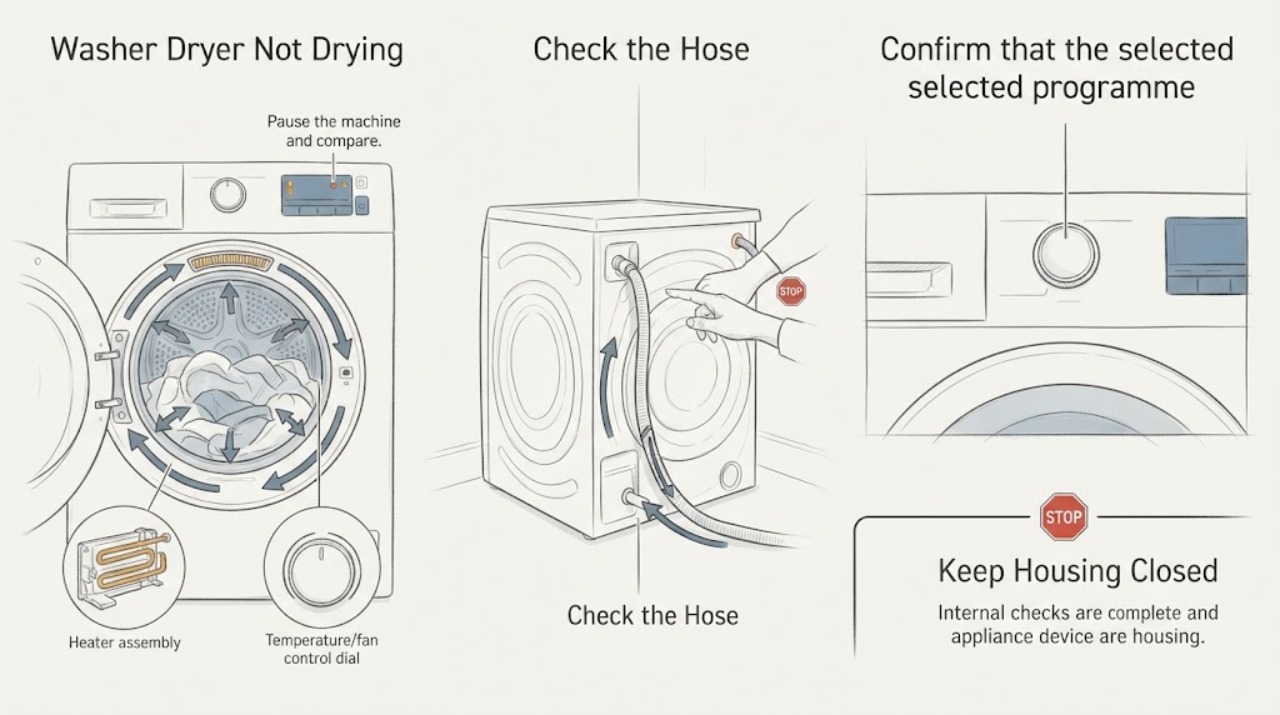
Start with the dry-load capacity, not the wash capacity: Hotpoint says washer-dryers can have a lower drying limit, and an overloaded drum restricts air circulation and spinning. Remove excess laundry, separate tangled items, and confirm that the selected cycle is actually a drying cycle rather than a short low-temperature or non-drying option. Then check that the machine has drained and spun, clean the lint filter and moisture-sensor surfaces where the exact model provides them, and inspect a vent hose or water container only when your model uses one. Record any fault code; Hotpoint identifies F13 as a dryer temperature-sensing fault and F15 or F19 as heater or fan-related drying faults that need service. Unplug before repair work and stop immediately for smoke, a burning smell, abnormal heat, a water leak, or repeated electrical trips.
Work through in order
Diagnostic checks
Use only checks that match the exact appliance or system and its official guide.
-
Check 1
Pause the machine and compare the current load with the model's lower drying capacity. Remove excess items, loosen sheets and other tangled pieces, and distribute the remaining laundry before selecting a drying cycle.
Expected result: The clothes dry better in a smaller, separated load, or they remain wet despite a load that is within the drying limit.
Next step: Use the lower drying limit and smaller loads for future cycles. If the result does not improve, continue with drain, cycle, airflow, and fault-code checks rather than adding more heat or time blindly.
Why this matters
Why: Hotpoint explains that washer-dryers have separate washing and drying capacities, and an overloaded drum restricts warm-air circulation and spinning. If a correctly sized load remains wet, capacity alone is not the cause.
-
Check 2
Before diagnosing heat, check whether the wash has fully drained and spun. Look for standing water, a very wet load, a drain or pump warning, or a kinked or blocked drain hose, using only the external checks permitted by the model guide.
Expected result: Water remains, the load is unusually wet after spin, a drain warning is shown, or the machine drains and spins normally.
Next step: If water remains, stop the drying diagnosis and follow the model-specific drain and pump-filter instructions. If drainage and spin are normal, continue to the cycle and sensor check.
Why this matters
Why: Water flow and spin performance affect how much moisture the drying stage must remove. Hotpoint lists blocked or kinked drainage and water-flow issues among washer-dryer checks; a normal spin shifts attention to the drying circuit.
-
Check 3
Confirm that the selected programme includes drying and is not a short, low-temperature, or non-drying option. If the model has an automatic or ECO sense setting, check the drum moisture-sensor surfaces for grease or residue and wipe them with a dry cloth only as the model instructions allow.
Expected result: Changing the cycle or cleaning the sensor allows drying to continue, or the correct cycle still stops early with damp laundry.
Next step: Use a suitable drying programme and a load size the sensor can detect. If the correct programme stops early or produces no heat, record the behaviour and continue with airflow and fault checks.
Why this matters
Why: Hotpoint says that certain low-temperature programmes may not provide the expected drying and that an undersized load can cause an automatic sensing feature to end early. Dirty sensor surfaces can also affect the sensed dryness result.
-
Check 4
With the machine cool and unplugged, inspect only the airflow or condensation components present on your model: a vent hose must not be crushed or blocked; a condenser model's water container and filters must be correctly fitted and clean; a heat-pump model's listed filters must be clear and undamaged.
Expected result: The vent is kinked or obstructed, a container is full, or a filter is blocked or incorrectly seated; or the model has no such user-accessible component and the airflow path appears normal.
Next step: Correct only the component and cleaning step described for the exact model, refit all covers and filters, and then test a small load. If airflow is normal and clothing remains cold or wet, do not open the cabinet.
Why this matters
Why: Hotpoint identifies a crushed or blocked vent, a full water container, and dirty filters as causes of poor drying performance. These checks are design-dependent, so an absent component is not evidence that another model's procedure should be used.
-
Check 5
Read the display or flashing-light pattern and record any fault code before resetting. Match it to the exact Hotpoint washer-dryer guide rather than assuming codes from another model are interchangeable.
Expected result: A code returns after the model's documented reset, or there is no code but the machine still does not heat or dry.
Next step: Stop using the drying function and arrange qualified service when a listed fault returns or the machine has no heat. Provide the exact model, code, cycle, and the checks already completed.
Why this matters
Why: Hotpoint lists F13 as a dryer temperature-sensing fault, F15 as a heater-control fault that can pause drying, and F19 as a fan-motor or heating fault that can stop drying. Those findings require engineer service rather than a parts guess.
-
Check 6
After the load, drainage, programme, sensor, and model-specific airflow checks are complete, run one short supervised drying cycle with a small balanced load. Stop at once if the drum stays cold, the machine smells of burning, the plug or cabinet becomes unusually hot, smoke appears, water leaks, or the breaker trips.
Expected result: The small load dries normally, drying improves only after a documented external correction, or the machine remains cold or stops with the same fault.
Next step: Use the machine only when it completes a normal supervised cycle without warning signs. Otherwise unplug it when safe, keep it out of service, and arrange qualified Hotpoint appliance repair.
Why this matters
Why: Improvement after a load, cycle, drain, sensor, or airflow correction supports that condition as the immediate cause. Continued no-heat or repeated stopping points to a heater, temperature sensor, fan, control, or another model-specific fault that cannot be confirmed safely from outside.
Use your observations
Decision map
Find the observation that best matches what you see, then follow the next safe action.
-
PATH 01Next step
What you see
Drying improves after reducing the load below the model's drying capacity.
Do this next
Continue using the lower drying capacity and separate tangled laundry. If normal-sized loads still fail, continue diagnosis rather than overloading again.
-
PATH 02Next step
What you see
Water remains after washing or the load is much wetter than expected after spin.
Do this next
Resolve the model-specific drain or pump-filter issue first. Do not rely on a drying cycle to compensate for a failed drain or spin.
-
PATH 03Next step
What you see
The selected cycle is a short, low-temperature, or sensing programme and the load is undersized or the sensor is dirty.
Do this next
Use the correct drying programme, a detectable load size, and the model-approved sensor cleaning step. Escalate if the correct cycle still stops early.
-
PATH 04Next step
What you see
The model-specific vent, filter, or condensation path is blocked, crushed, full, or incorrectly fitted.
Do this next
Clean, empty, or refit only the listed user-serviceable part, then retest once with a small load. Arrange service if the path cannot be safely accessed or the issue remains.
-
PATH 05Next step
What you see
F13, F15, F19, or another model-specific drying fault returns after the documented reset.
Do this next
Stop using the drying function and arrange qualified service. Do not replace a heater, sensor, fan, or control without a confirmed model-specific diagnosis.
-
PATH 06Next step
What you see
Smoke, a burning smell, abnormal heat, visible electrical damage, a water leak, or repeated breaker trips occur.
Do this next
Stop immediately, disconnect power only if safe, keep clear of damaged wiring or hot water, and seek qualified appliance or electrical service. Do not run another test.
Helpful context
Understand the symptom
Check the drying limit first
The load that fits for washing may be too large for drying. Wet laundry weighs more, and a full drum can prevent warm air from circulating and can reduce the final spin's effectiveness. Remove items until the remaining load fits the drying capacity printed in the exact model guide, then separate tangled pieces before testing.
Match the check to the appliance design
Some washer-dryers use a vent, while others use a condenser, water container, or model-specific filters. Do not remove a cover or wash a component unless the exact Hotpoint guide says it is user-serviceable. A code or a persistent no-heat condition is a service decision, not a reason to keep restarting the dryer.
When checks do not resolve it
Need a professional?
Book service for a returning drying fault, persistent no-heat condition, inaccessible airflow or drain fault, or any repair requiring the cabinet to be opened.
Common questions
FAQ
Why is my Hotpoint washer-dryer washing normally but not drying?
Check the lower drying capacity, final drain and spin, selected drying programme, moisture sensor, model-specific filter or vent, and any fault code. A normal wash does not prove that the drying circuit is working.
Can too much laundry stop a Hotpoint washer-dryer from drying?
Yes. Washer-dryers usually have a lower drying capacity than washing capacity. An overloaded drum restricts air circulation and spinning, so remove items and separate the load before testing.
What do Hotpoint drying fault codes F13, F15, and F19 mean?
Hotpoint identifies F13 as a dryer temperature-sensing fault, F15 as a heater-control fault that can pause drying, and F19 as a fan-motor or heating fault. If the code returns, stop using the drying function and arrange service for the exact model.
When should I stop using the washer-dryer?
Stop for smoke, a burning smell, abnormal heat, visible electrical damage, water leakage, repeated breaker trips, or a returning drying fault. Disconnect power only if safe and seek qualified service.
Read the exact guide
Official sources
- Why Is My Hotpoint Tumble Dryer Not Working? Troubleshooting GuideHotpoint · Use only the maintenance or drying-design checks that match the exact Hotpoint washer-dryer model.
- Hotpoint Washer-Dryer Error Codes - Quick Troubleshooting GuideHotpoint · Use the code meanings only when the exact Hotpoint washer-dryer model supports the same code set.
- Why Does My Laundry Come Out Wet From My Washer Dryer?Hotpoint · Use for Hotpoint washer-dryer load planning while following the exact model's capacity label and guide.
- Washer Dryer Troubleshooting & Repair ServiceHotpoint · Use as general Hotpoint washer-dryer guidance while checking the exact user handbook because models vary.
- Step-by-Step Guide on How to Clean Your Tumble DryerHotpoint · Use only the component-cleaning steps that match the exact Hotpoint washer-dryer design and user guide.
Community feedback
Share a repair observation
Share a plain-text repair observation. Accepted observations are published automatically; this page may take a moment to update.