
On this page
Start here
Quick answer
A brief, intermittent water movement can be part of how a condenser washer-dryer manages moisture, so do not identify a failed inlet valve from a water sound alone. A pool of white or cloudy water in the drum, a stream that continues, or clothing that is hot but wetter after drying is a different result: stop repeating the dry cycle and first separate a drain-path or hose-routing problem from an uncontrolled water-admission problem. For the Hotpoint RD1076JDUKN, record the exact model, when the water appears, whether it is a brief pulse or a pool, and whether the machine drains it. Check only the visible hoses and connections with the appliance safely stopped; do not open the cabinet or guess a pump, valve, or control part.
Before you begin
Safety first
- Owner checks are limited to model identification, cycle and water-timing observations, and visible hose, plumbing, leak, and connection checks with the appliance safely stopped. Do not remove the cabinet, reach into the drum or pump area while energized or hot, bypass a water or door safety, run service diagnostics, or replace an inlet valve, pump, sensor, heater, fan, or control from the symptom alone.
Work through in order
Diagnostic checks
Use only checks that match the exact appliance or system and its official guide.
-
Check 1
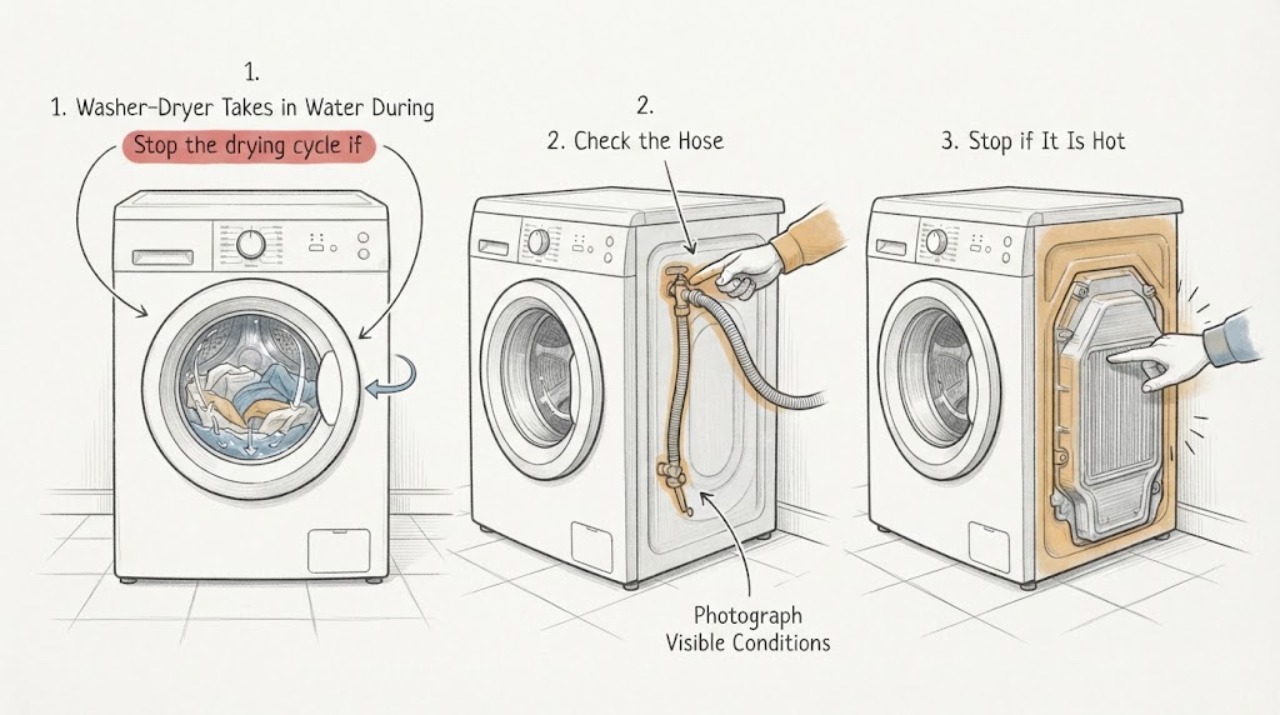
Stop the drying cycle if a pool is forming, the load is becoming wetter, or water is entering continuously. From a dry position, note the exact model RD1076JDUKN, whether the cycle was Dry Only or Wash and Dry, the time of the first water movement, whether it was a brief pulse or a stream, the water colour, and whether the drum emptied it.
Expected result: There is only a short intermittent movement with no accumulation, or there is a continuing stream, a visible pool, cloudy water, or hot laundry that is wetter than before drying.
Next step: Do not keep repeating the dry cycle when water accumulates or the load becomes wetter. Continue with the visible hose and leak checks only if there is no immediate overflow, smoke, burning smell, electrical damage, or trip.
Why this matters
Why: A brief movement that does not accumulate is a different decision path from uncontrolled filling or water that is not leaving. The latter pattern matches the distinct excess-water symptom reported for this exact model and cannot be classified as a failed part from observation alone.
-
Check 2
Confirm the identity and documentation before applying any drying or water-setting advice. Photograph the rating label and retain the complete model suffix, then use Hotpoint's manual search for that model rather than a similar RD 1076 or another brand's washer-dryer manual. Look specifically for the dry-cycle water requirement, drain arrangement, and the model's user-accessible checks.
Expected result: The label clearly reads RD1076JDUKN and the matching manual is available, or the label/suffix is missing, different, or unreadable.
Next step: Follow only the matching manual. If the label cannot be confirmed, treat the appliance as unidentified and stop at external observation and qualified service; do not use a generic valve, pump, or reset procedure.
Why this matters
Why: Hotpoint publishes model-specific documentation and warns that its appliances vary. A manual for a similar-looking washer-dryer cannot establish that the same water behaviour, hose routing, or user procedure applies.
-
Check 3
With the appliance stopped and safe to approach, inspect the visible drain hose and its connection to the standpipe or sink trap. Look for a kink, crushing, a hose pushed too far into the standpipe, a low or incorrectly routed section, a loose sink connection, or water returning after the pump-out. Do not remove the cabinet or reach into an energized or hot machine.
Expected result: The hose is visibly restricted or incorrectly positioned, the sink connection is blocked or leaking, water returns after pump-out, or the external drain route looks normal.
Next step: Correct only an obvious external hose position or accessible plumbing blockage described by the matching manual, then stop and reassess. If water pooled, returned, or the symptom persists with a normal external route, keep the drying function out of service and arrange qualified diagnosis.
Why this matters
Why: A restriction or routing fault can prevent condensation and wash water from leaving during the drying stage, so the drum may accumulate water even though a pump has previously appeared to run. A normal visible route does not prove that the internal drain path or pump is healthy.
-
Check 4
Inspect the visible inlet hose, tap connection, detergent-drawer area, and floor around the machine for fresh water or a loose connection, without starting another cycle. If water continues to enter while the appliance is stopped, close the water tap if it is safe to reach and leave the machine out of service.
Expected result: Water is present at an external connection or drawer, water enters while stopped, or there is no visible leak and water appears only during the dry cycle.
Next step: Do not tighten internal fittings, remove panels, or replace an inlet valve based on this observation. Keep the tap closed and arrange service for continued filling or leakage; otherwise continue only with the documented model-specific drain and drying checks.
Why this matters
Why: An external leak or continued admission while stopped is more urgent than a normal drying-stage sound and can create an overflow or water-damage risk. Water that appears only during drying still needs the exact manual and service diagnosis if it pools or makes the clothes wetter.
-
Check 5
Record any display message or flashing-light pattern before any reset, including whether the machine reports a drain, fill, heating, or drying fault and at what point the cycle stops. Compare it with the RD1076JDUKN documentation; do not substitute a code from another Hotpoint platform.
Expected result: A documented fault returns, the machine stops with a drying or pump symptom, or there is no code but a pool or repeated wet-hot load remains.
Next step: Stop using the drying function and give the technician the exact model, code, cycle, water timing, hose observations, and the Reddit-like symptom history if applicable. Do not run diagnostic modes or access internal wiring unless directed by a qualified service professional.
Why this matters
Why: Hotpoint's error guidance separates pump/drain, heating, temperature-sensing, and fan/heating faults. A code or repeated symptom narrows the service request but does not identify which internal component should be replaced.
Use your observations
Decision map
Find the observation that best matches what you see, then follow the next safe action.
-
PATH 01Next step
What you see
Water appears only as a short repeatable movement, does not form a pool, is removed through the drain, and the small load dries normally.
Do this next
Keep the documented load and cycle limits, monitor one normal cycle only if no warning sign is present, and stop if the water becomes continuous, accumulates, or the load becomes wetter.
Why this path and its safety boundary
Why it matters: That pattern is more consistent with a drying-stage operating behaviour than with uncontrolled filling. It still must be confirmed in the RD1076JDUKN manual, because the exact water and drainage arrangement is model-specific.
-
PATH 02Next step
What you see
A pool of cloudy water forms, water continues entering, or clothes leave the dry cycle hot and wetter; the visible drain hose may be restricted or may look normal.
Do this next
Keep the drying function out of service. Correct only an obvious external hose/plumbing issue from the exact manual; otherwise arrange qualified Hotpoint appliance service and provide the recorded water timing and model identity.
Why this path and its safety boundary
Why it matters: The symptom is abnormal at the user-decision level, but the observation cannot distinguish an external drain/routing issue from an internal drain, water-admission, sensing, or control fault. A clean pump or a single successful cycle does not prove the cause.
-
PATH 03Next step
What you see
Water enters while the machine is stopped, a hose or drawer connection leaks, the drum threatens to overflow, or there is smoke, burning odour, abnormal heat, visible electrical damage, or a breaker trip.
Do this next
Close the water tap and disconnect power only from a safe dry position if possible; keep away from damaged wiring or standing water and arrange qualified appliance or electrical service. Do not run another cycle.
Why this path and its safety boundary
Why it matters: This is a water or electrical safety event, not a drying-performance experiment. Continued operation can increase water damage or electrical risk.
Helpful context
Understand the symptom
The assigned appliance is the UK Hotpoint RD1076JDUKN washer-dryer. The useful first distinction is not simply whether water is heard: observe whether water appears as a short, repeatable movement and is removed, or whether it continues, accumulates in the drum, or leaves the load hot and wetter. The latter pattern is not explained by the sound alone and should not be treated as a normal condenser characteristic without checking the exact manual and external drainage path.
Hotpoint's public washer-dryer guidance says models vary, directs owners to the model manual, and identifies visible fill and drain hose conditions and external leaks as checks. Its model-specific parts page confirms the RD1076JDUKN identity and warns that fit must be verified by model. A matching Reddit report documents the same model and symptom but no confirmed repair, so it supports the observation pattern, not a component diagnosis.
When checks do not resolve it
Need a professional?
Use qualified Hotpoint or appliance service for pooled or continuing water during drying, water entering while stopped, repeated wet-hot loads, a returning fill/drain/drying indication, or any need to access internal components. Use qualified electrical service as well when the cord, outlet, breaker, or wiring shows heat or damage.
Safety scope: Owner checks are limited to model identification, cycle and water-timing observations, and visible hose, plumbing, leak, and connection checks with the appliance safely stopped. Do not remove the cabinet, reach into the drum or pump area while energized or hot, bypass a water or door safety, run service diagnostics, or replace an inlet valve, pump, sensor, heater, fan, or control from the symptom alone.
Have this ready
- Provide the complete RD1076JDUKN model and serial information, UK installation details, Dry Only versus Wash and Dry selection, load description, water timing and colour, whether the water was a pulse or stream, whether it drained, hose and connection observations, display or light pattern, and any leak, odour, heat, smoke, or trip history.
Common questions
FAQ
Is any water during a Hotpoint washer-dryer drying cycle automatically a fault?
No. A brief movement without accumulation should be checked against the RD1076JDUKN manual before it is treated as a failed part. A continuing stream, a pool, or clothes that become hot and wetter is a different result and warrants stopping the drying function and checking the visible drain and inlet conditions.
Does cleaning the pump prove that the excess water is not a drain problem?
No. The exact-model Reddit report says the pump was cleaned without resolving the symptom, but it does not establish that the complete drain route, hose routing, or internal drain system was proven healthy. Avoid parts bingo and have service separate drainage from water admission and control faults.
Can I keep running short dry cycles to see whether the water clears?
Do not repeat the dry cycle when a pool forms, water continues entering, the load becomes wetter, or any leak, burning smell, abnormal heat, electrical damage, or breaker trip appears. Record the behaviour and arrange service after the safe external checks.
Read the exact guide
Official sources
- Washer Dryer TroubleshootingHotpoint UK Appliances Limited · Supports external fill/drain hose, plumbing, leak, filter, airflow, and model-variation checks; it does not identify an internal part for RD1076JDUKN.
- Hotpoint Washer-Dryer Error CodesHotpoint UK Appliances Limited · Supports recording a returning code and separating pump, heating, sensing, and fan/heating categories; the code list is not a substitute for the exact RD1076JDUKN manual.
- Washer/Dryer taking in excess water during dry cycleReddit r/appliancerepair · Exact model and symptom report used only as lived-experience evidence; no confirmed repair outcome is claimed.
- Spare parts for Hotpoint: Model RD1076JDUKN - 769991606031Hotpoint UK Appliances Limited · Confirms the exact assigned model identity and that fit must be verified by model; it does not diagnose the excess-water symptom.
- Hotpoint Appliance ManualsHotpoint UK Appliances Limited · Supports using the exact model or 12NC to obtain the applicable manual; it is not a substitute for the RD1076JDUKN manual itself.
Community feedback
Share a repair observation
Share a plain-text repair observation. Accepted observations are published automatically; this page may take a moment to update.