
On this page
Start here
Quick answer
The LG WM3488HW is a compact all-in-one washer dryer with ventless condensing drying, so it does not use the exhaust-duct checks for a conventional vented dryer. Slow or incomplete drying is more often a load that exceeds the dry limit, thick items, insufficient preceding spin, closed water supply, or a drain hose that traps water; LG says combo units use a small amount of water during drying and expel hot humid air through the drain hose. Use the dry-capacity mark, spin the load well, keep the water supply open, and make sure the drain hose is not kinked or holding a U-shaped pocket. Do not add an external vent, open the cabinet, or guess at a fan, heater, sensor, or control. If a small suitable load stays wet after those safe checks, or there is smoke, burning odor, abnormal heat, a leak, cord damage, or a tripped breaker, stop using the dryer function and arrange qualified LG appliance service.
Before you begin
Safety first
- Do not add an external vent, open the cabinet, remove the heater or fan, access hidden condenser passages, perform live electrical tests, bypass a door or control, disconnect water or drain hoses under pressure, or run repeated tests after smoke, burning odor, abnormal heat, a leak, cord damage, or a breaker trip.
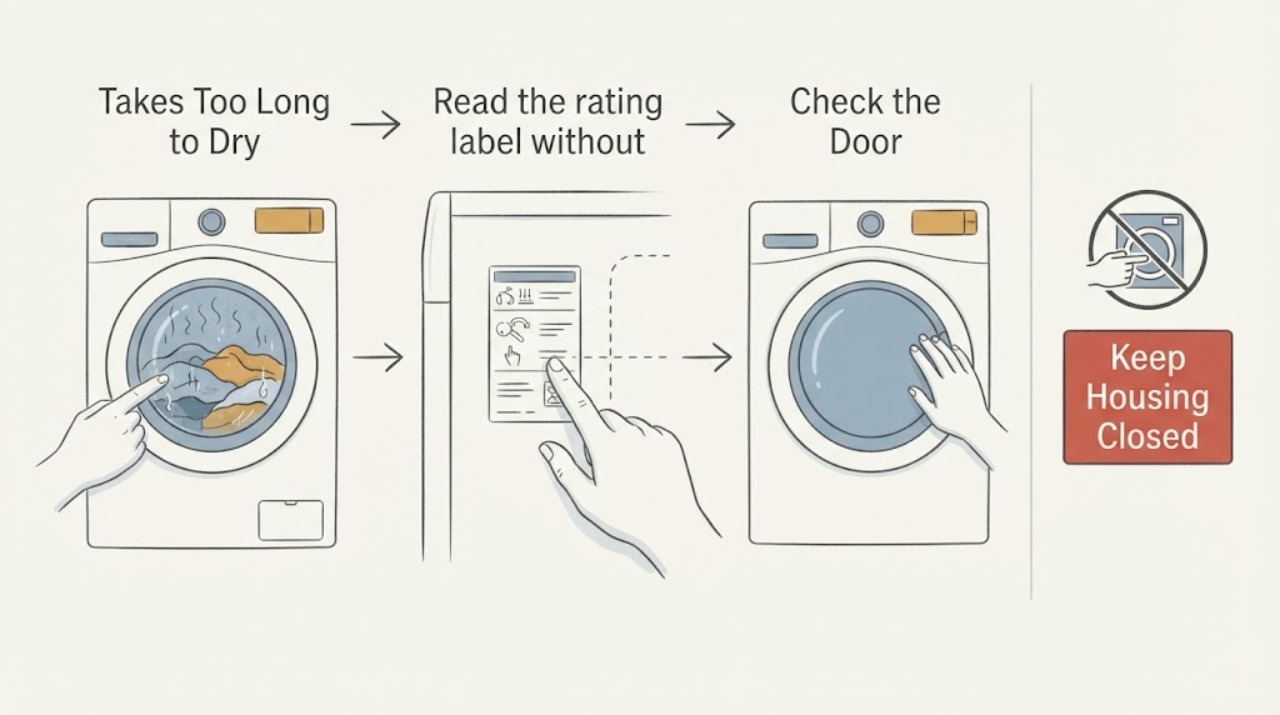
Work through in order
Diagnostic checks
Use only checks that match the exact appliance or system and its official guide.
-
Check 1
Read the rating label without moving the appliance and confirm WM3488HW, the full market suffix if shown, and whether the complaint is from Wash+Dry, a dry-only selection, or an added dry cycle. Note the selected dryness level or timed setting, load fabric, approximate amount, final-spin result, and whether the drum is warm, cool, or producing visible steam.
Expected result: The label matches WM3488HW and the programme is known, the label or suffix is different, or the programme and load history are unknown.
Next step: Keep the complete label and programme information for the exact manual or service request. Do not connect an exhaust duct or use a generic vented-dryer procedure.
Why this matters
Why: The exact WM3488HW specification supports ventless condensing drying and particular dry options, but controls and manuals can vary by market suffix. A changed model or unknown programme makes a model-specific timing conclusion unreliable; a warm but damp load and a cool dripping load point to different checks.
-
Check 2
Open the door only when the cycle is stopped and compare the load with the drying-capacity mark at the drum opening. Remove part of a full wash load, unfold thick items, separate bulky or mixed-thickness fabrics, and leave room for the remaining articles to tumble freely.
Expected result: The load is near the wash capacity, packed tightly, contains thick folded items, or is already a small similar-fabric load with room to tumble.
Next step: Run one supervised dry cycle with a reduced, similar-fabric load using the model-approved setting. Do not compensate for an overloaded drum by adding an external vent or repeatedly extending cycles.
Why this matters
Why: WM3488HW is a compact combo and LG says drying capacity is lower than washing capacity; load size and thick fabrics can make a normal cycle take much longer without proving a failed component. A small, suitable load that still stays wet is stronger evidence of a water, drain, or drying-system problem.
-
Check 3
Check how wet the clothes were when drying began. If they were dripping, redistribute the load and run one appropriate spin before drying; do not add detergent or softener to a dry-only cycle and do not repeatedly open the door while the dryer is working.
Expected result: The preceding spin was skipped, weak, or unbalanced; the load is only damp after a normal spin; or the load is still dripping after a completed spin.
Next step: Retry once with the reduced load after a suitable spin. If a balanced load cannot spin normally or remains excessively wet, stop the drying investigation and arrange service.
Why this matters
Why: Drying starts with the water left after spin. LG specifically recommends a spin before drying and notes that fabric type and load size change drying time. Persistent dripping after a balanced spin shifts attention to the water, drain, or appliance service path rather than a guessed heater or fan.
-
Check 4
From a dry, safe position, confirm the household water supply valves are open and the visible inlet hoses are not kinked. Do not disconnect a pressurized hose or alter the valve assembly. During a normal supervised dry cycle, note whether the combo periodically takes in and drains a small amount of water.
Expected result: A water valve is closed, a hose is kinked, no water enters when the cycle calls for it, the water path appears normal, or the floor/connection becomes wet.
Next step: Correct only an obvious accessible valve or hose-routing issue and retry once. For a leak, inaccessible connection, abnormal water entry, or normal supply with persistent poor drying, stop and arrange qualified service.
Why this matters
Why: This model's ventless condensing process is not the same as a vented dryer, and LG says combo drying uses a small amount of water; absent or restricted water can leave clothes wet even while the drum turns. A wet connection is a leak and safety issue, not permission to open the cabinet.
-
Check 5
Inspect the visible drain-hose routing without pulling the combo forward. It should descend smoothly rather than forming a U-shaped pocket or being pinched behind the cabinet. If the exact manual permits access to the pump filter, turn the unit off and cool, control residual water, and clean only that user-accessible filter procedure.
Expected result: The drain hose is kinked, rises and holds water, the hose appears correctly routed, the accessible filter contains lint or debris, or residual water cannot be controlled safely.
Next step: Correct only visible routing and refit an accessible filter cover securely. Run one supervised test; if water leaks, the hose cannot be safely accessed, the pump sounds abnormal, or the load remains wet, stop and call service.
Why this matters
Why: LG warns that water pooling in the drain hose can reduce drying efficiency because hot humid air is not expelled properly; a restricted filter or standing water can also affect the drain path. A clear hose or filter does not identify whether a hidden pump, condenser, fan, heater, sensor, wiring, or control is working.
-
Check 6
Use the exact WM3488HW dry selection shown in the manual or on the control panel: its official specification lists More Dry, Normal Dry, Damp Dry, Low Temp Dry, and 30/60/120-minute manual times. After the external checks, make one short supervised test with a small suitable load and record whether the time changes, the load warms, and the cycle finishes.
Expected result: The load dries normally when reduced, the display time extends while the cycle continues, the cycle ends with damp items, or the same poor result or a drying fault returns with normal water and drainage.
Next step: Use the appliance only when it completes normally without warning signs. Otherwise stop the drying function and give the provider the model, setting, load, spin result, water observation, drain-hose condition, and any displayed code; do not open the cabinet or replace a part based on this test.
Why this matters
Why: A changing or extended time can be normal sensor behavior, and Damp Dry intentionally leaves moisture. A repeatable failure with a small suitable load and normal spin, water, and drain conditions is no longer explained by the ventless operating method alone; it may require internal diagnosis.
Use your observations
Decision map
Find the observation that best matches what you see, then follow the next safe action.
-
PATH 01Next step
What you see
A full wash load, towels, thick folded items, or mixed fabrics take a long time, but a reduced similar-fabric load dries acceptably.
Do this next
Keep wash loads below the WM3488HW dry-capacity mark, separate bulky items, and use the exact dry level or timed option. Do not add a vent or select a replacement part.
Why this path and its safety boundary
Why it matters: The result fits the compact combo's lower dry capacity and the extra moisture retained by thick or mixed materials; it does not establish a failed dryer component.
-
PATH 02Next step
What you see
Clothes enter drying dripping or the final spin was weak, skipped, or unbalanced; after one suitable spin and a reduced load, drying improves.
Do this next
Redistribute loads and complete the appropriate spin before drying. If the washer cannot achieve a normal balanced spin, arrange appliance service rather than repeatedly running wet loads.
Why this path and its safety boundary
Why it matters: Starting moisture was the important difference. Drying time is not a direct measure of heater or fan failure when the load begins with excess water.
-
PATH 03Next step
What you see
The load is small and suitable, but the water supply is closed or abnormal, or the drain hose is kinked or holds a U-shaped pocket; the symptom improves after a safe external correction.
Do this next
Leave the water supply open, keep the visible hose routing smooth, and monitor one normal cycle. If the hose, connection, or filter leaks or the issue returns, stop and arrange service.
Why this path and its safety boundary
Why it matters: This pattern supports the ventless combo's water-and-drain path as the immediate restriction. LG describes water use during combo drying and warns that pooled drain-hose water can reduce humid-air removal.
-
PATH 04Next step
What you see
A small suitable load remains wet after a proper spin, normal water supply, smooth drain routing, and any permitted accessible filter check, or a model-specific drying fault returns.
Do this next
Stop using the drying function and arrange LG or qualified appliance service. Provide the exact label, market suffix, programme, load, spin and water observations, drain routing, and displayed fault; do not open the cabinet or order a generic component.
Why this path and its safety boundary
Why it matters: The normal ventless operating conditions no longer explain the result. An internal drying fan, heater, condenser path, sensor, pump, wiring, or control issue is possible, but the symptom cannot select one of them.
-
PATH 05Next step
What you see
Smoke, burning odor, sparks, abnormal heat, a hot or damaged cord, water near electrical parts, a leak, or a repeated breaker trip occurs.
Do this next
Stop immediately and disconnect power only from a dry, safe position; keep clear of water and damaged wiring and do not run another test. Use qualified electrical or appliance service, and seek emergency help if there is active smoke or fire.
Why this path and its safety boundary
Why it matters: This is an immediate electrical, fire, heat, or water hazard, not a slow-drying adjustment. A warm drum or steam alone is not proof of danger, but those warning signs require the test to end.
Helpful context
Understand the symptom
Why WM3488HW drying is different from a vented dryer
The opened LG material identifies WM3488HW as a 2.3 cu. ft. compact all-in-one washer/dryer and lists ventless condensing drying, an internal heater, sensor drying, and 30-, 60-, and 120-minute manual dry times. There is no outside exhaust duct to clean or add. LG's combo troubleshooting guidance says these washer-dryer units use a small amount of water during drying and expel hot, humid air through the drain hose; a hose that traps water can interfere with that path. That is why the first checks are the dry-load limit, spin result, water supply, and drain-hose routing rather than a standalone-dryer vent diagnosis.
Treat a long cycle as a result to interpret, not a part diagnosis
LG notes that a combo may continue operating until its selected dryness level is reached, so the actual time can be longer than the first display. Fabric thickness and starting moisture matter: a full wash load, towels, folded thick items, or a weak spin can leave too much water for the condensing system to remove. A small load that remains wet after a proper spin and normal external water and drainage conditions is a different decision from a load that was simply too large. The hidden fan, heater, sensor, pump, wiring, and controls should be tested by a qualified provider, not selected from the symptom alone.
When checks do not resolve it
Need a professional?
Arrange LG or qualified appliance service when a small suitable load remains wet after a proper spin and safe water, drain-hose, and permitted filter checks; when a drying-system code returns; when water leaks or cannot be controlled; or when the model's manual does not permit the proposed check. Stop immediately for smoke, burning odor, sparks, abnormal heat, a damaged cord, water near electrical parts, or repeated breaker trips.
Safety scope: Do not add an external vent, open the cabinet, remove the heater or fan, access hidden condenser passages, perform live electrical tests, bypass a door or control, disconnect water or drain hoses under pressure, or run repeated tests after smoke, burning odor, abnormal heat, a leak, cord damage, or a breaker trip.
Have this ready
- Provide the complete WM3488HW label and market suffix, programme and dry level or time, load fabric and approximate size, final-spin result, whether water enters during drying, drain-hose routing, filter status if safely accessible, temperature or steam observation, and any displayed code.
Common questions
FAQ
Does the LG WM3488HW need an outside dryer vent?
No. LG's WM3488HW product material identifies it as a ventless condensing washer/dryer. Do not add an exhaust duct or apply a standalone vented-dryer diagnosis; check the load, spin, water supply, and drain-hose routing instead.
Why does the WM3488HW take much longer than the time first shown?
LG says a combo can continue until its selected dryness level is reached, so the actual time may exceed the first display. Thick fabrics, towels, a full wash load, or excess water left after spin can extend the cycle. A small suitable load that remains wet after the safe checks needs service rather than endless extra cycles.
Should I close the water supply because this is a dryer cycle?
No. LG's combo guidance says the unit uses a small amount of water during drying and that poor supply or pressure can affect performance. Keep the valves open during normal use, but stop for a leak or unsafe connection and do not disconnect a pressurized hose.
Can I replace the heater, fan, or sensor because drying is slow?
Not from this symptom alone. First separate load size, starting spin moisture, water supply, and drain-hose routing. If a small suitable load still fails, have a qualified provider test the internal drying system and confirm any part against the complete model and market suffix.
Read the exact guide
Official sources
- [LG Washer] Dryer Performance TroubleshootingLG Electronics USA · Official LG combo guidance marked for washer-dryer combos and washers; it is not a WM3488HW-only manual, so model-specific controls remain subject to the exact manual.
- LG Washer Dryer Combo - Troubleshooting Poor Drying PerformanceLG Electronics USA · Official LG combo guidance used for safe symptom-level checks; it states that content is for all models, so the WM3488HW manual controls any model-specific procedure.
- WM3488HWLG Electronics Canada · Exact WM3488HW brochure in the Canadian market; used only for its explicit compact-combo and small-load context, not to transfer market-specific controls or service procedures.
- [LG Washer][Drying Function] Dry Time Stops at 6minutesLG Electronics USA · Official LG guidance for washer-dryer combos; used for interpreting changing or extended time, load/fabric effects, spin, water supply, and drain-hose pooling rather than for an exact WM3488HW fault code.
- LG WM3488HW.ABWEEUS Product SupportLG Electronics USA · Exact LG support page for the assigned WM3488HW model family; it confirms the model and provides the owner-manual entry point, but the displayed support page does not itself establish every drying diagnosis.
- 2.3 cu. ft. Compact All-In-One Washer/DryerLG Electronics USA · Exact LG product page for WM3488HW; supports the product type and ventless-condensing design, not a component-level repair diagnosis.
- WM3488H_ 2.3 cu.ft. Compact All-In-One Washer/DryerLG Electronics USA · Exact WM3488H family specification listing the assigned WM3488HW white model; supports design, dry options, manual times, spin capability, and electrical rating but not internal fault diagnosis.
Community feedback
Share a repair observation
Share a plain-text repair observation. Accepted observations are published automatically; this page may take a moment to update.