
On this page
Start here
Quick answer
Leave an IKEA refrigerator disconnected after a breaker trip; do not keep resetting the breaker and do not install a larger breaker to force the appliance to run. IKEA sells refrigerators made by different manufacturers, so first record the IKEA article number, model, serial number, and manufacturer or service number from the rating plate and use that exact manual. From a dry, safe position, note whether the trip was immediate, followed compressor startup, followed a leak or moisture, or affected other household loads. Check only the accessible plug, cord, and outlet for visible damage, heat, looseness, discoloration, or water; do not open the outlet, remove refrigerator panels, or perform a live test. IKEA manuals require the correct grounded connection and direct users to a qualified electrician or service partner when the circuit or appliance fault persists. Any smoke, burning smell, sparks, melting, shock, hot or wet electrical part, repeated trip, or warming food is a stop-and-service condition.
Before you begin
Safety first
- This article covers model identification, power-off observation of timing and hazards, and a visual check of accessible cord, plug, outlet, and moisture conditions. Circuit measurements, outlet work, refrigerator panels, compressors, start components, defrost parts, controls, wiring, refrigerant circuits, and all live tests require qualified service.
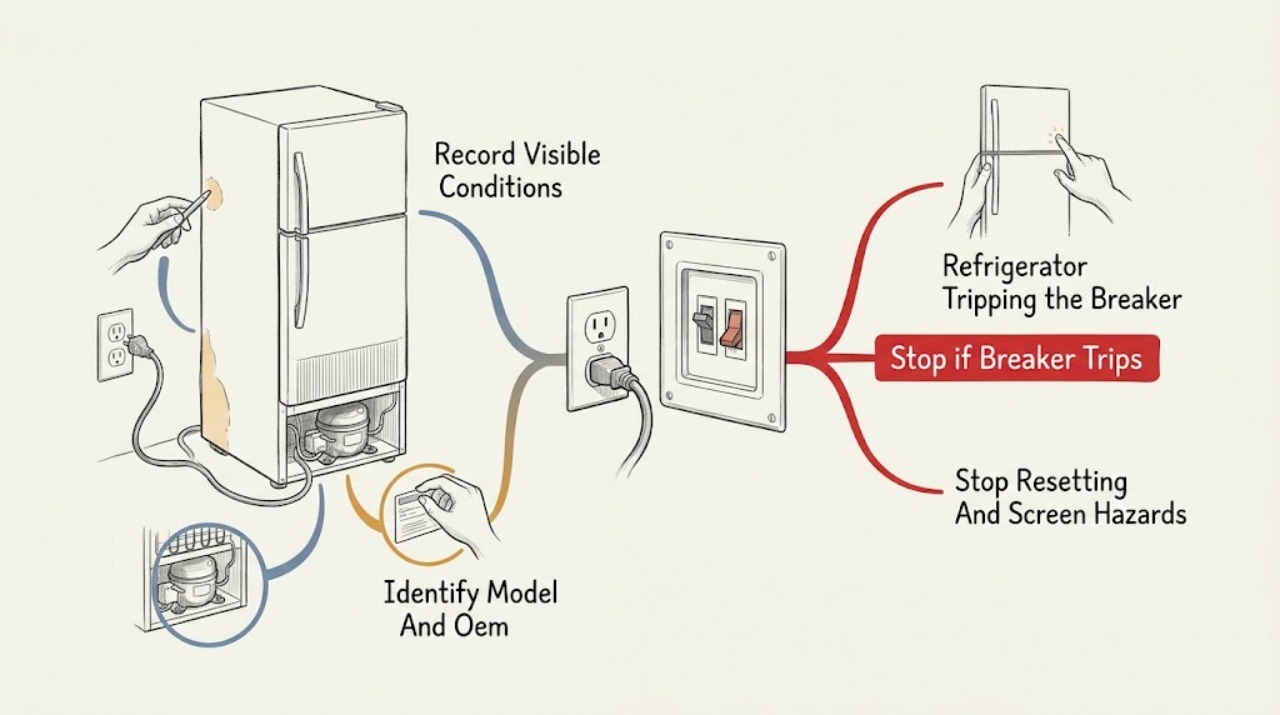
Work through in order
Diagnostic checks
Use only checks that match the exact appliance or system and its official guide.
-
Check 1
Leave the refrigerator and the tripped protection device alone. From a dry, safe position, look for smoke, burning or electrical smell, sparks, melting, shock, water near the plug or outlet, or a hot, wet, loose, or discolored electrical part.
Expected result: A fire, shock, moisture, heat, smell, spark, or melting sign is present, or none is visible.
Next step: For a hazard, keep clear and contact emergency or qualified electrical help as appropriate. If no hazard is visible, continue only with power-off observations; do not reset the breaker repeatedly.
Stop if: Do not reset the breaker again, fit a larger breaker, touch wet or hot electrical parts, or reconnect the refrigerator after smoke, burning smell, sparks, melting, shock, or water near electricity.
Why this matters
Why: Any hazard takes priority over diagnosis and may indicate shock or fire risk. No visible hazard does not prove that re-energizing the circuit is safe.
-
Check 2
From a dry, accessible location, record the IKEA article number, exact model, serial number, and manufacturer or service number on the rating plate. Locate the product's own IKEA manual and identify the listed service partner before interpreting any electrical symptom or code.
Expected result: The model and manufacturer/service information are clear, the rating plate is inaccessible without moving a heavy or wet appliance, or only the IKEA product family name is known.
Next step: Use the exact product number to retrieve the manual and service partner. If the label cannot be reached safely, leave the refrigerator isolated and ask IKEA or a service professional to identify it.
Stop if: Do not pull a built-in refrigerator out, remove panels, or infer the OEM from a similar-looking model or another IKEA manual.
Why this matters
Why: A clear identity allows the correct OEM manual and service path to be used. A family name alone is not enough to assume outlet, control, defrost, compressor, or error-code behavior.
-
Check 3
Without reconnecting the refrigerator, write down whether the breaker tripped immediately on connection, at compressor or cooling startup, after a long run or possible defrost period, after water or condensation, or during a wider household power event. Note whether other outlets or appliances lost power.
Expected result: The event was immediate, tied to a refrigerator operating stage, followed moisture, affected other loads, or has no reliable timing.
Next step: Give the timing and affected loads to a qualified electrician and the IKEA/OEM service partner. Do not perform a powered retest to obtain a more definite pattern.
Stop if: Do not cycle power, force a defrost, bypass a protector, or treat one successful restart as proof that the fault is repaired.
Why this matters
Why: Immediate or timed recurrence can make the appliance input, start, defrost, control, or wiring relevant; multiple affected loads point toward the circuit. Timing narrows the handoff but does not identify a part.
-
Check 4
Only if it can be done without touching damaged or wet parts, inspect the accessible plug and cord for cuts, crushing, heat, or discoloration, and look at the outlet for looseness, cracks, scorch marks, or moisture. Do not remove the outlet cover or measure it live.
Expected result: The cord, plug, or outlet is damaged, hot, wet, loose, or discolored, or the accessible power path looks intact.
Next step: Keep the appliance disconnected and call a qualified electrician for a damaged or overheated outlet, cord, or plug. If the path looks intact, preserve the observation and wait for model-specific service advice.
Stop if: Do not repair a cord with tape, open the outlet, probe contacts, use an adapter or extension cord, or reconnect a wet, hot, damaged, or discolored plug.
Why this matters
Why: A visible power-path defect needs qualified electrical assessment and can trip household protection. An intact-looking path does not clear an internal refrigerator fault or the circuit.
-
Check 5
From outside and without removing a cover, look for a leak, condensation trail, or pooled water near the base, cord, plug, or outlet. Record whether the display, alarm, cooling, or temperature changed before the trip; do not move a wet appliance or reach behind it.
Expected result: Water is near electrical equipment, the refrigerator is warming or alarming, or the exterior appears dry with no cooling change observed.
Next step: For moisture near electrical equipment or cooling loss, keep power isolated, protect food when safe, and arrange qualified service. For a dry appliance, keep the observation for the service handoff and do not continue with live testing.
Stop if: Do not touch wet electrical parts, tip or pull out a wet refrigerator, remove a rear or bottom cover, or reconnect while moisture or a food-safety concern remains.
Why this matters
Why: Water near electricity increases shock and short-circuit risk. Warming or a temperature alarm also creates a food-safety concern. A dry exterior does not rule out an internal fault.
-
Check 6
Prepare a service report containing the product identity, OEM/service partner, trip timing, affected loads, accessible power-path observations, moisture or hazard signs, cooling status, and exact display code or alarm. Keep the refrigerator isolated until a qualified professional confirms the next safe step.
Expected result: The breaker trips again, the refrigerator trips at a repeatable stage, the display or cooling is abnormal, a code or alarm persists, or the appliance remains stable only while disconnected.
Next step: Use the IKEA product number to contact the correct service partner and use a qualified electrician for outlet, circuit, or protection-device work. Tell both that the protection device tripped and reject a larger-breaker workaround.
Stop if: Do not remove panels, replace internal parts, perform live voltage or continuity tests, bypass grounding or protection, or operate after a repeated trip or hazard symptom.
Why this matters
Why: The pattern requires a qualified assessment of the home circuit and the model-specific refrigerator input, start, compressor, defrost, control, or wiring system. The breaker symptom alone cannot select a safe replacement part.
Use your observations
Decision map
Find the observation that best matches what you see, then follow the next safe action.
-
PATH 01Safety boundary
What you see
Smoke, burning smell, sparks, melting, shock, water near electricity, or a hot, damaged, wet, loose, or discolored plug, cord, or outlet is present.
Do this next
Keep clear, leave the refrigerator disconnected, and contact emergency or qualified electrical help as appropriate; arrange appliance service once the circuit is safe.
Why this path and its safety boundary
Why it matters: This is an immediate electrical or fire safety condition, not a part-identification exercise.
Safety stop: Do not touch wet or live parts, reset the breaker, fit a larger breaker, or reconnect the refrigerator.
-
PATH 02Safety boundary
What you see
Only an IKEA family name is known, the rating plate cannot be safely reached, or the available manual belongs to a different IKEA refrigerator.
Do this next
Leave the appliance isolated and obtain the exact product number and manufacturer/service information from IKEA or a qualified technician before applying any troubleshooting or parts advice.
Why this path and its safety boundary
Why it matters: The appliance architecture and service route are unresolved because IKEA uses multiple manufacturers and service partners.
Safety stop: Do not borrow another model's wiring, outlet, error-code, compressor, defrost, or replacement-part instructions.
-
PATH 03Safety boundary
What you see
The protection device trips as soon as the refrigerator is connected, or several household loads lose power, with no safe inspection identifying a damaged cord or outlet.
Do this next
Have a qualified electrician assess the household circuit and outlet, then provide the exact IKEA/OEM identity and trip history to appliance service if the circuit is cleared.
Why this path and its safety boundary
Why it matters: A circuit, receptacle, protection-device, or appliance input fault is possible; repeated reconnection cannot safely distinguish them.
Safety stop: Do not reconnect repeatedly, use a power strip or extension as a workaround, replace the protection device with a larger rating, or bypass grounding.
-
PATH 04Safety boundary
What you see
The trip is associated with compressor or cooling startup, a long run, or a possible defrost stage, while the accessible cord and outlet appear normal.
Do this next
Keep the refrigerator off and arrange service through the exact IKEA manufacturer/service route. A qualified professional can separate the appliance fault from the circuit without unsafe user testing.
Why this path and its safety boundary
Why it matters: An internal start, compressor, defrost, control, or wiring circuit becomes more relevant, but the timing does not identify a user-replaceable part.
Safety stop: Do not force a defrost, open panels, test a capacitor or heater, bypass a protector, or conduct live voltage or continuity checks.
-
PATH 05Safety boundary
What you see
The refrigerator is warming or alarming after the trip, or there was one unclear trip with no visible hazard and no confirmed model-specific cause.
Do this next
Keep doors closed as practical, protect or relocate perishable food when safe, record the model and alarm, and obtain qualified advice before restoring power.
Why this path and its safety boundary
Why it matters: Cooling loss is a food-safety concern, while an unclear single trip remains unresolved; neither condition justifies repeated operation.
Safety stop: Do not treat a successful restart as a repair, reset the breaker repeatedly, increase its rating, or leave food in an appliance that is not maintaining temperature.
Helpful context
Understand the symptom
Start with the IKEA appliance identity, not a guessed part
An IKEA badge does not identify one universal refrigerator electrical design. IKEA says its appliance range uses different manufacturers and service partners. Find the article number, model, serial number, and any manufacturer or service number on the rating plate, then use that model's manual. A direct connection, grounding, outlet, and protection requirement in one model must not be silently applied to another.
Treat the first trip as a fault signal
A breaker trip can involve the home circuit, the receptacle, the cord and plug, or an appliance circuit. The safe information is when it happened and what was visible—not a repeated powered experiment. Leave the breaker and refrigerator off, and never fit a larger protective device or bypass grounding to make the symptom disappear.
Protect food and preserve useful service evidence
If the refrigerator is warming, keep the doors closed as much as practical and move perishable food only when it is safe. Photograph the rating plate from a dry, accessible position, record any display or alarm, and tell the service partner the trip timing and whether other loads were affected. Do not reconnect the appliance just to see whether it runs once.
Safety boundary
Stop conditions
- Do not repeatedly reset the breaker and never install a larger-rated breaker to keep the refrigerator running.
- Stop immediately for smoke, burning or electrical smell, sparks, melting, shock, a hot or damaged cord or plug, water near electrical equipment, or a repeated trip.
- Do not perform live voltage or continuity tests, open an outlet, remove refrigerator panels, bypass grounding or protection, or borrow another IKEA model's instructions.
- Keep the refrigerator isolated after a trip until the exact OEM/service partner and a qualified professional determine that restoring power is safe.
- Protect perishable food and obtain service if the refrigerator is warming, alarming, or unable to maintain its normal temperature.
When checks do not resolve it
Need a professional?
Call a qualified electrician for a hot, damaged, loose, wet, or discolored outlet, plug, or cord, a wider circuit trip, or any shock, smoke, burning smell, spark, or melting. Contact IKEA's identified service partner for a refrigerator that trips at a repeatable operating stage, trips again after the circuit is assessed, shows a model-specific alarm or code, has suspected internal moisture, or cannot cool. Do not keep resetting the breaker or install a larger breaker as a workaround.
Safety scope: This article covers model identification, power-off observation of timing and hazards, and a visual check of accessible cord, plug, outlet, and moisture conditions. Circuit measurements, outlet work, refrigerator panels, compressors, start components, defrost parts, controls, wiring, refrigerant circuits, and all live tests require qualified service.
Common questions
FAQ
Should I reset the breaker if my IKEA refrigerator trips it once?
Leave the refrigerator off and do not keep resetting the breaker. Record the timing and inspect only the accessible, dry power context for visible damage; obtain qualified advice before restoring power. Never install a larger-rated breaker to make it run.
Why do I need the manufacturer number for an IKEA refrigerator?
IKEA says its appliances are made by different manufacturers and have different service partners. The exact article number, model, serial number, and manufacturer or service number determine which manual and service path applies.
What can I safely check without opening my IKEA refrigerator?
Record the model and trip timing, note whether other household loads were affected, and visually inspect the accessible cord, plug, and outlet for damage, heat, looseness, discoloration, or water. Do not open the outlet or refrigerator panels or perform a live test.
What if the breaker trips when the IKEA refrigerator starts cooling?
A repeatable trip at cooling startup makes the appliance input or start circuit, compressor, household circuit, or protection device relevant, but it does not identify a safe replacement part. Keep the appliance off and arrange qualified electrical and model-specific appliance service.
Can I use an extension cord or adapter after the IKEA refrigerator trips?
Do not use an extension cord, multi-plug adapter, or an altered grounding connection as a workaround. The exact IKEA model manual controls the required connection, and a qualified electrician must address an outlet or circuit concern.
What should I do if my IKEA refrigerator is warming after the breaker trip?
Keep the doors closed as practical, protect or relocate perishable food when safe, keep the refrigerator isolated, and contact the correct IKEA service partner with the model and any alarm or code. Do not restart it repeatedly to test cooling.
Read the exact guide
Official sources
- SUPERKALL Built-In Panel-Ready Refrigerator Installation InstructionsIKEA · IKEA SUPERKALL built-in refrigerator electrical connection and safety instructions
- OEVERNÄS Fridge Freezer IKEA 700 IntegratedIKEA · IKEA OEVERNÄS integrated refrigerator-freezer troubleshooting and safety
- Appliances repair serviceIKEA Austria · IKEA electrical appliance manufacturer identification, manuals, and service partners
- REFRIGERATOR INSTALLATIONIKEA · IKEA NUTID S25 refrigerator installation and problem solver
- Appliance claimsIKEA UK · IKEA appliance troubleshooting manuals and product identification for service
Community feedback
Share a repair observation
Share a plain-text repair observation. Accepted observations are published automatically; this page may take a moment to update.